

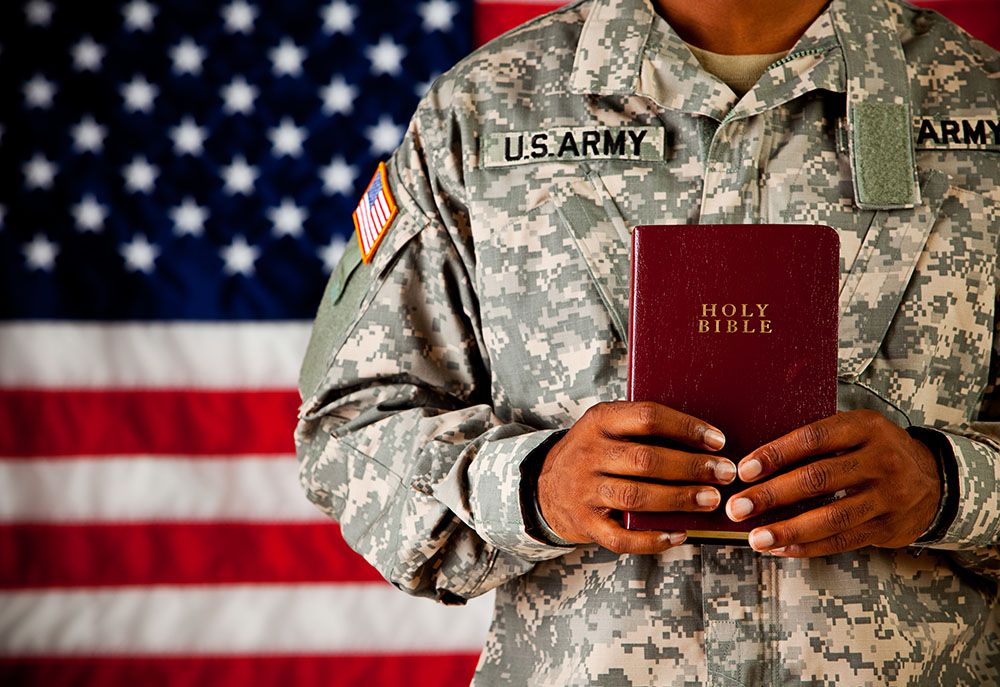
There is a soldier somewhere right now – Wiccan, Druid, Humanist, Asatru – who will walk into a military chaplain's office in crisis and be told, in effect, that their faith does not exist. Not because the chaplain is cruel, but because the United States government has officially decided that it doesn't.
That is the direct consequence of the actions that have been taken by the Pentagon in recent days.
What the Department of Defense (aka the Department of War) Did
A memorandum signed by Anthony Tata, Undersecretary of Defense for Personnel and Readiness, reduced the military's recognized religious affiliations from more than 200 to just 31. Gone from the list: Atheism, Asatru, Deism, Druidry, Humanism, Paganism, Rosicrucianism, Shamanism, Spiritualism, Unitarianism, Wicca, and over 150 other traditions. What remains is a list dominated by Christian denominations, alongside Buddhism, Hinduism, Islam, Judaism, and Sikhism.
If your faith does not appear on this list, as far as the military is concerned, it no longer exists:
- Agnostic (AN)
- Baha'i faith (BH)
- Buddhism (BU)
- Christian - Assemblies of God (AG)
- Christian - Baptist (BA)
- Christian - Brethren (BR)
- Christian - Catholic (CA)
- Christian - Church of Christ (CC)
- Christian - Church of God (CG)
- Christian - Church of the Nazarene (CN)
- Christian - Episcopal/Anglican (EA)
- Christian - Evangelical (EV)
- Christian - Jehovah's Witnesses (JW)
- Christian - Lutheran (LU)
- Christian - Methodist (ME)
- Christian - Non Denominational (ND)
- Christian - Orthodox (OX)
- Christian - Other (CO)
- Christian - Pentecostal (PE)
- Christian - Presbyterian (PR)
- Christian - Quaker (QU)
- Christian - Reformed (RE)
- Christian - Scientist (SC)
- Christian - Seventh Day Adventist (SA)
- Church of Jesus Christ of Latter Day Saints (CJ)
- Hindu (HI)
- Islam (Muslim) (IS)
- Judaism (Jewish) (JU)
- No Religion (NR)
- Other Religions (OR)
- Sikh (SI)
The official justification, offered by Defense Secretary Pete Hegseth, is administrative tidiness. The old system had "ballooned to well over 200 faith codes – it was impractical and unusable." He noted that 82% of religiously-identifying service members use only six codes.
That is one way to read the numbers. Another is this: the government just looked at the spiritual lives of tens of thousands of service members, decided they were statistically inconvenient, and deleted them.
Did your belief system make the cut?
What Gets Lost
These codes are not bureaucratic trivia. They tell chaplains what a service member needs – seasonal observances, ritual objects, dietary practices, the specific contours of a tradition. When a faith disappears from the list, the institutional machinery for caring for its practitioners disappears with it. Service members become "other." Their spiritual needs become someone else's problem... or no one's.
A decorated Army veteran who served three tours in Iraq – ordained as a Wiccan cleric, an Asatru Gothi, and a Druid – knows exactly what that looks like. During his first deployment, struggling with the weight of combat, he sought out a chaplain. For eight months, that chaplain used every session to evangelize and try to convert him. It took until 2007 – years later – before "Pagan" could appear on his dog tags at all.
When he heard about the new memo, he told Military.com, it rekindled the anger he felt when he was "actively discriminated against."
A former Army chaplain, speaking anonymously, called the new list a violation of the Constitution he swore to uphold. "The First Amendment is the free exercise of religion for everybody," he said. "All it takes is the chaplain to say, 'Well, I don't see them on this list. I don't know how I can help you.' And that's it. That's not the American way."
The Pattern Behind the Decision
This did not happen in a vacuum. It follows Pentagon prayer services led by evangelical speakers who have treated the military as a mission field, public statements from Hegseth invoking Scripture to describe military operations, and a December 2025 announcement that he intended to make "the Chaplain Corps great again" through a "top-down cultural shift." It follows a broader administrative posture that critics have described, without much ambiguity, as the advancement of Christian nationalism through military institutions.
Mikey Weinstein of the Military Religious Freedom Foundation – whose 100,000-plus clients are roughly 95% Christian – did not mince words. The new list, he said, is a "middle finger to the United States Constitution's separation of church and state." He pointed to a comparison that is hard to shake: the Department of Veterans Affairs recognizes more than 220 belief systems and offers over 80 emblem options for headstones.
"So, if you're dead, you'll get your emblem," Weinstein said. "But if you're alive, you can't get it on your dog tags."
The ULC has long held that Pagan and Wiccan traditions deserve the same respect as any other faith. So has the Constitution. What's striking about this moment is that the government isn't even pretending the decision is religiously neutral – it's framed as common sense, as efficiency, as a return to something simpler. That framing is worth examining closely, because what it calls simple, others call exclusion.
The tensions inside the military chaplaincy are not new. But erasing 180 faith traditions from official recognition is a different order of act. It takes a living, practiced spiritual identity and tells the person who holds it: for the purposes of this institution, you don't exist.
What Do You Think?
Does the government have an obligation to recognize every faith tradition practiced by its service members – or is some administrative limit acceptable? At what point does streamlining become exclusion? And what does it tell us about a country's values when it will engrave your religion on your headstone, but not acknowledge it while you're alive?
182 comments
-
 Amber M. Castleman
It is a Shame that they want to discharge veterans for their Religion instead of their actions as long as they believed in God it doesn't matter what Religion they are and why approve Pagan as Religion in 2007 then take it away accepting Catholicism as a Religion when it's a known fact that Catholicism is a Pagan Religion makes no sense to get rid of one Religion and not the other and Pagan was the first Religion then the other Religions followed through the years which is also a known fact.
-
 Lady Mutt Cat
Catholicism is a Pagan religion?🤣🤣🤣🤣🤣
-
-
 Adam White
I was about to post a very long comment regarding my perspective on this as a baptized Catholic faithfully guarding my atheism as an ordained minister, it lets agnostics be truthfully faithful and it lets my Catholicism be faithfully confirmable to be Roman Catholic. it's over 5000 characters. If anyone wants to read it drop your email and I'll send it.
-
 Antony John James Rockhill
It seems to me that the other religion (OR) option would cover every religion that has been removed from the list. I do understand why the pentagon has removed so many religions from the list. Scrolling through over 200 options does seem over the top to me. I myself would have to select the (OR) option because I am Church of England & that is not on the list. I think it just makes sense to have a smaller list. Mind you, being an Englishman & living in England I suppose my crazy government would do the opposite & have every religion there is & ever was on their list.
-
 Michael S. Russell
I've really don't care if the military recognizes my religion. Or anyone else. I will still practice it. My faith hasn't even made the ULC banner! And it's been recognized since 2014! But in all seriousness, a person with a faith in a religion really needs to sit down and think before enlisting. You are ordered to go somewhere to fight and KILL someone you don't know or have a problem with. Most religions don't support murder. But if you enlist to fulfill a sense of patriotic duty, then you need to learn your life is no longer yours. Yes, you might have some kind of home life after Boot, but the military is your employer now and you work 24/7. Under their rules. If they want blond hair, blue eyes that can goose step while wearing a cross, then let them have it. THINK before you enlist.
-
 Michael Thomas Maloy
Beware of wherevthis is headed.
Steaml ining from 200 to 31 without uphevel by all religious groups. If they get away with it now it'll be easier to steam line from31 to 10 and then 10 to 1.
-
 Kevin R Burke
Why so many divisions of Christian. Islam could be divided into several and Shinto is not on the list. Chaplains should be qualified through comparative religion courses and qualification testing.
-
 Harvey Zeller
Why is Hegseth interfering? What difference? Could it possibly make to him?There's no additional bureaucracy.It's just typing in a name. That's what you get with true believers. They want to counsel everything else out.Except themselves
-
-
 Michael Kinman
Jesus Christ is LORD our God. He came in the Flesh. He Gave up the Ghost was Pierced and Poured out Blood and Water. John saw. He poured out His Spirit on All Flesh. He Was pierced for our iniquity. You will look upon Him who was pierced. Repent John told you. So did JESUS Our LORD! Hear O Isreal the LORD our God is One LORD. Moses told you that John the Baptist was coming before the LORD. Isaiah Told you in Isaiah 40. Jesus Christ is LORD our God. He came in the Flesh and He is Coming Again! Do not add or take away from his Word! “For I testify unto every man that heareth the words of the prophecy of this book, If any man shall add unto these things, God shall add unto him the plagues that are written in this book: and if any man shall take away from the words of the book of this prophecy, God shall take away his part out of the book of life, and out of the holy city, and from the things which are written in this book. He which testifieth these things saith, Surely I come quickly. Amen. Even so, come, Lord Jesus. The grace of our Lord Jesus Christ be with you all. Amen. THE END” Revelation 22:18-21 KJV https://bible.com/bible/1/rev.22.18-21.KJV
Repent and give your life to the LORD JESUS. Be baptized in the Name of LORD Jesus! Amen
-
Harvey Zeller
The world is full of simpletons, and this guy is one of them.
-
 Lester
Please remain on topic. Don't be that guy who posts random junk in every thread, everywhere.
-
-
 Religion as a Weapon is Wrong
Information is kept in a data base. A data base can hold any first or last name so it can hold any faith in memory storage. Duh. Mr. Meritocracy is trying to transform the military into some Old Testament fighting force. I have no respect for this man. Just because someone buys their way out of a rape charge with money and an NDA does not make him a voice of moral authority. If this is what Mr. Meritocracy wants, recruits should be told at the recruitment office that they are not welcome unless they meet his narrow "list" requirements. He doesn't want women, he doesn't want people of color, he doesn't want anybody except Evangelical Christians. He is the most un-Christian person to ever lead our military. He's an embarrassment to our dedicated, hard working troops. I mourn for them and the "leader" they must now obey. May they once again be respected and honored in the near future.
-
Harvey Zeller
Once Trump is out, this guy'll be out on his ass, too
-
-
 Samantha Winburn Messersmith
This is very unconstitutional. Exactly who made this decision? People who live in the United States of America need to start standing up to the Government. This is not a Communist Country, but it seems that the Government is trying to make it that way. We the People need to start standing up to the Government & remind the Government that this is a free country where the People are supposed to be following Constitutional Laws, not Communist Laws.
-
Samantha Winburn Messersmith
This is very unconstitutional. Exactly who made this decision? People who live in the United States of America need to start standing up to the Government. This is not a Communist Country, but it seems that the Government is trying to make it that way. We the People need to start standing up to the Government & remind the Government that this is a free country where the People are supposed to be following Constitutional Laws, not Communist Laws.
-
 Mary Elizabeth Strange
I am a practitioner of Tibetan Buddhism. However, i have many friends who are of persuasions that were " erased". None of us are in the military so I don't believe it matters very much. I do find it rather absurd however.
-
 Mark Warren Burns
Where's Unitarian, or Unity generally? Though Christian based, these spiritual practices are not officially part of a Christian faith or ritual.
-
 Linda Jean Miner
United Church of Christ not on the list? I'd like to see a list of the ones that were removed.
-
 Toni Price
I would also like to see the previous list.
-
-
 Thomas Ross White
OR - Other Relgions
Seems to me a catch-all for 'everything else' - it just looks like they're streamlining the list that was getting out of hand in some database or other. I don't see the ordeal. They're in no way telling you what you're allowed to believe. If it's a belief where you're the only 'member' you'd still fit in the OR classification.
-
 Joseph George Freas
Having been through just such an ordeal myself (from the review position), sadly, this removal of certain faiths is nothing new. Secretary Hegseth is not the first cabinet member to institute a "removal of denominations" based strictly on cutting the budget. That's what this all comes down to, in essence. Saving money where it's deemed unnecessary, regardless of Religious Freedoms. And, the United States Armed Forces is also not the only military to have gone through this either.
During the First World War, The Salvation Army spent grueling years trying to become "recognized" by its home nation's defense board. General Booth, the commander-in-chief of The Salvation Army, tried in vain to get the British Armed Forces to recognize "Salvationist Chaplains". Sadly, only (Canada, South Africa, Australia and New Zealand) recognized them and it wasn't until 1918, only a few months before the Armistice, that the British Army, finally, recognized their use.
Why? Because in the whole of the British Army, there were less that (200) soldiers who held this faith and if the numbers are less than a certain "required status", they typically are ignored. The review commissions generally seek to eliminate these few numbers by hoping the soldiers will just forget or they'll convert. Unfortunately, this is now being repeated in the United States. In fact, it's sort of an oxymoron. The U.S. Government allowed the U.S. Constitution and the Religious Freedom (as per the U.S. Constitution) and now, the very Government of the United States is trying to remove these religions to save a buck in the end.
-
Religion as a Weapon is Wrong
I agree but I don't see how it saves money.
-
-
 Roberta Jeanne Hoffman
Our Founding Fathers are respected as Unitarian Universalists and it is disgraceful that the Military of our government has removed so many religions including the one practiced by John Adams and John Qunicy Adams. Thomas Jefferson was influenced by the Unitarian theology of Joseph Priestly, a prominent figure in the Unitarian church.
-
 Rolando Couce
THERE IS ONLY ONE FAITH AND THAT IS THE WORD OF CHRIST NOTHING ELSE
-
 Rev. Kev
People all around the world have faith in a great many other things besides that one. Which renders your comment factually incorrect.
If you had used some sort of limiting language such as "I only have one faith..." or "I only have faith in...." then you are speaking for yourself, and it becomes more likely to be true.
Just a suggestion.
-
Lester
Then, why would you join an interfaith community? Why would you post on a interfaith board? Would you go to a Mexican restaurant and complain that you only eat Chinese food?
Be gone, fool!!!!
-
Lady Mutt Cat
Why are you a member of an organization that embraces all beliefs?
-
-
 James Gary Russell Jr
As the article points out, this did not happen within a vacuum. This action was a clear act of religious discrimination. All people of "other" faiths want is equal recognition of their faith, not something "customized" or "special". Any comment that it is "customized" of claim it's asking for something "special" is in itself discriminatory.
-
 Daniel Todd Kamm
Nice they included Jews.
What was the sign at the pools back in the day? "No Coloreds, Dogs or Jews."
As above so below?
I'm reminded of a song from back in the day: Fun Boy Three , The Lunatics Have Taken Over the Asylum."
The day was no better then. Ronald Reagan was presiding. You know the one: even in the 60's wouldn't run for president "unless you insist."
I still don't know who "you" was. But I'm figuring it out.
Let's skim from one old man with dementia in the 80's to another orange and seemingly unstable fellow in the present; neither had or has power, just personality. Amazing what the media can do: Bedtime for Bonzo to the Apprentice.
The real problem is the "power behind" and it's not a good power.
Was anyone really expecting grace from this administration and its Project 25 gospel?
This one will be going to court, wasting my tax dollars and yours, creating more "frivolous" republican lawsuits (remember when they were concerned about "frivolous lawsuits?") headlines, and a smokescreen for the next offensive from the Project 25 playbook ...
"Average" people will be too worried about the price of gasoline, putting enough food on the table, paying the bills and meeting medical and school needs to pay attention. Here in my state of farmers, most of whom receive food stamps and Medicaid to get by, still vote for the very politicians who are taking that away from them....
Blind leading the blind? I don't think so. The leaders are not blind; nor are they deaf or dumb.
And now you know who "you" was then and is now.
Peace, Out...
Reb tk
-
 Cindy L Edgar
This is running against the law ,nobody has the right to tell people what they can believe in or what faith and what path that you choose to believe that that's just the government trying to control everybody in so many ways that was so illegal. And that goes against your constitutional right.
-
 Allen W. Sanderson
It's all numbers... Milllions, hundreds of thousands, even thousands of connected worshippers fill the ranks under 1 specific religion... A lot of what they where trying to weed out where the ones numbering under 20... Jedi's, Bokkonons, Worshipers of the great spaghetti monster, the Cult of Cathullu.... When they opened the door and said you can list what you want, some took idiotic advantage of it. OR is how they chose to fix the system...
-
 Michael Joseph Cheney
When you look at the likes of that scheister and blasphemous harlot, Paula White, babbling incoherently in nonsensical children's tongues, you understand where this deranged administration is coming from. The very pits of Hades. I don't believe these people are Christians in any sense of the word. They are all Satanic and aligned with the Synagogue of Satan. Just look at the fruits these fruits are dropping. Pure 😈 I'm pretty sure Sneaky Pete got rid of all these religions and their various versions of chaplains or priests so that he could stock a better bar and get more prostitutes at the pentagon. That or buy more bombs to drop on little girls or maybe even a thicker black pen so that he could redact more lines in the Ebstein Files a bit quicker. Whatever his reasons, I highly doubt it 's for the good of America or the American people.
.
-
 Michael Burton
Holycowhide! My faith doesn't need a structure or a set of rules to give me guidance. All things are infinite in time and space, just not form. Is the form random or determined? The miracle is that we exist at all and any "list" of faiths ignores the reality of understanding eternity in whatever form.
-
 Sharon D Childs
I am praying that when Donald and his bunch of unqualified nuts leave the White House we can go back to have some kind of normalcy who gives Hedge whatever his name is the right to change and decide who's religious more important in the next religion no one I'll be so glad when the term is over with bunch of nuts
-
 Minister Rob
They will leave office on Jan, 20 2029!!!!!! Then y'all can rejoice! NO MORE TDS!!!! Until then, Tough T!tt!e said the Kitty! But the milk's still good!
-
-
 James H. Tijerina-Spalten
If this doesn't make your bloody boil what does? I'm not going to go on a tangent but I could. This administration is the most corrupt since Nixon and Watergate. This country was not built on one NATION UNDER ONE GOD! It was built on many nations and some times the belief in other than the Christian God. Pete Hogsbreath is a disgrace and is nowhere fit to lead real heros. We are the laughing stock of the world. A feeble orange king demanding loyalty like those our fighters swore to defend against. Anyone who defends these people, they themselves go against what this country was built upon.
-
 Russell Allen Foszcz
Pretty soon it will morph into:
- MAGA’s POV religion
- Any one who leans “leftist” religion
-
 Rev Ned
No religion is a faith?!? HAHAHA!!!
-
 Mother Elizabeth
Correct me if I’m wrong, but I did not see Protestant or Unitarian Universalist either. Such a high focus on Christianity. Obviously, it is not really all inclusive. One of the major reasons, the early settlers came was to have religious freedom. Were the Quakers on that list and what about the beliefs of Native Americans? I guess none of those people supposedly have rights. Instead, you get certain prayers indoctrinated to children in schools and elsewhere. What they are really talking about is Make America Worse again and again, but what do you expect from a President who is almost completely destroying the Constitution and the Bill of Rights and any concept of justice and equality? I am hoping after his term is up, that this self-proclaimed demigod will not start a world war or some form of Holocaust, and imagine people tearing down his golden image the built for himself and any other signs that he was ever here. May God/dess preserve the US.
-
 Beverly J Kirby
Is it possible they’re putting them under “Christian - OR (Other Religion)”? That’s the only other “explanation” I can see. SMH😒
-
-
 Edwin L Alvarez
For someone who doesn't want to offend you took a wrecking ball to the lgbtq+ community. Who btw the current government is doing a great job of erasing as well.
-
 Scot M Cantalupo
The Department of Defense's limits on acknowledged religions do not mean the military claims those unlisted faiths "do not exist." Rather, the policy is an administrative measure designed to consolidate hundreds of faith traditions into broad categories to help chaplains allocate resources and support. DOD spokespersons have stated that this consolidation is not an attempt to declare which religions are legitimate and which are not. Instead, it serves as a shorthand to map units with appropriate resources. Is it reasonable to expect that we should have religious resources through ordained soldiers for 200 specific religions or might it be OK to have these folks cover and try to help many instead?
-
Rev. Kev
It's weird that the longer list didn't have any of those problems. Didn't require adding on chaplains. Didn't create a strain on resources. It just gave chaplains a way to better understand and help an individual service member.
Narrowing that list literally makes no changes to the Chaplains Corp in a substantive way. It just makes it harder to accomodate the needs of the men and women who lay their lives on the line for our nation. As someone in a previous comment pointed out, if a service member is in a coma or incapacitated in some way that the only way the attending chaplain can know how to provide care for the spiritual well-being is what's on their dog tags, they may be wholly unable to do anything that may offer comfort to the service member or -- if the worse happens -- his or her surviving family.
It's not unreasonable to think that what's coming out of the administration is less than truthful in this or any other matter.
-
Lester
The problem goes even deeper, unfortunately. Now, on paper, there are no enlisted Wiccans or Druids or pagans in general. We are being systematically erased. This is just the early stages.
One need not a crystal ball or tarot deck to see the future.
-
 Patricia Ann Gross
Rev. Kev,
Exactly. "Other" can mean a wide range of things, and if a chaplain is trying to help a particuar service person, it is best to know what flavor of "other" the person is so they can locate the best resources. I guess, the biggest question is, since the 200+ is still recognized after the soldier dies for inscription/ insignia on their tombstone, is that information readily available to the chaplain if the soldiers cannot speak for themselves?
-
Rev. Kev
The grave markers for military are processed through the VA. So that would all be specified by relevant family or executor during the application process.
-
Patricia Ann Gross
So, I guess that means that for the 169 eliminated religions, their religious affiliation is only fully honored after they are dead.
-
-
-
-
 Amy Varela
If they were trying to help chaplains help service members, why erase any of the other ones at all? Why not keep all of them and lump the religions that claim to believe in Christ as christians? How can chaplains help druids, for example, if, according to Hegseth, druids are no longer recognized by the DOJ.
This is a stupid change, but what has this administration does that is NOT stupid? The entire administration is populated by unqualified suck-ups.
-
Lester
Stupid implies that they don't know what they are doing. That is NOT the case. They know EXACTLY what they are doing....
-
-
-
 Donald G Magel
It has been reported that the Later Day Saints, the Mormons, are no loner considered by Heggy as a Christian religion.Your list above still lists them.
-
Patricia Ann Gross
The above list recognizes Mormons as the Church of Jesus Christ of Latter Day Saints, but did not include them in the "Christian" list. They have since removed "Christian" from all of the Protestant and Catholic entries, because of the backlash from the Congresspeople from Utah pitching such a fit about it not being listed as Christian, so now none of them are.
Just so everyone is clear, Mormons consider themselves followers of Christ, but have a few modern-day saints and Prophets that they recognize in addition to the Bible and Book of Mormon (written by Joseph Smith, their founder/leader) during the westward migration into the [then] frontier territories of the 1800s, and the Catholics were the first Christians. They don't "worship" idols, saints or the Blessed Mother Mary, they use statues and candles as inspiration for prayer, and are asking the Saints and Mary to pray for them, since they are in a place that is closer to God than us here on earth. This was part of the doctrine before Ignatius introduced the Jesuit concept that you can find "God in all things" because all things were (directly or indirectly) created by God. The practice is still used in all orders of Cathocisim. I grew up in an area where there were a lot of both, and although I don't fully understand or abide by their theological stance, from the standpoint of understanding Jesus as the Son of God, they both comply, which makes them both Christian.
-
-
 Jeremy Black
I belong to the Church of the Flying Spaghetti Monster and The Satanic Temple. Where is my representation? Seriously, why so many Christian designations? There are three main types of Buddhists: Theravada, Mahayana, and Vajrayana. There are two main types of Islam: Sunni and Shia. If Christians can get that many designations, why aren't the sub-divisions of other religions recognized?
-
 Gwendolyn Siobhan Patton
Those Buddhist sects are the Chinese/Tibetan sects. Don't forget that Japan has their own, Zen and Pure Land being vocal and well-known. And Korea has Won Buddhism.
Pagan is a wide umbrella, having Wiccans, Druids, Jedi, and others. I've never seen the Morrigan mentioned, but she would be lumped under Pagan.
There's a whole flock of personal faiths that can be included under Syncretic Faiths, that combine some from column A, a bit from column B, add column C to taste and shake. Who's to say they aren't valid, if the beliefs so assembled are sincerely held? To that, how about the Scientologists, and those from the Church of All Worlds? Both were created, or at least postulated, by science-fiction authors. CAW doesn't get all bent out of shape about it, but if you want to tell a Scientologist that's not a religion, I want to be out of the line of sight! With a Kevlar vest! And unless I miss my guess, we're overdue for something like Heinlein's Fosterites, too -- a Dionysian, charismatic faith that isn't above sawed-off pool cues -- or shotguns -- when their sincerity is cast into doubt. The way things are going, I wouldn't put it past the creation of the "Church of the Blessed Six-Seven" at some point, given the latest memery from Generation Alpha.
But I agree with you in principle, that if Christians can have as many flavors as Heinz has little pickles, why do the other faiths have to be lumped under terms that may be as far from representing them as chalk is from cheese? I'm not a big fan of what I call "digital thinking", where everything has to be dissected down into every atom-sized piece and given its own letter in the initialism (I'm thinking the latest one for the LGBT community, via Canada: MMIWG2SLGBTQQIA+), but there should be a way to at least clearly include faiths other than Christian without disparaging them in the process, or chopping them to bits to include in some list.
I have a fondness for bibliographies and giving people things to read about what I talk on, rather than just mentioning something in a vacuum, so I've included some links for those things that might not be general knowledge.
Food for Thought:
https://www.patheos.com/blogs/johnbeckett/2014/02/temple-of-the-morrigan.html https://helpfulprofessor.com/syncretism-examples/ https://gassho.info/blog-page/whats-the-difference-between-zen-and-buddhism/ https://www.purelandbuddhism.org/ https://wonbuddhism.org/ https://www.scientology.org/ https://caw.org/ https://www.realclearreligion.org/articles/2013/01/15/a_triumph_of_science_fiction_prophecy.html https://www.newsweek.com/mmiwg2slgbtqqia-meaning-canada-explained-11806539
-
-
 Amy
Amy
My views are no longer recognized, and oh am I angry!
-
 Michael G Doyle
As retired military member, no Chaplain would turn away anyone. Wicca and paganism would fall under the “other religions” category.
-
Lester
Wicca/paganism may fall under the "other" category, but what if you are in a coma, dying? They look at your tags "other," they look at your files "other." They shrug and walk away...
-
-
 John Casillo
List is still too complicated....all that is needed is God, no God, or maybe God
-
Rev. Kev
What about all the world religions that don't even consider "God" to begin with? Shinto has kami. Different schools of Buddhism recognize different deities and bodhisattvas. The many pagan faiths recognize a variety of gods and goddesses. Shamans recognize the lives or spirits of the world around them. The list goes on.
You could say they fall under "no God" but that is a meaningless distinction. It serves no one. Which diminishes the office of chaplain and a chaplain's ability to serve the needs of others. Which is literally their job.
This isn't about a list or what's convenient. This is about the welfare of actual people and their families. It's about treating people like PEOPLE. Living beings who have wants and needs and feelings who can suffer like you or anyone else. It's about treating others as if they actually matter.
Which should be especially relevant to any so-called patriots out there when it comes to treating men and women who volunteered to lay their lives on the line for others.
By the way....keeping that list didn't cost anyone on a continuous basis. Doesn't hurt anyone. Doesn't create any undue burden. But it could help people. Or is helping people who don't fit into a simplistic category just too much of a burden in your view? And what happens if you one day fail to fall into someone else's simplistic category choices?
-
Lady Mutt Cat
Or lots of gods.
-
Lady Mutt Cat
Also need the category Lots of Gods.
-
Lady Mutt Cat
John, you need to add “lots of gods/goddesses”.
-
-
 Reverend Jackie
No my religion is no longer recognized by the military which is wrong.
-
 Ari Joseph Bertine
"At what point does streamlining become exclusion?" ^ That point, right there. I still remember the legal battles to get service members of these faiths recognized by the military so that they could have chaplains help them, and so that they could not be preyed upon by corrupt chaplains claiming that it was their duty to try to convert people. I still remember the first Wiccan pentacle engraved on a service member's headstone, and the emotions conveyed by his family over finally being granted that right by the institution to which he gave his life. "Streamlining" is obviously bullshit. No one believes it, and they know no one will believe it, but that's their lie and they're sticking to it. This is a way to exclude minorities, which is the best way to work toward excluding other majorities you don't like. You have to start small and work up, get systems installed.
When this begins to prohibit the free exercise of the excluded servicemembers' religions, they'll be able to bring it up in court as unconstitutional. In fact, two Sundays from now, some chaplains ought to be called upon to assist with Solstice rituals, and when they refuse I hope that this gets the paperwork started to reverse this gross abuse of power disguised as goverment administration.
-
Beverly J Kirby
I’d say immediately, from what’s already been/being done.
-
-
 William Patrick Bradish
PS--reading way too much Dogma here--Universal Life Church is just that--Universal!
-
 David M Gibbar
There is a category OR, other religion. That seems to pretty well cover it all!
-
Amy Varela
Then why not just lump all of the christian sects, including the LDS church, into one category of "christian"?
This isn't streamlining. This is exclusion of the things Kegsbreath doesn't like or understand.
-
-
 Minister J. Abram
"Absolutely ridiculous "
-
William Patrick Bradish
Hegseth is a fascist and this but one more step into that hell!
-
Michael G Doyle
Not a respectful comment. Do better
-
-
 Roy S. Thorpe
George Carlins joke about new religions every day! There is a new religion that believes that when you die your soul goes to a car wash in Buffalo! As long as you believe in something was the bottom line! People like "convenient" religions that allow them to do what they want and when they want! Sunday's not good day? Pick a day that convenient and a time too if you even want to go! Regular religion is too hard! What are you going to do if this isn't the right way to heaven? Get away from the braying morons who are going to hell and listen to the one true God who is offering life forever!
-
 Mark Duncan Baxter
This recent decision does not prohibit the free practice of any of the religions not listed, but specifically includes them in the category "OR" (Other Religions). The Department of War recognized that by officially recognizing over 200 different religions, our current culture of "Entitlement" could eventually require them to provide separate and distinct spiritual support services for every different religion in the world. That would have been a crushing logistical burden which would have detracted from other more essential activities. This recent decision avoids that potential nightmare and still allows armed service members to practice the religion of their choice. There will inevitably be a group of military clergy that specialize in meeting the unique needs of those service members whose religions are in the "OR" category.
-
 Jacob Casack
This is ridiculous! Our nation, The United States of America, was founded on the belief that all citizens could believe in whatever faith that they see fit! Yet they just added more letters to the gay and trans community, now it's LGBTIQCAPGNGFNBA+. I AM NOT JOKING!!! They are cutting out entire religions and adding more communities to the gay movement. Did you know that furries are now part of this? You can dress up like an animal and have rights for your beliefs, but you can't participate in a religion of 1000 years old? I am a Christian, but I spend my time openly studying pagan religions and really all religions and would be part to marry any couple in any community under any religious flag, but I think what they are doing is hypocritical and against the American beliefs that so many have died, fought for, and risked everything to be a part of. America as a nation is getting diluted, as well as religion! I'm sure even homosexuals can agree that this stuff is getting silly and all proud religious people should agree that all religions should be held with high regard. If i decide to start worshipping a cucumber in my garage and call it the cumbayah religion with crosses made of cucumbers then best believe I have that right in the constitution of the United States of America and as long as I am not hurting the innocent, it is my birth right as an American citizen to practice, preach, and promote whatever ridiculous religion I see fit. They have no right to cut out any religion from any American branch. If they want to cut something, cut some of this LGBTQ nonsense. We should all be free and treat each other equally without adding a letter for every fetish. Something is seriously getting messed up with our belief system. Btw I dont mean to offend anyone I'm just angry about the discrimination of religion, any of us can be next.
-
 Elizabeth Ann Miller
As a Christian I am appalled that the government thinks they have the right to exclude any religious practices. If religions are being banned how soon will my Christian practices be banned. Look to the Constitution.
-
Ari Joseph Bertine
That'll depend on whether your Christian practices are close enough to Official MAGA Christianity™ or not. Obviously denominations are to become a thing of the past once American Sharia settles in.
-
Patricia Ann Gross
This wasn't a ban on any other religion not on the list, just not recognizing them as necessary to provide Chaplain support for. There is a significant difference.
-
-
 Zeke Hanzl
The ULC is not included on the list and should be. My guess that thousands of service people are ULC ministers
-
 Kevin Joseph Kervick
Multiculturalism and a national military cannot coexist.
-
Lady Mutt Cat
That statement is absurd.
-
 Rev. Miche'al Yosef Dixon
Have you actually ever been in the military? I worked and fought beside, defended and been defended by men and women from every so-called religion (like mine secretly i could have been court martialed), every sequel oriented (although secretly most they could be court martialed), different cultures from different areas of the USA. Hell, 98% Yankees and 50% those from other states outside Louisiana had never heard of Community Coffee, one of thousands of culture shock when multicultural people put together. Yet when the bullets start flying we all got each other's backs.
-
-
Zeke Hanzl
The ULC is not included...and should be.
-
 Cameron Lewis
THIS IS A DISGUSTING DISASTER. Yet again we violate the US constitution. We let a drunken right-wing nazi reprobate dictate thier views to the mass...
-
 Delight Phillips
It appears the government (and let's face it-it's the present administration doing this) thinks that basically Christianity is the only real faith. I'm a Christian, but I have the morality to accept a person's right to their religion. I don't think Jesus would be excluding people, because he was a prejudice right winger. They can thump their bibles and wear their crosses,but actions are what show a person's truth.
-
 Mel Chapman
Freedom of Religion, is just that...freedom to practice one's beliefs without fear of reprisal, and a reasonable support to do so. While it might not be practical to have a chaplain specific to every variant, the chaplain corps should be cognizant of the varied belief systems in order to provide the necessary personal support to those who need it. Keep in mind that certain chaplains may be concerned about violating their own belief systems by supporting some of the others. It's a tightrope walk. How is another faith tradition supported without violating one's own belief requirements?
-
 Charles G Sanders III
I disagree. Freedom of religion does not include “reasonable support” to do so. Therein lies the issue. The government, and any other employer, gets to decide how much, if any, support it wants to provide and is it completely unreasonable to provide 100% support to all faiths.
You might not like it but someone has to decide and it’s absolutely right for the ones providing that support to be the ones to do so.
-
Ari Joseph Bertine
Then chaplains should be removed entirely, because to decide to support certain religions but not others is the government respecting an establishment of religion. The government is not allowed to endorse any faith or faiths, and by prioritizing certain ones and erasing others, it is doing exactly that. The only equitable and Constitutional thing to do, if they cannot provide for all servicemembers' religious needs, is to provide for none of them.
-
-
Charles G Sanders III
I disagree. Freedom of religion does not include “reasonable support” to do so. Therein lies the issue. The government, and any other employer, gets to decide how much, if any, support it wants to provide and is it completely unreasonable to provide 100% support to all faiths.
You might not like it but someone has to decide and it’s absolutely right for the ones providing that support to be the ones to do so.
-
-
 Jeff Grippe
The First Line of the First Amendment:
Congress shall make no law respecting an establishment of religion, or prohibiting the free exercise thereof.
I'm not sure that you can get clearer than that!
The military is not Congress, but still, in the spirit of the Constitution and the Bill of Rights, it doesn't matter if there are thousands of codes. People have the right to declare their religion. I don't think anyone is going to bring a suit, but I'll bet it wouldn't survive being challenged.
-
 Russell Wilborn
Regardless of anyone's opinion, the constitution should reign supreme. Those of us who were sworn in the day we joined swore an oath to defend the constitution against all enemies (of that constitution) both foreign and domestic. No one, and I reiterate, no one, has the right to alter the words for any convenience. And if and when they do so they have made themselves that enemy.
-
Jeff Grippe
You make a good point, although military justice has sometimes held itself to its own standards, which diverge from ordinary laws, which are subject to constitutional scrutiny. It isn't quite as simple as many people posting here would like it to be. This is why I mentioned the First Amendment, as well as the caveat that the military sometimes holds itself outside it.
-
-
-
 Todd Richard Thorne
How can this or any other administration circumvent so many things within the Constitution without reprecussions of those people being removed from office or charged with crimes against the Constitution. If anyone else in this country especially a military service member did that, we'd be incarcerated immediately.
-
Ari Joseph Bertine
Because the ones who would charge them with it are the same group doing it. It's like police not arresting each other for drunk driving. The ones that DO do that are very quickly blacklisted and wind up quitting because their fellow officers make life miserable for them. In Washington D.C., they have more to lose than being "fired", they have retaliations and loss of their ill-gotten wealth and who knows what else is a real thing in the bizarre world of ultra-rich powerful people. They don't think like normal humans. Maybe fear of losing money IS the worst thing in the entire world to them, but however it is done, everyone is being kept in line because of what they'll lose if they do the right thing. The Constitution is an inconvenience to those in power and it's being ignored because there's no one there with the power to do anything about those ignoring it.
-
-
 Rev. Lindsay
I don't know what they cut but they neglected to cut Islam which is a cult because it believes in killing in God's name and doesn't accept Jesus Christ being our savior which make them anti-Christ.. They should have also cut Jehovah's witness from the list which has a made up bible by man which the bible condemns strongly to edit the word of God. The Mormon faith is also another one that exists based on much false doctrine, The book of the Mormons that is not holy spirit inspired leads them away from biblical truth being authored by a man in 1830. Whoever made up this list had no clue what they were doing.
-
Ari Joseph Bertine
Quite a few Christian denominations, even in the USA, believe in killing in God's name, and genuinely seem disturbingly invested and excited by the idea. Just look at all these evangelical pastors preaching about killing the gays. And the people who are promoting hatred in the name of God are certainly anti-Christ as well--they would absolutely ICE Jesus if he showed up in America today.
-
Rev. Lindsay
Comment removed by user.
-
Rev. Lindsay
There's no such thing as Christian denomination that kills in God's name. Once you take on that belief your church is no longer found in the faith and you are backslidden or you aren't part of that church and backslidden. Obviously thou shalt not kill is one of the ten commandments. Anyone who claims they are Christian and believes in killing is living a deceived life and bound for eternal punishment.
-
Lester
"Anyone who claims they are Christian and believes in killing is living a deceived life and bound for eternal punishment."
Isn't it ironic then, that this whole discussion is about military service members?
As for any particular religions being "cults" I would refer to the definition of cult:
According to Google Gemini, A cult is a system of religious devotion directed toward a particular figure or object, often characterized by unconventional beliefs, extreme devotion, and an authoritarian, charismatic leader who exercises high control over members.
That would be pretty much every Christian denomination.
-
-
-
 Cynthia Gail Wright
i agree with everything you said.
-
 Elizabeth Jane Erbe Wilcox
I don’t see “christian nationalist” listed but their movement is working very hard to spread their hatred and division. After all, that’s what tRUMP and his administration practice. Odd.
-
Rev. Kev
Gerald,
You could have saved some time and effort by just writing "Anyone with a belief different from mine doesn't belong."
-
Rev. Lindsay
I only mentioned a few religions. I take it you must belong to one of the ones I mentioned.
-
Rev. Kev
You take it wrongly. Your words indicated you judge other religions by the standards of your own faith.
Many people do it. If a person believes the doctrines of their religion as true, they will usually see all others as not true. I simply suggested cutting to the chase.
-
Rev. Kev
I'll just tack on here that what any one individual thinks is the "true faith" or not is irrelevant to the topic. Because it's not about a list of "true" or "false" beliefs. It doesn't matter what any person thinks about all the other names on the list. Doesn't matter if anyone sees them as a cult or anything else. It is simply a list of religions practised by people who already serve or may be called to serve in our military service. It is a tool to help serve the spiritual and emotional needs of people who may give their life for our country. Their respective beliefs are true to them. It matters to them. The don't need permission or clearance from other people to hold that position.
-
-
-
-
-
 Dr. Zerpersande, NSC
One good thing… only 31 to go.
-
 Bishop William Dusenberry, DD
There’s no denomination of Christianity, that still overtly practices, promotes, encourages, and/or supports the Hindu-first known “Golden Rule.” Therefore there are no more Christians —other than in “name only.” Let’s classify them as “CINO’s. As per irony; As far as I know, I’m the only ordained minister in the USA, who trying to convert those who require a provable, actual, real, easily demonstrable God — which Thomas Jefferson noted in his US Declaration of Independence as Nature’s God. The irony??? The only quasi-religious group, which can prove the existence of God — isn’t approved by the US Military— but the American Atheists, the American Humanist Association, FFRF’ers, et al — don’t recognize God as Nature, either.
-
 Brother Peter
The Pentagon just updated the list. They removed the "Christian" prefix from all the faiths listed. It's a way to keep the Mormons happy since they consider themselves Christian while most other faiths don't.
-
Patricia Ann Gross
I guess things are different in the military. From what I understand, this was done to limit the backgrounds of they have to Chaplains they bring in. As a trained secular Chaplain, we are required to be interfaith. I provided spiritual support to a wide range of religions including Wiccan, Jewish, Muslim, Hindu and a plethora of Christian denominations (not Catholic, though, because we had specific Catholic Chaplains in the hospital I worked. What it sounds like they are trying to do is provide clergy specific to each "religion" or denomination. Those are Pastors/Priests/Imams/etc. not Chaplains.
-
Rev. Kev
Not at all. No one expects a chaplain to perform rituals or prayers from every religion. But having the information allows a chaplain to consult with relevant practitioners when necessary or when the service member can be accomodated. Things such as going to a local service, recognizing certain holy days, calling on a local religious official to help tend to a sick or dying service member. It helps the local chaplain know who to call if needed for special funerary rites. In the field, it helps the chaplain know what to do or not until the relevant authority can be consulted or even brought in. Because such things can give families of an injured member hope, or the surviving families comfort.
-
Patricia Ann Gross
Rev. Kev,
You are exactly right, and I apologize if I did not make that clear. We weren't required to do everything every clergy could, but to know how to contact them if necessary. We were also never allowed to evangelize or try to convert anybody, but be respectful of all traditions. The order of the day was to meet them where they were. I guess with how the troops can be stationed all over the world and change locations frequently, it makes knowing "who to contact" a bit more challenging, but nobody can expect a single chaplain to be all things for all people. We were also exempted from doing anything not allowed by our own traditions. That is why they had Catholic chaplains on staff, since only Catholic clergy can perform certain rituals, and there was a large percentage of our patients that were Catholic. I did pray with a Wiccan, Jew, and Muslim, though. All with permission, of course. I also attended to families of many other religions as well, such as helping a Hindu family prepare for their death rituals before the funeral home arrived and set up the body for the "journey" to the afterlife by providing food and other items that would be required. Some things don't require sacramental authority, just compassion.
-
Rev. Kev
Very cool. So you know how it works. It can be both a challenging and deeply rewarding calling.
I think compassion is the most important thing. All the religious talk and rituals have their places, depending on the individual's faith. But, in the end, we're talking about human beings. Because chaplains -- or really any responsible clergy/counselor -- do far more than the religious rituals part. They have to be there for the people. If we sincerely care, we can connect to others despite our differences. We share the human experience. Sometimes, that bit of connecting and being treated like a person with value is what matters. To actually know they are being seen and heard.
I can think of some places in the world that need a lot more of that.
But, to borrow words of wisdom from the Dude, that's just my opinion, man.
-
Patricia Ann Gross
Amen to all that.
-
-
-
-
-
 Leslie A. Hulberg Née Tomasura
- All religions should be recognized by our military and given the same respect as any other religion. Especially when it comes to soldiers serving.
- If one religion is acceptable then all must be accepted otherwise they are not treating people equally under the law.
- Separation of church and state is more important now than ever before in our history.
- Indigenous people, Hare Krishnas, Jainists, Atheists, Wiccans, Pagans, Muslims and many others are NOT being equally represented. That is unconstitutional!
-
Leslie A. Hulberg Née Tomasura
- All religions should be recognized by our military and given the same respect as any other religion. Especially when it comes to soldiers serving.
- If one religion is acceptable then all must be accepted otherwise they are not treating people equally under the law.
- Separation of church and state is more important now than ever before in our history.
- Indigenous people, Hare Krishnas, Jainists, Atheists, Wiccans, Pagans, Muslims and many others are NOT being equally represented. That is unconstitutional!
-
Cameron Lewis
Good job!
-
 ServantOfJudgement
I don't think Jesus Christ has any trouble getting into a foxhole or a tail turret with a fella. He'll get right down where the rubber meets the road with you. He's not worried about being on a list in a corner office. Everyone in the world knows about him. I've got an old friend that died an atheist from a bee sting. He was brought back at the hospital as a Christian. Jesus Christ isn't constrained by death death, he'll still shake hands with a willing soul.
Let the military chaplain focus on the soldier and not religious dogma. Even if all religious categories were hit with whiteout in the military, Christianity wouldn't be phased one bit. The Christian doesn't need special headgear or funky mustaches to keep in line with things, just an open heart to the spirit of God.
Give no special treatment for any religion at all. It's the US military, not a flea market. Whiners and sweethearts can stay home. Let the men handle things.
-
Rev. Kev
How very self-centered of you. "My particular brand of superficial faith doesn't need stuff. Therefore no one else does. Jesus can go anywhere, so that should apply to everyone, regardless of what they really believe."
You truly encapsulate this administration to a T.
I'm curious how a chaplain tasked with the spiritual welfare of a service member is supposed to focus on that individual's spiritual well-being without benefit of understanding their actual faith and what their religion teaches or requires?
What you wrote is not how "men handle things". It's how self-centered, arrogant people who choose not to think of other, fellow human beings and their individual lives handle things. It's the mindset of the small child in an adult body.
Also truly encapsulating the current leadership. So at least you're on point there.
-
Lester
If I were lying on a field hospital cot, in the process of dying, I would want a chaplain to administer service compatible with MY faith.
"I can administer last rights..." "I'm not a Catholic." "I can..." "I'm not a Muslim..." "I can......." "I'm not a Jew...." "Well.... What are you?" "I'm a Druid/Wiccan/Gnostic/etc..." "Have you heard the good news about our Lord J...... "
-
Patricia Ann Gross
Lester,
A chaplain's duty is to find the right resources for the person if they have no ability to perform the required rituals, which is touchy in areas you are not familiar like a local hospital or hospice chaplain would have. If they are doing it to assign priests, pastors, Imams, and Rabbis, then it sounds like they are trying to put someone who can help a soldier make a deathbed confession of faith, which is not part of a chaplain's duty. In that case your fears are founded, and I'm not sure that isn't their intent (and I apologize for the double negative there).
-
-
-
 Rev. Roe
WOW what ever happened to “ Freedom Of Religion “??
-
Ari Joseph Bertine
It's been reinterpreted as "Freedom of religion for those in power." In fact, pretty much everything in the Constitution can now be interpreted that way, it's like that old game where you add "between the sheets" to your fortune cookie fortune. Just add "for those in power" to the end of everything in the Bill of Rights.
-
Rev. Kev
It's slowly disappearing. Along with things like freedom of speech and due process.
-
-
 Barbara Harris
My father and late husband both served in the Navy during war times. I remember my father talking about the chaplain taking time to speak with as many of the men on the ship to see exactly what their faiths were. My father had been raised Greek Orthodox but drifted away from it when he became a musician. My father was impressed with how the chaplain was asking if there were any rituals he needed to be aware of to serve my father better. Fast forward to my husband and the chaplain on board his ship gave very generic sermons and really didn't interact at all.
Then when my husband was going through the end stages of life at the VA hospital the chaplain came in to speak with he and I. At the time my husband was unresponsive so I explained that he had been raised Southern Baptist but really hadn't ever followed it. He asked me my faith and I told him I was a Pagan. He set for a moment and then smiled and said "it goes to show how love can make anything work". We visited for awhile and over the months he would stop in to see how my husband was doing and on the rare occasions that my husband was responding they would talk about fishing and hiking and sometimes religion would come into the mix.
So I know that some chaplains will do all that they can to minister to those in their units, no matter their faith, and then of course their will be the ones who just don't care. But for me, during those times when life is coming to an end, that will be when who is with you will matter. Will they be able to serve your traditions and beliefs or will they only focus on theirs.
-
Rev. Miche'al Yosef Dixon
Interesting, when I was in the military I had to hide being "Satanist" (Anton LaVey Satanic Church) and tell them I was "Protestant" or "Catholic" because to be anything other than that you'd be court martial and put in prison with "Dishonorable" for not being Christian. From what was written in the above article the military is not dis avowed other religions but for paperwork reasons trying to piss off the others. Messaic Jew not on list, but I can get the emblem on my head stone; but my family probably put a Protestant "Christian" emblem on it if not just throw me in the city dump.
-
Lady Mutt Cat
You hope. I’m afraid the VA will be next, and there goes the symbols for grave markers.
-
 Dr Dennis Chevalier PhD, DDvin
I'm sorry but I laughed so loud after reading you told people you were catholic....while being a satanist .OMG LOL
-
-
 John W
Well, given that the Secretary via his tattoos has made it abundantly clear where he stands, such a move is to be expected of him as his system of beliefs are very narrow and exclusionary. Over the years the military has added the various religions of those who serve, regardless of what the belief was to minister to the whole military flock not just those who the Secretary wants to keep around.
-
 Douglas Robert Spindler
Notice the Church of LDS was removed, but Mormon fundamentalists who practice sexual abuse of children and polyonomy was not.
Scientology's is apparently okay as well. And Theistic Satanism is still on the list.
It's only the Christians they don't won't.
-
 Rev. BH
"If your faith does not appear on this list, as far as the military is concerned, it no longer exists"
I just counted 21 acceptable Christian denominations, Doug. What are you talking about?
-
Lester
"Christian" is the key word here... I'm not a Christian, and neither are many others.
They can make the list larger, and add 1000 Christian denominations (they'd probably have to make some up), and it would still only represent 1/3 of the world...
-
-
Brother Peter
The LDS church is included, but is not referenced as "Christian". My Mormon friends are having fits over this. You should see their comments in the local Utah media.
-
ServantOfJudgement
I didn't see theistic satanism on the list Douglas. You don't mean Islam do you? True allah fits the biblical description of Satan but I don't think it's proper satanism.
-
Lester
The "God" of the Bible also fits the description quite nicely.
-
-
 AWSII
AWSII
Perhaps you missed the 18 versions of Christianity posted on the "Approved" list.
-
Elizabeth Jane Erbe Wilcox
But within each “religion” there are multiple denominations. Presbyterian is one and the denominations are NOT in synch with one another on many beliefs.
-
-
-
 Reverend Paula Copp
Wow! So now they’re trying to tell people that they can only choose a religion which is on their list? So much for freedom of religion! 🙄
-
 Jessica North-O'Connell
That is something Indigenous people have probably been saying for a few hundred years now...
-
 John Robert Peters
No. You can follow your beliefs but be denied spiritual support and comfort unless you made the list. This is coercion and shamefully insulting to service members and families not on the list. It's apparently ok the send a soldier into danger and incredible stress, possibly dying for his/her country but not ok to respect his religion and religious practices. No doubt SCOTUS will support the administration as they have regularly done over any serious destruction of human rights and dignity.
-
-
 Colleen McAllister
- Not listing every religion does not "erase" them.
- Atheism is not a religion, but the lack of one. Agnostics are simply unsure.
- It is nearly impossible to cover or even acknowledge every faith. Why not just use yes or no to the basic question of do you follow a specific faith?
-
Rev. Kev
I think the point is that such information is put on a service member's dog tags and is coded in their personnel jacket. So wherever the service member is stationed, that information is available to the relevant chaplain(s). This can aid in everything from basic counseling to making an effort to take their specific faith into account for special holy days or observances all the way to grief counseling or funerary rites and practices. A pagan will not be comforted by Bible stories or praying to Jesus. A family can be upset if their son or daughter who fell in battle wasn't treated properly as far as special prayers, caring for the body, buried in the proper casket, or not cremated within the appropriate time limits. For such people, it can be a matter of knowing their loved one will be in the proper afterlife condition. In worse case conditions this can only be determined in the field by the dog tags until transport to the rear area. For the deeply religious, this can have eternal consequences. The expanded list didn't interfere with any military mission so there is no real reason to start editing it down.
-
Rev. Kev
Let me add that knowing the religion of service members also extends to allowing members to go off base or off post to attend religious services in the local area not provided by the chaplain. Something especially relevant for new recruits who are usually restricted in travel and may need transportation provided. For example, an Orthodox Christian can only properly receive the Mysteries (what Catholic call the Sacraments) from an Orthodox priest. So something like a marriage or rite of confession performed by anyone other than an Orthodox priest will not be recognized as valid. The chaplain will know which religious bodies meet and where in the local community. They can also arrange for local clergy to be admitted on the reservation in a limited capacity if necessary to attend to the needs of a service member.
-
-
Lester
Being agnostic isn't so simple as "not knowing." Agnostics believe that the truth is fundamentally unknowable.
-
 Cyndi McReynolds
The first amendment of the US Constitution guarantees our freedom of religion. Noone including Sec. Hegseth has the right to decide what religions are recognized by the government of the US and which are not.
This will surely be litigated and found to be illegal. I will be contacting my congressman and would encourage everyone to do the same. Congress must be made aware that this has happened, prompted to take action to reverse this unconstitutional action and have Sec. Hegseth explain his actions before the Senate Armed forces Committee. This seems like it could be an impeachable offense.
-
 Stephen P Singleton
Wow! They kept in the Sikhs! I served in the USMC from 1969 to 1976. My last couple of years I was the base "Drug Education Officer" It was a great experience for me, but what we could do for the Guys was so limited. It was really the Chaplin (Army) who was therapist, advocate; a mentor/friend who could step out of the Rank structure and offer more than just a medical discharge. This is coming from "Whiskey Pete" Hegseth and is just one more tiresome negation of basic Humanity helped on all the other decisions coming out of this administration. When it finally ends (and everything ends) we have so much work to do to rebuild; to reclaim the true "greatness" that Narrowmidedness has stolen from us. Unitarian Universalists and our own ULC, in honoring ALL beliefs is the One Great Truth that I'm thankful to be part of.
-
Stephen P Singleton
(there's the word "helped" in there that my danged auto correct robot changed. it should be "heaped".)
-
Barbara Harris
Auto-correct and I are not friends. That drunk gremlin gets me in more trouble then I can by myself. So I understand the frustration.
-
-
John Robert Peters
Actually the chaplain is to provide spiritual support and comfort to the service member and family. Evangeizing and prosyletizing is forbidden but as 1 post here shows it happens. Some chaplains are open minded and put their rank and religion aside and assume the role of spirituality of whatever belief system is there. I had a friend chaplain who was Baptist and he and I discussed multiple myths that serve as the core of various religious traditions. He was open to my Gnostic Pantheist beliefs. He even read and studied the Nag Hammadi codicies. Of course he was fired ...transferred...by a senior Chaplain who objected to my friend's openness. It isn't the religion that causes friction, but the narrow mindedness and arrogance of pastors. Our current administration is encouraging that ignorant and arrogant mind set. Whisky Pete is just a symptom of the bigger problem of Christian Nationalism destroying free expression of conflicting beliefs. It really must be stopped completely and restore Constitutional rights across the board. The list should be shredded and Chaplains should be educated in comparative religion and mythology so they could offer true support and comfort to servi e members and their families
-
-
 James Riggle-Johnson
And Secretary Hegseth will no doubt continue claiming that Christianity is under attack in America. I suppose we should feel grateful that "Other Religions" was included as a category at all.
What I find most disturbing is the account of the Iraq War veteran who served three tours and was subjected to evangelizing during every session with a military chaplain.
What exactly are they doing at the Department of Defense, and have they read the Constitution of the United States?
The government has no business deciding which faiths are legitimate and which are not. Yet that is exactly what this policy appears to do: the Department of Defense is effectively choosing which religions count and which ones can be ignored.
-
 Dylan Tuatha Le Danaan
This is unconstitutional. It is not what 5 generations of my ancestors took their oaths to serve. This identifies as the rise of an foul mess that is domestic.
-
Lady Mutt Cat
So much for the separation of church and state. Witchcraft/Wicca is gone. This is not acceptable. What scares me personally is whether the VA will be next. Will these bastards eliminate the pentacle from my husband’s grave marker? Will it be eliminated when it is reworked to add my name when I join him?
-
 Alexander Clarke
If Trump and Hegseth have their way the answer is yes.
-
Lady Mutt Cat
That’s what I’m afraid of. The VA secretary is a bit quieter but no better.
-
-
 Dr. Darryl G Dykes
Comment removed by user.
-
Dr. Darryl G Dykes
There is no Consitutional seperation of church and state never has been. Your misguided belief is the Consitution reads that there shall be no national religion. The federal government does support faith based programs as long anyone who ask to take part of the program is allowed to. One program that comes to mind is Catholic Charities which does allow anyone of any faith or no faith receive financial assistance.
-
Lady Mutt Cat
Tell that to Thomas Jefferson and the Supreme Court.
-
-
-
Douglas Robert Spindler
What are you going to do about it?
-
Lady Mutt Cat
Since when did the current administration show any respect for the constitution?
-
 Lion on the Beach
You're on here now voicing your outrage. Case solved.
-
 Martin S
They are actively working to stop that as we speak.
-
-
-
-
Lady Mutt Cat
Comment has been removed.
-
-
 Keith D
So, for Military folks, they swore an oath (kinda unfitting a Christian tradition) on taking the position.
It made the Constitution sacrosanct So they're all Constitutionalists, which can be construed as personal sovereignty as the one key tenet.
Monad
They swore to uphold and defend the US Constitution against all its ebemies, foreign and domestic. ...thus to uphold personal sovereignty in that manner.
Illegal orders and policies should bring arrest of the offending commander.
As I see it, that's roughly a clean sweep of all government officials, all foreign pressure groups, and every unrepentant religious narcissist chanting 'my religion is the one true fsith.'
-
Rev. BH
Anyone have the full list of the deleted religions available? Curious.
-
Dr Dennis Chevalier PhD, DDvin
i just got it, the old and new, will post it soon after retyping it from the scanned images sent me 08 June 2026 1641 hrs.
-
-
 Nicholas J Page
Unbelievable only in America can this be allowed to happen a faith is a faith no matter the religion 🙏
-
Lester
Unfortunately, "America" is one of the better places to be, when it comes to religious freedom. I say "unfortunately" because, sadly, the bar has been set pretty low...
-
-
Dr Dennis Chevalier PhD, DDvin
What my breatharian in the US Army (USA) just did PXXSES ME OFF! I was raised Episcopal, the went to Morman, Presbyterian, Baptist, and a few others until then finally Roman Catholic. When I was in the army my dog tags said Protestant when I was Baptist but my journey was very important to me and if the army suddenly said I couldn't practice my faith, it would have been as deadly to me as the bullet that ripped out my spleen and ascending colon and left knee.
-
ServantOfJudgement
I don't think the military is saying people can't practice their faith Dr D. From my angle the average chaplain just couldn't keep up with hundreds of different beliefs. He'll end up offending most of them.
-
Dr Dennis Chevalier PhD, DDvin
well i think its about the paperwork of reporting (i know because i did it) the counseling forms ask for recommendations after the treatment/interactions for that soldiers command structure and to remember all the options the DOD chief said, is a nightmare.
at least his explanation anyway....
-
Ari Joseph Bertine
Think of a chaplain like a doctor. Doctor's don't have to memorize hundreds of illnesses and their treatments, they learn the foundations of health, and how to diagnose, and then they know how to pull up the information they need to treat a specific condition. Chaplains learn the foundations of religion, and they know how to ask the questions needed and have resources to show them how to minister to any religious need.
-
John Robert Peters
Comment removed by user.
-
-
Rev. BH
"A breatharian is an adherent of a pseudoscientific lifestyle who claims that humans can subsist entirely on "prana" (life energy), sunlight, and air..."
Brethren, maybe?
-
Dr Dennis Chevalier PhD, DDvin
or maybe its a spelling typo?
occam's razor
-
-
-
 Najah P Tamargo
Najah Tamargo-USA
The military "fights" for upholding the Constitution. Yet they are denied their faith? That is a serious slap in the face to them. And is in direct violation of said Constitution. What are these "top dogs" smoking???
-
Delight Phillips
You are correct. Our brave men and women in the military deserve our upmost respect. That includes our respect towards their faith. I respect all people's faith. I may not agree with it, nor practice it, but I respect it. Why can't our government do the same, without looking for more things to villianize? Jesus respected people. He did not respect cruelty. We are seeing cruelty in our country and it takes many forms.
-
Alexander Clarke
It has nothing to do with "top dogs" it has to do with Pete Hegseth. If he had his way there would only be one faith, Christian Nationalist, his.
-
-
 obere mchugh
deplorable, since most of this approved list is christian and to be frank having a catagory of other is just insulting for practices that are not of the big three or affiliate practices. its just demining and insulting.
go figure for christian nationalist types just sick. another reason would never join the institiution what so ever.
-
 Sir Lionheart
If there really is a god, I hope it approves of the list. I wouldn’t want to get it upset, we don’t want any more world genocidal floods, pestilential catastrophes, or children of the first born dying like when Pharaoh upset it. God, whatever it is, seems to have huge anger management issues. 🤭
🦁❤️
-
ServantOfJudgement
Obere,
If it were about Christian nationalism they'd have bumped Islam off the list straight away. That
I'm a former atheist, self converted hard boiled Christian and Id not mind it if the military ditched all religions and focused on missiles and machine guns. Save the chaplain some grief with dealing with 666 different religions.
If someone's god has to live in an office filing cabinet someplace, they ain't got that much at all.
We want men and women who love this beautiful and free nation. We don't want unstable people who love or hate it depending on who's president. Those ones we'd like to stay home and enjoy their freedom.
-
Delight Phillips
I don't think Americans hate America, because of who is President. We are PROUD AMERICANS that are ASHAMED OF OUR PRESIDENT. You can abhor the fallicies of a man. That is not the same as hating the country or being ashamed of our country. The President is NOT the country, nor does he own everything in this country. Our White House, National Monuments, National Parks and Government Buildings belong to the PEOPLE! Someone doesn't understand that.
-
-
-
Sir Lionheart
Only 180. At least “No Religion” is on the list of acceptable beliefs.
🦁❤️
-
 George Dolicker
The Constitution guarantees that there will not be a national religion, and guarantees your freedom to practice your faith. It does not guarantee to provide customized support for any religion. So far no harm no foul. I do not believe that a Chaplain will be unable to help any soldier in need just because their religion is not on “the list”.
-
Cameron Lewis
George as a counselor and expert in behavioral health who worked with the military by contract all faiths Need to be and have to be the same- in my experience what book of faith fiction you adhere to crisis is crisis, emotional pain is emotional pain, need for an ear and guidence is all the same be you Jew, christian/Christian, witch, satanist or spagetti god worshipper. THE HEGSETH MILATARY DONT GET IT,CAUSE HE IS A DRUNKEN MESS..
-
-
 Mark James Clark
When asked for a name to be called by he said I Am...says it all.
-
 Robert James
In your tradition, perhaps. In mine, She said no such thing.
-
 F. Martin Aller-Stead
Nonsense, as demonstrated here and in the world at large. Express YOUR opinion for youself, without imposing it in others. That is both freedom OF religion and freedom FROM religion. If all of us who differ from your faith are wrong, Insuggest your faith needs serious examination. The Lord was not EXclusive but INclusive.
-
-
Lester
Actually, it says nothing at all.
-

One: read the constitution Two: It is a way to take support services away from members who do not follow the party line while they are in the service and after. It seems like they are trying to find a way to cut corners, pigeon hole who will qualify under their rules and lists and dictate how our country should be. Our troops have trouble with support as it is. Those who think that they have it made because they have housing and medical taken care of should look at the pay grades and how little they get. Is this a way to deny those basic benefits as well in the future? Picture a snowball rolling down a snowy bank.... I will be afraid of what will come next as we keep losing constitutional rights a little at a time. So who will want to be in the service in the future?