

 Emily Roth is raising her children without religion. Audrey Rosa Nath is raising hers across four traditions at once: Jainism, Hinduism, Judaism, and Quakerism. Sanjam Kaur Sohal is raising hers Sikh. On paper, the three Houston mothers have little in common.
That all changed last week, when the unlikely trio filed a lawsuit together. The moms, in their suit, are arguing that Texas cannot force a King James Version of the Ten Commandments onto their children's classroom walls. Their kids attend school in three different districts, Houston ISD, Cypress-Fairbanks ISD, and Spring Branch ISD.
Their legal action, filed in Harris County, targets Senate Bill 10, the controversial 2025 law requiring every Texas public school classroom to display a poster of the Ten Commandments measuring at least 16 by 20 inches. It asks a judge to order the posters removed before the school year starts. There isn't much time left – students in the Houston ISD return to class next Monday, August 10th.
Rather than leaning on the First Amendment, though, the mothers are taking the unique tact of suing under two pieces of Texas law: the state's own Religious Freedom Restoration Act, which bars the government from substantially burdening a person's free exercise of religion, and Proposition 15, a voter-approved parental rights amendment guaranteeing parents control over their children's upbringing.
Where Do Parents of Different Faiths Find Common Ground?
The strategy is not incidental. Earlier federal challenges to Senate Bill 10 have already ran their course. Last year, sixteen families and eleven school districts sued, and a district judge agreed the law crossed from exposure into coercion. This spring, however, the 5th Circuit Court of Appeals reversed that ruling, finding that the mandate to display the posters did not violate the Constitution. The decision cleared the road for a similar law in Louisiana. With the federal route closed for now, these three mothers turned to Texas's own statutes instead.
Emily Roth put the objection in personal terms. "It teaches students, and their teachers, that exclusion is acceptable, maybe even preferred," she said. Her attorney, Megan Hassan, regrets that they even had to take this step when discussing the action the mothers felt compelled to take: “They did not want a legal battle with the state of Texas. They wanted a poster removed from a classroom wall. That should never have required a lawsuit.”
Vanessa D. Gilmore, a former district judge now also representing the mothers, put the underlying complaint more bluntly: the state cannot advance a Christian agenda while excluding every other religious background in Texas. Texas Attorney General Ken Paxton's office sees the same poster differently. His lawyers argue the Ten Commandments belong in classrooms as part of the nation's heritage, and that a display, unlike a lesson, cannot coerce anyone since students remain free to ignore it.
Even putting aside the newest lawsuit, the defiance is already showing up in districts where the posters have been up since spring. One suburban Dallas teacher has ringed hers with hot-pink placards listing tenets of Buddhism, Hinduism, and Islam. A Houston-area substitute sends her twin daughters to school wearing First Amendment pins, and gave them extras to hand out to classmates. Further south, a teacher says that if administrators force the issue, she will hang her copy of the poster upside down and take her chances.
The mothers' lawsuit is unfolding alongside a closely watched U.S. Senate race in which Paxton is a candidate. His Democratic opponent, state Rep. James Talarico, has made opposition to laws like Senate Bill 10 part of his campaign, arguing that a mandated Bible verse in every classroom leaves Muslim, Jewish, Hindu, Sikh, and nonreligious students feeling excluded. A former teacher who has pursued a Master of Divinity at Austin Presbyterian Theological Seminary, Talarico frames his opposition in explicitly Christian terms, describing government-imposed religion as Christian nationalism rather than genuine faith.
Why This Matters Across the Faith Spectrum
The objection to displaying the commandments is rarely to rules against murder or theft. These are ethics that nearly every faith tradition already teaches. It is to the commandments that open the list: no other gods before this one, no graven images, no bowing to any other form of the divine. Those lines, critics argue, are not shared moral ground, they form a specific claim about how many gods exist and which one gets worshipped.
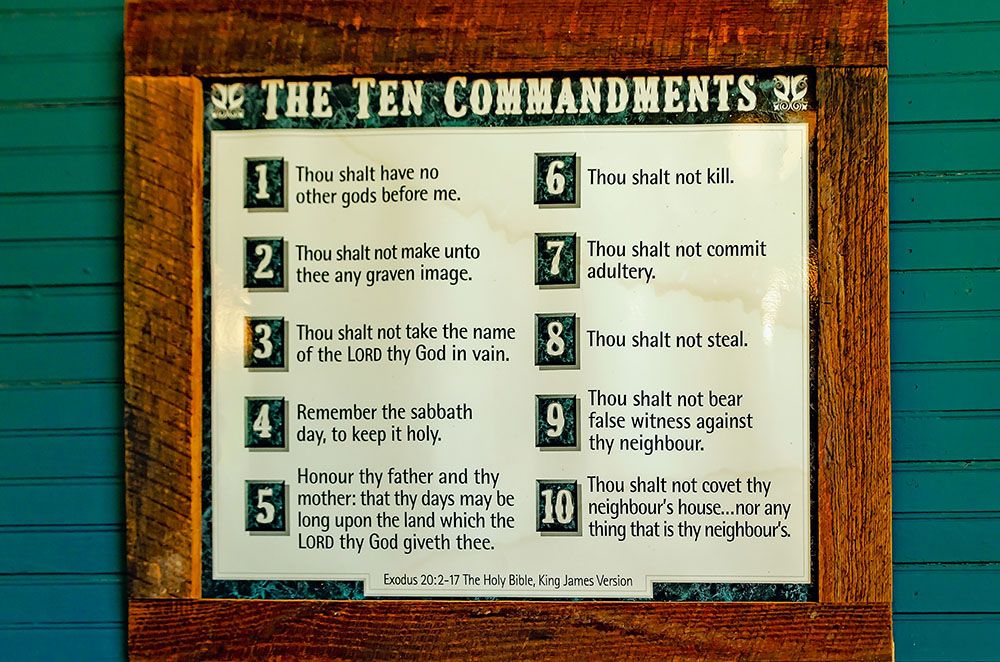
That claim sits uneasily beside the very traditions represented in this lawsuit. Hindu and Jain practice is built around many gods or none at all, depending on the school, neither of which the poster's first lines allow room for. Sikhism rejects depicting the divine in any fixed image altogether. A poster that opens with those commandments is not offering universal ethics, it is asking every student in the room to read one tradition's theology as settled fact.
This is not Texas's first pass at putting faith front-and-center in the classroom. The state's Board of Education voted in June to add Bible passages to the required reading list for more than five million students, arriving less than two months before this lawsuit.
ULC covered the original signing of Senate Bill 10 last year, along with the injunction that briefly blocked it. Each round raises the same underlying question in a new form: whether a state can promote one faith's text as shared heritage without asking whose heritage it actually is.
For now, the posters will stay up while a Harris County judge decides.
Should a religious text ever count as secular heritage? Whose version of the Ten Commandments, if any, belong on thoses walls? And does a parental rights law written for one purpose change how you see this fight?
117 comments
-
 Rev. B.D. Rees
PEOPLE....PEOPLE....PEOPLE..... The point of this is... "PUBLIC FUNDED SCHOOLS are SECULAR!! That's the way our Constitution was written!! Using Public Schools for the Texas legislatures Religious practices is AGAINST THE CONSTITUTION!! Our Nation is a Nation for ALL PEOPLES.... not just your petty Christian practices that preach hatred, and Bigotry!! Following Christ teachings is one thing and a very private thing.... Cramming it down the throats of those who don't believe as we do is WRONG by any stretch of the imagination!!
-
 Shawn David Spencer
Something that tugs at my mind is that these women represent an attack not on religion but on the moral structure of our society. It's common knowledge that every society is built upon the logic and wisdom of other cultures before them. The ten commandments represent that wisdom of the past in the US, so attacking it is an attack on our children, the next generation of our future, moral compass and foundations. It should be seen as such moreso than a religious argument.
-
 Michael Hunt
Why do Christians believe they have a monopoly on morality? You don't need the 10 Commandments to be a good person and have a good moral compass. I know plenty of self-described Christians who lack a good moral compass and fail to live up to the 10 Commandments so why should we only promote Christianity in public schools?
-
-
 Randy Michael Mellinger
The Ten Commandments have been the standard for Morality and social order. They were taught in our schools for decades. When they were removed from our schools in the mid 1960's there was a steady decline in the behavior of students in our country. These Islamist, Comunists are attempting to breakdown the moral standards in our country to fit into their radical ideology that deny the God of the Bible. These women if they don't like what is in the Texas public schools they should look to an alternative solution such as home schooling or a private school that shares their values.
-
 Annmarie Buckley
I'm not sure why you would group Islamists with Communists? That sounds very prejudicial, very unchristian. All organized religions recognize a supreme being - Christian or not. Many people don't realize that there are many similarities between Islam, Judaism and Christianity. All three religions are monotheistic i.e., they believe in one God. I invite you to go to legitimate websites to read more. Remember there are extremists in all faiths....
-
 Rev. BH
Randy, there's always been something new blamed for the "breakdown of moral standards". Mine were broken down by comic books.
"Fredric Wertham remains best known for his concerns about the effects of violent imagery in mass media and the effects of comic books on the development of children. His best-known book is Seduction of the Innocent (1954), which asserted that comic books caused youth to become delinquents."
Violent movies. The internet. And yet, "the exact phrase "juvenile delinquent" first appeared in writing in 1680." Long before the removal of the Commandments from schools.
-
 Rev. Fr. Craig Goral D.D.
In Canada i was taught by Nuns and Brothers. School was faith based back then.
-
-
 Rev. Miche'al Yosef Dixon
Obviously whomever came up with this Proposition 10 never read, understands and/or ignoring the 1st amendment of the United States of America Constitution. “Congress shall make NO LAW respecting an establishment of religion, or prohibiting the free exercise thereof; or abridging the freedom of speech, or of the press; or the right of the people peaceably to assemble, and to petition the Government for a redress of grievances.” That's exactly what they did. If it was a teacher or school policy that's a matter of the Parent's Association to address to the School Board. But Texas Congress made it a law and that's blatantly violates 1st Amendment.
-
Rev. BH
The first four commandments are the exclusively religious ones. Drop them. The eight you have left is summed up in the Golden Rule. If you must post something in schools, for impressionable young minds, I have little problem with "Do unto others as you would have them do unto you." This core ethic of reciprocity appears in nearly every major world religion and secular philosophy as a foundation for empathy, fairness, and human kindness."
-
 Justin Adam Kalm
Great point, but how did you get 10-4=8?
-
Rev. BH
Justin, good question, good catch. Mel Brooks? Or how about this - https://thewholedangthing.wordpress.com/2011/07/13/exodus-20-the-12-commandments/
more likely, my brain's arithmetic monitor went on sabbatical.
-
-
-
 Cisco
Cisco
The separation of church and state in the United States comes from the Establishment Clause of the First Amendment to the U.S. Constitution. It states that "Congress shall make no law respecting an establishment of religion." While the exact phrase "separation of church and state" is not in the text, this clause—along with the Free Exercise Clause—forms the legal foundation for keeping government and religion separate. What the Law Does it Stops the government from making an official national church. Prevents the government from favoring one religion over another. Protects people's rights to practice any religion or no religion at all. Keeps government out of religious affairs and keeps religious groups out of government control. This is why the First Amendment exists in this country is to protect all its citizens from the government and religious sects. By passing and forcing these laws on American citizens is only saying one thing. We are no longer a democracy but a dictatorship especially if it's that easy to just add or change our laws without is citizens vote first.
-
 Leslie A. Hulberg Née Tomasura
It is not part of the national history anymore or less than every other religion and non religion. Therefore Texas must either add all satanism, Jainism, Islam, humanism,Judaism, Hare Krishna, Taoism, Buddhism and other creeds or they must get rid of the Christian creeds in public schools. If they want that taught to their children they can either enroll them in a faith based school or teach it at home. The Constitution of the United States of America says one religion cannot be held in higher regard than any other. I would like to know why these people who claim patriotism so much, do so much to Undermine everything this country stands for? I would also like to know why they want to usurp the constitutional rights of every other American in the process?
-
 Ari Joseph Bertine
"Part of our nation's heritage" and yet teaching literal historical facts about slavery is "critical race theory." These people are so full of manure they could fertilize the Sahara. The posters contain coercive language, in context. Putting them up in the first place is coercive. Nobody is buying the "heritage display" bs.
-
 Tim R Eichenberg
Law is wrong. Should not be mandated. Clear step beyond free exercise. I believe in the Commandments. But these truths must be communicated through love not coercion. Proponents of Christianity may not always be the ones in power as they are not in many states. We want to be able to exclude other religious teaching being forced. Let's consider the bigger picture.
-
 Richard James Holden
Just a point of interest.The founding fathers were never escaping religious persecution, as was suggested in the thread, that is just nonsense. The Puritans left the UK because they thought Britain was far to Liberal for their particularly harsh and difficult attitudes. They then went to Holland and after a while were kicked out by the Dutch, again for being too harsh and violently forcing there views on others against their will ( they were anti music, dancing, bright clothes and any form of joy frankly). It was only then that they went to America, where they nearly starved but were fed and rescued by the Native Americans. The following year the Puritans started murdering the native Americans. They were a particularly unpleasant group of people, who later started burning women for so called witchcraft. Do not believe the simple "school" history that is force fed to kids and is enormously incorrect.
-
 DocRobbi
Comment removed by user.
-
DocRobbi
Please fact check your post. There are a few big inaccuracies along with some truths. I get the gist of what you are trying to say, but feel it's important to use factual information to get your point across.
-
 Lester
The inaccuracy being that they did not burn women for witchcraft... They hanged them...
-
Lester
The inaccuracy being that they did not burn women for witchcraft... They hanged them...
-
-
-
 Charlie K.
This is a country that has freedom of religion. That makes a person has the freedom to practice whatever religion they believe. Christian is only one of the religions.
-
 Merle A Clark
Which is exactly why it should not be persecuted
-
Michael Hunt
How is Christianity being persecuted?
-
-
-
 Ronaldo
The Constitution says nothing about a separation of church and state. It does say that Congress cannot make laws forcing a particular religion, or denying the practice of one. Based on that, school districts who wish to post the Ten Commandments should be allowed to without government interference, but should not be required to. If we truly want a total separation of church and state, we would have to require that the People either go to church, or to vote, but not both. Most Americans found in voting booths hold to some form of religion, so there is no separation.
-
Michael Hunt
The Texas State Congress passed a law forcing the display of a particular religion's set of rules. It's forcing Christianity onto all Texas children in public schools.
-
-
 Lorraine Kathleen Chapdelaine Dite La Riviere
There is Separation of Church and State for a reason. That is why there are private Christian Schools and public schools. The public schools should be non-denominational, and if parents want their children to live by the 10 Commandments, send them to a Christian school. This country was NOT founded on Christian beliefs, but the premise to be Christian or not. This country is a "melting pot" of beliefs and nationalities. It is sad that there is a lack of respect for all humans who live here.
-
 Mary Smith
Before we ask the government to place the Ten Commandments in every classroom, maybe we should first ask whether we, as Christians, have written them on our own hearts.
“You shall have no other gods before Me.” Yet how often do we place politics, money, careers, success, comfort, or even our own opinions above God? Scripture teaches that anything we place before Him becomes an idol.
“You shall not make for yourself a graven image.” Christians have debated this commandment for centuries. Some traditions use statues and icons in worship, while others believe that violates God’s command. If Christians themselves cannot agree on its application, which interpretation should a public school display?
“Remember the Sabbath day, to keep it holy.” This is one of the Ten Commandments, yet perhaps one of the least practiced. We work, shop, travel, play sports, and often treat it like any other day. If it is important enough to hang on a classroom wall, why isn’t it important enough for us to honor in our own lives?
“You shall not take the name of the Lord your God in vain.” This is more than using God’s name as profanity. It also means claiming to represent God while living contrary to His character—using His name to justify hatred, division, greed, or personal agendas.
“You shall not bear false witness.” Gossip, slander, half-truths, and dishonesty have become commonplace, even within the Church. God calls His people to be known by truth, integrity, and honesty.
“You shall not covet.” Our culture celebrates comparison, envy, materialism, and the constant pursuit of more. Yet God warns us that coveting begins in the heart long before it becomes visible in our actions.
Jesus didn’t simply tell people to display God’s law—He called us to live it. The greatest testimony has never been words hanging on a wall, but lives transformed by them.
I am a Christian. I have studied Buddhism, Hinduism, Judaism, and other faith traditions, and each has deepened my understanding of God, compassion, and humanity. That is precisely why I believe faith should first be lived before it is legislated. Sacred words have the greatest power when they are reflected in our actions.
I believe the Ten Commandments are holy, timeless, and inspired by God. But before we ask our schools to display them, perhaps we should ask whether our churches, our homes, and our own lives reflect them. Children will always learn more from watching our example than from reading a framed poster.
Maybe we should focus first on living God’s commandments in our families and our communities. When society sees Christians consistently practicing what we preach, then the conversation about displaying them in classrooms carries a very different weight.
Rev. M.K. Smith
-
 sanctuary
Consider the golden idol on a golf course prayed to by an ordained minister and his flock, an image that haunts me. And the indiscriminate killing of Americans, Venezuelans, Iranians. Innocent children murdered. Threats, hate, zero empathy, images generated of Jesus firing mortar rounds, so many disturbing occurrences by the same people who profess belief in the Ten Commandments. Ultimate paradox.
-
-
 Daniel Mark Rosenfield
There is really no good legal argument for people who believe government-supported institutions should in any way endorse a particular religion or even religion itself. The Constitution is very clear and very specific on the church and state issue.
In addition, the idea that we cannot develop or live by a moral code without first believing in a deity is proven to be incorrect countless times every day.
-
 Kevin Patrick Dabbs
Agree with the moms, religion should not be in schools, if you teach 1 you have to teach them all
-
 Donald G Magel
Can they win in Texas? Never happen in the state that supports a convicted Felon and sexual assaulter as President who is the anti-christ sent bySatan. The mushroom smiles at Bibles in Churches. The arguments keep Texans minds off The Epstein files! Trump, the heavy christian's favorite bible verse is, "all of them".
-
 Bruce Harry Garbett
Get Help
-
-
 David Pfuhler
More power to these women, I do not believe that the Ten Commandments or any part of religous structure belongs in public education. If you wish to have your children educated through a religous institution that is on you and your church, not for the state to accomodate. I also always find it interesting that it is the Ten Commandments of the Old Testament that are being inserted but not Jesus' Eight Beatitudes that are supposed to be put up in a classroom.
-
 Julie Armstrong
Don't like American Leave. More God loving people than not. Our country became because of Christian Val ues Leave them up
-
 Cyril R. VanKeirsbelk
I have a better idea. If you don't like living by the US Constitution, you leave.
-
Donald G Magel
This is living by the Constitution? Mushroom doesn't even know or care what it says. He is the decider of right and wrong. And the Bible is too woke for the Trumpets.
-
-
-
 Thomas Richard Saunders
I lived in Texas at 2 different times in my life . I went to Kindergarten and went to College both in San Antonio . In between I lived in West Virginia as I do now . I can honestly say in all my years , I never read anything on the walls of my classrooms . Except the cute little kitten poster that said hang in their baby . I get separation of church and state . I am a parent , grandparent & Great Grandparent . But , let's look at it this way please . School shootings , bullying , teachers sexually assaulting students every year . Why would you not want your children to read do not kill , do not steal , don't commit adultery. A father just got sentenced for giving his child a gun that was used in a school shooting . Hey Mom's don't cry when your kids go to jail . Or worse .
-
Kevin Patrick Dabbs
Why dont parents teach this at home? Not the schools job to raise the child, its the parents
-
 John Edward Ambrose
Hi Thomas, I agree with ya' for sure..I'm 67 and it never harmed any of my school friends nor me seeing anything religious including the ten commandments, it made us think and respect our elders business owners property etc: I went to school in Hawaii, B.C. and now live in Calgary Alberta..there are more things to focus on besides displaying good values..as there aren't many parents instilling proper values in their own children..I've two myself and am ever so proud of them, always open discussions on everything you can and should be thinking ..John Ambrose
-
-
 Wilberta M. Berry
So much for separation of church and state. So much for there shall be no religious tests to be an/ in America since, The Constitution states we are not a religious country. Which is why we don't had a Church of America like England has. I wish all the success in the world for these astute and correct mothers
-
 David W Falknor Jr
Where is it stated in the US Constitution regarding "speration of church and state"?
-
Michael Hunt
"Congress shall make no law respecting an establishment of religion, or prohibiting the free exercise thereof;..." This section of the first amendment creates a "speration" between church and state.
https://constitution.congress.gov/browse/amendment-1/
-
Wilberta M. Berry
Thank you!
-
-
-
-
 Alice Kay Looney
The first "commandment" of the Christian religion states "Thou shalt have no other gods before me."
Plain as day. Posted on the wall of their Public School. By what convoluted logic do Paxton's lawyers think that would fail to be intensely coercive to children who may also be experiencing other detrimental societal issues?
☀️🌙⭐
-
 Amy Varela
Those commandments were directed to the Hebrews, since even the men who wrote them understood that there were many gods that all of the other mythological groups worshipped at that time. Christians weren't even a thing until after Jesus died. Oh, that's funny. Jesus was never a Christian. It's strange to me that the belief in the earlier gods waned as science explained things which were attributed to them, yet the belief in the god of Abraham persists, though those who believe have very different views. Jews, Muslims and Christians all claim to believe in the same god, yet even in those very different groups, there is no universal consensus. It's almost as if each person makes up their own version of god to legitimize how they live their own life. That said, if the 10 Commandments are posted, so should every religion's tenets plus proven scientific theory, since atheists typically prefer facts and evidence over myths and fairy tales.
-
-
 Joseph Grieco
If this were any state other than Texas (or maybe Florida), I'd say they have a chance to get the 10Cs removed. As this is Texas, if this is a jury based hearing, they'll lose. If it's a bench trial, it depends on the judge, the day of the month, the phase of the moon, and how good Texas' baseball teams do this week.
-
 Vincent C. Santucci
What is wrong with the Ten Commandments? They are beyond faith, they are a code of conduct for behaviors that everyone should model. If the 10th Commandment is the sticking point, it doesn’t have to be interpreted as a Judeo-Christian God. If the possibility of a supreme being is offensive to some, post the first nine commandments as a universal code of conduct. You can’t have a religion unless you believe in something higher than yourself. And why does the specter of believing in something higher than yourself scare some people?
-
Lester
While many of the ten commandments are basic moral precepts, there are a few that are definitely judeo-christian.
Thou shall have no other gods before me.
Thou shall have no graven image.
Etc...
-
Rev. BH
Vincent, it doesn't "scare some people", it misleads them. Believing in any higher power has altered nothing on our planet. After centuries of believing, praying and worshipping, we still have wars, famines, mass murders, suicides, abuse, disease, infant deaths - need I go on?
Get off your knees and commit to doing some real good for your fellow man here and now. Your god isn't.
-
-
 Rev. Mojo
Bottom line, separation of Church and State.....this discussion is OVER!!
-
Mary Smith
Before we ask the government to place the Ten Commandments in every classroom, maybe we should first ask whether we, as Christians, have written them on our own hearts.
“You shall have no other gods before Me.” Yet how often do we place politics, money, careers, success, comfort, or even our own opinions above God? Scripture teaches that anything we place before Him becomes an idol.
“You shall not make for yourself a graven image.” Christians have debated this commandment for centuries. Some traditions use statues and icons in worship, while others believe that violates God’s command. If Christians themselves cannot agree on its application, which interpretation should a public school display?
“Remember the Sabbath day, to keep it holy.” This is one of the Ten Commandments, yet perhaps one of the least practiced. We work, shop, travel, play sports, and often treat it like any other day. If it is important enough to hang on a classroom wall, why isn’t it important enough for us to honor in our own lives?
“You shall not take the name of the Lord your God in vain.” This is more than using God’s name as profanity. It also means claiming to represent God while living contrary to His character—using His name to justify hatred, division, greed, or personal agendas.
“You shall not bear false witness.” Gossip, slander, half-truths, and dishonesty have become commonplace, even within the Church. God calls His people to be known by truth, integrity, and honesty.
“You shall not covet.” Our culture celebrates comparison, envy, materialism, and the constant pursuit of more. Yet God warns us that coveting begins in the heart long before it becomes visible in our actions.
Jesus didn’t simply tell people to display God’s law—He called us to live it. The greatest testimony has never been words hanging on a wall, but lives transformed by them.
I am a Christian. I have studied Buddhism, Hinduism, Judaism, and other faith traditions, and each has deepened my understanding of God, compassion, and humanity. That is precisely why I believe faith should first be lived before it is legislated. Sacred words have the greatest power when they are reflected in our actions.
I believe the Ten Commandments are holy, timeless, and inspired by God. But before we ask our schools to display them, perhaps we should ask whether our churches, our homes, and our own lives reflect them. Children will always learn more from watching our example than from reading a framed poster.
Maybe we should focus first on living God’s commandments in our families and our communities. When society sees Christians consistently practicing what we preach, then the conversation about displaying them in classrooms carries a very different weight.
Rev. M.K. Smith
-
 Kenton Sherman McManigal
Government has no business running schools or being involved in "education". That solves the problem. The Ten Commandments aren't a threat to anyone, but also have no place being posted on government property that everyone is forced to fund. It's a trivial concern among bigger issues, so even though they are right, it's not worth the fight- being a distraction from important matters. After 150 years or so of government involvement, education has almost entirely been eliminated from "public" schools and illiterate kids graduate routinely.
-
 Melissa Lewis
Go moms! Personally, I don't think any religion belongs in a classroom. They are there to get an education, not to learn Religion. Go to church if you want your children to learn about your God, but to force your belief system on anyone else is wrong.
-
 Lion on the Beach
One of the greatest gifts any parent can give to their child is to remove them from any and all public schools.
-
 Michael Joseph Garceau
And what a blessing for those who remain in public education 🙏🏼❤️
-
-
 Rev. Lindsay
Moving past all the reasons that you could argue on it being a a display for a religion. they have no case because posting the ten commandments on a wall is an expression of free speech protected by the constitution.. That being said there's no way to take the ten commandments down legally. Just because it doesn't align with your views isn't a reason to remove them. If they are so determined that the ten commandments is so bad and don't want your kids in this school there's still private schools or home schooling as options..
-
Lester
It's NOT free speech, if it is mandated by the state.
-
 Patricia Ann Gross
Thank you Lester,
It is a whole thread of an argument summed up in a simple sentence.
-
-
Kevin Patrick Dabbs
Freedom of speech? What about Do not infringe upon the rights of other people, if you teach one religion, have to teach all of them, you want Islam taught in school?
-
Rev. Lindsay
It's not being taught. It's just a display. Also there's no such requirement as far as teaching religions goes.
-
Michael Hunt
And what is the purpose of displaying them in schools if not for the display to teach children the 10 commandments?
-
Rev. Lindsay
I was just stating nothing is being taught. It's just a reminder to live by the commandments. To the children who don't know them they are just a curiosity and meaningless..
-
Michael Hunt
Reminding students to live by the 10 commandments is teaching them the 10 commandments. Posting them in school but not posting the tenets and rules by which other religions live by is the school promoting Christianity above all other religions in a state run and funded school. That's tax payer money being used to teach Christianity in schools and it's unconstitutional.
-
Rev. Lindsay
Actually you could look at as literature being displayed. lust being on the wall doesn't mean it's being taught. If you reject God's laws it means God will reject you. You're just one person convicted by them. This is for the benefit of many children.
-
Lester
Many of us are not interested in your god's law.
I don't care if that demon rejects me. I reject him!
This is not "for the benefit of [...] Children." This is for the benefit of Christianity.
-
Michael Hunt
It's not just literature, though. It's a religion's rules for how one should live. If the 10 Commandments are to be posted in all public schools, they should also be posting Islam's Surah Al-Isra and the Five Precepts and Noble Eightfold Path of Buddhism and the Sikh Rehat Maryada and the Seven Fundamental Tenets of The Satanic Temple and every other religion's guidelines on how to live a good life.
If you're only mandating the display of the Christian 10 Commandments, you are making a law respecting an establishment of religion and that is unconstitutional.
What would benefit children more than displaying religious commandments is properly funding and staffing public schools so we can better educate our children. Instead, Texas is spending money to promote Christianity.
-
-
-
-
-
-
-
 Mrknowitall
Women are the downfall of any society...Women in any sort of power and women judges is the root of all evil.
-
Patricia Ann Gross
Mr. K,
"women judges is," says it all. You need to go back to school. You must have been raised and taught by wolves. Did they all have the same attitude toward women that you do?
-
Rev. BH
Mr. K. Your mom too?
-
-
 Steven Ferrell
If schools can post rainbow and alphabet garbage, they can post the 10 Commandments.
-
Cyril R. VanKeirsbelk
Rainbows and "alphabet garbage" aren't religious. The 10 commandments are religious. The US Constitution specifically prohibits laws respecting religion, even if we have a bunch of theocrats in the Supreme Court who rule according to the Bible instead of the Constitution. It just means we need them removed for bad behavior, not that we should require religious doctrine to be posted in public schools.
Religion should be taught at home and in church, not in the schools we all pay for.
-
 Jacqueline Hayes
What, explain how rainbows and the alphabet are comparable to religious law, please.
-
 Jere Scott Rehmert
100%
-
Patricia Ann Gross
Steven,
Are you suggesting that we remove the alphabet from first grade rooms where children are learning to write and rainbows which are a staple decoration signifying the spring season (science)? These were staples in the elementary school I attended in the early 1960s, and they had nothing to do with what you are suggesting about "alphabet people."
-
-
 Colleen McAllister
I'm on the side of the children. In this case if Texas wants to post moral guidelines then post basic, non-religious ones.
Don't lie. Don't steal. Don't want other people's things. Treat people nice.
Works for me.
-
 David Alan Downes
And if those so-called Texas Christians want to post a commandment that the gospel Christ actually said, how about "Love your neighbor as yourself." Maybe then Paxton would have to spend less time picking on all of the downtrodden that Christ mentioned in the beatitudes.
-
Cisco
I totally agree on your option of wording seems a lot more less religious and more common sense. I'd back your idea.
-
-
 Bishop William Dusenberry, DD
Remember; those who support posting the 10th Commandment (the one banning anyone actually accepts such a prohibition) from wanting the same, or better things (cars, Christmas decorations) than their neighbors. Without breaking the tenth, of the Christian/Hebrew Commandments, there’d be no capitalism— and probably, by now, we’d all be communists. And, as a ULC bishop, I approve of this notice.
-
 Rory J Cavanaugh
Believe me when I say. None of what these Mothers are doing makes any sense. Our nations laws are based on the 10 commandments. If the United States of America has to hide the foundation of its inception, then it is no longer the United States of America. We cannot tolerate non assimilation in the United States of America. Why come to a country that doesn't line up with your core values? Stay in the country that does.. It is very simple in a man made confused state. We have a Constitution. Abide by it, or don't come here. You will not and cannot change the laws of any land to suit your purpose nor agenda. Become an American when you arrive because where you came from must have been intolerable. God bless you in Jesus name...
-
Michael Joseph Garceau
Our nation's laws ARE NOT BASED ON ANY COMMANDMENTS OF ANY RELIGION. PERIOD. Read the Constitution.
-
Joseph Grieco
No they aren't. Our Constitution defined the framework for our federal government and the laws they established. The main body of the Constitution, itself, provided a clause that excludes religious "litmus tests" for candidates for office. The 1st Amendment allows for the free practice of religion of choice, not forcing the religious beliefs of folks who do not understand the allegorical nature of the Old Testament, and refuse to recognize the inconsistencies and contradictions within.
-
 Maximillian Martin
You're absolutely dead wrong!!!! The constitution, which is the basis of law and law making, is based on the Gayanashegowah, the great law of peace of the Iroquois Confederacy!!!! Learn some real history!!
-
 Elizabeth Jane Erbe Wilcox
For your opinion to be even marginally believable please cite your peer reviewed research to back it up.
As an aside, my mother was a Republican, raised myself and three brothers as Presbyterian and Republican.
I raised my three children Presbyterian as well. We went to church, they attended VBS, and we were involved in other church activities. I used to pray fervently.
Then at some point I realized that there simply wasn’t any god. My three children came to the same conclusion on their own. I didn’t bring it up with them once I became a non-believer.
How can anyone believe in a supposedly omniscient god who knows everything that was, is, and will be? To do so means you and he are ok with child predators. It also means there is no such thing as “free will” since he knows infants, babies, toddlers, etc will be raped and he does nothing.
He doesn’t stop poverty, disease, homelessness, sexual assault, nor anything else that’s disgusting.
-
Patricia Ann Gross
Rory,
You are so wrong. That SOME laws align with one of the ten commandments, does not even mean they were inspired by them. They also align with the moral laws of several other religion. Given that, we could also say that the laws were based on Buddhism, Hindi, Wiccan, Paganism or even Islam. (BTW, the Quran also has the ten commandments).
-
-
 Elvin St. James
If It aides in keeping certain behaviors in check.........Then Post It! The behavior of some children in shools today is ....Off the chain, any positive aide will do. Stay Blessed.
-
 Rev. Mike Eggleston
It sets a very bad examples by basically saying one can just ignore rules one doesn't want to obey.
-
-
 Cindi
Cindi
There is no separation of Church and state. The founding Fathers wrote the United States Constitution based on the Holy Bible.
-
 Reverend Paula Copp
You are VERY inaccurate regarding the Constitution. The Founding Fathers established a country which was NOT ruled by religion! Please revisit your history books.
-
 Deborah Davenport
Sorry, but no, the Constitution was not based on the Bible. The Founding Fathers were of mixed religions, although many followed some branch of the Christian faith and Catholicism, others were Diests who essentially believe there is a God but that God doesn't get involved.
The First Amendment states that Congress shall make no law establishing a religion which means people are allowed to interpret their holy text -- Bible or otherwise --according to their individual conscious. It also grants the Freedom of Religion so long as it doesn't harm anyone else (hmm...sounds like the Wiccan Crede of "as it harm none, do what thou whilst "). The Fourteenth Amendment states that this is to include every individual state.
Freedom of Religion means that no one religion -- Christian or otherwise -- takes precedence over any other. It means that any religion may be practiced so long as it doesn't harm any one.
This "mandate" of demanding the posting of the Ten Commandments is, by definition, harming others by forcing Christianity on everyone regardless of their individual religious beliefs.
My opinion? If you're going to post this, post the same tenets of EVERY religion not just the one you believe this country was founded on. But, again, that's just the opinion of an ordained Christian minister, Pagan High Preistess and Indigenous Shaman who believes in Love, Light and Enlightenment to everyone of every faith and spiritual path.
-
Michael Joseph Garceau
Wrong...read the Constitution There are plenty of "christian" schools to send YOUR offspring. Send them there. End of problem.
-
Patricia Ann Gross
Michael,
This is an argument that I often use, but the unfortunate reality is that most "religious" schools in Texas are more expensive than tuition in an Ivy League University. At least this was true when I lived there. (Left in the early 2000s). I'm not sure if it is true everywhere else.
-
-
Bishop William Dusenberry, DD
To know the truth— because the truth might make you free, read Matthew Stewart’s “Nature’s God” and you’ll find out, that when the USA’s founding father— referred to God as being Nature itself— (as he did in the Declaration of Independence which he edited) he referenced the one and only true God (Nature) which created everything; and all the other creation myth stories are make believe.
-
Rev. BH
Bishop W. All creation myth stories are make believe. Myth means make believe.
-
-
Maximillian Martin
You're a liar!! The constitution is based on the Gayanashegowah, the great law of peace of the Iroquois Confederacy!!! You need a serious history lesson!!
-
 Sir Lionheart
Some historians argue that the Haudenosaunee Confederacy influenced early American ideas about federal union, particularly through Benjamin Franklin and the movement toward colonial unity. However, most constitutional historians do not believe the U.S. Constitution was directly based on the Great Law of Peace, and the extent of any influence remains debated.
🦁❤️
-
Deborah Davenport
According to a September 21,2023 blog entry by the US Library of Congress,
"The Senate recognized the influence of the Haudenosaunee (Iroquois) Confederacy on the construction of the Constitution in a resolution read on September 16, 1987, that noted, “the original framers of the Constitution, including most notably, George Washington and Benjamin Franklin, are known to have greatly admired the concepts, principles and governmental practices of the Six Nations of the Iroquois Confederacy. Whereas the confederation of the original Thirteen Colonies into one republic was explicitly modeled upon the Iroquois Confederacy as were many of the democratic principles which were incorporated into the Constitution itself."
https://blogs.loc.gov/law/2023/09/the-haudenosaunee-confederacy-and-the-constitution/
I am a member of the Seneca Tribe of thee Haudenosaunee Nation and this has been a part of our history for generations.
-
Sir Lionheart
My apologies, Deborah, I can now see that original statement I just alluded to on my last paragraph came from Maximillian.
🦁❤️
-
Sir Lionheart
I appreciate you sharing that, and respect your heritage. I certainly don’t question that this is an important part of Haudenosaunee history and tradition. Nor do I dispute that Franklin and other founders admired aspects of the Iroquois Confederacy or that there were interactions between colonial leaders and the Six Nations.
Where I think we differ is over the strength of the historical claim.
The 1988 Senate resolution (introduced in 1987) does indeed state that the confederation of the colonies was modeled on the Iroquois Confederacy and that many democratic principles were incorporated into the Constitution. But a Senate resolution is a political statement recognizing a historical interpretation; it isn’t itself evidence that the framers actually used the Great Law of Peace as a blueprint.
When historians look at the documentary record, such as Madison’s notes from the Constitutional Convention, the Federalist Papers, the founders’ correspondence, and other primary sources—they find abundant evidence for influences such as British constitutional law, the colonial governments, the Articles of Confederation, Montesquieu, Locke, and classical antiquity. They find much less direct evidence that the Constitution itself was drafted from the Great Law of Peace.
So I think it’s fair to say the Haudenosaunee Confederacy may have influenced some American thinking about union and federalism, particularly through Franklin and others. What I don’t think the historical evidence establishes is that the Constitution was based on the Gayanashagowa in the way your original statement suggested.
That seems to be where the scholarly debate actually lies.
🦁❤️
-
-
-
-
Cyril R. VanKeirsbelk
This is a lie. I don't know if it's because you were lied to or if you are pushing an agenda, but it is not the truth. Most of the founding fathers we revere were Deists, not Christians. It's not an opinion, it's a fact. This nation was created on the principal that government should not be beholden to a religion. All people should be free to practice the religion they choose, or to practice none. The Texas law respects an establishment of religion, it is therefore unconstitutional. Just because one political party was able to pack the Supreme Court with theocrats doesn't change the facts. It just means they need to be removed for bad behavior.
-
Michael Joseph Garceau
WRONG; Please remove the blinders from your mind and read the Constitution!
-
 Reverend Bobbie
Here is the bottom line on our founders opinions on religion
“This would be the best of all possible worlds, if there were no religion in it.” John Adams “In every country and in every age, the priest has been hostile to liberty. He is always in alliance with the despot, abetting his abuses in return for protection to his own.” Thomas Jefferson “Christianity neither is, nor ever was a part of the common law.” Thomas Jefferson “The Government of the United States of America is not in any sense founded on the Christian religion.” John Adams “The United States of America should have a foundation free from the influence of clergy.” George Washington “Question with boldness even the existence of a God; because, if there be one, he must more approve of the homage of reason, than that of blindfolded fear.” Thomas Jefferson “I have found Christian dogma unintelligible. Early in life, I absenteed myself from Christian assemblies.” Benjamin Franklin “The hocus-pocus phantasm of a God like another Cerberus, with one body and three heads, had its birth and growth in the blood of thousands and thousands of martyrs.” Thomas Jefferson “But how has it happened that millions of fables, tales, legends have been blended with both Jewish and Christian revelation that have made them the most bloody religion that ever existed?” John Adams “The Bible: a history of wickedness that has served to corrupt and brutalise mankind.” Thomas Paine “Whenever we read the obscene stories, the voluptuous debaucheries, the cruel and torturous executions, the unrelenting vindictiveness, with which more than half of the Bible is filled, it would be more consistent that we call it the word of a demon than the word of God. It is a history of wickedness that has served to corrupt and brutalize mankind.” Thomas Paine “The purpose of separation of church and state is to keep forever from these shores the ceaseless strife that has soaked the soil of Europe in blood for centuries.” James Madison “Religious bondage shackles and debilitates the mind and unfits it for every noble enterprise. During almost fifteen centuries has the legal establishment of Christianity been on trial. What have been its fruits? More or less, in all places, pride and indolence in the clergy; ignorance and servility in laity; in both, superstition, bigotry, and persecution.” James Madison “I do not believe in the creed professed by the Jewish Church, by the Roman Church, by the Greek Church, by the Turkish Church, by the Protestant Church, nor by any Church that I know of. My own mind is my own Church. Each of those churches accuse the other of unbelief; and for my own part, I disbelieve them all.” Thomas Paine “All national institutions of churches, whether Jewish, Christian or Turkish, appear to me no other than human inventions, set up to terrify and enslave mankind, and monopolize power and profit.” Thomas Paine “I wish Christianity were more productive of good works. I mean real good works. Not holy-day keeping, sermon-hearing, or making long prayers, filled with flatteries and compliments despised by wise men, and much less capable of pleasing the Deity.” Benjamin Franklin “Lighthouses are more helpful than churches.” Benjamin Franklin “We discover in the gospels a groundwork of vulgar ignorance, of things impossible, of superstition, fanaticism and fabrication.” Thomas Jefferson “The way to see by Faith is to shut the Eye of Reason.” Benjamin Franklin “Millions of innocent men, women and children, since the introduction of Christianity, have been burnt, tortured, fined, imprisoned; yet we have not advanced an inch towards uniformity. What has been the effect of coercion? To make one half the world fools, and the other half hypocrites. To support roguery and error all over the earth.” Thomas Jefferson “Take away from Genesis the belief that Moses was the author, on which only the strange belief that it is the word of God has stood, and there remains nothing of Genesis but an anonymous book of stories, fables, and traditionary or invented absurdities, or of downright lies.” Thomas Paine “Erecting the wall of separation between church and state is absolutely essential in a free society.” Thomas Jefferson “The Bible is not my book nor Christianity my profession. I could never give assent to the long, complicated statements of Christian dogma.” Abraham Lincoln
-
-
Patricia Ann Gross
Leave it to Texas to pass state laws that violate laws already on the books. I want to hear how a teacher explains to a curious first grade student what a graven image is, what the 7th commandment means, what covet in the 10th commandment means, and why the 9th commandment (after explaining what a "false witness" is) doesn't just say "Don't lie." Doesn't anybody there understand that "thou shalt not" or "thou shall have no," even translated to age appropriate language to kids with an eight to ten year-old growing and developing mind only encourages them to try it? At least that was my experience raising two of them. The teenage years were fun, but the eight to ten-year olds were a real challenge.
-
 Brian Hand
These are the type of mothers that produce mental patients and liberals. Most times they are one and the same.
-
Elizabeth Jane Erbe Wilcox
For your opinion to be even marginally believable please cite your peer reviewed research to back it up.
As an aside, my mother was a Republican, raised myself and three brothers as Presbyterian and Republican.
I raised my three children Presbyterian as well. We went to church, they attended VBS, and we were involved in other church activities. I used to pray fervently.
Then at some point I realized that there simply wasn’t any god. My three children came to the same conclusion on their own. I didn’t bring it up with them once I became a non-believer.
How can anyone believe in a supposedly omniscient god who knows everything that was, is, and will be? To do so means you and he are ok with child predators. It also means there is no such thing as “free will” since he knows infants, babies, toddlers, etc will be raped and he does nothing.
He doesn’t stop poverty, disease, homelessness, sexual assault, nor anything else that’s disgusting.
-
Michael Joseph Garceau
Et tu, Brut?
-
Justin Adam Kalm
I know you meant this as an insult, but it's really not.
If it weren't for liberals, you wouldn't have been able to be ordained in the Universal Life Church. Thanks liberals for your freedom of religion.
And mental patients are awesome. What a wonderful thing to be able to seek help when you're having emotional difficulties. The problematic people are the ones who think they are mentally healthy when they are anything but.
-
-
 obere mchugh
Here here to these brave mom's. there should be no religion in public schools only in history class where it belongs. othere wise trying to indoctrinate children to a single belief system. my children would never be in a texas classroom that is for sure as texas is a toxic. I hope they win there suit. no religion in public school's or in any local government what so ever abolish all public displays or christianity within the whole of public display including the government local state and federal remove all forms of religion display's
-
 Najah P Tamargo
Najah Tamargo-USA
Kudos to those moms!!! Since the founding fathers (and mothers) came to this country to escape religious persecution, public schools have no right to support one religion over another. If you want you child to have your religious beliefs taught to them, send them to your church's school!! Good luck in Texas!!!!
-
Joseph Grieco
Well, yes and no. If you look at the Massachusetts colonies (Plymouth and Mass. Bay) they were established by folks who weren't allow to persecute Anglicans and force them to the Puritan or the Separatist worship practices. And they, like the Virginia Company, were established for financial gain. Pennsylvania was initially established to allow Quakers the freedom to practice their religion, but they welcomed folks of all faiths. Ironically, it was Rhode Island that was actually established to escape the religious persecution by another colony from the above named Massachusetts colonies for folks who didn't want to follow either of their two exclusionary paths.
-
-
 Amy Minckler
Well if displays are not able to coerce, then how about some posters of other things. Like I don't know..something from the sex ed classes (do they even have them anymore?) or maybe one for the local drag queens (talented ppl imo), or maybe a display of a half naked woman...oh wait those are on billboards already. Or maybe something less "dramatic" how about a display of the Noble Eightfold Path, the 13 principles of Wiccan belief etc. smh this poop is getting way out of hand. Even the bible says to pray in private that it is between you and the lord no one else (yes very paraphrased as I am too lazy this late at night to look up the exact quote).
-
 Dr. Zerpersande, NSC
I don’t know if anyone’s actually considered doing this, but perhaps there should be a separation of church and state. Politician shouldn’t even mention anything about religion when performing their duties. It’s irrelevant. They shouldn’t be passing laws about religion. They shouldn’t be discussing religion. The only time they should be discussing religion is when they correct a member by saying we don’t talk about religion in here.
-
Lion on the Beach
Agreed. Voting for state or federal should also not be permitted on or at any church property also.
-
Dr. Zerpersande, NSC
At first thought I have an attitude of ‘Hmmm, why not?’ but it has the potential to be a case of being a slippery slope. There is just no telling how the religiously delusional will be able to take that twisted and cause a problem.
-
-
-
 Geoffrey C. Olive
If parents want RE then they should send their children to religious schools and/or Sunday School! The history and practice of all religions as part of sociology or an optional academic subject at higher education is good, but not to create more believers particularly in one religion at public primary and secondary school level!
-
Rev. BH
Go Moms!
-
 PKBW
PKBW
Who cares. There are things all around us that we all don't agree with. Are they preaching to the kids? If not then what are they hurting. Just like books in the library, if it offends then don't read. This has always been the problem with countries, RELIGION. Mind your own and leave others alone.
-
Justin Adam Kalm
It's visual preaching. It's not like books in the library. It's like a book opened to a certain page, photocopied, blown up, and taped to the wall in front of your desk. The whole purpose of the law is to push Christianity in your face.
-
-

Wow emily roth is doing a lot teaching her children in 4 religions practises, I wonder which one the children will pick when they come of age.