

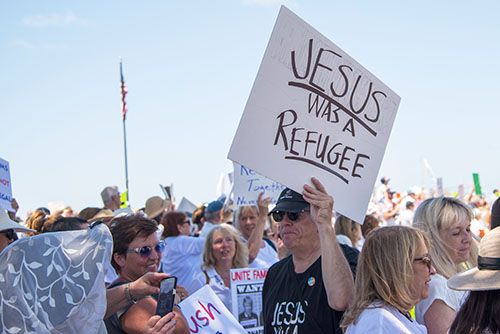
In 1943, French police came to the mountain village of Le Chambon-sur-Lignon demanding a list of the Jewish refugees hiding there. Pastor André Trocmé gave them nothing. "We do not know what a Jew is," he told them. "We only know men." By the war's end, the village of 5,000 had sheltered roughly that many Jewish refugees, forging papers, sneaking families across the Swiss border, and treating strangers as neighbors.
That same instinct is unfolding again right now, amid the ongoing ICE crackdown and as Temporary Protected Status runs out for hundreds of thousands of Haitians and Syrians. Faith communities across the nation are responding. We'll get to that. First, it helps to see how far back this pattern actually goes.
Is This Pattern Older Than Any Single Crisis?
Trocmé's villagers weren't improvising. Le Chambon was Huguenot country, descendants of French Protestants who had spent two centuries as a persecuted minority themselves. When the danger shifted to someone else, the community's own history of being hunted became the reason to hide people being hunted now.
That pattern shows up again and again in American history, well before this month's headlines about immigration. Quakers, the same tradition persecuted for refusing to swear oaths or fight in wars, became the backbone of the Underground Railroad, hiding escaped slaves in barns and cellars on the theological conviction that every person carries 'that of God' within them.
A century later, Black churches supplied the meeting halls, the money, and much of the leadership that fueled the nationwide civil rights movement, drawing on Exodus and the prophets to frame segregation as a moral crisis rather than merely a legal one. In the 1980s, congregations across denominations declared their buildings sanctuary for Central American refugees fleeing wars that the United States had helped fund, reviving a legal concept nearly as old as the church itself.
Was America Ever Meant to Be One Faith?
That history collided with current politics this week. Supreme Court Justice Neil Gorsuch, promoting a children's book on the Declaration of Independence, told PBS that America was never supposed to be built around a single race or religion, breaking publicly with Vice President JD Vance's argument that the country's founding was fundamentally Christian. "It's demonstrably not true that we came from the same religion," Gorsuch said, pointing to the Amish and the Quakers as evidence.
The same dissenting religious minorities he cited as proof of pluralism are the ones who built this country's tradition of protecting other minorities once they'd found their footing. Our earlier piece on Is America a "Christian Nation" After All? traces how every generation that insists otherwise tends to surface at moments of anxiety about diversity, not confidence in unity.
What Holds These Movements Together Theologically?
Underneath the specific history sits a shared instruction that shows up across traditions. The Torah repeats it more than almost any other social command: love the foreigner among you, because you were foreigners yourselves in Egypt. It's a shared memory that became law, based on the notion that people who forget what displacement felt like will eventually inflict it upon someone else.
Christianity inherited that logic and sharpened it. In Matthew's account of final judgment, Jesus tells his followers that welcoming a stranger is the same as welcoming him directly. The Book of Hebrews goes further, warning that hospitality to a stranger might mean unknowingly hosting something holy. If you recently saw Christopher Nolan's film The Odyssey you probably noticed a similar sentiment mentioned several times, cited as 'Zeus's Law'.
Islam's founding story runs on the same current: when the Prophet Muhammad's followers fled persecution in Mecca for Medina, the Quran praised the Medinans who took them in for preferring the refugees' needs over their own, even while poor themselves.
None of this makes any single tradition innocent. The same scriptures invoked to defend the vulnerable have also been twisted to justify conquest, forced conversion, and worse, a tension we explored in our piece on whether Christianity's violent history is unique. In reality, religion doesn't have one settled answer to how outsiders should be treated. Across the faith spectrum it's been a centuries-long argument, and everyone keeps citing the same books.
Is This Still Happening Today?
That argument is playing out again right now. A 6-3 majority on the Supreme Court recently voted to allow Trump to end the Temporary Protected Status (TPS) for hundreds of thousands of Haitian and Syrian people currently living in the United States. The Haitian and Syrian refugees are largely here as a result of an earthquake which devastated their home country and an ongoing civil war, respectively.
In recent years, even before their TPS was revoked, their welcome in the United States appeared to be rapidly dissolving - perhaps most noticeably after Donald Trump and JD Vance both repeated a debunked claim that Haitian immigrants were eating the pets of their neighbors in an Ohio town.
As the federal government continues to step away from these communities, faith groups from Ohio to Texas have revived an old Catholic framework called 'accompaniment', staying physically present with people facing deportation rather than only advocating from a distance. In effect, it's a practice in which a person, rather than a physical building, acts as a source of sanctuary for someone being persecuted.
In Ohio, that theology becomes grocery runs, translation help, and rides to Cleveland. It looks like a Mennonite church in Columbus that housed a mother named Edith Espinal for more than three years while her deportation case worked through the courts, and a Catholic parish in Lorain that helped Puerto Rican families displaced by Hurricane Maria find housing, jobs, and English classes.
It also looks like the quieter shift our earlier piece on ICE Arrests Nun On Her Way to Mass described: a Texas sister now telling every nun in her diocese to carry identification, since a church building no longer guarantees the protection it once did. For more on how clergy across the theological spectrum are wrestling with where obedience to law ends and obedience to conscience begins, see Clergy Deeply Divided On Immigration Crackdown.
What connects Le Chambon to a Springfield church basement is not a single doctrine or a single political outcome. It's a pattern: people who remember, or were taught to remember, what it felt like to be the stranger, choosing again and again to be the ones who answer the door.
Would You Answer the Door?
If a religious tradition's history of persecution creates a moral claim on how it treats today's outsiders, does that claim expire after enough generations have passed? Where does your own tradition, or your own family's history, sit inside this pattern?
57 comments
-
 Leslie A. Hulberg Née Tomasura
I know my family always taught us to treat the least of us as we would treat the best of us. I know when we had a hurricane that wiped our out valley in 1972, strangers were welcomed in our homes without question of race, religion, sexual orientation or national origin. And everyone was treated equally. There was never an issue or a debate. To This day whenever someone is seeking shelter or assistance of some kind, our doors are open.
-
Leslie A. Hulberg Née Tomasura
I know my family always taught us to treat the least of us as we would treat the best of us. I know when we had a hurricane that wiped our out valley in 1972, strangers were welcomed in our homes without question of race, religion, sexual orientation or national origin. And everyone was treated equally. There was never an issue or a debate. To This day whenever someone is seeking shelter or assistance of some kind, our doors are open.
-
 Gary Greenwood
This is exactly how Islam ruins every country they invade and take down , ruin and total oppression! FOOLS WAKE UP AND DON'T ALLOW ASYLUM AND BAN ISLAM!;THEY ARE E DEMONIC! ISLAM IS SATAN'S ARMY!
-
 Michael Dwayne Cooper
There s a big difference between saving Jews and smuggling rapist, criminals, drug dealers with fentanyl across the borders.
-
 Michael Hunt
Were these pregnant women all rapists, criminals, and drug dealers smuggling drugs across the boarder?
https://www.aclu.org/news/immigrants-rights/pregnant-and-postpartum-women-face-neglect-and-abuse-in-ice-detention
How about this Guatamalan mother of 2 who has a pending asylum claim but was detained by ICE without a warrant?
https://tennesseelookout.com/2026/07/31/ice-separated-nursing-mom-from-infant-toddler-against-its-own-rules-advocates-say/
Over 70% of people in ICE detention have no criminal convictions.
https://tracreports.org/immigration/quickfacts/
This has nothing to do with protecting criminals and everything to do with protecting beloved members of our community who, like our ancestors, came here seeking a better life and make wonderful contributions to our communities.
-
-
 James Riggle-Johnson
These people are not here illegally. They have temporary protective status. The problems in their countries have not been resolved, and yet we are now going to revoke that status. The Governor of Ohio, a Republican, recently said that deporting these individuals will hurt his state’s economy. It will hurt businesses that lose workers and the local economies.
Deporting these individuals is a personal decision. They are not criminals. What happened to getting rid of only the criminals?
-
Leslie A. Hulberg Née Tomasura
I believe a church, temple, grove or any place the clergy holds their sermons is considered a sacred place and should never be entered in a manner that is negative or has negative implications. If an armed team of masked men burst into your place of worship, how would you feel? And if they dragged out a man separating him from those he loves, or in thw midst of a religious service? And if it was a woman? What about a single family? If you were on the opposite side of the law, how would you feel being that man? That woman? That family?,especially if you were imprisoned because you came here to make a better life for yourself or your family?
-
 ServantOfJudgement
Leslie,
What about churches that do illegal things? In your mind, are those churches immune to law enforcement? Exactly what laws are churches privy to ignore that you and I are not? Human trafficking? Perhaps cooking meth? What about torture? If a church were hiding a serial killer cannibal, is that ok? What about hiding 5 gang members who just killed 4 kids on the playground? Is that ok?
Who chooses what laws a church can ignore?
-
-
 Ari Joseph Bertine
I'm pagan, and I would help anyone suffering from persecution not because pagans did and do continue to be persecuted but because I could not live with myself if I was the kind of person who could turn my back on suffering without offering whatever help I have to offer. I don't want anything to do with people who have cold hearts toward anyone who isn't just like them, and I don't want to be one.
-
 Bridget Kielas-Fecyk
Here's what's VERY sickening. They are rounding up and MURDERING Puerto Ricans. For people who completely FAILED civics, as well as US Geography, Anyone born in Puerto Rico is a US CITIZEN. Same as if they were born in Guam or in Hawaii. THEY ARE US CITIZENS!
This is because P.R. and Guam, as well as the American Samoan Islands, are US Territories. They fly the US flag and ALL PEOPLE BORN THERE are United States Citizens. Period. People scream "Deport them!"
Deport them where? Back to P.R. where they can just book a legal flight back to the mainland?
Of course, those screaming to deport them actually want them to go to death camps to be "Final Solutioned". If people remember what people like these ICE agents and the Brown shirts - aka the Red Hats - did in Auschwitz.
-
 Roy S. Thorpe
My mother's parents came to this country from Europe under the Immigration laws. With love and hard work they created a family of loving hard working people who made this country into America! They did not have to be hidden in a church because they sneaked across a border illegally! Apply and pray is better way!
-
Michael Hunt
Your ancestors likely didn't have to apply to enter the country when they came here. The modern immigration process is incredibly more difficult and complicated than it was a century ago.
https://www.americanimmigrationcouncil.org/fact-sheet/why-dont-they-just-get-line/
-
-
 Steven Ferrell
I find it interesting that most of those who protest for ILLEGALS are people that live in lilly white communities away from the illegals with their gangs, drugs and crime that come with them. Try living in the city with them directly across the street from you, where you have to have an alarm for your home and have lights all around the outside of it at night. Where you have to chain all your deck furniture together so it does not disappear. You have to have several extra heavy duty hasps and locks on your shed so you have to keep replacing stolen items.
The list goes on. For those that love the ILLEGALS so much, how about you take them into your home and you foot the cost for them.To try and compare Jesus to modern day illegals, is like comparing apples to oranges.
-
Michael Hunt
Undocumented immigrants statistically commit less crime than US citizens.
https://www.cato.org/briefing-paper/illegal-immigrant-incarceration-rates-2010-2024-demographics-american-imprisonment
Stop demonizing a group of people based off false beliefs.
-
ServantOfJudgement
The very first action of all illegal aliens was to willfully and knowingly break our law.
-
 Robert James Ruhnke
It’s a misdemeanor to come into the country undocumented, SOJ. It’s barely a criminal offense, ignore it. Like you ignore the fact you side with pedophiles anyway.
-
 Reverend Paula Copp
Well said.
-
ServantOfJudgement
That's all irrelevant Robert.
First impressions count brother.
-
 Patricia Ann Gross
SOJ,
For someone who rails against an immigrant who might be a criminal to call someone who is actively shielding pedophiles hidden in the contents of the Epstein files irrelevant is the very definition of hypocracy. ALSO, thousands who entered this country legally got their status stripped indescriminately by "our" fearless leader simply because of where they came from. For example, what evidence is there that EVERY person who came here from Haiti, seeing refuge from persecution did so under false pretences? What evidence is there that they DESERVE to have their TPS stripped? How's that for a first impression? They did everything right, then boom, they're on a boat back home to the same hellhole they thought they would never have to see again.
-
-
 Brian Hand
No. We don’t side with the Demoncrat party.
-
Michael Hunt
Democrat politicians have been calling for the release of the Epstein files while Republicans tried to block the release and Trump's DOJ still has not released all of the files as they've been legally required to do by congress. If the Democrat party is protecting pedophiles, as you claim, why are they actively calling for justice for Epstein's victims while the Trump administration and his GOP backers are trying to squash the entire Epstein scandal? If the GOP isn't protecting pedophiles, why have they done nothing to hold Epstein's clients responsible?
-
-
ServantOfJudgement
Robert my mindset on pedophiles is to give them a fair trial with no plea deals. If guilty, hang them at the front entry of the courthouse immediately after the trial.
Do you have a convicted pedophile in mind? You said I support pedophiles. Joe Bidens daughter said he was inappropriately showering with her as a child. If you mean him, I don't support Biden. Even so, he's not been convicted of pedophelia. Kinda hard to hang someone without a conviction.
How do you think we should handle Joe Biden's rumored pedophilea? I'm all ears.
-
 Jennifer Roussel
It's funny you use the term "Joe Biden's RUMORED Pedophilea" when we have legal documents supporting Trump, Epstein, Maxwell, and too many others to name right now, that aren't being convicted and still have "Christian Evangelicals" supporting them. I believe you're out of line.
-
ServantOfJudgement
Jennifer, why didn't Joe Biden go after Trump and all the rest when Joe Biden had possession of the files and power to prosecute? Why didn't Biden release the files? He had them for four years.
I'm all ears on that one too.
I'm in favor of releasing everything unredacted and mercilessly prosecuting whoever's been naughty. I don't care who it is.
Why does the left ignore all their pedopliles? I have the answer. They actually don't care, not really. That's why you don't care about Biden's daughter saying her dad did some creepy things in the shower with her.
Why don't you take the blinders off and join me? Let's get them all in front of a judge.
-
Michael Hunt
As I've said here before, possibly to you, the reason the files weren't released under Biden is because they were still investigating the crimes and gathering evidence. You don't publish your evidence when you're still actively investigating.
Once Trump took the Presidency, his DOJ said there was nothing in the files and that they weren't pursuing charges. That's why congress mandated the release of the files. The Trump administration is still holding back over 2 million documents regarding the Epstein investigation.
"I'm in favor of releasing everything unredacted and mercilessly prosecuting whoever's been naughty. I don't care who it is." Yet you continue to attack Biden and lie that his daughter said her dad did creepy things in the shower with her while giving Trump a pass despite the decades of evidence and accusations of Trump having sexually assaulted numerous women and possibly even children. Her exact words were that her father taking showers with her was "probably not appropriate." That's a far cry from saying he "did some creepy things in the shower with her."
What pedophiles on the left are being ignored? Who on the left has been accused of sexually abusing women or children?
RJ May? Oops, Republican.
https://wpde.com/news/local/sc-gop-rep-joebidennnn69-screen-name-child-sex-abuse-pedophile-court-case-plead-charges-mugshot-rj-may
Roy Moore? Oh, also a Republican.
https://whyy.org/articles/roy-moore-pedophilia-accusations-test-gops-cracked-moral-compass/
Dennis Hastert? Also a Republican.
https://cease.law.uga.edu/news/dennis-hastert-gets-15-months-in-prison-in-hush-money-case/
Matt Gaetz? Republican again.
https://ethics.house.gov/press-releases/statement-of-the-committee-on-ethics-regarding-representative-matt-gaetz-2/
I'm glad you agree that anyone accused of the sexual abuse of a minor (or adult, for that matter) should have to stand trial for their alleged crimes. The problem here is that you always point the finger at Biden based on limited, thin evidence but never point out the numerous credibly accused and even admitted pedophiles on the right.
-
-
Michael Hunt
Why are you more obsessed with Biden taking a shower with his child daughter who has never claimed abuse from her father than you are about credible allegations of sexual assault by Trump, including a woman who was 13 at the time of the abuse? How is showering with your own child more heinous than having a close relationship with Epstein and being accused by multiple women, some children at the time, of sexual abuse?
https://thebloomfirm.com/why-the-new-child-rape-case-filed-against-donald-trump-should-not-be-ignored/
https://popular.info/p/trumps-alleged-sexual-assault-of
-
ServantOfJudgement
Again and again Michael I say to you the same thing.
Let's get them all in front of a judge. Not just who you want to see swing. I want justice for all. I have no blinders on. I'll not excuse disgusting showers or worse. The anonymous complaint against Trump should come forward and get him in front of a judge just like Biden should be.
Life without blinders is delivery from ignorance.
-
Michael Hunt
How would you know what life without blinders is like? You obsess over Biden's daughter saying her father showering with her was "probably not appropriate" and want him in front of a judge over those words alone but you never seem to call for Trump to face justice or any of the people around him who have been protecting those in the Epstein files by slow walking their release and incorrectly redacting the names of accused pedophiles. Why is that?
-
ServantOfJudgement
Michael I bring up joe Biden showering with his little girl because I enjoy watching the left defend and ignore. I have the high hope someone on the left will wake up. Just one is my goal.
Did you know the left's tried and tested complacency with a grown man showering with a little girl is exactly why my prediction of the future lgbt2qia++MAP acronym will become reality.
Indeed, some here on this blog have said there's nothing wrong with it.
Pedophelia has no party line friend. We should all aspire to ignore party lines when dealing with it.
-
Michael Hunt
"Did you know the left's tried and tested complacency with a grown man showering with a little girl is exactly why my prediction of the future lgbt2qia++MAP acronym will become reality."
Wow that's an insane leap. Showering with your child does not mean you sexually abused them. Biden's daughter never once accuses her father of doing so despite recounting abuse from others in her diary. By no means am I saying that he should have showered with his daughter and that it's totally fine and acceptable. What I am saying is that there is no evidence or even accusation that Joe Biden sexually abused his daughter. To constantly bring this up while defending and ignoring the actions of Trump is incredibly hypocritical when the level inappropriate behavior by Trump compared to Biden is a drastic difference.
"Indeed, some here on this blog have said there's nothing wrong with [pedophilia]."
What insane people here have made that argument?
If pedophilia has no party line, why isn't the GOP doing more to seek justice for the victims of sexual abuse by Epstein and his cohorts?
-
-
-
-
-
 John H
Those numbers are because there are tens of millions more US citizens than there are illegal immigrants. With that said, it doesn't matter how much more or less they commit. What matters is that they came here illegally and are adding to the problem. Not all illegal immigrants are bad, but there are enough that are, which means we need to keep them out. There has always been a process for them to come legally. Every civilized country has borders and laws prohibiting illegal entry. You need to stop protecting them. You have no idea how many are criminals. Even one criminal is not ok. My guess is that you, Mr. Hunt, are probably part of the Gen Z or Millennial group of Americans. You don't think about things before you act, and you believe that open borders is ok. Well, it's not!!! Open borders (letting anyone in) has already proven to be a gateway for terrorists, drug smugglers, and child traffickers. Wake up!
-
Patricia Ann Gross
Yes, John H.,
You said, "Open borders (letting anyone in) has already proven to be a gateway for terrorists, drug smugglers, and child traffickers. Wake up!" I agree. Look where it got the Native Americans. I don't think anyone is advocating for totally open borders, but the wholesale demonization of ALL immigrants because of a few bad ones is not the right answer either.
-
John H
Not once did I say ALL immigrants. I'm talking about the ILLEGAL immigrants. I'm all for immigration if it is done through the proper, LEGAL, channels. As for Native Americans... it stinks. However, that is no different than every nation, every country, at some point conquering land. Was it right? Of course not. Things aren't the same as they were in the 1400s, the 1500s, the 1600s, the 1700s, the 1800s, and even the early 1900s. When you say you don't think anyone is advocating for totally open borders... that is absurd!!! The left used to believe in borders, but now they prefer to let millions in. Remember the Great Walk of 10s of thousands back during Biden's term. They welcomed it. The left leaning citizens even protest (mostly peaceful... ha!) the deportation of child rapists, murderers, violent gang members, etc. They think we should let anyone and everyone just walk in. How ludicrous is that???
-
Patricia Ann Gross
I am a left-leaning citizen, and do not agree in open borders. I DO agree in assylum, however, for people trying to escape oppression. The only reason I would protest deporting a child rapist is if they do that in lieu of putting him in prison for the rest of his life here in this country to give the victim a little taste of justice. Rounding people up and deporting them because of what the "might have done" does not give me any sense of justice for the victims they might have left behind. Rounding up a nun who is in this country legally, as was later substantiated and on her way to mass outside her home because of the color of her skin and her accent was a deplorable act of racism. It defies the notion that ICE is looking for the child rapists and murderers. Where was any probable cause? Where was any judicial warrant? The courts have ordered these, and ICE continues to defy them. Also, where are the body cams and why are they still covering their faces?
-
Michael Hunt
"The left leaning citizens even protest the deportation of child rapists, murderers, violent gang members, etc."
When did this happen? Not a single leftist I know is protesting the deportation of criminals.
There are some people on the far-left that are for completely open borders but to claim that the left prefers to let millions in is absurd when those things aren't happening. The thousands of people coming here during the pandemic were welcomed if they applied for legal entry. They literally had to wait at the border to receive approval to enter the US.
-
-
-
Michael Hunt
The numbers are adjusted for population size... Immigrants commit crimes at a lower rate than US citizens.
The legal immigration process is incredibly difficult to navigate and can take decades to go through. Nearly all undocumented immigrants want to be here legally but face serious roadblocks toward that path.
https://www.americanimmigrationcouncil.org/fact-sheet/why-dont-they-just-get-line/
You're right that I fall into those generations but I do think before I act and no, I don't support open boarders. I believe that there needs to be less restrictions on immigration and better pathways towards legal immigration but, no, freely open boarders where anyone can cross at any time is not something I believe in.
The people I'm hoping to protect are overwhelmingly model residents and often important members of the communities they live in. The contribute to the local and national economy and are here seeking a better life, just like my ancestors did when they got on a ship and sailed to America, no visa or green card or citizenship application required. The reality is that immigration, legal or illegal, is a net benefit to our country even with the limited crime they are "adding to the problem." I'm not excusing any criminal acts committed by anyone, I'm just not deeming all undocumented immigrants as being problematic because a small percentage of their population will commit a crime.
-
ServantOfJudgement
That's right John, it's crime that wouldn't occur if they weren't here.
Proportion is irrelevant. We're talking about addition friends.
-
-
-
Bridget Kielas-Fecyk
You ARE aware it is 100% legal to come across our borders without documentation as long as you go to a US border patrol agent or similar status individual and ask for Asylum right? This is built right into our Constitution, and our laws, AND the international laws we are supposed to be following.
And, btw? It's no more a crime than me walking across your lawn would be a crime. At MOST it'd be a misdemeanor. And people who come undocumented are LESS likely to commit crimes than US citizens.
I'm guessing it's not where they come from you object to, and more the amount of melanin in their skin.
-
ServantOfJudgement
Bridget, If I committed a misdemeanor on your property or in your home, you most definitely will call the fuzz on me and have me removed. Hands down you would have me removed. Everyone on this blog would call the cops and have me removed if I committed a misdemeanor against them, on their property or in their home.
There are zero exceptions to what I just said.
-
Michael Hunt
You'd be removed but not put in a detention center for months with poor food, little medical treatment, little to no access to family or even lawyers, and be physically and sexually assaulted and then sent somewhere where you've never lived or even had ancestors from. That's what is happening to undocumented immigrants under the current administration.
-
-
-
Ari Joseph Bertine
This should also apply to every single American citizen that has driven 5-10 mph over the speed limit, jaywalked, pirated digital content, possessed marijauna where it isn't legalized, drunk alcohol before their 21st birthday, or had sex in an airplane bathroom or in a car parked on state or federally owned land. These are all equally illegal to being in the USA illegally, and apparently millions of people get away with these things every day. They should all be tracked down as well, or we are just a country that doesn't care about all the criminals living and working beside us.
-
ServantOfJudgement
No Ari,
They should quadruple the size of ICE and offer a bonus to every ice officer that apprehends and deports an illegal invader.
When you offer a bonus to factory workers for each part they produce, production goes through the roof.
That would get em out quick.
-
Michael Hunt
All that's gonna do is motivate ICE agents to racially profile US citizens and legal residents hoping to find out that they're undocumented and it will lead to citizens and legal residents being wrongly detained. If you want masked and armed ICE agents roaming every city in America and stalking anyone who looks like they could be an undocumented immigrant, I suppose increasing the size of ICE would be a good idea but I have no interest in living in a militarized police state.
-
-
-
-
 Bruce David
A nation without entry regulations/screening is doomed; immigrants are welcome but need to OBEY our laws...We also need to do away with our ludicrous Anchor Baby policy-No other nation offers this & we now see Chinese & Russian women on tourist Visas flocking here for birthright citizenship. As a former Deputy in AZ I witnessed tons of crime by illegals including welfare fraud, ID Theft, Child Trafficking, Drug & fun running, even murder!
-
Reverend Paula Copp
I’m familiar with the requirements for being in law enforcement in Arizona; you’d need to show me valid data regarding your claims…
-
Michael Hunt
"No other nation offers [birthright citizenship]"
That's inaccurate. Thirty-two countries offer birthright citizenship in a manner similar to the US. It's not common, but other nations do offer birthright citizenship.
https://www.pewresearch.org/short-reads/2026/03/31/us-style-birthright-citizenship-is-uncommon-around-the-world/
-
Brian Hand
It doesn’t matter. Its use has been perverted from its original intention & has been so for far too long. It needs to stop immediately.
-
Patricia Ann Gross
Brian,
So saying something inaccurate and being called out for it doesn't matter? Perhaps it's been perverted from its original intention, but since it is part of the constitution, taking it away, or even narrowing its scope requires a constitutional amendment. The ONLY exception that has ever been granted is for children born to people here (legally) on a diplomatic visa.
-
-
-
 Donald G Magel
We are all made in god's image; born sometimes in evil places. Jesus shared his love, teachings and gave his life for all of us. Now HE is too woke for some to follow. Some of us chose and continue to support the anti-christ. God's war with Satan and his emissaries is ongoing. Which side have you chosen?
-
-
Patricia Ann Gross
Several years ago, I assisted a young Haitian man renew his Green card. The young man needed a fee of several hundred dollars, or a waiver in order to do so (based on financial need). I helped him fill out the paperwork for the waiver, got all of his renewal paperwork completed and copies of all of the documents required for the renewal process, and a few weeks later, his updated Green Card appeared in the incoming mail. I retired from that agency three years ago (not affiliated with ICE, but a non-profit that assists people needing assistance, regardless of their circumstances), and ran into him on the street while I was walking my dog a few days ago. He immediately recognized me, and came up, gave me a hug and thanked me profusely for the assistance I had given him years ago, because without that renewal, he would be in fear of being returned to a place he hasn't seen since early childhood, and very possibly in danger for his life. He has lived here his entire life, worked, paid taxes, and has gone through all the steps necessary to stay compliant with all that ICE is requiring for him to stay here. The one time he couldn't and ran into a "sanctuary" that was willing to help out, was something he considers life-saving to this very day.
-
Bridget Kielas-Fecyk
Sadly, they are now rounding up green card holders, and even US citizens that "look foreign" aka have dark skin, in their eyes and shipping them to the prison camps. They are refusing to look at any ID's, refusing to allow any contact with family or lawyers, and sending them, not back to their OWN countries, or in the case of US citizens letting them get out, but to death camps. That way the monster-in-chief, the fuhrer, can claim "but WE aren't killing them... not really."
-
Patricia Ann Gross
Bridget,
I've heard that too, and there are several other Haitians that I have lost track of. I'm not sure if any of them had TPS or were here on visas, but this one already had a green card, so he was much further along in the process. I know one guy was working on full refugee status, but lost track of him several years ago.
-
John H
That is blatantly false. Everything you said is ridiculous. You need to quit watching your YouTube clips and small sound bites from X, Facebook, Instagram, Snapchat, and all that other nonsense. Literally, everything you said is a lie. Your TDS has gotten so bad that you have been blinded from the truth.
-
Patricia Ann Gross
John,
Now that Haitians have ALL been stripped of TPS status, all of a sudden, people seeking assylum from persecution are now "undocumented," and therefore subject to deportation back to the living hell they were running from. All you have to do is look at your local news source for that. Your TWS (Trump Worship Syndrome) has gotten so bad that you have been blinded from the truth.
-
Michael Hunt
We can maybe disagree about the death camps part (we did send many people to CECOT which is a notoriously dangerous and deadly prison), but US citizens have been detained by ICE despite having their photo ID on them and detainees are denied contact with family members and even lawyers. Families aren't even notified when a relative is detained. I'm not seeing this on social media sites, I'm seeing this on reputable journalism websites. Additionally, 59 people have died in ICE detention since Trump's second term started. 2025 was ICE's deadliest year in more than two decades.
https://icefalltracker.com/
https://www.hrw.org/report/2026/06/25/dying-in-detention/rising-deaths-in-an-expanding-us-immigration-detention-system
It's telling that your rebuttal to Bridget's claims is to claim everything she said is a lie and that she has "TDS" but you haven't presented any evidence that what she said was false.
-
-
-
-
 Brother Peter
Excellent blog post. Thank you!

I know my family always taught us to treat the least of us as we would treat the best of us. I know when we had a hurricane that wiped our out valley in 1972, strangers were welcomed in our homes without question of race, religion, sexual orientation or national origin. And everyone was treated equally. There was never an issue or a debate. To This day whenever someone is seeking shelter or assistance of some kind, our doors are open.