

The video is hard to unsee. Men in camouflage walk down the center aisle of Mt. Olivet Baptist Church in Lexington, Kentucky, carrying airsoft rifles. They corner a man dressed in black on the steps to the altar. Children in the pews, led by their pastor, chant along: "Take him out. Blow him up." A shot rings out. The man in black is carried out the side door.
What Happened at Mt. Olivet Baptist Church?
The church describes this as a Vacation Bible School tradition, one it says has run for more than 30 years, built around killing off a figure who represents the devil. Pastor Dewayne Walker defended it after the clip spread online, saying "we're painting a real picture to kids, visibly what's going on invisibly." Reverend Leah Schade, who watched the footage, called it traumatizing for the children who witnessed it.
None of them, on either side, were arguing about whether Vacation Bible School should teach children about good and evil. Instead, the argument was over the method: a simulated firing squad, a chant of triumph, a body carried out a side door while the crowd cheers. That specific choreography, the idea that evil has to be seen dying for the lesson to land, has a name and a long paper trail behind it.
Where Does the Idea That Evil Must Die Come From?
Mainstream Christian atonement theology holds that sin can only be settled through violence: Jesus had to be tortured and killed to satisfy a debt humanity owed. Theologians call this substitutionary atonement, and it draws on passages like Isaiah's suffering servant and the sacrificial language running through the book of Hebrews. The logic is precise: Blood is required. Someone has to pay, and paying looks like dying.
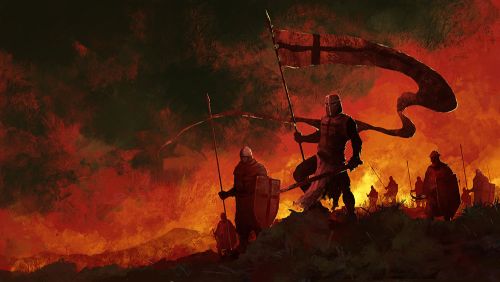 That doctrine did not stay confined to a single crucifixion two thousand years ago. In 1095, Pope Urban II stood before a crowd at Clermont and promised soldiers that killing for Christ in the Holy Land would erase their sins outright, no confession required.
Crusaders took him at his word. Some never made it past the Rhineland, where they massacred entire Jewish communities in Worms and Mainz along the way. The ones who reached Jerusalem in 1099 were reported by their own chroniclers to have waded through blood in the streets after the city fell.
Centuries later, racist American lynch mobs borrowed the same grammar... Christian ministers sometimes led the crowd in prayer beforehand. And these were not secret acts: newspapers sometimes printed the time and location so families could bring a picnic. Photographers sold postcards of the aftermath.
The theology underneath was rarely spoken aloud, but it didn't need to be: evil had been identified, and now the crowd got to watch it die. Mel Gibson's The Passion of the Christ later repackaged a version of that same impulse as a devotional film, stretching Christ's flogging for a paying audience. Mt. Olivet's skit sits at the end of that line, not off to the side of it.
Is Violence Inherent in Judaism?
Christians share their Old Testament with Judaism, and that shared material is far from gentle. The book of Joshua describes the conquest of Canaan city by city. In 1 Samuel 15, God instructs Saul to destroy the Amalekites entirely, sparing neither the elderly nor the livestock. Scholars call this herem, a mode of warfare in which the enemy is not merely defeated, but erased.
Most of Jewish tradition long ago filed herem under history rather than instruction, something a covenant people once believed about a specific ancient enemy rather than a standing order. But the idea has resurfaced when politics gave it somewhere to go.
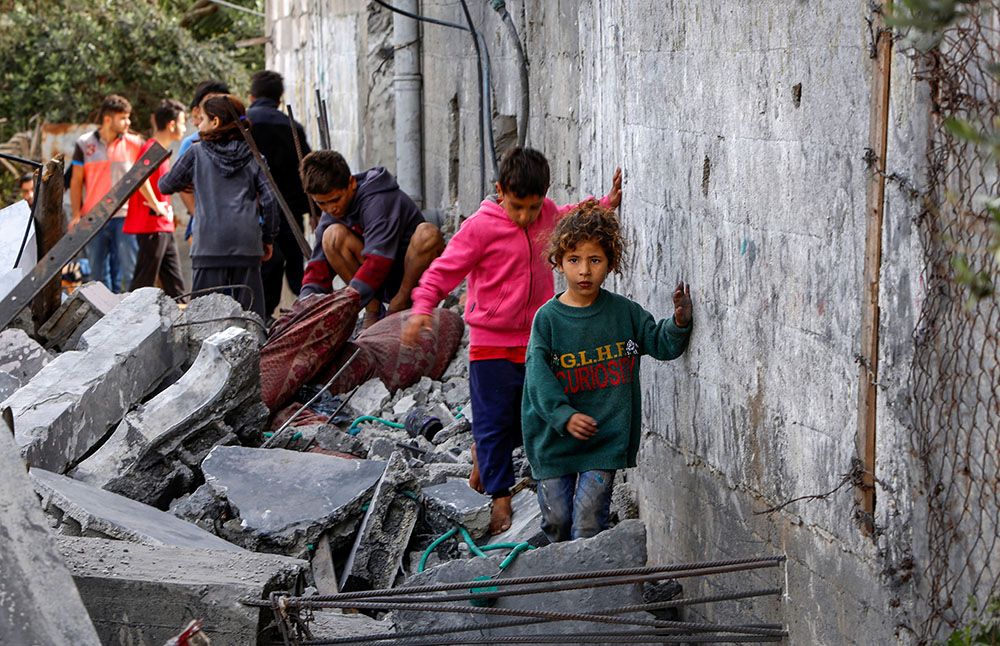
In 1994, Baruch Goldstein, a settler who invoked the memory of Amalek in his own writings, opened fire on Muslim worshippers at the Cave of the Patriarchs in Hebron, killing 29 people. Decades of hilltop settler violence in the West Bank have continued to cite religious claims to the land since. Mainstream rabbinic authorities across the spectrum condemned Goldstein immediately and have kept rejecting that reading of the text, but the reading persists at the margins, kept alive by people who found something usable in it.
The concept resurfaced more directly in 2023. Announcing the ground invasion of Gaza that October, Israeli Prime Minister Benjamin Netanyahu invoked the same tradition, repeating the command to remember and ultimately destroy the nation Saul was ordered to wipe out in 1 Samuel 15. South Africa's genocide case against Israel at the International Court of Justice later cited the remark as evidence of intent, a reading Israeli officials rejected, saying the comparison was aimed at Hamas, not the Palestinian people.
How Does Violence Factor in Islam?

Islamic extremist groups like ISIS and al-Qaeda lean hard on a handful of Quranic verses about fighting unbelievers, most famously the so-called sword verse in chapter 9. What that reading skips is the body of classical Islamic jurisprudence built specifically to constrain when and how fighting is permitted, distinguishing defensive war bound by rules of engagement from indiscriminate slaughter of civilians.
That constraint has real historical depth. When the first caliph, Abu Bakr, sent troops north in the seventh century, he reportedly ordered them not to kill women, children, or the elderly, not to harm monks in their cells, and not to destroy crops or slaughter animals except for food. Later jurists built entire legal frameworks on instructions like these, centuries before the modern laws of war arrived at similar rules.
That argument between rule-bound war and total war is not new. The Kharijites, one of Islam's earliest sects, split off in the seventh century and began declaring other Muslims apostates worthy of death, a pattern strikingly close to how ISIS has treated fellow Muslims who refuse to submit to its rule.
The Islamic response to groups like ISIS has been loud, if underreported. When Abu Bakr al-Baghdadi, the group's leader, declared himself caliph of a self-proclaimed Islamic State in 2014, more than 120 Muslim scholars worldwide answered with an open letter. It worked through his claims and justifications point by point and rejected every one using the same texts he claimed to follow.
Is There Violence in the Faiths of Southeast Asia?
The Bhagavad Gita opens with the warrior Arjuna refusing to fight a war against his own family, and Krishna spending the rest of the text talking him into it, framing the coming slaughter as righteous duty rather than tragedy. That frame, dharmayuddha, or righteous war, has outlasted its original battlefield.
Hindu nationalist politics has drawn on it alongside the sanctity of the cow to justify real violence: the 1992 demolition of the Babri Masjid mosque, which set off riots that killed more than 2,000 people, and a string of vigilante lynchings of Muslim men, including Mohammed Akhlaq in 2015 and Pehlu Khan in 2017, both killed over rumors involving cattle.
Buddhism carries less obvious scriptural cover for violence than any of these traditions. Nonviolence sits closer to its center than to its margins, which is what made it so startling when monks became the public face of a nationalist campaign against Myanmar's Rohingya Muslim minority.
So Which Religion Is the Most Violent?
 A three-volume survey of 1,763 historical conflicts, the Encyclopedia of Wars, found that only around 7 percent of wars listed religion as the primary cause, though historians working with the same data have pushed back on how cleanly any single war's cause can be reduced to one label.
The Crusades served papal ambitions to unify a fractured Europe as much as they served theology. The campaign against the Rohingya served a military junta's ethnic nationalism far more than it served anything the Buddha taught. What keeps showing up across every one of these traditions is not a uniquely violent text, but rather, a recurring alliance between institutional power and whatever verse happens to be lying around when that power needs some cover.
Every tradition here also carries a louder, better-attended counter-theology: Christian pacifism, the Islamic jurisprudence built to restrain jihad rather than unleash it, Hindu ahimsa, and a Buddhist monastic code that treats incitement to violence as a direct betrayal of the faith. Reform-minded voices inside each religion have spent generations arguing that scripture written for tribal survival in the Bronze Age was never meant to license a disturbing kindergarten Bible lesson, a settler's rifle, or a monk's sermon against a religious minority.
For more on how this same argument surfaces when religion and modern warfare collide, our earlier piece on Is This a Holy War? traces that pattern in the current Middle East.
Mt. Olivet's defenders and its critics are, in a strange way, both right. The pastor is correct that Christianity has always reached for vivid imagery to make abstract stakes concrete for children. His critics are correct that atonement theology carries a body count, one that Christianity shares, in different forms and different centuries, with virtually every tradition that has ever been handed real political power.
So, Where Does That Leave Us?
Is there a meaningful difference between what a religion's holy texts say and what its adherents have done with them? Can any faith tradition fully account for its own violent history, or only choose which chapters to keep in the light? Does teaching children that evil deserves to be destroyed shape how they handle conflict once they're grown?
78 comments
-
 Bishop William Dusenberry, DD
Evolution explains everything— Nature does what it does, to everything, and evolution is the explanation of how Nature functions — and the more one understands the physical sciences, the easier it becomes to acknowledge that Nature and God are the same thing. Nature always was, and always will be, a Cosmos without a begging, nor an end; and as H L Meinkin opined, “There’s nothing supernatural in the Cosmos, that the human mind can comprehend.” Those dying for religious reasons— die for nothing, so, “You can “imagine” no religion better, the more physical science you know..
-
 Doctor Loyal
The body of classical Islamic jurisprudence was built specifically to constrain when and how fighting is permitted, distinguishing defensive war bound by rules of engagement from indiscriminate slaughter of civilians. -vs- All The Islamic Terrorist Groups. How can we believe Islam when they don't stop senseless Hate, Violence, Murder, Rape, and Assault? The vast majority watches while death and violence is repeatedly used for Conquest. I'm sure that someone in this forum will claim the same about Christianity, but since Medieval times, there haven't been violent unwarranted invasions from Christians invading Islamic Nations with the accompanying Death, Rape, Kidnaping, and violence. When did Christians plot a murderous 9/11 against any other Nation?
-
 Geoffrey C. Olive
The only solution to all the pros and cons of religious beliefs is to ignore them all as the mumbo jumbo that they are!
-
 Bruce Lee Williams
Prayers for others, is at least as much for your own benefit spiritually and psychologically, as for the other person. Your last sentence shows a pious passive aggression, without any intention of a good outcome. I think Jesus would pray for that person.
-
 Brien
Brien
I think the question is off the mark. As with all things discussed here, violence is a man-made construct. Human beings have been killing each other, mostly for power, as far back as recorded history. Man learned to give the violence a label in order to sway others to the cause. Is a label violent? No, mankind is violent. There are always those that wish to be the "Alpha". Our species has alot of growing up to do. Peace ✌️
-
 June Whalen Gonzalez
Religion is a man made explanation about the formation of the universe, tries to make sense of the unknown, and attempts to write a narrative of how the perfect world would exist .... But man is not perfect, and words in good intention can be corrupted or misused by anyone to whom power is relinquished to
-
 Warren Calvin Wall
Institutional and organized religions serve only one purpose, the control of society. Most times, the mechanism of control is violence. All religions are equally violent because that is their nature and purpose.
-
 Patricia Ann Gross
Warren,
"Most times" is overstating it. What you are describing are the fringe that want complete control over both the religion and society. Neither is the teaching of any of the major religions, who generally teach peace and compassion rather than control and violence. In all those cases, the "fringe elements" have sneaked a couple of sentences from a holy scripture to justify their actions when the majority of their scripture also condemns it.
-
-
 Rev Ned
Let’s sing the hymn, 🎼Jesus loves me, but He can’t stand you!
-
 Roy S. Thorpe
It's a bunch of zealots that ruin all religions with their my way or die nonsense! Freedom of religion means that! Your 3 foot circle of My Way ends where my 3 foot circle begins! And loud and obnoxious doesn't make it right!
-
 Rev. Dr. Robert Allan Roush
While I don't believe violence is justified, sitting and doing nothing while innocents are slaughtered is not justified either. There may be a time and place for it. I hope that it's never necessary. Yet, there is so much murder, killing and disconnected and insensitive violence in the world today, it's clear that it's never going away. Is some of it justified by religion. Sure, and that's religion's shame.
-
 Steven Ferrell
The Crusades were started because of islam trying to move across the world and force islam on the world. It was fight or surrender to islam.
-
 Guy E. Sanders Jr
For those who point frantically at Islam, let us remember that there exists extremists in all religions, or more correctly, all professed religions. One will find that those committing violence in the name of religion, any religion, are generally violating the stated tenets of those religions. The violence between Shi'ite and Sunni Muslims surpasses any violence against Christians or Jews.
Those who point to Islam and Islamic terrorists ignore the fact that they actually slay more Muslims than any other denomination for not adhering to their strict interpretation of Islam. As far as Christianity is concerned, we don't even have to go back to the Crusades. There are those who killed OB/gyn doctors and bombed clinics who professed themselves "pro-life Christians". How long did "The Troubles" rage on in Ireland over Christianity? In the US, the KKK proclaimed Christion Nationalism even as they wreaked havoc, lynching, shooting, torturing, burning and bombing,,, even bombing churches. We won't even go back to the Third Reich which, while not claiming Christianity, was certainly supported by the Catholic church who even provided false documents so that Nazis could escape to South America and other places.
We can document the carnage cand atrocities committed by the Japanese in World War II, especially against the Koreans and Chinese.
Essentially, no one religion has a monopoly on violence and the Judeo-Christian beliefs are mired in genocide as much as any other.
-
 John Reddan
The problem with the article is that it is conflating past events (e.g., the Crusades) with current events. With respect to current events, Islam is clearly in the lead from a religion perspective. As the west as become more secular, it is no longer appropriate to point at Christianity as an instigator of violence, even if as a whole they are not less violent. Scoring smaller outbreaks of violence (e.g., tribes in Africa) would be interesting, particularly is a per capita scoring methodology was used.
-
 David J Hebert
The most important aspect of the materials presented is in my opinion; any group regardless of religious, political, race, etc. is not only committing crimes, it is evil behavior that must be stopped. The KKK must be stopped just like the current Islamic extremist of every flavor. And personally, yes Evil does exist and people who believe in the elimination of any people group represents that evil. There are plenty of examples, as shared, in every group that do believe that genocide is evil but will not commit any form of violence, good for them. Others are willing to take up arms against those who would commit violence against others including genocide. Everyone should follow their conscience and convictions as long as it doesn’t include genocide. A man was recently arrested for killing an active shooter because he was randomly shooting people just because he was from out of state. For me that is the epitome of liberal stupidity. Balance and common sense are becoming increasingly absent in many societies around the world.
-
 ServantOfJudgement
It requires very little thought or investigation to conclude what the most violent of the world's religions is. Conversely, tremendous effort and intellectual tap dancing must be applied to not see or know what religion is the most violent.
The list of Islamic militant groups and nations goes on and on. They butcher men women and children everywhere they can. Islamic forces hang homosexuals and behead them. Take children as wives to produce more fighters. They call it good. Yesterday, today and tomorrow they will chop people up. You can trust it.
Islam is the religion you're looking for if seeking the most violent.
-
Bishop William Dusenberry, DD
Does Islam know that the Christian/Hebrew God, in, or, about 7,832 yers ago, flooded our Earth for 40 days, and 40 nights, resulting in everyone on Earth (12,857,922) being drowned —including 12,865 pregnant teenagers, and adults? Only Noah and his family survived — thereby making Judeo-Christianity the most violent metaphysical hocus-pocus to date.
-
 Sir Lionheart
And the only family that survived the flood was headed by a drunkard. I don’t feel so bad now having a glass of wine 🍷 now and then. I’m convinced that God, if there is one, will obviously approve. I don’t plan on building an Ark though. 🤭
🦁❤️
-
Doctor Loyal
Beer is proof that God loves us and wants us to be happy !!
-
Bishop William Dusenberry, DD
Back in Homer’s time; the Greek religion (which Christian mythologists today categorize as Greek myths) they used to sing a song — which began “In heaven there is no beer— that’s why we drink it here” —Nature always was, and always will be— so respect Nature, because if you don’t, Nature will do, as Nature does, mother or father, take your pick.
-
Sir Lionheart
I actually quite like the God of wine, Dionysus. Now there’s a god I could quite take to?
But there have been many Gods that have associated themselves with Beer/Ale worth considering. 🤗
🦁❤️
-
-
-
Geoffrey C. Olive
Bishop William, I cannot believe that someone as intelligent as you can believe such nonsense! On the other hand …!😂
-
Doctor Loyal
Blame Bill Cosby...
-
-
-
 James Riggle-Johnson
I think it’s safe to say that violence has been committed in the name of every major religion. Christianity, Judaism, Islam, and others have all inspired people to kill in the name of God. Each believes it possesses the one true path to enlightenment or salvation.
It’s the same conclusion I’ve reached about these religious texts: they were written by people who claimed God was speaking to them, when I believe they were really listening to their own egos.
This Bible school scene is disgusting, in my opinion. I agree with Reverend Leah Schade that these children are being taught to see anyone they perceive as evil as an enemy to be defeated. The gunshot at the end makes it clear what "defeated" is supposed to mean. And for the child who fears they might be one of those "evil" people, the message is terrifying. If that isn't indoctrination, I don't know what is.
-
Doctor Loyal
Unfortunately, it is also teaching them that Violence is the answer to Evil.
-
-
 Reverend Paula Copp
I seem to remember Jesus saying that those who live by the sword shall die by the sword…
-
Sir Lionheart
According to the Gospel of Matthew, Jesus is depicted as saying that. Whether those are his exact historical words is something we cannot establish, because the Gospels were written decades later in a different language and are our only sources for his sayings. I wonder how many of the sayings that it’s alleged he actually said, are true? It’s an interesting statement though, for sure.
🦁❤️
-
 Rev. BH
True to Jesus or not, Lion, the sayings are instructive and considered. I particularly like "let he who is without sin cast the first stone", no matter who came up with it.
-
Sir Lionheart
Yes I totally agree with you. That is indeed a wonderful saying. There are some wonderful sayings in the Vedas, and many other religious books. I just wish we really knew for sure who wrote these words of wisdom to give them full credit.
🦁❤️
-
Rev. BH
Lion, Do they need our credit? Or do we simply need to "credit" them by our actions?
-
-
-
-
-
Bishop William Dusenberry, DD
All religions (except mine) are just attempts to personify Nature (the one and only God) — personify Nature — so you can talk to it, and ask it for favors; until you learn what science can tell you — instead of religious mythologies (which they all are). God is akin to Nature — once one becomes proficient in science; but, until that happens, God will have to do.
-
Sir Lionheart
I think ChatGPT is possibly the new modern deity. Not only can you talk to it for real, but this new one actually replies back. That’s one in the eye for all these other silent gods. 🤭
🦁❤️
-
-
 Douglas Robert Spindler
Teaching this to kids only encourages them it okay to shoot people at schools, shopping malls, movie theaters and at gas stations.
The bible teaches violence against others while loving them. Great message for children.
-
 Rev. Carol M Anaski-Figurski
Interesting article. The concepts of faith all are allowed to exist. Not all faith is Christianity. Christianity is the only faith that has a human sacrifice. Jesus. The devil is real & that is allowed to exist ie satanism is a religion, Buddhist believe in the strength within themselves. if you respected all religions & promote more wiccan philosophy " do what you want, but do no harm." teach tolerance & respect of what others believe. Raise your children with what you believe & give them something to believe in. The bible is full of Holy wars & violence. There is a time for Peace. The bible speaks of wars & rumors of wars until the end of time. It will never forever be peaceful all the time.
-
 Lori Mongillo
Sadly, people don't seem to get that belief, on any level, is NOT the truth. Your religion or spiritual practice is your means of getting in touch with your sacred nature. It's a language that is used to make a connection to something we cannot, and will never, understand. The creative forces are creative and destructive. Not good and evil. Good and evil are human concepts that we keep very much alive. Religion promotes superiority and arrogance. You can live in denial your whole life, but it doesn't change the facts.
-
 George Walter Kauffman
First and foremost, you have to distinguish what is a religion and what is a cult. After that, then you can decide.
-
Sir Lionheart
I don’t think that’s a prerequisite. There isn’t a universally accepted definition separating a religion from a cult, and scholars have debated that for years. Historically, one could say that all religions started out as being a cult. More importantly, whether a belief system is labeled a religion or a cult doesn’t determine whether its actions or teachings are open to criticism. What matters is evidence and consequences. If a group promotes violence, suppresses dissent, discriminates against others, or exerts harmful control over its members, those actions can be criticized regardless of the label attached to it.
🦁❤️
-
Geoffrey C. Olive
Religion is just a greatly enlarged cult!
-
-
Geoffrey C. Olive
All religions are unnecessary for humans to live peaceful lives! Religion is just another way for some humans to control others, similar to slavery or the stronger controlling the weaker! Unfortunately religion has divided humanity and religious wars are still happening all over the world! Only a common enemy (aliens, pandemic, Trump😂, etc?🤔) may end them.
-
 Merlin
Religion is and has always been a shallow political philosophy based on fear and retribution cloaked in “love”.
-
 Father Frederick
When I saw the question, "Is Christianity The World's Most Violent Religion", I had to wonder what the writer of the question was thinking, and what was the event. Were they triggered by a video of the Mt. Olivet church. Truth is, if you search and not assume or are lead to videos, many religions have a few sects which can be violent.
I look back to the 50s to a local Catholic church in my neighborhood where young kids would occasionally come home with bruises; disciplinary treatment by the nuns and priest for a child acting up. In a neighboring town there was a Baptist church where children were paddled bare butt in front of classmates for acting up.
Even now there is an offshoot of a Lutheran-Catholic group in which children and adults train like soldiers as their belief is to be prepared when civility collapses and they will have to fight for their existence. Stretch that a bit and you could argue that Israel is like this with their mandatory military service. And lets not forget why they are fighting. They have several religions seeking their elimination.
And what about here in the U.S. Can you walk safely in some Muslim neighborhoods if you're a Christian. China? Look at how some are being forced into slavery simply for not being the "right" religion.
So is Christianity the Most Violent. Friends, I would say it's more of a competition than a fact Christians are the most violent.
Fighting on behalf of one's culture and ideals as they apply to how one has been brought up in their family and religion is as old as the early Egyptians. Christians can, and will fight, and for various reasons. But so do many others, and for reasons we can't comprehend.
-
 robert1701
What the 'bleep' were they thinking? This absolutely is not Christianity! This unbelievably stupid video is now going to be used to vilify the Christian faith. This is exactly what 'the other side' is teaching there children and doing the same? Barbaric I say. About the crusades, this was asked by a local king in the east. He needed help because of the murderous invading forces.
-
Patricia Ann Gross
Robert,
Don't be naive. The group may NOT be acting like they are Christians, but they are calling themselves Christians and truly believe that they are. There is NOTHING Chrisitan about ANY kind of violence.
-
-
 Rolando Couce
THE DEMOCRATS ARE THE MOST VIOLENT RELIGION LOOK AT WHAT THEY HAVE DONE IN THE USA TRING TO KILL TRUMP LETTING IN RAPIST MURDERERS AND PEDOPHILES IN OUR COUNTRY WHO MURDERED AND RAPED OUT WOMEN AND CHILDER
-
 John Robert Peters
You may benefit from som therapy. There is a large cognitive dissonance in your comment as well as really crazy statements promoting hate. Not a go9d thing for a minister
-
 Donald G Magel
Amen. I would send prayers but I think that they would be wasted on you; so sad!
-
-
 Harvey Zeller
Comment removed by user.
-
Harvey Zeller
Who let that simpleton in?
-
Harvey Zeller
This is a response to Couse.
-
-
-
 Dr Dennis Chevalier PhD, DDvin
Anything made by man will fail. Anything of man can be evil. Anything. That has an agenda. Will somehow find a way to leak its original purpose out to what someone elses intent is for.
It is written.
Dr. D
-
Geoffrey C. Olive
Dr. D, I presume you are including the man made bible when you write, “It is written”!
-
Dr Dennis Chevalier PhD, DDvin
Nope!
-
-
-
 Colleen McAllister
Teaching children that violence is ever a solution is wrong and dangerous no matter the reason.
-
 Chaplain Shawn
No
-
 Melinda Fulk
That play acting was emotional and mental child abuse. Full stop. And they yell about violent video games desensitizing youth to violence!
As for violence in religion, it hurts my heart. Jesus, I am sure, would NOT approve. But organized religion has always been used by folks with power - or who wish to have power - to manipulate folks into letting them have it.
-
Doctor Loyal
Comparing Christianity with other Religions to determine if it is the most violent Religion is as disgusting as the middle ages arguments about how many angels could dance on the head of a pin. In my humble opinion, Islam is rated as the undisputed champion of hate, violence, rape, mutilation, and murder. Any Religion that blindly equates violence, assault, rape, murder, torture, and arson with faithfulness doesn't equate to a religion unless the tenets of that religion blindly embrace the entire spectrum of violence, in which case, it is just a belief, not a Religion.
A belief is simply accepting something as true, such as a personal conviction or philosophy. A religion is a formalized system of beliefs that includes shared practices, sacred texts, a community, and most importantly, moral codes. While a belief can be entirely personal, religion is typically institutionalized.
-
 Richard James Holden
Sadly, however, Christianity has indulged in all the acts you have mentioned, you just have to pick up a history book to understand that. The truth is all religions gets mixed up in political power, the more vicious the government the more vicious that particular religion is likely to be. It isn't a case of which religion is worse, they all can be unfortunately, dependant upon the political power of the day.
-
Richard James Holden
Sadly, however, Christianity has indulged in all the acts you have mentioned, you just have to pick up a history book to understand that. The truth is all religions gets mixed up in political power, the more vicious the government the more vicious that particular religion is likely to be. It isn't a case of which religion is worse, they all can be unfortunately, dependant upon the political power of the day.
-
-
 Dr. Zerpersande, NSC
Worked with a guy from Iran once. We were talking about something having to do with religion or politics or terrorist activities and I said that something about ‘Islamic terrorists’. He very quickly corrected me by saying ‘There are no Islamic terrorists. You cannot be Islamic and be a terrorist. Islam is peace. Those people have stopped being Islam.’
I have been of the opinion that something approaching the majority of people who will tell you that they are xtian are not really xtians. They ‘qualify’ because they will stress their belief in Jesus, but they don’t follow the what Jesus taught. I’ve always felt that the Islamic religion was the most violent because of the terrorism aspect. But this clip of Baptists? Not surprised at all. It’s not that they have become more violent. They’ve just been encouraged to wear uniforms, let their hatred out to play, and kill people.
-
 Perry N Nash
I believe there has been an elusive,insideous, deceitful force that invaded the church shortly after Christ left this earth. It had turned itself over the years into the mainstream Christian Church. There is only one church and those saints are who God,(Father),drew to Jesus Christ to make up his body at the end of the age. These are called,chosen by God,and are entirely faithful to the Word. This is the true church.
-
Sir Lionheart
Thank you for telling us what you like to believe, Perry.
🦁❤️
-
Dr Dennis Chevalier PhD, DDvin
SL, LOL
Dr.D.
-
Doctor Loyal
Dry, or droll, that, is the question, whether 'tis nobler than thou or not. Aye, there is the rub of sand on kuhnskin...
-
-
Lori Mongillo
You're promoting the same attitude, without the violence. It is often just about degrading others with simple words and self-righteousness. Superiority in religion promotes arrogant gestures.
-
Dr Dennis Chevalier PhD, DDvin
Lori, I think you would be happier is y stop judging. Just a suggestion.
Dr. D
-
-
-
David J Hebert
No, not even close. Stupid question.
-
Sir Lionheart
Where this leaves us is recognizing that no religion has a monopoly on either compassion or violence. Human beings have repeatedly used religious belief, political ideology, nationalism, and even secular philosophies to justify actions they were already motivated to take. Religion often provides the language of justification rather than the underlying cause.
The more important question is not whether Christianity, Islam, or any other religion is “the most violent,” but whether any belief system encourages people to place unquestionable authority above evidence, empathy, and critical thinking. History suggests that whenever people become convinced they possess absolute truth—whether that truth comes from a holy book, a political ideology, or a charismatic leader—the risk of dehumanizing others increases.
Teaching children that “evil” exists is not inherently problematic. Teaching them that people who disagree with them are evil, or that violence is a righteous solution, is. A healthy moral education should encourage compassion, skepticism, reason, and peaceful conflict resolution rather than celebrating the destruction of perceived enemies.
Perhaps the lesson isn’t that one religion is uniquely violent, but that every worldview should be judged by the behavior it inspires, its willingness to accept criticism, and its capacity to revise harmful ideas in light of new evidence and human understanding.
It’s also worth distinguishing between historical fact and theological tradition. We often speak as though we know precisely what Jesus, Muhammad, Moses, or the Buddha said, but our knowledge comes through texts written, compiled, copied, translated, and interpreted by human beings over long periods of time. That doesn’t automatically make the teachings false, but it should make us cautious about treating any interpretation as infallible or beyond question.
“Does teaching children that evil deserves to be destroyed, shape how they handle conflict once they’re grown?”
The more relevant question is whether children are taught to distinguish between evil actions and evil people. If children learn that people can be labeled as embodiments of evil, history shows that this can make persecution easier to justify. If they’re taught that harmful ideas and behaviors should be challenged while every person’s humanity is respected, they’re far less likely to see violence as a moral solution.
🦁❤️
-
Brien
100% everything you said peace ✌️
-
Lori Mongillo
Totally Yes!
-
Donald G Magel
How many wars have Humanists started? Just wondering.
-
Sir Lionheart
If by humanists you mean people whose worldview is based on Secular Humanism or a broadly humanistic philosophy, there is no well-documented case of a war being started because of Humanism or with the goal of advancing Humanism.
By contrast, there have been wars in which religion was an explicit or central motivating factor, such as the Crusades, the Thirty Years’ War, and various sectarian conflicts. Historians generally recognize, however, that even these wars also involved political and economic interests.
That doesn’t make humanists morally superior or incapable of supporting wars. It simply reflects the nature of Humanism as an ethical philosophy. It doesn’t contain doctrines that call for conquest, holy war, or the forcible conversion of others. Humanism emphasizes reason, human welfare, individual rights, and resolving conflicts through evidence, dialogue, and cooperation where possible.
Great question though, Sir Donald.
🦁❤️
-
-
Doctor Loyal
I realize this could be considered a rhetorical question, but, quoting your statement indeed opens an intriguing yet thoroughly confounding deep subject; “Does teaching children that evil deserves to be destroyed, shape how they handle conflict once they’re grown?”
Yes, no, and perhaps is the non-answer. Indeed it imposes a dilemma. In the first part, in my humble opinion, "Evil", either philosophical, rhetorical, or physically, I can honestly state that, Yes, Evil must be destroyed, and that teaching Children this fact indeed shapes how those Children handle conflict once they are grown. Now that the simplistic portion is stated, now for the rest of the story... On the premise that evil must be destroyed, then arises the crux, in what manner must it be destroyed? A fine balance between blind destruction and thoughtful, concise eradication through positive methods becomes the issue. Indeed, the entire Spectrum of thoughtful planning, Ethics, and Morals must first be thoroughly taught in conjunction with the premise of destruction of evil, in order that a thoughtful approach can be applied. Walking over to your neighbor's house and blasting away with a shotgun or a planned Social strategy complete with intelligent and thoughtful action show that apposition of the concept of "Evil" with the higher principals of Mores and Ethics in mind may in the long run be the most effective choice.
Thank you for putting up with my opinion.
-
Patricia Ann Gross
Excellent answer, but the question remains, who gets to decide what is wholesome and what is evil. This is the highly divisive and the answer is highly subjective. The goose and gander don't always agree. Yes, there are a few easy ones, like taking a life, inciting violence, and willful oppression, but what one sees as wholesome, another can see as evil in some of the more subjective matters, like which (or no) religion, who gets to be in the ruling class, and the whys of all of those.
-
-
Patricia Ann Gross
Very well said, Sir LH, I totally agree.
-
 Michael Hunt
Fully agree, LH!
-
-
Dr Dennis Chevalier PhD, DDvin
Angels and Ministers of Grace, Defend Us! Hamlet act 1 scn 4.
I grow tired of all the violence!
Dr. D
-
 Najah P Tamargo
Najah Tamargo-USA
It seems that religion and bloodshed have gone hand-in-hand since time inmamorial. It is a very sad state of affairs. And those of us that simply desire peace, sadly, have to fight for it. What's that old song...." what the world needs now, is love sweet love"??
-
 John Alex Paxson
It's a shame, there is good and evil in all religions, from the inner cities to the unknown hunter gatherers of the jungles. It's just that over time they bend so called "rules of the religion" to fit what they believe. Sad. (My opinion only).
-

Just a thought, using AI, I queried if there were Religions based on "Evil" -vs- violence. The response is intriguing.
AI Overview: 1. Intentional "Sinister" Paths (True Malice)There are rare, extremist occult networks that actively embrace moral transgression, violence, and terror as religious sacraments.
The Order of Nine Angles (O9A): This is a decentralized, secretive network founded in the UK. Unlike mainstream Satanists, the O9A practices what it calls "Traditional Satanism" or the "Sinister Way." They openly champion the transgression of moral norms, including calling for acts of violence, political terrorism, and human sacrifice (referred to as "culling") to force the evolution of a new civilization.
Tempel ov Blood: An offshoot of the O9A, this group actively combines occultism with violent accelerationism, using real-world harm and chaos as a means to tap into dark spiritual forces.