

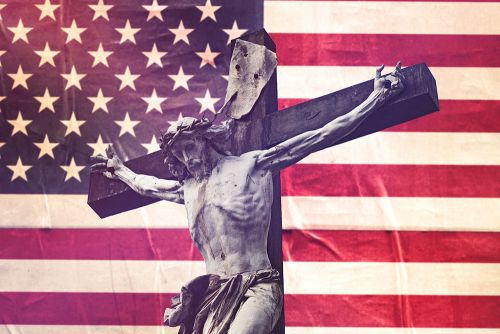
 Is America a "Christian Nation"? Was it ever?
It's a question that many are asking as we approach the 250th anniversary of the nation's founding. It also appears to be a question that many leaders have apparently already answered on our behalf: Recently, thousands gathered on the National Mall to "re-dedicate" the United States of America to God. House Speaker Mike Johnson led the event, declaring, "We hereby rededicate the United States of America as one nation under God." President Trump (appearing via a pre-recorded video) read scripture from 2 Corinthians. One attendee later told a reporter that without Christian faith, "the whole country will collapse."
To many watching, the moment felt like something new: a louder, more confident claim that America belongs to Christianity. Historian David Mislin, writing for Religion News Service, sees a longer pattern. According to Mislin, this kind of declaration has surfaced before, usually at moments when Christian Americans felt threatened, rather than triumphant.
Before we get into that history, there's one more important question to consider: what the heck does "Christian nation" even mean? And the reality is... that answer stretches across a wide spectrum. On the soft end, it simply means that since its founding, most Americans have historically identified as Christian, a demographic fact nobody disputes. On the harder end of the framework, the one used by Hegseth and the "Re-Dedicate 250" organizers, it means something closer to a mandate: that Christianity should shape America's laws, government rhetoric, and national identity... not just describe the people living under it.
A Familiar Script
Defense Secretary Pete Hegseth echoed the Re-Dedication rally's language in his own role, declaring "Christ is King" at a convention in February, and alleging that there is "a direct through line" from the New Testament to the founding of the United States. Mislin connects this rhetoric to earlier waves of the same instinct.
During the Civil War, both the Union and Confederacy invoked God's favor for their cause, and a coalition of Northern Protestant denominations pushed a constitutional amendment declaring the U.S. "a Christian government." A decade later, Protestant leaders tried again, seeking to name the Bible the nation's "supreme rule." Neither amendment passed. Both reflected real anxiety, over a fracturing union in one case and rising religious diversity in the other.
The Cold War produced a third wave. Two of the country's most familiar God-references are newer than most people assume: it wasn't until 1954 that President Eisenhower signed "under God" into the Pledge of Allegiance, framing it as a defense against "godless" Soviet communism. The following year, "In God We Trust" was placed on all U.S. currency. One of the bill's sponsors, Rep. Charles Bennett, argued the country "was founded in a spiritual atmosphere and with a firm trust in God."
What the History Leaves Out
Mislin's history is solid as far as it goes, but it perhaps skips one fact that could arguably be the decisive end to the conversation: In 1797, the Senate unanimously ratified the Treaty of Tripoli, which states plainly that "The government of the United States is not, in any sense, founded on the Christian religion". President John Adams signed it.
Even the founding fathers who debated faith and government most directly landed closer to neutrality than they did to the triumph of Christianity. Thomas Jefferson, famously a deist himself, wrote of a "wall of separation" between church and state. James Madison warned that government was no "competent judge of religious truth." Their caution complicates any claim that the founding itself was Christian in any official sense.
The piece also leaves out one of the loudest waves of all: the rise of the Religious Right. After the Supreme Court banned school-sponsored prayer in 1962 and legalized abortion in 1973, Jerry Falwell founded the "Moral Majority" in 1979, fusing evangelical identity with electoral politics in a way that continues to shape American elections.
That movement, more than the Mall rally or Hegseth's speeches, built the infrastructure now amplifying "Christian nation" claims today, running from school boards to statehouses to the Pentagon, decades after Falwell first linked the cause to a ballot box. That same infrastructure arguably allowed Texas officials to mandate that the Bible be read in all of its public schools earlier this week.
Who Actually Counted?
To their credit, supporters of the "Christian nation" framing aren't simply inventing a connection. Indeed, many early colonists identified as Christian by upbringing, and many founders saw religion as a public good worth encouraging. Defenders often lean on that history's demographics rather than its theology, pointing to something like 90 percent of the founding-era population being Christian, as if sheer numbers decided the nation's character before the Constitution was even written.
It's a tidy statistic. It's also built on a foundation that doesn't hold up. Historians who study colonial church membership put the real figure closer to one in five, with estimates ranging from 17 to 80 percent depending on how loosely "church" is defined. Many of the earliest colonists were far less religious in practice than popular memory suggests.
The 1790 census, the source behind most founding-era religious math, also excluded Native people from its count entirely, treating them as a separate group rather than part of the population being measured. Hundreds of tribal nations across the continent practiced their own ceremonies and spiritual traditions long before European contact, and many still do. A statistic that reaches 90 percent only by erasing them says more about who was doing the counting than about who was actually here.
The disagreement was never really about whether Christianity mattered to early Americans. It's about whether the federal government should ever declare one faith its own.
Where This Shows Up Today
That same question is alive across ULC's own pages, where ministers and members have argued for years over what the founders actually intended. It's alive in the Pentagon, where Hegseth's prayer services and chaplaincy changes have drawn complaints from non-Christian service members. And it's alive in Texas classrooms, where the same Establishment Clause questions resurface every time a school treats one faith as the default.
What unites all of it is the same anxious instinct Mislin describes: when the country feels unstable, someone reaches for God's name to stabilize it. The trouble is that America was built to hold many gods, and no god at all, under one Constitution. Declaring it Christian doesn't restore that founding promise; it narrows it.
History suggests the current wave will eventually recede, the way the Civil War amendment and the Bible campaign and the Cold War worries did before it... but what it leaves behind each time, in mottos, pledges, and policies, tends to stick around far longer than the anxiety that produced it.
So, where do you land? Is America a "Christian Nation" after all? And if it is... what does that mean for the tens of millions of Americans who practice something else, or nothing at all?
71 comments
-
 Pastor Bobby Roy
If America wants to call itself a Christian Nation, then America must repent like a Christian, live like a Christian, love like a Christian, and serve like a Christian.
Otherwise, it is only borrowing God’s name — and God will not let His name be used in vain.
Because the Lord does not bless a nation for claiming Christianity. He blesses a nation for obeying Christ.
And until this nation bows its knee to the truth — not the slogans, not the rallies, not the political theater — it will stand under the same warning the prophets gave long ago:
“Choose this day whom you will serve.”
-
 Rev. Matthew Mastrogiovanni
Christian nation? America was never Christian - it was always about power, belief, and what people are willing to sacrifice for it. The cross is just another banner, another mask worn by the same hungry gods that crossed the ocean with the first ships. Before them, it was thunder and oak groves. Before that, rivers and stones.
This land has always been about faith - not faith in some desert god, but faith in gold, faith in guns, faith in the promise that tomorrow you'll have more than today. That's the real American religion. The churches are just convenient meeting places where the faithful practice what they truly worship: themselves and their own prosperity.
So is America a Christian nation? No more than it's a nation of immigrants or a nation of freedom. It's a nation of believers - they'll believe whatever fills their pockets and validates their choices. And when that stops working, they'll find something new to believe in. They always do.
-
 Rev Ned
We were founded by religious fanatics who came here to set up their own religions and oppress others.
-
 Cindy L Edgar
Before and there was Catholics and Christianity there was paganism and polytheism those were the main religions at one time before the holy Roman empire took over and made it where it was only one God so no not everybody is a Christian and not everybody believes in one God as I know this because I am a pagan high priestess. And there are many other religions besides just Christianity.
-
 Stephen James Oder
The USA was not founded as a Christian nation and the Founders said so. It must be that way for religious freedom to exist at all. All we require of those who claim to be Christians is that they friggin' behave as Jesus told them to, and to do so under the laws that are designed for our mutual benefit. If you want the freedom to be whatever sect of Christianty, or any other religion you subscribe to, then leave me to be whatever I decide I'll be. Anything else tyranny, which will be tolerated under no circumstances.
-
 Bridget Kielas-Fecyk
The United States is not, and has never been, a "Christian Nation". While many founding fathers were Deists, they were NOT Christians. And several were also what we consider in the modern era to be atheists.
However, the Far Alt Right and the CURRENT administration are trying to ram THEIR views of religion down everyone's throat and make the ultimatum of "Covert Or Die!!"
We see that in one other nation brutally. The Taliban's version of Afghanistan.
-
 Clifton W Dowers
America is a free, People can choose to be who they want to be. God gave us free will to do just that. What we need to do is treat each other the way we our self would like to be treated. If you kill someone then I guess this is what you would want someone to do to you. God gave us his commandments it all leads to loving on another. I don't see love I see sadness. I can only say for myself, no one else. be who people want you to be IF THAT MAKES YOU PROUND THE GREAT. otherwise, be what makes you proud we all were not created the same our own experience in life guides our hearts.Cliff
-
 Paul William Boaz
Christianity has unfortunately taken a back seat to politics. Politian's evidently don't understand what it means to be a Christian nor do they understand the origin of our country. It was not based on Christianity but instead slavery and possession of wealth.
-
 James Bullard
Your essay is an excellent explanatoin of the history. I am firmly for separation of church and state. The essence of our revolution was ot establish individual freedom of choice. Governments that enforce a particular religion are the opposite of the founders' intention.
-
Rev Ned
While the US was not founded as a Christian nation, it wouldn’t hurt to become a more Christian nation. You know, be kinder to immigrants, homeless and poor people. Stuff that Jesus taught. Not Christofascist hatred.
-
 Rev. Kev
There are other choices that come with less baggage. Maybe we could be more Buddhist. All the compassion and caring parts without the smiting. Or we could be more Humanist. Work towards what causes humans to thrive without gods or supposed divine edicts or promised real estate.
The good teachings of Jesus can be found in many other sources. Some which predate his purported life.
Just sayin'.
-
 Lady Mutt Cat
Excellent point!!!!
-
-
 Rev.J.Buchanan
How could we "find" a country that was never "lost"? It was already established by the native peoples who lived here. They had various tribal cultures, spiritual beliefs, customs, ways to handle unruly members, and food supplies. Invaders with better slaughtering methods took over. That is not "Finding"; that is Genocide takeover.
-
 Everett Alsobrook
The 2 have been separate, which is according to God's law. So,to change that is like changing God's law.
-
 Paul Luther Smith
Over 7000 American service men and woman have died since 9/11 fighting global extremist and conservative religious values just so we can become what we tried to prevent. And the death toll is continuing to rise in Iran. When are we going to stop being hypocrites.
-
 Jennifer Rebecca Lovsey
The U.S. was NEVER a "Christian Nation", hope this helps.
-
 Teresa Louise Barberot
In early America when forming the Declaration of Independence the majority Faith was Protestant Christianity. Some more so than others. Some Founders were non-Christian but believed in God as the Creator. Shaping the morality of our Laws based on the Christian Moral Truths of God. Nature’s God. Divine Providence. Congress added the Supreme Judge of the World. God as Our Moral Judge & Guiding Hand. This is my understanding of how America became One Nation Under God. Religious Equality for All. Not just Christians. 🇺🇸🙏🏻
-
Jennifer Rebecca Lovsey
Uhhhh, no.
-
 Scarecrow
First off most of the founding fathers were Deist (god was an architect and has had no interaction since creation, which you can see much of this in Masonic teaching) or atheist...which has been well known by most. Second the one nation under God was added during the Cold war because Russia was seen as a godless country.
-
 ServantOfJudgement
No offense to any Deist, but...
To think an entity would create something as magnificent as the cosmos and then have no interaction with it is in pure denial and east idiocy for breakfast.
-
Lady Mutt Cat
Why are you a member of an organization that embraces all faiths? Deists have just as much right to their beliefs as you do, and more importantly their beliefs are just as valid as yours.
-
-
-
-
 Rev. B.D. Rees
The basic theory of our Founding Fathers was a beautiful and wonderous experiment, and it worked for almost 175 years, before those in power on the right side of the aisle thought they knew better than the American People. Power hungry representatives and executive branch men and women decided that their idea of a "Christian Nation" was the model that should be adhered to for all American citizens, even though they might not agree with their idea of an Evangelical, Pentecostal, utopia of Christian Nationalism!!
It is a hard lesson to learn for those who think thier way of thinking is the ONLY way this Country is to grow as a respected Nation of the known World.... Here it is anyway, "WE ARE NOT A CHRISTIAN NATION"!! We are instead, a "SECULAR NATION" founded under a CONSTITUTION and a BILL OF RIGHTS along with a DECLARATION OF INDEPENDENCE!! These governing documents give us our Law's and statutes that we here today live by!
"ALL MEN ARE CREATED EQUAL".... This can be found in Our Declaration of Independence.... They did not say the Right side of the aisle was created more equal than others.... They did not say if you are NOT an Evangelical Christian you are not part of the American ideal..... They said "ALL MEN (and in today's society Women) ARE CREATED EQUAL!! It makes me sad to think that because of this present administration, Hatred, Bigotry, and Discrimination have become vogue like they were in the 20's, 30's, 40's, and up until today!! We had made strides in Our Country after the 1965 Civil Rights Act was signed by President Johnson. We were finally accepting people for who they were and getting along with each other, until yet another BULLY introduced himself to the World as the President of the United States. It was then that Our Country started to backslide into the abyss of the Black hole of Bigotry.
Our Nation is NOT a Christian Nation but until we wake up and take the masks off those in Law enforcement that are too cowardly to show their faces, we will continue to backslide into the 1930's when there was a washroom and drinking fountains that said "WHITES ONLY"....!!
-
 Ronald A. Wilson
I wish our Founders were still with us to give us their own answers: That might settle the question or open up another avenue for more questions.: Granddad always said - " Their guess is as good as mine!".
-
 Jeff Grippe
The idea that "America was founded...." is, in itself, ludicrous. There wasn't an empty place that founders walked into and could therefore declare that America was anything. The fact that they displaced entire populations and committed genocide means that in order to found a "so called" Christian nation, they had to steal and kill. I'm pretty sure that violates a few commandments. If you are founding a nation that is supposedly Christian by using non-Christian behavior, can you call it a Christian nation? Are you going to put this nation in place using amoral methods,, and then say, "Ok, now we'll behave"?
-
 A.E.
A.E.
It starts with calling ourselves a "Christian" nation and the next thing you know, they're cutting the ears off Quakers again for not being the "right" kind of Christian.
The government should be strictly secular. Individuals in the government are free to live by the tenets of their faiths and be guided by them, but not impose their version of faith on the rest of us.
I'm no more interested in living under the rule of Christian Nationalists than under Hasidic or Sharia law.
-
 Tod Steinbauer
The United States was legally and politically founded on the freedom of religion, though its societal and cultural roots were deeply shaped by Christianity.Legal and Political
Foundations: The Constitution: Contains no mention of Jesus Christ or Christianity.Article VI: Explicitly bans any religious test for holding public office.The First Amendment: Bars the government from establishing a state religion or restricting free exercise.
Treaty of Tripoli: Signed in 1797, this official document stated that the U.S. government "is not, in any sense, founded on the Christian religion.
Cultural and Societal Influence demographics: The vast majority of early American citizens and leaders were Christians.Moral Framework: Christian teachings deeply influenced early American laws, ethics, and social norms.
Declaration of Independence: Mentions a "Creator" and "Divine Providence," reflecting a widespread belief in a higher power, though using universal terms rather than strictly Christian ones.
The nation was designed as a secular republic to protect religious liberty for everyone, allowing a heavily Christian society to practice its faith without government interference.
-
 Douglas Robert Spindler
Just another story/lie being told by Christians. All one has to do is read about the founding of the United States. While there were White Christian White Supremacists who where involved in the founding of our country, they were NOT successful in making this a Christian nation. They tried again about 100 years later with Manifest Destiny. And trying again as less Americans identify as Christians.
-
 SDA
SDA
It is overly simplistic to call this a Christian nation. The Continental Congress and Constitutional Conventions were populated by a broad spectrum of beliefs. From Jefferson's deism thru many variants of Christianity to behind the scenes prominent Jewish financiers backing the revolution, there were too many beliefs involved to proclaim the US as a Christian nation. Who's version of Christianity would they have codified. This is, in fact, the basis for the establishment clause in the first amendment, to keep one branch of the Christian tree from choking out all others. American law has, and still does, codify Judeo-Christian moral codes. Some of this is good and successful; Thou Shalt Not Steal, Thou Shalt Not Kill (Murder), etc. In other ways that has been problematic: Thou Shalt Not Commit Adultery...
-
 Roy S. Thorpe
America was founded on freedom. Freedom from people trying to shove their ignorance down other's throats! Free to live a life of their liking!
-
 Patricia Mitchell
They were not trying to create a Christian nation. They were trying to create a free nation—one where religion could flourish without government control, coercion, or favoritism.Their personal beliefs ranged from devout to skeptical, but their political design was consistent: religion is strongest when conscience is free, and government is weakest when it tries to enforce faith. Christianity was a very important force… but the founders made it clear they were committed to a republic in which people were free to practice their religion as they chose.
-
Rev. Kev
It doesn't matter what faith any of the early colonists or the Founding Fathers were. It doesn't matter what faith some majority of people in the country claim to follow. The only thing that matters is that the foundational document of the Republic makes zero mention of gods or preferred religions, and we have writings directly from the people involved in creating the Republic to give us a look at the intent behind the American experiment.
Let's face it, you can't have freedom of religion and a State Religion at the same time. You cannot have freedom to worship in peace without threat of retribution by authorities if only one religion has the backing and power of the State behind it. The Founders saw that very clearly in their own homeland.
The funny thing is how many people I see in America whinging about Islam and how people in Islamic countries have no freedom, but lack the ability to exercise some self-reflection to see the very same problem in their "this is a Christian nation" approach. Same problem. Different religion.
Muslims today still wage wars over theological differences. Christianity equally has a history of long and bloody wars over theological differences. Mostly Protestant and Catholic warfare. Which even existed in the colonies in the New World. Just can't seem to stop fighting. Give a single denomination the backing of the government and it will happen again. Guaranteed. We can already see it taking shape now.
To use a saying often misattributed to Einstein: "Insanity is doing the same thing over and over again and expecting different results."
-
 Ahmed Abduljabar Al-Hujazi
Totally agree with you.
-
-
 Kevin Joseph Kervick
The United States of America was founded by Deists with the preponderance of its citizens practicing Christians. The new film, Young Washington, hints at this fact by attributing use of terms like "divine providence: to Washington and his family members. A radical turn took place in the 20th Century with the Scofield propaganda for Christian Zionism, which opened the door for a Zionist infiltration of several branches of Christianity and the US Government.
-
 Rev. Dr. Robert Allan Roush
What a travesty if the place that people fled to in order to escape religious persecution, becomes one that persecutes others for their non-christian - or non-religious beliefs. That said, it's been a history of groups that didn't but then had to learn to get along. Why go back on learning how to live together?
To do this, you'd have to create a very specific State Christian religion that people must adhere to. Who on the face of the earth would think that was a good idea? 62% of Americans identify as Christian - go ahead and declare that means we're a Christian nation, but make no other changes and move on.
-
 Patricia Ann Gross
Rev. Dr. Robert,
I'm not sure there is there is a place in our history where we all agreed on this subject. The only reason we were able to "live together" in the 18th and 19th centuries, especially in the frontier lands, was that there were miles of distance between us, as the agricultural culture was large ranches and plantations. Then there was the issue with slavery, followed by Jim Crow and 2 world wars, then two more "military operations that divided the country" and here we are. This country has always been in turmoil for one reason or another, and its unfortunate that this is the history that people are trying to erase from our schools. If we don't study history and learn from it, we are destined to repeat it.
-
-
 Ari Joseph Bertine
The Treaty of Tripoli could not be any clearer. The religions(s) of the Founding Fathers doesn't matter, because they intentionally founded a secular nation meant to stay that way.
-
 Gary D Minnis
John Adams to Thomas Jefferson in a letter Dated June 28, 1813
“The general principles on which the fathers achieved independence were the general principles of Christianity... I will avow that I then believed, and now believe, that those general principles of Christianity are as eternal and immutable as the existence and attributes of God.”
-
Rev. Dr. Robert Allan Roush
What of it? Your post is non-sequitur for an argument for a full-on Christian Theocracy. Something Adams would have been against.
-
-
 Marcia Jayne Frazee
There’s a very good reason the separation of church and state was written into the US Constitution — not everyone has the same religious/spiritual beliefs (or none at all). This country became a melting pot from the time the first settlers sailed here to escape monarchical/patriarchal persecution.
The wall needs to remain in place. Period. Full stop.
-
ServantOfJudgement
Thirteen colonies filled with with Christians voted for leadership that declared independence from England to the world.
We created a place for Christianity to thrive along with anyone else who wanted to thrive in. Christianity taught a nation how to read and write in tiny little churches speckled throughout.
A theocracy? No. A Christian nation filled with Christians? One upon a time yes, we weilded a high trust Christian society.
Long gone now.
-
Ahmed Abduljabar Al-Hujazi
"Christianity taught a nation how to read and write in tiny little churches speckled throughout." Right. Where native american faiths were quashed, along with culture and language. How many tribes had they young people's cultural heritage stolen and destroyed by those tiny little churches?
-
ServantOfJudgement
Ahmed,
The wicked men of the world who don't follow Jesus The Christ are the culprit you're looking for. That includes the native Americans.
All nations of the world murder, enslave and oppress. The so called native Americans were no exception. Some of the tribes were brutal beyond anything we see today except the drug cartels and Islam. Those two outfits can't seem to put the hatchet down.
Christianity is the reason native Americans still exist. Any other people or religion would have eradicated them and their culture in totality.
-
 Michael Hunt
Christians tried to eradicate Native American culture by forcing them into Christian boarding schools where they were abused and neglected and even killed for practicing their culture.
Claiming Christianity is the reason Native Americans still exist is laughable and incredibly ignorant of history. Christians spent 150 years committing genocide against Native Americans and their culture.
https://boardingschoolhealing.org/us-indian-boarding-school-history/
https://alumniandfriends.uchicago.edu/s/uchicago-review-story/a4X8Z0000006103UAA/christianitys-role-in-native-american-boarding-schools
-
ServantOfJudgement
Michael, did you know a man can claim he's a woman and some people actually believe and defend it? Even though the man has none of the characteristics of a woman, some people still actually believe it. They'll even post links to organizations that prove the man is a woman via data tap dancing.
I can't tell you the number of times people here tell me I'm not a Christian even though I say I am. This room is filled with people who aren't Christians that school me on what a Christian actually is.
Apply that same reasoning to people who murder as a policy. Once you do that, you'll easily see that Christians are incapable of genocide.
-
Rev Ned
I believe Christofascist is the proper term. I would recommend a red letter Bible so you can read.what Jesus actually taught.
-
Lady Mutt Cat
Apparently you’re denying The Crusades, too. Christianity has proven just how bloodthirsty it is. Christianity also killed off the people and the culture of Hawai’i.
-
Michael Hunt
Besides claiming that Christians are incapable of genocide, which is false, what does your comment have to do with mine? Why are transgender persons being dragged into this conversation about Christians' actions towards Native American peoples?
-
-
-
-
-
-
 James Riggle-Johnson
The First Amendment clearly states, “Congress shall make no law respecting an establishment of religion or prohibiting the free exercise thereof.” Meaning, the Government cannot make America a Christian Nation. That would be establishing one religion over all others or none.
It doesn’t matter that Mike Johnson stood up at the National Mall and rededicated the US as a Christian nation. Just saying it doesn’t make it true. What is true is that most of our Founding Fathers were Christian, but they had the sense not to mandate any one religion for the country.
It’s interesting that this historian, David Mislin, wrote that people do this when they think Christianity is under attack. I don’t think that’s the issue here. I think that the Christian Nationalists use that as an excuse. They want to pass laws to prevent people from doing things they don’t approve of—that go against the way they think you should live your life.
Thank God for the First Amendment!
-
 Bishop William Dusenberry, DD
The BEST one book, those REALLY interested in familiarizing themselves about the religious thoughts of our “founding fathers” is Matthew Stewart’s “Nature’s God” which is the must recommend work (until I read a better one) by my denomination in the Universal Life Church in Oklahoma. If you decide to read it — this ordained ULC highly recommends that you read the last chapter first — then when you start with the first chapter you’ll find the rest of the book far more interesting. One more thing — google Matthew Stewart and watch his one hour talk about this book, on line. Then, after you’re through— you might be able tell those who’re still atheists, there is a provable God, and that’s Nature. When I do my missionary work for the Universal Life Church — most of my converts are impressed by the fact, that my ULC has a provable God. And, as most of you have already found out — o one has ever been able to physically describe the God, in which they profess to believe — including their priests, reverends, or any other title, as you’ll see, if any other the God-believers reading these posts will show you, if they try to physically describe their God — including the Pope.
-
Lady Mutt Cat
I’ve always loved those words: “Nature and Nature’s God.” Nature’s God is invoked in the Declaration of Independence, not Jesus or the Christian God.
-
-
 Stacey Owens
America now is babylon the great.
-
 Religion as a Weapon is Wrong
Christian Nation? What does that mean? I asked AI.
Catholic
The largest single Christian communion.
Unified under the Pope and the Roman Curia.
Includes 24 autonomous sui iuris churches (Latin Rite + Eastern Catholic Rites), but all are part of one global Catholic Church.
Orthodox
Includes Eastern Orthodox Churches (e.g., Greek, Russian, Serbian) and Oriental Orthodox Churches (e.g., Coptic, Armenian).
Autocephalous (self-governing) but united by shared theology and ancient tradition.
Protestant
A broad family originating from the Reformation.
Includes Lutheran, Anglican, Reformed, Methodist, Baptist, and many others.
These are often counted as separate denominations organizationally, but globally they are treated as one major tradition.
Independent / Non-denominational / Indigenous Churches
A globally recognized category for churches not formally aligned with Catholic, Orthodox, or Protestant structures.
Includes African Independent Churches, Chinese house-church networks, and global non-denominational movements.
-
 Keith D
The article is exceptionally well written and sourced. Congrats to the writer! ❤️
Even in the Constitutional Convention, the notion of making the US officially a Christian country ('one nation' was also rejected!) was rejected.
Even Bellamy's version of the Pledge of Allegiance did not contain 'under God.' It fid include the renegade 'one nation indivisible,' however.
And then, 'what is a Christian?' If you look at everything that happened between Yeheshoah's death and 325 CE (Council of Nicea), it utterly defies any coherent definition. Yeheshoah's brother 'James' was off and running and stayed mightily Jewish, 'with a twist.' Everyone else wandered off and did their own thing, too.
The rise of the Gnostics was in there, too, also not remotely a unified movement. The opposition, the proto-orthodox--in other words, the people who gave rise to what became a shaky Christian Orthodoxy for Constantine to wrangle into a shape he liked--and the emperors who followed him--were people who wanted to create an INSTITUTION called Christianity--the would-be new but different Sanhedrin and professional priesthood that Yeheshoah openly blasted.
So what is a Christian? To Hegseth, et al, a Christian is one tainted with the maneuverings of Zionism via Rothschild (some, not all Rothschilds) and Darby and Scofield, along with an extant 'judeo' bent of a self-declared 'messiah' who took his followers into Islam at the behest of the Ottoman Empire, and then the movement that took up his 'salvation by sin' nonsense well after him.
The Gnostics assuredly had one thing right, and that is also what was finally, somewhat grudgingly by some, taken up at the founding of the US: your spirituality, whatever it is or is not, is a personal experience and accomplishment, not transmissible from or to you.
I don't know how people miss this point. But missing that point, or desperation to reject it because it bruises their ego that others aren't like them, brings the narcissistic need to make everyone else in your fake image. Yaldabaoth indeed!
-
 David Cox
Acts 11:26 At Antioch they were first called Christians. Meaning follower of zchrist
-
Keith D
David,
Yes, that's the easy and obvious definition. It's also very inclusive, which is alright by my standards.
Some want to be exclusivist... for instance, whereas crist / christ is anointing oil, and Cristos is anointed one --and is a direct translation into Greek from the Hebrew word for messiah (yes, it took a while in history for that word to mean a saving superman even to the Hebrew ancients--meesiah only meant anointed one until they wrangled it into 'savior'), you can see how utterly inclusive it could be. 'Followers of the anointed,' which could mean a lot more anointed ones than one individual.
If the anointed one was necessarily to be Yeshua/ Yehoshoa/ Yeheshoah (short form YSVA, long form YHVSVA, alternate YHSVH to connect to YHVH by adding shin 'S'), now we're getting into excluding: no other anointeds are suitable leaders for followers to be called Christian. And this is, provisionally, what was meant at Antioch.
Later, proto-orthodox Christian thought leaders systematically increased the exclusivity to rule out everything not in agreement with a christology consistent with those decided at Nicaea and then later refinements until there was a 'proper' (haha) grasp, concept, of the godhead as sort of 'three faces of one God.'
Not everybody believed that or accepts that notion even today. Hence we have Catholic, then five or six flavors of Christian orthodoxy, and then myriad 'reformed' and Protestant flavors of 'what can be called 'Christian.' . .(Gnosticism is back, and so are other notions of how to connect to the same Divinity as indicated by Jesus's 'father.')
And that mouldered through the Dark Ages during which Islam arose, various Gmostic views came up and were re-exterminated or driven into hiding ('occulted') or genocided, then restorationists and Christian Zionism (apparently an outgrowth of Judaic reforms and twists from the 1400s into the late 1800s) well after. Most of these want to tell you that your notion of 'christ' or 'Christ' is simply wrong, and you aren't Christian if you persist with that notion.
So yeah, it's just not that simple. Antioch is probably right, and was a genuine 'big tent' notion.
Still, we have other figures in human history that reflect the unity consciousness described in Gnostic materials. Krishna, Buddha, and ... I could list for a while. Saints of Catholicism?
Some systems say that the anointing is from within--among others, Kundalini, the 'serpent' connecting masculine and feminine elements within every individual and then to the whole of Divinity... the Gnostic Monad, even if not practiced as a follower if Jesus, ... an 'oil' in the properly energized human (at least humans, but also elsewhere in Creation?) that flows up the spine and activates the pineal and other parts of the brain to bring 'sight' to the individual, to be sovereign, and to be in unity, and to be perceiving far beyond what the body's senses and physical brain can observe or comprehend.
If one quit quivering over fears instilled by those who profit as gatekeepers in religion (various priesthoods, churches), one can look into Gnostic texts and find handy understandings and means of connection to Divinity without the interference of gatekeepers. I would say that this, too, fits "Christianity," as it is my gnosis that what Jesus taught is exactly that anointing and connection.
So I 'ask' again, 'what is a Christian?'
Honestly, no one should be excluding anyone.
-
-
-
 John A Carreiro
Hi Rev J here. Our nation started out as a Christian nation and God was with us. Over these 250 years I am sure we strayed away from God, but we always came back. However along this way, of these 250 years, we kicked God out of the vernacular of our language. Washington believed that religion and morality are the two most important tools for a successful country. He wrote that no nation can expect to keep God's blessing if it ignores the rules of right and wrong. In George Washington's farewell address, to the nation, he stated:"Reason and experience both forbid us to expect that national morality can prevail in exclusion of religious principle." This means he felt that a country needs religion and morals to survive. I see this as today's society not only in America, but also world wide. The research arm of Planned Parenthood estimates a total upwards of 69 million abortions from 1973 through 2025 have taken place in America. If you are a believer in God, than this is an outrage by us to God who creates life not us.God does not punish us for this outrage now but as we have abandoned God in our nation he just removes His protections for us as we believe that we can run the show. I see today's division in wars, natural disasters, pandemics, and who knows what esle we have entered into the end times. Read the Christian Bible of the en time and see how many predictions are in active play today. I would estimate that the sides are being drawn up now for the end battle and I owuld say that as of this moment the sides are about 50 / 50.
-
 Donald J Rothschild Jr
Sorry but the United States was never, ever built as a Christian nation. A large number of the founding fathers were Deists. Did they believe in a Creator God, yes. Did they believe in the so called holy books, no. Their reasoning is quite simple, they saw what the mixing of religion and government causes. They saw bloodshed across Europe all related to religious beliefs. Many colonists came to the new world to escape all of that. Here’s a question for you: who wrote all the holy books than mankind has seen/read? If your answer is anything other than man then you prove that you are brainwashed. Religion has always been about control. Control the minds of the masses and you control everything around you. The Catholic Church has proven to be the experts on that.
A proud Deist.
www.ulcbrooklynonline.com
-
Paul William Boaz
Unfortunately, that is not true. There is a PBS Documentary called "The American Revolution" that may change your mind.
-
David Cox
The majority of our founding fathers were christians
-
Lady Mutt Cat
And what if they were? That does not mean they they decided to make the U.S. officially Christian.
-
-
-
-
Cindy L Edgar
No it's not and never should've been.
-
 Keoni Ronald May
When Congress was first created, there was a Christian prayer said, on the floor of Congress. Look it up.
-
 Maximillian Martin
That doesn't mean anything!! But the fact that the constitution itself was modelled after the Gayanashegowah, the great law of peace of the Iroquois Confederacy, does. And they were NOT christian in any way. Just because they said some of their words doesn't mean that this is their nation!! If so, the government's supreme law of the land is Native American law and it will be enforced!!!
-
 Elizabeth Jane Erbe Wilcox
Were you there?
Your assertion/opinion, even if true, does not prove anything other than that said a christian prayer. It proves nothing else.
-
 Dr Dennis Chevalier PhD, DDvin
yes, Just look up Ben Franklin's history.
Dr. D.
-
-
 Robert Gagnon
It should be noted that the pilgrims were a radical Christian sect that was thrown out of many countries before cast out to the wilds of this continent. Followed by the British Protestants and later the Catholic Irish and Italians. We’ve had government sponsored witch trials, forced conversion of native Americans and racial bias all condoned in the name of Jesus. Organised religion, like politics tends to divide us more than guide. For this reason alone government should not mandate any particular spiritual belief. This is purely a power play to control American citizens by those in charge. Trump is the result of this movement not the cause. As stated above it’s not the first time they’ve tried this tactic. If they were to succeed how different would they be than the Taliban? It’s all about control and restricting our individual rights our founding fathers gifted us through the constitution.
-
 Dylan Tuatha Le Danaan
The United States from the very beginning has stated that it is not a Christian Nation it is however a nation where you are allowed to be a Christian as well as a nation where you are allowed to be of another religion, or if so chosen no religion at all.
A person's relationship with their chosen deity is a personal thing and should never be mandated by another.
This unconstitutional demand is harmful to this great country, and speaks of a type of authoritative abusive behavior that we have seen in the past from other political regimes to be detrimental to the world at large. And our own founding fathers wished to avoid for us.
-
 John Alex Paxson
Being able to practice any religion you believe in, I agree, but you cannot cross the beliefs culture with the laws of this country.
-
-
 Najah P Tamargo
Najah Tamargo-USA
I am a firm believer of "separation of church and state." Religion is a private matter. Government is a national matter. They need to be two separate issues, and not a combined issue.
-
Maximillian Martin
NO!!!! ABSOLUTELY NOT!!!! As long as the constitution and freedom of religion exists, it will NEVER be a theocracy!!!!!

NOT THE WAY PEOPLE HAVE BEEN ACTING LATELY