

On May 28, an undercover ICE agent walked into the gymnasium at University Baptist Church in Minneapolis and joined a martial arts class. For roughly two hours, she sparred with participants, talked with them, and secretly recorded what was happening with a concealed audio device. Then, she accidentally dropped the device onto the gym floor. The agent left, realized it was missing, and came back about three minutes later to retrieve it.
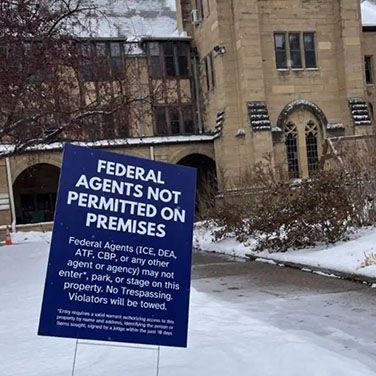
Apart from the setting, it almost reads like a (clumsy) spy novel. The scene would be strange enough on its own, but University Baptist Church was not simply another building on the agent's route. The church had already been specifically designated as a protected location under a federal court order restricting immigration-enforcement activity in and around certain houses of worship. Signs posted at the church's main entrances said exactly that.
Church leaders say they had no idea the government had been spying on their congregation until the surveillance records surfaced months later in a separate criminal case involving anti-ICE activists. On August 20, eleven religious plaintiffs asked the federal judge who issued the injunction to order the government to explain why it should not be held in contempt for sneaking an undercover ICE agent into the church.
The incident also prompted a strong reaction from our community when we opened the discussion on Facebook:
A Church Under Court Protection
University Baptist Church is affiliated with American Baptist Churches USA and the Alliance of Baptists, both plaintiffs in a lawsuit challenging the federal government's 2025 rollback of protections for so-called "sensitive locations."
In February, U.S. District Judge F. Dennis Saylor IV concluded that the plaintiffs were likely to succeed on a claim under the Religious Freedom Restoration Act. He acknowledged the government's compelling interest in enforcing immigration law, but found the new policy gave lower-level agents too much discretion around religious spaces and was not the least restrictive way to pursue that interest.
The preliminary injunction that followed created specific rules for the religious organizations covered by the case. Without an emergency, DHS and ICE are legally prohibited from conducting immigration enforcement activities inside protected areas. Additionally, the order specifies that agents generally need either an emergency or prior approval to conduct these actions within 100 feet of an entrance to one of these facilities. The order defined covered activity to include searches, questioning, interviews and investigations undertaken, at least in part, to enforce immigration laws.
University Baptist Church was placed on the protected-location list in February. According to the religious plaintiffs' new filing, federal agents nevertheless surveilled the church on four occasions between April and June. The May 28 operation went furthest: an ICE agent walked right by posted notices identifying the church as protected by a federal injunction and secretly recorded a class in the downstairs gym.
The discovery landed like a grenade among the congregations themselves. On August 16, Rev. Cody J. Sanders, University Baptist's interim pastor, stood before worshipers and told them the church had been “targeted by undercover Department of Homeland Security infiltration.” He urged them not to accept that as ordinary: “We should not become accustomed to this.” Sanders said the congregation had not known an undercover agent entered its building until the surveillance records became public months later.
University Baptist was not alone. First Universalist Church of Minneapolis was also reportedly surveilled. Its leader, Rev. Jen Crow, responded by telling Religion News Service that her congregation had never concealed its immigrant advocacy. “There’s nothing that the government’s going to do that’s going to make us too scared to care for our neighbors,” she said.
Thus far, ICE has not conceded that this activity violated the injunction. According to the August 20 filing, government lawyers argue that this specific undercover operation was aimed at alleged federal crimes under Title 18 involving efforts to obstruct or intimidate federal officers, not at enforcing immigration law itself. Lawyers for the churches counter that the investigation grew directly out of alleged interference with immigration operations and therefore falls within the order's language.
That distinction is now before the court. As of August 21, Judge Saylor had not yet ruled that ICE or DHS violated the injunction.
How Churches Became "Protected Areas"
The idea that immigration agents should exercise special restraint around houses of worship did not begin with this lawsuit.
Federal immigration agencies have followed some version of a sensitive-location policy for decades. A 1993 Immigration and Naturalization Service policy instructed agents to avoid apprehensions and tightly control investigations at places including houses of worship, and in 2011 ICE required high-level approval for most planned enforcement actions at churches, synagogues, mosques and other worship sites.
DHS expanded those protections in 2021, saying immigration enforcement should not prevent people from accessing worship, medical care, schools, food or shelter. The Trump administration rescinded that policy in January 2025, instead telling agents to use discretion and “a healthy dose of common sense” as it launched its aggressive nationwide immigration enforcement effort.
The ULC has been following that shift, including reports last year that immigration enforcement was moving closer to church property. The latest litigation is substantially broader than one Baptist congregation: more than 50 denominations, regional religious bodies, faith organizations and houses of worship have joined four lawsuits challenging the change in federal policy.
Court records indicate DHS agents monitored events at at least five churches in Minnesota and Michigan while investigating anti-ICE activists, although some of the gatherings were organized by outside activist groups rather than the congregations themselves.
Sanctuary Has Never Meant Legal Immunity
The word “sanctuary” once meant considerably more in law than it does today.
In medieval England, sanctuary was an actual legal procedure. Someone accused of a serious crime could “take church” and receive temporary protection from arrest, generally for up to 40 days, after which he could surrender to royal justice or “abjure the realm,” confessing and agreeing to leave England. Some specially chartered churches and monasteries later offered sanctuary for much longer periods.
Unlike today's largely symbolic use of the term, medieval sanctuary could temporarily interrupt the ordinary machinery of secular justice.
The English system did not survive into American law. In a 1983 opinion, the Justice Department's Office of Legal Counsel noted that England abolished the traditional criminal-law right of church sanctuary in 1623 and concluded that it did not become part of American common law.
Common law notwithstanding, the 1980s in particular saw churches again testing what sanctuary could mean in the United States. The modern Sanctuary Movement had begun in the Southwest as clergy and laypeople helped people fleeing violence in El Salvador and Guatemala. On March 24, 1982, Southside Presbyterian Church in Tucson publicly declared itself a sanctuary for Central American refugees. The movement spread to hundreds of congregations, religious orders and faith organizations.
The federal government did not recognize those declarations as immunity from immigration law. Instead, investigators infiltrated the movement. University of Arizona archives preserve records from what would come to be known as Operation Sojourner, including documents from government informants and recorded conversations used in the prosecution of these sanctuary providers. Eleven activists went to trial in Tucson; eight were convicted of federal offenses.
That history makes the Minneapolis episode feel less novel than the dropped recorder might suggest. Houses of worship have long claimed a moral or sacred duty to shelter vulnerable people, often grounding that duty in biblical commands to welcome the stranger and care for the foreigner. Conversely, the federal government has long maintained that religious buildings cannot become absolute law-enforcement-free zones, especially when it comes to immigration enforcement.
Declaring that a church is a sanctuary does not, by itself, create immunity from federal law. But University Baptist Church had something more specific: a federal injunction blocking certain ICE activity at its property. Whether this investigation came within that injunction is the question the court has now been asked to answer.
How Far Should Immigration Enforcement Reach?
The Minneapolis dispute is about more than whether a martial arts class counts as religious activity. It comes as immigration enforcement moves closer to religious life itself.
Just last month, ICE arrested Sister Leticia “Letty” Ugboaja on her way to Mass in Texas. The Catholic nun was in the country legally, but agents still stopped her near her church, confiscated her rosary and detained her for hours.
Now, an undercover ICE agent has entered a church already protected by a federal injunction and secretly recorded people inside. DHS says the operation was a criminal investigation rather than specifically immigration enforcement; the churches say that distinction does not put the covert operation outside the court order.
American churches have never had blanket immunity from federal law, but federal immigration policy long treated houses of worship as places deserving unusual restraint. That presumption has changed.
So how far should immigration enforcement reach into religious life? Should churches retain a special buffer from surveillance and arrests, or should federal agents have the same latitude there that they have almost anywhere else?
100 comments
-
 Henry Buehler
Chicago police Spy on community organization. Cop becomes president of organization. He does a good job. Everyone knows he is a cop. Unfortunately he develops a sense of good. And he said something about another cop withholding evidence in a murder case. He lost his job and his wife divorced him
-
 William Teats
Here is this biggest two points one from the Old Testament, and one from the New Testament:
1st Old Testament: ““ ‘Do not seek revenge or bear a grudge against anyone among your people, but love your neighbor as yourself. I am the Lord.” Leviticus 19:18
2nd New Testament: “So in everything, do to others what you would have them do to you, for this sums up the Law and the Prophets.” Matthew 7:12
I agree with the comment that we need to help others on their own front yes being a member of a CMA church and currently taking my discipleship training, although we can’t turn our brothers and sisters in need. These people may be of another race, color, ect although discrimination has no place in the Bible, nor should it in the government, like it does today. We are all human, we all bleed, we all have that same brain that was given to us by God, we all have the same heart that was give to us by God, we walk have the same everything inside, so why treat anyone any different because they look any different outside. The person behind all this will pay his price the day he does and I hope he goes and bows down and confesses a load of self centered sins before he dies…enough said!!!
-
 Daniel Todd Kamm
Very messy. The rub: "DHS expanded those protections in 2021, saying immigration enforcement should not prevent people from accessing worship, medical care, schools, food or shelter. The Trump administration rescinded that policy in January 2025, instead telling agents to use discretion and “a healthy dose of common sense” as it launched its aggressive nationwide immigration enforcement effort."
I welcome you to Ohio:
Just a few months ago, a sheriff from a small district, accompanied by a new employee still training, falsely represented herself and her intentions when she presented herself at several Cincinnati Public Schools under the auspices of doing well-child checks, etc.
The public schools this sheriff visited had/has students from all kinds of backgrounds.
The law says kids go to school; public schools are obligated to enroll and educate kids regardless of background and provide accommodations to ensure success, whether a child has a physical / emotional disability, a learning issue, or a language barrier.
Cincinnati Public Schools has very strict guidelines regarding access to students. And this lady (the sheriff) did not get past the front desk at any of the schools she attempted to infiltrate.
She was not local; she had no reason to request access to kids for well checks outside of her area of responsibility. Unfortunately, she dragged a new worker into her plans, acting illegally under her authority.
The school district quickly closed ranks across schools according to its policies and procedures: each school maintains a contact list approved by the parent/guardian/care-giver/Children's Services, etc.
So what did this outsider want?
Well she has lost her job... I don't know what happened to the new employee she deceived... and what was her motivation to do what she did to access children under false pretenses? Immigration? Tired argument.
No school and here, I am lending same to places of worship, inside, outside and on the way to and from: there are places where DHS/ ICE should have no access... period. I would include grocery stores as well: people need to eat and feed their kids.
The whole thing is out of control, but what can you expect from an executive who is capricious and often raging, blaming, cursing and demeaning others?
That's the one that needs to be contained... good luck with that!
-
 Mark James Clark
If you want to come to this country please obey the laws,obey your god and my Jesus. Amen. If you don't want to why come here.i will give a place of relief to all who praise mine and your lord. But be only honest to thy self.for the lord is all .he is him and do not question because he is .
-
 James Richard Norby
How does one obey their God and your Jesus??
-
Mark James Clark
My Jesus is my heart, your god is yours,be it any entity ,it is what is in your heart and mind. I don't ask you to forsake your beliefs. Embrace it and help all to understand what's important to you. There is only one.he is him.ask the qestion what is your name. I am him.......amen I am so sorry lord that they don't understand. But I will stand and deliver your message the best I can.help me lord amen.
-
James Richard Norby
Did you mistakenly say "obey my Jesus"?
-
-
-
 Joseph Saffomilla
Amen!
-
-
 Clara Ries
Churches should be a place of refuge. A place to make peace with yourself and God. It should never be a place of fear. Churches far and wide should be preaching against the brutality of ICE and other forms of repression.
-
 Sir Lionheart
I agree that churches should be places where people can seek peace, refuge and spiritual support. But that doesn’t mean they become legally exempt spaces where law enforcement can never investigate suspected criminal or immigration violations.
A church is a place of worship, not a sovereign territory beyond the reach of the law.
Churches can preach against government policies they believe are unjust, but refuge from the government shouldn’t automatically mean immunity from the law.
🦁❤️
-
 Doctor Loyal
With all due respect, a Church should not be a refuge of Law-Breakers either. At Minimum, "Render Unto Caesar that which is Caesar's" and Render unto God that which is God's.
-
Doctor Loyal
Peace and Brutality coupled with Sanctuary isn't where I would expect to see Neutrality and Harmony.
-
-
 ServantOfJudgement
A church aids and abets fugitives and they're surprised the law is looking into them?
Lol! What the heck would anyone expect!!??
Sheesh!
-
 Neil L Glazer
There is zero evidence, not a shred of public information, to support this notion that law enforcement was seeking to apprehend fugitives. You totally made that up. Even the government in its court papers has not made that claim. A person is not a fugitive unless there is an active judicial warrant for their arrest, they have been given notice of that fact, and have fled or gone into hiding. That’s simply not the case here. Please don’t make up “facts,” that does nothing to advance an intelligent conversation.
-
Doctor Loyal
Not a problem, If I were that easily offended, I would be ranting on Tik Tok !!
-
 Patricia Ann Gross
SOJ and anyone else accusing churches of "harboring fugitives,"
From my experience in the churches and church leadership, having helped develop policies around "public safety" (primarily as it relates to children), churches have no problem working with law enforcemet when provided with appropriate documents, such as judicial warrants. If a LEO asks to coms "snoop around" to see if there is a shady character lurking there, they should expect to have to provide proof that a "shady character" has been reporterd within their confines, and the identification of such a character.
If the man were looking for "a fugitive" he would have had a warrant, and the church (even though it was declared a "sanctuary") would have likely complied. Where there is an issue of cooperation, the most common objections surround clergy privilege and ethics with respect to pastoral care issues (commonly known as the confessional privilege) and being nosy, which is what this person was doing. If you want to partake in a YOGA class for your health and wellbeing, you are more than welcome. It is not a place to spy on the parishioners or others within the community that are there for their health and wellbeing.
-
-
 Justin T La Plante
Ice schmice
-
Patricia Ann Gross
Agents should use discretion and a "high dose of common sense" is laughable coming from this administration. If you were to collect all of the "common sense" there from all of the department heads, Cabinet, and other administration officials, it is doubtful that it would equal a "high dose." It's like telling a two-year-old to just do whatever they want.
-
James Richard Norby
As a citizen of Minneapolis I understand that there was a judicial ruling stating that ICE and CBP could not do immigration enforcement in the Baptist church or it's property. It appears that many of the commenters did not read the article before commenting. The actions of over 3000 ICE and CBP "officers" were unconstitutional and violated most of the legal guidelines that fully trained local and state police must follow. They brutalized peaceful protesters and kidnapped legal immigrants based on the color of their skin. CBP and ICE murdered two Minneapolis citizens and shot many others. There has been no accountability for these actions. Again, there was a judicial order stating that ICE and CBP could NOT do immigration enforcement in the Baptist church that was clearly stated in the article.
-
 Brian Hand
Illegal is illegal. Nowhere is off limits to take out the trash.
-
James Richard Norby
The Baptist church was following the readings of the bible. They also had a judicial ruling protecting them from immigration enforcement. Who is it that you refer to as trash? Please be specific.
-
James Richard Norby
Why won't Brian answer my question??
-
 Lady Mutt Cat
Because we can see that the finger points directly at him.
-
 Perry Minor
He is ordained or has infiltrated this organization in order to post trolling comments and stir people up for the simple purpose of causing chaos and dissention, that's why.
-
-
-
 Justin Adam Kalm
I wonder why you feel that this is appropriate venue for spewing hate? Reasonable minds can disagree about what our immigration laws ought to be, but immigrants are not “trash,” regardless how legal their residency might be.
I’d like to remind you that the Universal Life Church is based on the belief that we are all equal and welcome.
-
Patricia Ann Gross
Brian,
Illegal is not deterimined until proven in a court of law. The "trash" you are refering to are human beings, first, and in this country and protected by the bill of rights and rule of law.
-
Doctor Loyal
Thank you Brian, Placing one's self above the Law gives NO one authority, nor does it excuse illegal behavior.
-
-
 Reverend Paula Copp
ICE agents need to suffer the same punishment they inflict upon others. They abduct and brutalize men, women and children with impunity… don’t worry… Lady Karma is waiting.
-
Sir Lionheart
If an ICE agent commits a crime, prosecute them. If they abuse someone, hold them accountable. But wishing suffering on them because they allegedly made others suffer isn’t justice—it’s simply the same cycle of dehumanization you’re condemning. We should be better than that.
🦁❤️
-
 Rickie Lee Sands
If only they would prosecute the ICE agents who abuse their power instead of swiftly reassigning them to another state, hiding and withholding evidence, and blatantly lying to the media to create a false narrative.
-
Sir Lionheart
If you have evidence that ICE routinely transfers abusive agents to bury misconduct, deliberately withholds evidence, and lies to the media, by all means provide it. Those are serious allegations and deserve serious evidence.
But “I’ve heard they do it” isn’t evidence, any more than “ICE says they didn’t” automatically makes ICE’s version true. We should judge individual cases on the evidence—not assume guilt or innocence based on which side we sympathize with.
Otherwise we’re not demanding accountability; we’re simply choosing which narrative we want to believe.
🦁❤️
-
 Michael Hunt
Look up the case of Christian Castro in Minnesota. After the ICE agent shot a fleeing man in the leg, ICE claimed he was defending himself after being attacked with a broom and shovel for 3 minutes. Video evidence later showed that was a baseless lie. ICE then transferred him out of the state to Texas where he was temporarily jailed but now walks free. Despite charges being filed against him in Minnesota, Texas has refused to extradite him back to face trial. Additional more serious charges the state DA had planned to file against Castro were blocked by Trump's DOJ.
https://www.propublica.org/article/doj-blocks-charges-ice-agent-minneapolis-julio-cesar-sosa-celis
The shootings of Renee Good and Alex Pretti are "under investigation" but there is little indication that the federal probes are actually progressing.
https://www.npr.org/2026/04/10/nx-s1-5775847/alex-pretti-renee-good-ice-shootings-federal-investigations
Numerous reports have been published documenting the abuse sustained by detainees in ICE facilities by ICE agents.
https://www.hrw.org/report/2026/07/15/youre-only-getting-out-deported-or-dead/abusive-us-immigration-detention-at-ft
That is not accountability.
-
Sir Lionheart
I appreciate you providing the specific cases rather than just making the allegations generally. The Christian Castro case is certainly troubling, and the evidence reported in that case raises legitimate questions about both his conduct and the government’s handling of it. Minnesota did charge him, Texas did resist extradition, and there are credible reports that federal prosecutors wanted to pursue a more serious civil-rights charge than the one ultimately approved.
That said, I think it’s important to distinguish between “there have been serious failures of accountability” and “ICE agents are given immunity from prosecution.” Those aren’t the same proposition.
And there’s an important update to the Castro case: as of today, he has actually been federally indicted on six counts of making false statements concerning the shooting and has been re-arrested. So the story isn’t that he simply “walks free” without facing federal prosecution.
I’m also not going to defend misconduct simply because the person involved works for ICE. If an agent lies, uses excessive force, abuses detainees, or commits a crime, I want the same thing I would want for anyone else: an impartial investigation, evidence made available where legally appropriate, and prosecution when the evidence supports it.
Where I disagree with you is the broader conclusion. The existence of disturbing individual cases—and even evidence of institutional failures—doesn’t by itself establish that there is a blanket policy of protecting ICE agents from prosecution or routinely transferring them around the country to evade justice.
So perhaps we’re actually closer on the important point than it initially appeared: misconduct should be investigated and punished. My objection is to turning allegations about an entire agency into established facts without examining each case and the evidence behind it.
🦁❤️
-
Patricia Ann Gross
So, Sir LH,
If they are so transparent and open with all they are doing, why are the agents still wearing masks and why did it take 18 months to decide to equip them all with body cameras, and yet they are still not all distrubuted? That is an INSTITUTIONAL failure in protocol. Every other LEO organization except ICE are required to remain transparent and accoutable, yet we still hear of breakdowns there. Are there similar issues in other LEO organizations, you ask? Of course, but not with the frequency or brutality that you are hearing about ICE. These aren't isolated cases.
Have you ever worked under a quota system before? I'm talking about having to sell or make so many units or provide so much revenue or else lose your job (or not get paid)? I have, and people in those situations often resort to unseemly, if not illegal and unethical acts in order to meet their quotas. ICE is under an edict: Arrest (no clause about probable cause in that order) x,000 PEOPLE, (not specifying illegal immigrants, because requires adjudication) and if you do, then everybody gets a bonus, if you don't, the bottom 10 percent get laid off. This is what these officers are dealing with, so they "round up" anything that looks or sounds like an immigrant "hoping" their paperwork isn't in order and there you have it. What could they (ICE leadershop all the way to djt) possibly have expected the outcome to be?
-
Sir Lionheart
Thanks Patricia. I don’t disagree that body cameras, clear identification, and proper oversight are important safeguards. If ICE has been slow to implement them, that’s a legitimate criticism of the agency and something that should be corrected.
But you’ve also made several very specific claims that I think need to be separated from your opinions. You say ICE agents have been ordered to arrest a certain number of people, that the order deliberately avoids specifying illegal immigrants because that would require adjudication, that everyone receives a bonus for meeting the quota, and that the bottom 10% are laid off if they don’t. Those are extraordinary claims, and I’d want to see the actual directive or documentation establishing those things before accepting them as fact.
The same applies to the assertion that ICE agents are routinely “rounding up” anyone who looks or sounds like an immigrant. If individual agents are doing that, they should absolutely be held accountable. But that’s very different from establishing that this is an institutional policy or the predictable result of a quota system.
And I don’t think masks, by themselves, demonstrate a lack of accountability. There can be legitimate operational and personal-safety reasons for agents to conceal their identities from the public. The relevant question is whether their identities are known to their agency and whether there are effective mechanisms for investigating their conduct—not simply whether the public can see their faces.
Finally, I think we need to be careful with the phrase “these aren’t isolated cases.” If we’re going to make the case that ICE has an institutional culture of brutality rather than a collection of individual misconduct cases, then we need evidence demonstrating that pattern. Reports of multiple incidents certainly justify investigation and scrutiny, but frequency alone doesn’t establish that every incident has the same cause or that misconduct is an institutional policy.
I’m not opposed to strong oversight of ICE. I’m actually in favor of it. But I’d rather distinguish between what we “know”, what we “suspect”, and what we “believe ought to be true”. That’s a standard I think we should apply to ICE, its critics, and everyone else equally.
🦁❤️
-
Michael Hunt
It's great that Castro has finally been charged and turned himself in. The fact his only charges are making false statements, though, is hardly accountability. Pending further charges, this is a slap on the wrist.
It's also important to acknowledge that this isn't the first incidence with ICE agents acting inappropriately yet other agents have not been charged with any crimes for their actions despite killing people or being documented assaulting others.
It's not that one incident damns the whole agency, it's that this one incident of minor accountability is an anomaly compared to the numerous reports of violence towards detainees by agents as well as taking months to release information regarding the killers of Renee Good and Alex Pretti.
We have to acknowledge the obstruction that's happening in these cases by the federal government.
https://minnesotareformer.com/2026/07/13/feds-turns-over-evidence-in-killings-of-renee-good-alex-pretti-by-federal-immigration-agents/
-
Sir Lionheart
I don’t disagree that there are serious questions about accountability in some of these cases, and I certainly don’t think an indictment for making false statements necessarily represents adequate punishment for everything that may have happened. If the evidence supports additional charges against Castro, then those charges should be pursued.
Where I think we still differ is in how we get from those facts to the conclusion that the federal government is deliberately obstructing justice across the board.
“An agent hasn’t been charged” doesn’t necessarily mean the agent was protected from prosecution. A shooting, even one that looks disturbing on video, still has to be investigated and prosecutors have to establish that a crime was committed and that the evidence meets the applicable legal standard. Likewise, an investigation taking months doesn’t establish that it is being obstructed. Sometimes investigations take months precisely because the evidence is disputed, multiple jurisdictions are involved, or prosecutors are deciding whether the evidence supports criminal charges.
And I think “the killers of Renee Good and Alex Pretti” assumes something that is itself still a matter for investigation—that the agents involved unlawfully killed them. Calling them “killers” before the investigations and legal proceedings establish that is essentially deciding the verdict before examining all the evidence.
So I’m not arguing that ICE should be given a pass. Quite the opposite: if agents committed crimes, prosecute them. If they abused detainees, investigate it and hold them accountable. If DOJ officials improperly interfered with a prosecution, that deserves scrutiny too.
But there’s an important distinction between saying “there are troubling cases where accountability appears inadequate” and saying” the federal government is obstructing justice and routinely protecting ICE agents.” The first can be supported by documented cases.The second requires considerably more evidence of a systematic policy.
That’s really the point I’ve been making from the beginning: I’m all for accountability. I just don’t think accountability requires us to abandon due process or assume guilt before the evidence has been tested.
You quite reasonably want Renee Good and Alex Pretti’s deaths investigated and, if wrongdoing is established, those responsible held accountable. I agree with that principle.
But I would like to see that same concern applied consistently to American citizens who have been killed by people who were in the country illegally. Laken Riley, Sarah Root, Jocelyn Nungaray and Mollie Tibbetts are just a few of the names that come to mind. Their families suffered an irreversible loss too, and their citizenship and the immigration status of the perpetrators shouldn’t determine whether we regard their deaths as worthy of public concern.
I’m not suggesting that one tragedy somehow cancels out another. It doesn’t. Nor am I suggesting that every undocumented immigrant is dangerous—obviously that would be an unjustifiable generalization.
My point is simply that if our standard is “every innocent person’s life matters and every wrongful death deserves accountability,” then that standard should apply consistently. We shouldn’t have one level of outrage when the alleged perpetrator is a government agent and another when the victim was killed by someone who entered the country illegally.
Justice shouldn’t depend upon which political narrative a particular victim happens to fit.
🦁❤️
-
Patricia Ann Gross
Sir LH:
First the sources...
Quotas: https://immpolicytracking.org/policies/report-ice-directed-to-increase-arrests-to-meet-daily-quotas/
Racial Profiling: https://www.npr.org/2025/09/13/nx-s1-5507125/the-supreme-court-clears-the-way-for-ice-agents-to-treat-race-as-grounds-for-immigration-stops
If someone with a mask on who refuses to identify themselves as law enforcement, and carries no badge or identification were to try to stop me, detain me. I am going to first take out my phone, call 911 and then fight like hell before I get into a car with them. If I manage to get into my own car, I am going to first lock the doors, then turn on my phone video and record what they are doing as I am getting the hell out of there. Wouldn't you, or would you simply submit? Don't masked and unidentifiable law enforcement people make it that much easier for imposters who ARE criminals? How are we supposed to know the difference, because there isn't any.
-
Sir Lionheart
I understand the concern about masked officers and the difficulty of distinguishing legitimate law enforcement from an impostor. I think that’s a legitimate concern, particularly when officers aren’t readily identifiable. But I wouldn’t jump from that concern to “fight like hell” or physically resist someone claiming to be law enforcement.
If I genuinely didn’t know whether someone was a legitimate officer, I’d want to verify their identity, call 911, keep my hands visible, avoid confrontation, and record the encounter if possible. Physically fighting or attempting to drive away could turn a confusing situation into a potentially deadly one — especially if the person actually is a law-enforcement officer.
There are also legitimate criticisms to make about current ICE practices. Reports have documented pressure to increase arrests, including reported daily arrest targets, and masked ICE officers have become increasingly common. Those are reasonable subjects for scrutiny and debate.
But I think there’s an important distinction between saying, “Law-enforcement officers should be clearly identifiable and accountable,” which I agree with, and saying, “Therefore I should physically resist anyone I don’t recognize.” The latter is dangerous advice.
And regarding racial profiling, the Supreme Court’s 2025 action didn’t simply establish that being a particular race makes someone subject to arrest. It concerned what factors ICE could consider when deciding whom to stop in an immigration-enforcement context. That’s a controversial decision, but it shouldn’t be reduced to “the government can now arrest people because of their race.”
So yes — I think there are legitimate civil-liberties questions here. But I’d rather address them through identification requirements, warrants where required, judicial oversight, recording, accountability and the courts, than encourage people to physically fight officers whose identity they haven’t established.
Thanks for your comment.
🦁❤️
-
Michael Hunt
The killers of Laken Riley, Sarah Root, Jocelyn Nungaray and Mollie Tibbetts have all been arrested and charged for their crimes with some even being convicted already. They received their justice. There was accountability for the people who committed the crime. These deaths are tragic and horrible but claiming they're somehow being given less public concern is laughable. The people who committed the crimes were caught and punished as they should be. It has been about 9 months now since Good and Pretti were killed and it wasn't until July that the federal government turned over evidence in the killings to the Minnesota prosecutors. The prosecutors asked for the evidence numerous times without success and ultimately had to sue the government in March to gain access to the evidence. That is not a transparent, cooperative DOJ seeking accountability for their agents, it's blatant obstruction.
You're continuing to muddy the waters in this discussion and make straw man arguments all to dismiss the fact that our government is not doing their job at holding their agents accountable. I have provided you with reports of DOJ officials preventing local DA's offices from pursuing more serious charges. I have provided you with numerous reports of abuse by agents in detention facilities across the country and DHS's response has been to deny the reporting. Despite this evidence I've provided, you seem to have ignored most of it or dismissed it as either fake or overblown.
Complaining about me labeling the people who killed Alex Pretti and Renee Good as "killers" is another example of how you are trying your best to protect the image of ICE. I did not call them "murderers" or "criminals" because they have not been charged or tried for any crimes. However, they did kill someone which makes them a killer, even if the killing is found to be justified. If you kill someone while at war, you're a killer. That's the literal definition of the word "killer."
Lastly, your statement that, "We shouldn’t have one level of outrage when the alleged perpetrator is a government agent and another when the victim was killed by someone who entered the country illegally" is one I disagree with. I'm not saying we shouldn't care about someone who dies because of the criminal actions of an undocumented immigrant. We should and do care about those crimes and we hold the perpetrators responsible. However, when someone acting in a government capacity kills someone, I do think it is completely reasonable to feel more outrage, particularly in cases where there seems to be a lack of accountability for the people who killed Good and Pretti but there is accountability for the undocumented immigrants who killed the women you've named. Government officials are meant to serve our country and it's people, not kill them or harm them, and when government agents are acting inappropriately with little to no public accountability, there should absolutely be more outrage.
You're correct that, "Justice shouldn’t depend upon which political narrative a particular victim happens to fit" but that is exactly what you are doing. You support the actions and goals of ICE under this administration so you are dismissing any inappropriate behavior by ICE agents and highlighting inappropriate behavior of undocumented immigrants to distract from the actions of ICE. Where is the justice for Renee Good and Alex Pretti? Why was Laken Riley's killer convicted of her murder less than a year after her death yet there's no evidence of any charges being brought against the ICE agents?
-
Sir Lionheart
I don’t think I’ve said that the deaths of Laken Riley, Sarah Root, Jocelyn Nungaray or Mollie Tibbetts somehow weren’t properly investigated or prosecuted. My point was about applying a consistent standard of concern for victims, not claiming that their killers weren’t held accountable.
And I certainly don’t support misconduct by ICE simply because I support immigration enforcement. If federal agents unlawfully killed someone, abused detainees, concealed evidence, or interfered improperly with a prosecution, I want that investigated and, if the evidence warrants it, prosecuted. Government officials should be held to an exceptionally high standard precisely because they exercise government authority.
Where I still disagree with you is that allegations of obstruction or institutional misconduct should be treated as established facts before the investigations and legal proceedings have determined what actually happened. The fact that evidence was delayed or that prosecutors disagreed over charges is certainly concerning and deserves scrutiny; it doesn’t automatically establish that everyone involved was deliberately obstructing justice.
And yes, you’re technically correct that someone who kills another person can be described as a “killer.” My objection wasn’t really semantic. My concern was that repeatedly calling the agents “killers” in a discussion about whether their use of force was justified can subtly imply a conclusion about culpability before that question has been determined.
Ultimately, Michael, I think we actually agree on the central principle: if government agents committed crimes, they should be held accountable. Where we differ is how much can reasonably be concluded before all the evidence has been examined. I’m not defending ICE agents who commit misconduct; I’m defending the principle that accusations—against ICE agents or undocumented immigrants—should be judged by evidence rather than by political allegiance.
🦁❤️
-
Sir Lionheart
Here’s yet another recent death Michael that would never have happened if the illegal immigrant was not in our country. It’s not going to end anytime soon but we can at least mitigate these occurrences by removing illegal immigrants when we find them. Blue sanctuary states and cities are not making it easy, but hopefully things will change.
https://www.dailymail.com/news/article-16117633/ohio-couple-drunk-driving-crash-illegal-immigrant.html
🦁❤️
-
-
Doctor Loyal
re: propublica.org, While the organization does not publish opinions or endorse political candidates, media watchdog groups and internal surveys indicate that its reporting timeline and selection of topics frequently lean left/liberal.
-
Michael Hunt
And your point? Just because they lean left doesn't mean they're not providing good, factual reporting.
-
-
-
-
-
 Joseph Grieco
The DOJ policy currently has them with "Qualified Immunity" from Federal Prosecution, and does their best to move them to other locations so they don't face State prosecution.
-
Sir Lionheart
That’s not quite how qualified immunity works. Qualified immunity isn’t a blanket exemption from federal criminal prosecution; it’s primarily a protection against certain civil lawsuits for actions taken in an official capacity. It doesn’t mean an ICE agent can commit a federal crime with impunity.
And if you’re claiming there’s a current DOJ policy of deliberately moving abusive ICE agents around the country specifically to prevent state prosecution, that’s a separate allegation that needs evidence. Where’s the policy, directive, or documented cases showing that’s what is happening?
There are certainly legitimate questions about whether individual federal agents have committed misconduct, and I’m perfectly happy to see them investigated and prosecuted where the evidence warrants it. But that’s very different from asserting that DOJ has a policy of protecting abusive agents by transferring them and preventing prosecution.
In fact, we’re currently seeing a real example of a state attempting to prosecute an ICE agent: Minnesota has charged ICE agent Christian Castro with several felonies, and the dispute over his extradition from Texas is playing out in court. So the claim that ICE agents simply have blanket immunity from state prosecution isn’t accurate.
If we’re going to accuse the government of systematically covering up crimes, I’d rather see the evidence than turn an assumption into a fact.
🦁❤️
-
Michael Hunt
All Christian Castro has been charged with is making false statements. The DOJ prevented any serious charges from being filed. Get your facts straight.
-
Sir Lionheart
Please see my comment to you on this topic, above, with an update on Castro.
🦁❤️
-
-
-
-
-
 Irvin March Cutler
I agree. Illegal is just that. One so called minister says Ice should suffer. Wow!
-
Justin Adam Kalm
She wouldn’t be the first minister to warn people that they reap what they sow. And she’s not wrong about the abuses the agents from ICE and other agencies have carried out in the Trump administration’s racist and xenophobic immigration crackdown.
I don’t believe in karma and I don’t believe we should seek to increase the already more than sufficient levels of suffering in our world. I do, however, believe that we need a justice system that can make victims as whole as possible, hold wrongdoers to account, and dissuade others from following in the wrongdoers’ paths. I believe we can do that without resorting to cruelty.
-
ServantOfJudgement
Justin,
Sow the seed of illegal entry to a nation, reap deportation.
Sow the seed of aiding and abetting fugitives of the law, reap legal action.
Sow the seed of opening the borders to unknown 10's of millions, harvest aggressive immigration enforcement.
None of them s would be happening if the illegal aliens never broke the law in the first place.
Follow the order of logic and you'll never go wrong.
-
Lady Mutt Cat
Your use of the word harvest is amusing and strangely accurate. Many of those so-called illegals are the people who harvest the crops that we eat. Now food is rotting in the fields thanks to Trump and ICE and all of those deportations. Hope you enjoy growing your own food.
-
Patricia Ann Gross
SOJ,
When you pour salt water or bleach on the crops, you have nothing to harvest. This corresponds to yanking legal protection from a half a million who immigrated legally and were going through the process, and because the "goalposts" moved, by adding salt to the irrigation water, that's where we are.
I'll add to what Lady Mutt Cat said with: do you see any correlation with the sudden increase in food-borne illnesses (parasites and food poisoning) and two related issues: Loss of farm workers through the immigration raids and laying off of half the staff at the FDA/USDA? A "concept of a plan" cannot be adequately or successfully carried out until you actually have a plan and consider all the consquences of such large-scale operations.
-
-
-
-
-
 Colleen McAllister
Let's get real. This is not about harboring murderers, thieves, or drug dealers. This is about keeping innocent families safe. It is about helping them find deliverance from harsh regimes that care nothing about common people. ICE and Immigration officers need to back off and honor the safe areas afforded by religious institutions. Churches, Mosques, and such do not work against our government. They work for the people.
-
Doctor Loyal
In that case, the Churches can go to the countries where the problem lies and help them there in those countries. The LDS Church does, in fact provide missionaries for a lot of those countries. Simply harboring illegals puts a stain on the soul that is from breaking the Law.
As Jesus stated, concerning Civil and Government Laws:
When asked if it was lawful to pay taxes to Caesar, Jesus famously answered, "Render to Caesar the things that are Caesar's, and to God the things that are God's," Instructing COMPLIANCE with civil taxation and government authority.
-
James Richard Norby
I doubt Jesus would refer to the stranger and foreigner as the dehumanizing term "illegal".
-
 Rex Alan Ebnit
Jesus commands, "Love your enemies and pray for those who persecute you" in Matthew 5:44 during the Sermon on the Mount.
Reinforcing their hate with hate and not love, only reinforces their actions. Pray for them and tell them so.
-
-
 Martin S
I think somewhere it there, it also says to "Welcome the sojourner" and to "lend shelter to the immigrant". Many times it instructs us to protect the poor and to help those in need.
How can you quote a part of the Bible at the same time you ignore the rest?
-
Lady Mutt Cat
There is nothing worse than a missionary. People should be free to follow their own religions, not be bullied into following a different god. Missionary have a long history of destroying the civilizations that they invade.
-
-
 Douglas Robert Spindler
Colleen McAllister, Where are you getting your information? Is it from ICE agents? I have ICE agents in my congregation who are responsible for transporting detainees after being taken into custody. The people they transport most are some of the most vile mass murderers having tortured and rapped their victims before killing them. Many are drug dealers which is why they are in this country. And yes men and women the safety of religious institutions. Colleen please tell my religious institutions should provide safety to men and women who rape, torture and murder people?
-
James Richard Norby
Where are the mass murders happening. That would be national news. The vast majority of undocumented detainees were reroofing houses and providing care to the elderly. They were taken with no due process and often torn away from their children. Ice and CBP are committing unconstitutional crimes and this continues!
-
Michael Hunt
I'm sure that's what ICE agents tell you so they can justify their brutality towards detainees. ICE agents have no credibility after their blatant lies about Renee Good and Alex Pretti.
-
Brian Hand
If the church is within the US, then ICE should enforce our laws. I f your harboring illegals you should go to jail & be shut down!
-
Brian Hand
Good & Pretti got what they deserved. Cry me a river.
-
-
Joseph Grieco
Somehow, I don't think most ICE agents will admit they have been arresting roofers, gardeners, housewives and school children. I'd be willing to bet all the murderers, rapists, etc. they have claimed to "escort" are more than the total number of violent felons arrested by ICE in the past 20 years.
-
Patricia Ann Gross
Joseph,
I'll take that bet. From everything I have read, seen, heard, or dug up on my own, there are only a handful of "seriously dangerous criminals" (as in "most wanted list") and very few with serious crimes that have been abducted by ICE that are worthy of a news release. Wouldn't the DOJ be flooding the media with these WONDERFUL news clips? Most of the infractions (when they exist) have been minor infractions and were committed years before the arrest, so there is an issue of statute of limitations, among other issues of due process with your statement. That a few have been rounded up is a good thing, but what about the thousands of others that are losing their jobs because they were detained for days or months (obviously without pay) and then let go because there was no removal order and their paperwork was all in order? I could do the whataboutism game until the cows come home but I will stop with that.
Just know, they are also arresting (not "escorting" valid VISA holders and American Citizens as well, all to meet a quota that was instituted by djt and Steven Miller. If they "look like" an immigrant, then it's "round 'em up," and let the courts and detention centers sort it all out. That's not the way criminal justice is supposed to work in this country.
-
-
-
 Rev. Lindsay
There's really no such thing as "safe zone" in America for criminals. Once a foreign national crosses one of our borders he automatically becomes one. Assisting an illegal alien can land you in jail so why would you take the risk and become a criminal at the same time for being an accessory. I believe ICE can legally film who goes in and out but that should be done only outside near entry doors. Most religious churches misidentify criminal aliens as the suffering poor which they clearly are not.
-
Patricia Ann Gross
What do you mean by "once a foreign national corsses one of our borders he automatically becomes one. I assume from your previous senstence, you meant he becomes a criminal. Obviously you have never crossed a border as a foreign national or otherwise, becuase there is an army of border patrol agents waiting to process you into the country and make sure any necessary VISAs are in order. If not, they send you back. If they let you through, then you have done everything properly and are definitely NOT a criminal. The only ones that are, have done something outside the provisions of their VISA, which is usually a civil offense (overstaying, for example, when the VISA is for 90 days) NOT criminal. Those on work visas have to check in with ICE on a periodic basis, as well, to renew or review their work permits. Just because they are aliens, does not make them criminals, and if they are poor, why wouldn't the church help them. Policing the parishioners is not the job nor the purpose of the Church, any more than it is for a barbershop is. If every business or service agency stopped providing their merchandise and services to anyone who appeared to be an alien because of the color of their skin or their accent/tone, then our entire economy would collapse, but if you are okay with that, then support everything that is going on. Don't be surprised or complain when they come for you because they don't like something you said or the way that you look or speak.
-
-
-
 Paul Johnson
Churches if they want to help people break the law then they should have no protection just because they want to use the name of a church as a means to seek protection. The church when it wants to be aiding and abetting, then why should one group of people think that they can break the law and get by, their tax exemption needs to be taken away and the 501.3c voided. We don't need anymore law breakers than what we already have.
-
Reverend Paula Copp
Are you a judge? Judge not, that ye be not judged!
-
Martin S
Please explain...WHAT LAW WERE THEY BREAKING?!!! They were holding a karate class. That is not illegal. They were doing it INSIDE their church. Also not illegal. The agent was there, posing as a student and violating an injunction delivered by a duly appointed judge in a United States Court Room.
Tell me...WHO was violating the law?
-
Patricia Ann Gross
Respectfully, Paul,
Until a person has their day in court, EVERY person is to be considered innocent. The reputation ICE has is that it's to "shoot first and ask questions later," therefore even truly innocent people have been detained or arrested by ICE. This includes those with valid VISAs, AND American Citizens. Until this latest sweep of agents with no apparent training masquerading as Federal LEOs came and wearing masks to hide their identity became the "new normal" for law enforcement, everyone understood that they were safe walking on the streets without carrying a breifcase full of documents that proved they were born here, or had all their paperwork in order if they didn't. I am married to a man that could easily be "confused" with an immigrant, and worry about him if he were to be "detained" getting the medical attention required for him to stay among the living. He was born and raised here, and has more true "native" blood in his veins than most people, but that is the world we are living in now.
Even after 9/11/2001. mosques were given more of a "high dose of common sense" (which seems to be nonexistent in this administration) before any LEO entered in NYC, and they were "investigating" much more scary people then than the potential that exists now. People with accents or dark skin do not need to live in fear that they will be rounded up indescriminately and shipped of to God only knows where, just because the "might be something bad." That's not the way this country is supposed to work.
-
Doctor Loyal
Thank you, Paul. That is just as Jesus instructed, urging compliance with Civil Authority. Breaking the Law by helping others to break the law is not compliance with Civil Authority, it is simply placing one's Self above the Law as a form of self-justification. When Simon Peter cut off the ear of Malchus, the servant of the Jewish High Priest Caiaphas, Jesus rebuked Simon Peter, not Malchus that came to see Jesus arrested and then Healed Malchus while stating as a rebuke to Simon Peter, telling him, "Put your sword back in its place, for all who draw the sword will die by the sword"
-
-
 Najah P Tamargo
Najah Tamargo-USA
Is nowhere sacred anymore????
-
Reverend Paula Copp
Apparently not…
-
 Catherine Marie Romach
Churches used to be sanctuaries and I have no clue when that changed. Now, I'm trying to figure out how Caesar's laws ended up superseding God when Jesus clearly stated: Matthew 25:35, 40: "I was a stranger and you welcomed me...Assuredly, I say to you, inasmuch as you did it to one of the least of these My brethren, you did it to Me." How did this country end up here? Are we getting rid of the Statue of Liberty next?
-
Doctor Loyal
Nowhere did Jesus say, "I was a criminal and you welcomed me..." Sophistry only works while playing catch with live hand grenades.
-
Patricia Ann Gross
Dr. Loyal,
No, but he did say I was a STRANGER and you welcomed me. He also said I was in prison and you visited me.... So tie the two together and there you have it.
-
-
-
-
 Bishop William Dusenberry, DD
As a full time “Secular Humanist Pantheist Denomination missionary, in the Universal Life Church, I engage in missionary work, every time I engage in a conversation while accompanying the doggie that Nature (aka, God) entrusted to me, to act as a caretaker, because this doggie is apparently in doggie heaven — which is clearly socialistic — with me being his full time valet. And, I consider everyone I meet, to be a potential convert to my SHP denomination in the ULC.
As the entire Earth is open to being my church, and everyone on Earth is potentially part of my congregation, ICE is not welcome anywhere— unless they are ULC ministers; so they should take heed, least I categorize them as enemies of beholding, and then enforcing the Golden Rule — which is impossible for them to do, because MAGA’ers, are the antithesis of what Kant’s “categorical imperative” was meant to suggest.
-
Paul Johnson
This is so ridiculous; again forgetting to check history. This is no different than what the catholic church was doing during WWII helping the Germans escape and helping them to migrate to South America. And I guess that's okay as long as there was no MAGA involved.
-
Justin Adam Kalm
I’m sorry but are you likening immigrants unlawfully present in the U.S. with Nazi war criminals? I must be mistaken because that’s too absurd to believe, but it sure looks like that’s what you were inferring.
-
 Dr Dennis Chevalier PhD, DDvin
I am not aware of the Catholic church working to protect Nazis. Please provide me a link somewhere that will show this.
In my 7 years of theological training this was never shown, proven or hinted at.
Dr. D.
-
Justin Adam Kalm
It’s not hard to find. Despite many heroic actions on the part of some Catholics to save Jews from Nazi atrocities during WWII, other Catholics, including arguably the Pope aided the Nazis.
https://www.theguardian.com/world/2000/jul/03/rorycarroll
https://www.vanityfair.com/style/1999/10/pope-pius-xii-199910?srsltid=AfmBOoqYRMNxZbpjoZXJa1kSh0iFevsYvIyD86D8vvklcZjK8azZ3Rpx
https://www.yadvashem.org/articles/academic/the-german-churches-in-the-third-reich.html
https://www.catholic.com/qa/did-the-vatican-help-nazis-escape-justice
-
Daniel Todd Kamm
Justin is correct.
The Roman Catholic Church during World War II, was headed by Pope Pius XII (born Eugenio Pacelli), who reigned from March 1939 until 1958.
His role and legacy during the war under Fascist Italy and the broader European Fascist expansion, ultimately resulting in the murders of millions of Jews and many other diverse communities, remains a subject of debate: he tried to maintain a "neutral" position, appeasing the Italian fascists under Mussolini, and Adolf Hitler. I think he was a weak man who refused to use his bully-pulpit to speak out for right, and he fcked up... and fcked many others in the process.
-
-
Patricia Ann Gross
Dr. Loyal,
All you have to do is go out to the Vatican's Holy See website at vatican.va and search for "Nazi" or "Holocaust" and you will find a wealth of information. The greatest sin the Catholic Church did was take no side in the conflict between the Nazis and the Jews. The second Vatican Council did a lot to direct the church to re-establish a relationship with the Jewish faith and work together going forward. If you limit your search to popes Leo, Francis, and John Paul II, there are multiple cases where the Popes are reaching out and observing "Holocaust Remeberance Day," and in an Encyclical by Pope Leo XIV, he presents concern over the wars that are escalating today that could lead to history repeating itself.
-
Doctor Loyal
Thank you. Our Heavenly Father is Infallible, but we Humans are weak, easily Tempted, and quite often misled by our gullibility. I am enjoying the discourse, and am not offended.
-
-
Patricia Ann Gross
My apologies to Dr. Loyal. My remarks were to the "Dr. of many things."
-
-
-
-
 Nicholas J Page
ICE cannot stay out of trouble Churches are a sanctuary for people not illegal spying.
-
Irvin March Cutler
There are no sanctuaries. Since when did God ok lawbreakers?
-
Justin Adam Kalm
Book of Joshua, Chapter 20 (NIV): 1 Then the Lord said to Joshua: 2 “Tell the Israelites to designate the cities of refuge, as I instructed you through Moses, 3 so that anyone who kills a person accidentally and unintentionally may flee there and find protection from the avenger of blood. 4 When they flee to one of these cities, they are to stand in the entrance of the city gate and state their case before the elders of that city. Then the elders are to admit the fugitive into their city and provide a place to live among them. 5 If the avenger of blood comes in pursuit, the elders must not surrender the fugitive, because the fugitive killed their neighbor unintentionally and without malice aforethought. 6 They are to stay in that city until they have stood trial before the assembly and until the death of the high priest who is serving at that time. Then they may go back to their own home in the town from which they fled.”
7 So they set apart Kedesh in Galilee in the hill country of Naphtali, Shechem in the hill country of Ephraim, and Kiriath Arba (that is, Hebron) in the hill country of Judah. 8 East of the Jordan (on the other side from Jericho) they designated Bezer in the wilderness on the plateau in the tribe of Reuben, Ramoth in Gilead in the tribe of Gad, and Golan in Bashan in the tribe of Manasseh. 9 Any of the Israelites or any foreigner residing among them who killed someone accidentally could flee to these designated cities and not be killed by the avenger of blood prior to standing trial before the assembly.
-
-
-
 Todd
Todd
Churches should take care to not be a nuisance to a govt. They should be neutral in all dealings. When a church steps into the political leanings of the govt or against it they become the reason all churches could lose status. There are long term consequences when the church harbors ppl who may be criminals and are wanted.
-
Doctor Loyal
Render unto Caesar...
The primary federal law governing the harboring, aiding, and abetting of unauthorized immigrants is 8 U.S.C. § 1324 of the Immigration and Nationality Act (INA). This statute outlines specific crimes and penalties for individuals or organizations who assist those who are unlawfully present in the United States.
-
Justin Adam Kalm
Nice try, but attorneys for ICE claimed that their agents were not attempting to enforce immigration laws when they conducted operations in seeming violation of the injunction. They were allegedly investigating crimes under Title 18.
-
Paul Johnson
Thankfully there is a few who understand wh y we have laws and that they should be enforced. I guess it's to bad half of the people are following the god of this dirt and few who want to follow Jesus.
-
-
-
Sir Lionheart
Good luck trying to enforce that! It’s like saying Pol(ice) Officers are not allowed on Church Premises, only choir boys and parishioner's. 🤭
If someone has broken the law, even priests/clergy, Law Enforcement is allowed to apprehend and detain anyone, anywhere, at any time, and they are doing it for our safety.
🦁❤️
-
Martin S
Who broke the law there? Who was the person they were investigating? It was a karate class...Were there any illegal immigrants there? In what way were they doing this "for our safety"?
This was not "Law enforcement", this was covert surveillance simply because they had been told they couldn't do it. This was a LAW ENFORCEMENT AGENCY taking it on themselves to violate the orders placed by a United States Court.
-
Brian Hand
What court? Some rogue liberal judge? They should be removed from the bench.
-
Michael Hunt
Numerous courts across the country. It's a lame cop out to dismiss this as a rogue liberal judge.
-
-
Sir Lionheart
Thank you for pointing out things we don’t know. We don’t know who, if anyone, broke the law there. We don’t know who they were investigating. We don’t know if there were any illegal immigrants in there.
We also don’t know whether the person involved was there because they had been told they couldn’t do it, unless you have any demonstrable evidence to support your claim, Martin.
It’s very easy to make assumptions which can very often be driven by confirmation bias, but I find it best to wait until we know all the facts, otherwise, stories like this can drive us crazy.
Thanks for your comment though.
🦁❤️
-
-

How can I receive that ICE sign. Love it.