

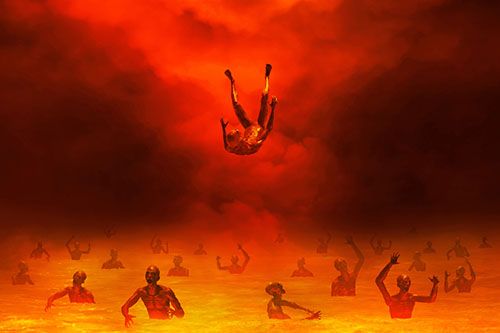
 Jen Hatmaker spent decades as one of evangelical Christianity's most trusted voices. Last week, the bestselling author announced that she no longer believed in something most Christians treat as non-negotiable: Hell. She called the decision "the best thing that ever happened to me." Her announcement reopens an older question: where did the idea of Hell actually come from, and does it hold up against the texts believers point to?
In a Substack essay titled "There You Are," Hatmaker described a childhood spent fearing a God who would condemn most of the world to endless torment. Setting that belief down, she wrote, rescued her faith rather than costing her one. She said she now experiences God as fundamentally loving rather than punitive. Critics have accused her of picking convenient scripture. Her response: the scholarship on Hell is far messier than most churches let on.
Does the Bible Actually Describe Hell?
You may be shocked to learn that if you crack open a Hebrew Bible you'll find that the word "Hell" never actually appears. In fact, the closest that the Old Testament ever gets is in speaking of a place called Sheol, a shadowy underworld where every person, righteous or wicked, ends up after death. It carries no fire, no judgment, and no distinction between saints and sinners. The idea of eternal, fiery punishment that most Christians picture today simply is not there in the earliest Hebrew texts.
In the New Testament, three other words sometimes get translated as "Hell", but even in these instances, the translations are shaky. Gehenna refers to a real ravine outside Jerusalem, once linked to child sacrifice and later used by prophets as a symbol of divine judgment against injustice. Hades, borrowed from Greek religion, described a holding place for the dead awaiting final judgment. And Tartarus, appearing just once in 2 Peter, also comes directly from Greek mythology, is said to be the place wherein rebellious gods are imprisoned.
Three different words, three different origins, one modern translation that doesn't seem to align with contemporary understanding.
So Where Did Our Modern Idea of Hell Come From?
It begs the question... where the hell did "Hell" come from? The vivid picture most people carry: bouncing flames, demons with pitchforks, and the eternal screaming of sinners, took shape much later. At some point, Jewish apocalyptic writers, including the authors of the Book of Enoch, began publishing texts in which the dead were sorted into separate chambers based on how they had lived. Historians trace much of this shift to Persian and Greek influence absorbed during centuries of foreign rule over Judea.
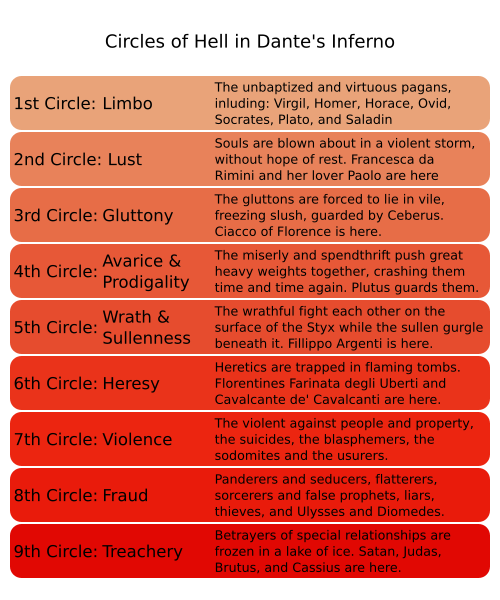 None of this reached readers as settled doctrine so much as cultural inheritance. Centuries later, it was Dante (in the Inferno section of his epic poem, The Divine Comedy) who gave Hell its different levels, punishments matched to specific sins, and vivid geography, and much of the imagery most churchgoers now assume came straight from scripture. It did not. As we've explored on this blog before, translation choices shape what a text seems to say long before any modern reader opens a Bible.
What Do the Major Religions Actually Teach About Hell?
Judaism offers no fixed doctrine of eternal damnation. Its rabbinic tradition speaks of Gehinnom, drawn from the same Hinnom valley as Gehenna, but mostly treats it as temporary purification lasting up to twelve months, not an eternal sentence. Islam takes the opposite stance: the Quran describes a place called Jahannam vividly and repeatedly as a real, literal fire, though scholars still debate whether every occupant stays forever or only those who die rejecting God outright.
Traditions built around karma and rebirth take a different approach. Hinduism and Buddhism both describe hell realms, called Naraka, but treat them as temporary consequences of past actions, not final destinations. Souls sent there serve a sentence proportional to their misdeeds, then continue the cycle of rebirth. Zoroastrianism holds a similar view: its version of Hell empties out when history ends and every soul is restored.
Two newer traditions push the idea further still. In Baha'i, Hell exists merely as a metaphor for distance from God rather than a physical place. The Church of Jesus Christ of Latter-day Saints teaches that only a small number of people, not the general population of sinners, ever face true eternal punishment.
Mainstream Christianity, it turns out, is unusually undecided among major religions on the Hell question.
How Did Hell Become Official Christian Doctrine?
The early church did not immediately settle on eternal torment as the only acceptable answer. Origen, a hugely influential third-century theologian, taught that God's mercy would eventually restore all sinners... even Satan himself, a position called apokatastasis. That door to redemption stayed open for centuries. All the way until the year 553, when the Second Council of Constantinople met and formally condemned the idea, declaring that the punishment of the wicked has no end.
That is to say – and this may not come as a great shock – "Hell" (as we know it) was actually invented in a board room.
Augustine of Hippo did more than any single figure to cement that position in the West. Writing in his book City of God, he argued directly against Christians who hoped punishment might eventually stop, insisting that Hell's fire had to be as endless as Heaven's reward. His arguments became the default assumption running throughought medieval theology, shaping how ordinary believers, not just scholars, understood the afterlife.
That doctrine became fully official centuries later in 1215 when the Fourth Lateran Council decided that it would be formally taught that the wicked will receive perpetual punishment alongside the devil. Thomas Aquinas would give that teaching a rigorous philosophical foundation soon after. Notably, Martin Luther and the Reformation he sparked barely touched this idea: Protestants and Catholics split over nearly everything else, but both kept Hell as settled doctrine despite the stunning lack of textual underpinnings.
What Did Pope Francis Mean by an "Empty Hell"?
But, it turns out, the debate may not be over yet. Before his death, in a televised interview, Pope Francis famously (and controversially) offered his own view: "I like to think of Hell as empty; I hope it is."
He was careful to call it personal opinion, not official doctrine. But the idea echoes a serious current in Catholic theology known as "hopeful universalism," most associated with theologian Hans Urs von Balthasar, who argued Christians cannot know for certain that everyone is saved, but may reasonably hope so.
Von Balthasar's position is not full universalism, the belief that everyone will definitely be saved, which the Catholic Church still views as heretical. His argument was narrower: since no one can know the outcome of divine judgment in advance, hope itself remains theologically legitimate. It is a small distinction with real consequences for how a tradition speaks about mercy versus certainty.
Officially, the Catechism still describes Hell as a real possibility, a state of separation from God. What has shifted is emphasis: fewer sermons dwell on eternal torment, and more theologians treat the Bible's afterlife language as symbolic literature shaped by its era rather than a blueprint. Our own study of biblical literalism made a similar point: much of scripture reads as poetry and metaphor, not literal transcript.
Not everyone thinks this theological tug-of-war matters much either way. Christopher Hitchens, one of the most prominent atheist writers of his generation, argued that human decency does not come from religion at all, but exists before and apart from it. On that view, whether hell is full, empty, or nonexistent has little bearing on whether people choose to be good.
Hatmaker's announcement will keep making headlines, but the deeper question predates her by millennia and is far from answered: What is "Hell"? How much of that idea is reflected in the original texts, and how much is a product of fear, art, and translation? Do you believe in it? And if the concept was eventually erased from mainstream faith, what would that mean for human behavior?
64 comments
-
 Shai Shahar
Gehenna was the pit or ravine outside the city where the trash was burned. The fire was constant, burning day and night. The whole idea behind the wicked being condemned and going to hell(Gehenna) after death was that "evil" ones did not deserve proper burial nor have their names remembered. Instead they'd be cast into the trash pit where the fire would consume them day & night forever. That is the whole story. Everything else is "religious dogma' designed to put the fear of eternal damnation into congregants.
-
 Patricia Ann Gross
I agree with the notion of a man-made concept of hell to keep people in line or face eternal torment. That said, I have no idea what happens to us when we die, nor do I have any desire to find out any time soon, as that will all be taken care of when the time comes. I just know I have to live a life in a way I imagine my creator has created me, by being as helpful to others as I can. As Jesus said in the Great Commandment, first love God, then love others as yourself. All ten of the original commandments given to Moses are covered in those two. My concept of death is walking up to the "pearly gates" and asking St. Peter a full list of questions about whether or not God "really" did this or that, and St. Peter just giving me a nod and telling me to go through to see what awaits on the other side. Somehow I know that whatever that experience is like, it will NOT be like anything I imagined.
-
 Martin S
The whole idea of "Hell" and "Eternal Torment" and even the personage of Lucifer, flies in the face of the tenets of the Christian Faith.
God is a perfect and loving being. He created angels to serve him. He created Man and gave him dominion over the Earth. Luckier and his followers grew jealous and led a rebellion against God. Did God not see that coming? One story is that Lucifer was angered that God gave Man Free Will. Wouldn't that mean that God created Lucifer to disobey him? That he INTENTIONALLY made Lucifer so that he would cast him out for doing exactly what he was made to do? Or did God screw up? Did he accidentally create an imperfect being? No...I'm not talking about Man. I mean Lucifer. Also, since Lucifer isn't a creator, then that would mean that God created Hell. God made a place to cast the souls HE CREATED if they didn't just blindly decide to believe and love him?
So which is it? God is imperfect and got blindsided by a creation he couldn't control...or did God intentionally create beings for the express purpose of torturing them?
-
 Keith D
Was Francis riffing on Shakespeare?
"'Hell is empty and all the devils are here' is a famous line from William Shakespeare's play The Tempest (Act 1, Scene 2). It is spoken by the spirit Ariel when reporting how the King's son, Ferdinand, leaped from a burning, storm-tossed ship, believing the end of the world had come."--Google AI quoting a Reddit reference
Was Francis hoping that Earthly hell was plenty?
In 1995 or so, I declared that I needed a new god. My sense of Divinity was essentially a mean kid with a magnifying glass and I was his victim bug. (Does that sound also like a confession? 😂 yes, I was that rotten kid.)
This didn't exactly echo the religion I had taken up at 17, the Mormons. But it was what I had in my mind. By 1995, I was long disassociated from them, trying to find what wouldn't stop working in a few years, as Mormonism had for me in ten years.
Things started dawning on me FINALLY after 30 years wandering around whatever mysticism caught my attention. ...and saying, 'it has something, but it's not working for me.'
Anyway, hell. I have friends who identify as starseeds and complain vociferously about 'this place.' They say, "I'm never coming back" (they and I believe in reincarnation and that we are eternal, immortal, that we are a consciousness beyond the body's mind. So to say, 'I hate here' and rather says that they think they are in hell
My comment to them is, "Heaven on Earth: your final exam and senior project."
Without placing blame on self gor every trauma; Without spiritual bypassing; Our experience is so colored by our attachments (hopes and fears and 'must be' ourcomes) that it sets us in a heaven ir hell right here.
Ma'at: balance, justice, the Egyptian sort of karma concept. Is your heart heavy? Or do you 'clear systems' and stay light, heart lighter than a feather?
Carrying resentment, regret and guilt, very heavy. When we learn to process and move on, light.
The Mormons taught me that 'damned' meant 'stuck.' Psychology taught me that you can somewhat recognize what ails a person by where theyvare psychologically ... stuck.
Hell is stuck, heavy, unhealthy spirit/psyche. I don't think it's a place; I think it's an attitude. Forever? I doubt it.
-
 Michael Dwayne Cooper
I'm always hearing people say there is no Hell in the Bible. The Bible gives very precise descriptions of Hell none of which I care to spend eternity in. If you wish to choose Hell over Heaven that's on you. I'll witness to you now, Choose Heaven over Hell.
-
 Louise Marie Harmon
My dad, who was a confirmed atheist, always said he wanted to go to hell when he died, because he wanted to be with his friends!
-
 William M Buzanoski
Whatever happened to the status of Purgatory in this discussion about the existence of Hell???? If there is no Hell, is there a Purgatory??
-
 Randall William Fox
I'm pretty sure that I've found purgatory and it's not in Colorado as rumored, but rather in the deserts of Utah. We call it "Moab"...
-
-
 James Riggle-Johnson
The existence and idea of hell were created by a council? No… tell me it’s not so. The entire bible was written by man.
-
 Tom Pearson
As I tell people with this view point, you believe what you believe and I shall do the same.. The bible is written by man directed by the hand of god.
Matthew 8:12: And shall cast them into a furnace of fire: there shall be wailing and gnashing of teeth.
Revelation 14:11: And the smoke of their torment ascendeth up for ever and ever: and they have no rest day nor night, who worship the beast and his image, and whosoever receiveth the mark of his name.
-
 Kevin Joseph Kervick
As with so many ideas, hell is marketing spin to build allegiance and control populations. Vaccines are sold the same way today.
-
 Leslie A. Hulberg Née Tomasura
I am with some thinkers that say there is no such thing. I also believe that people are good mostly and it has nothing to do with fear of a heaven or hell or judgment aside from one’s peers. You can be moral without being religious. You can be good without having faith in anything. I believe it comes from inside. When one does true good, is it for acknowledgements or is it for a self euphoria? I know if I do something good or kind, my first thought isn’t, I’m doing this so I won’t spend eternity in hell. Usually if I do good, I am not even thinking about how it makes me feel until after it is done. And then I sometimes feel good because I made someone else feel good. I don’t care if anyone notices. I don’t need accolades. But sometimes it makes my heart lighter. As for hell, I don’t feel a loving deity would do that to someone they created. And is supposed to be in the deities own image. That would make them an insane deity or at the very least certainly an unstable one. Who can say if there is a judgement day? I believe the whole idea of hell is something the human leaders (both canonical and political) have used it as a way to justify controlling the masses.
-
 Jennifer Roussel
Thank you. Your reply is exactly as I have felt for decades. I was always afraid as a child for not being "good enough" and being cast into hell. Children shouldn't grow up that way. It's child abuse. We're all made of energy and energy only changes. The Bible was written by men to control the masses and they've done a fairly good job of it.
-
-
 John Casillo
ALWAYS WONDERED IF HEAVEN WAS MORE LIKE A DRIVE THRU......COME AND GO AS YOU PLEASE
-
 Ari Joseph Bertine
Hell is a version of the Boogeyman made for adults. The reason why the 2nd Council of Constantinople could not allow the ruling religion to portray a forgiving God and a temporary punishment was because that is not scary enough. You cannot terrify people into following all your rules without a sufficient threat. Eternal punishment is a lot more effective in getting people to toe your line.
-
 Patti Anne Lisenbee
I was raised to believe in hell. After getting baptised at age 8, in a religion of "Saved and Lost Again" I sinned right after dunking and had to confess my sin and ask for forgiveness. Starting that night, I had a nightmare where I dreamed I was fine, then I sinned, was killed and Satan himself grabbed my heels and yanked me down to hell. I had that nightmare every night for 12 years! It was driving me insane. As an adult I learned hell was not in the bible and stopped believing in it. Some other person made it up! Where Ghenna in the bible is written is a garbage dump outside of Jerusalem that is constantly on fire, used as an allegory. Therefore, I do not believe there is a hell waiting for me or anyone else. When you die and the brain finished shutting down, that is all she wrote. All your emotions are in the brain. All your memories are in the brain. When you die, they are lost unless you have written them down. You are just plain dead when you die, no reincarnation, no heaven, no hell, no nothing. I think people made up heaven and hell because they could not stand the thought of not existing after death. I personally don't mind.
-
 June Whalen Gonzalez
I believe heaven and hell are our own creation. It has been shapped by our family of origin, the faith they practiced, social, educational and environmental influences. Heaven was the carrot to earn the prize identified.....likewise the concept was to keep one in line And what of purgatory .... a place where you stone and earn your way into heaven ---- too good to go to hell and too bad to go to heaven
-
 Warren Calvin Wall
First, there are questions that need to be addressed. 1. Where does God cast Satan after losing the war in Heaven? 2. Who holds domain over Hell? 3. Who holds domain over the Earth? Answers: 1. God casts Satan and his minions to the Earth and gives Satan domain. 2. According to scripture, Satan holds domain over Hell. 3. When Satan is cast down from Heaven, God gives him domain over the Earth. The only logical conclusion is that Earth is Hell and we are, in turn, it's inhabitants. There is no concern for us going to Hell. We are already here. This explains certain cultural beliefs such as reincarnation. If you consider that your punishment in Hell is eternal, you die, are reincarnated in this Hell and do it all over again. And again, and again for all eternity. There are beliefs that punishment is not eternal and redemption is still possible through purification of Spirit. Both God and Satan are jealous beings and actively compete for those Souls. This makes perfect sense to me. It's the only way that any of this can be real.
-
 Lori-Ann Neeb
To me the quest thatneed answers first are how accurate is the Bible? It was written some hundreds of years after Jesus lived by a corrupt church with its own agenda. As my beliefs go you are correct that there is no hell because no angels ever fell from grace and Satan does not exist. Dark entities such as we are entities, souls, etc. ( whatever term you use.) Do exist. We reincarnate here as we choose to experience and perfect our souls for God. We live lives we charted before we ever came down again. But God is not and has never been a jealous or spiteful God. He may have been painted that way in the old testament but again those were the interpretations of people of that time. Man's sins have always been on us and remain with us. Even the definitions of what is or is not sin we're created y men. Mary Magdelyn, as a Jesus wife, was who he talked to the most and she stated in her book that what is or is not sin depends on the heart and intent of the person doing the deed.
-
-
June Whalen Gonzalez
I believe heaven and hell are our own creation. It has been shipped by our family of origin, the faith they practiced, social, educational and environmental influences. Heaven was the carrot to earn the prize identified.....likewise the concept was to keep one in line And what of purgatory .... a place where you stone and earn your way into heaven ---- too good to go to hell and too bad to go to heaven
-
 Carolyn Jo Bjorholm
I believe that what we give in this life is what we will get back in the next. God loves all his children. Give love and kindness in this life....get love and kindness in the next. Give hatred and pain in this life......get hatred and pain in the next. As for WHERE you will receive this.........time will tell
-
 Roy S. Thorpe
It has always been someone trying to describe hell by what they imagined it would be! Early minds focused on worldly things that they knew about! Fire was a large and mysterious part of their world! Most people today cannot grab the concept of the spiritual world! Spirits cannot be burned by fire! Easier to think of creation by a warm loving God that when you do evil you move spiritually farther away from that spirit who the center of spiritual light and warmth! The term of being cast out into the darkness is more to the point! Do good and you stay close and do evil and it's byebye! And he gives you those choices every day of your life!
-
 Rev. Dr. Robert Allan Roush
Thanks for the article - something well known for some time. Unitarians rejected the notion of hell a long time ago. Yes, when it was a Christian denomination. Lots of confusion and continuing wringing of hands and gnashing teeth with these replies though.
-
 Wayne L Christensen
These comments are all very interesting. Tell me what you feel about your own life, and what and where you believe you're goings-on. Are you truly practicing your faith or judging others for theirs? Tell me are you just practicing or living your beliefs?
-
Wayne L Christensen
Forgive my typos, my phone knows not what it does.
-
-
 Jacob Vincent Williamson
Hee. I've been podcasting about hell for five years at "The Dispatchist." There's nothing quite like making a study of divine punishment to make you question everything you were told about God.
-
 Lynnea Urania Kaylor
The Conditionalist ideas of some Reformers may assuage the fears some have about the idea of hell fire, but not those who thought through what that would mean even if the fire does go out when there's nothing left to burn, for the one so afflicted never knows his own ending. He only knows the torment of flames for no thoughts can exist in an oblivion. On the other hand, if the burning isn't complete but goes on without an ending, then God never achieves a clean universe, and that's a problem too. It either render's God's hand shortened that He cannot save or renders the character of God as vengeful as many wrathful Christian leaders have themselves been throughout history. One may be tempted to see God as the "God of the Temper Tantrum" whose promise of flames is a default more certain than any remote possibility of deliverance in case we should "slip up" at the last minute. One may end up preferring a Buddhist idea behind hell in which the Bodhisattva Vow of the Pure Land Sutras declares that until the hells are emptied out, the Boddhisattva will not accept final nirvana.
From a very young age when raised a Lutheran, the idea of death as taught to me had troubled me so much that my parents sent me to the doctor to see whether I will live or not. I was taught that God's judgment would not only focus upon our deeds, but our words, and even our thoughts. Lots of passages are quoted to support it like Romans 2:16, Hebrews 4:12-13, Matthew 5:28, 2 Corinthians 4:5, 1 Chronicles 28:9, and no doubt you can think of some others of your own. Stacking the cards so that God judges all thoughts because He knows all thoughts raises some other issues too.
Is this referring to ALL thoughts or only thoughts of which we're conscious? Many tell me it's the former. That would include all thoughts in dreams that may be forgotten the next morning. In such a case, God judges us for what we don't even know about ourselves and would be left without any possibility of giving an account. How can anyone trust such a judgement?
It's also interesting with the Tophet issue (Jeremiah 7:31), for when it's written that such things never entered into the mind of God, and He knows all thoughts, how could God NOT know when people conceived of infant sacrifice in the first place? Or does God have a divided mind, one of which He knows, and another in which He does not know? And if He does not know on some level, then He cannot be omniscient, and if not omniscient, He cannot properly judge.
Perhaps the most comforting approach to all of this is to simply rest upon the Reformer's approach to Justification by Faith, for in this kind of judgment, God only sees the righteousness of Y'shua as an accounted righteousness instead of one that's somehow infused. Justification and sanctification become 2 different things instead of 2 sides of 1, leaving us with no need to worry about how God can manage to judge all those icky-sticky things we don't understand ourselves. That way, we can simply enjoy the journey and let God worry about the sanctification that He would consider to be fit for the World to Come. After all, if any or us get there, it won't be because of our own doing, but in spite of it.
-
 Michael Edward Ratcliff
Luke 16:24 King James Version
24 And he cried and said, Father Abraham, have mercy on me, and send Lazarus, that he may dip the tip of his finger in water, and cool my tongue; for I am tormented in this flame. Sinners look for excuses to prove yhere us no he'll. This is but one verse that backs up the Hates Translation to show there us a hell. Stop looking for a single verse. The Bibke is parts of a whole. Kniw the Bible or be accused in Heavrn of misleading souls. Even the Title of this discussion is false. The Bibke includes the New Testament. The most important part as it brings Salvation through Christ. He'll is as real as heaven. All you really need yo know that the God of Love is not there. That it's controlled by Evil. Fire is the least of your worries! Those of you not Teaching truth will likely go there.
-
 Charles Wesley Fuller
hell in the "christian" bible is translated from sheol,which simply means grave,nothing else.
-
 Mrknowitall
Thank you....That's all it is
-
 Jimmy Moon
WRONG ANSWER.
-
-
 Steven Ferrell
While the description of where sinners go is not called hell in the Bible, it indeed is not a place I would like to spend eternity.
-
 Daniel Alaniz
I agree with Hitchens. I was in parochial schools for 12 years. We were indoctrunated in the concept of Heaven, Hell and Purgatory, although the Jesuits lighten up on it in my high school. The nuns in grade school threated to send us to Hell quickly for perceived misdeeds. Unbaptised babies and people who dies in all other non christian countries without being baptised went to purgatory. Now the Catholic church has steered away from the entire concept of Purgatory. Hitchens also likened Heaven to North Korea in that everyone spent every moment worshiping god. I try to live my life by the best Christian standards which are pretty simple and also held by other religions and cultures. I'm happy with no religion in my life and feel that I lead a very good life.
-
 Floyd Cornwell
Ther is no he'll or why do we go up to heaven Amen
-
 Christian
The True Abyss is NO-THING, and as any created thing falls into an Abyss, That Falling is fot all Eternity, because any Created thing can not 'Be' in the No-Thing. The complete true Stack Overflow never reaches the absolute No-Thing, because there is not even a 'there' there : Obivion is unobtainable by any created object, person, soul, or Angel. This is why the LEGION did not want sent into the Abyss - they fall for all eternity. Unfortunately even piggies are GOD'S Creatures, & when they went insane with fear and fell into the water and all drown, the Legion of Demons still fell forever downward into the Abyss... The Story demonstrates Jesus gave even the Demons a Second Chance, permitting them to go into piggies. Jesus had compassion and Knew what unfortunate outcome the Demons would face: And Yet because of His great Agape Love, He still willing granted the Legion's Final Request. And in this recounting is the message to Us: MAKE GOOD USE OF YOUR SECOND CHANCES ! Don't blow it...
-
 Lori Mongillo
When it comes to religious belief, of any kind, we are the creators. Hell is a place we create for all the people we don't like, we think of as evil, and for all the people that don't believe as we do. It's psychological satisfaction. It makes a person feel superior and self righteous. As for going to the Great beyond when we die, your guess is as good as mine. What I do know, through scientific facts, energy does not die. we are made of energy. When we die that energy goes out in many directions. I love the Great Mystery! I like being free of all the BS that's peddled by religious and spiritual fabricators. It's big business. My spiritual nature is just connecting to the natural energies around me......who ever they may be.
-
 ServantOfJudgement
From what I understand, the hell will be knowing you're living in darkness apart from God.
Starving while watching people eat. Dying of thirst while looking at clear blue cold water. Watching someone else fulfilling your dreams. The runners next to you pass you by for first, second and third place while you're out of breath eternally. A terrible reality you just can't wake up from. Knowing you could have flown but chose to crawl.
Knowing in fullness the loss you chose to lose. Life eternal in death with no hope of anyone ever changing anything.
True godlessness while knowing God exists with all his children given the power to create anything God wold will.
Terrible burning loss. This is what I imagine from reading the bible.
-
Jimmy Moon
There are only two places where everyone believes in Heaven or Hell: Heaven and Hell. There are no unbelievers there.
-
 MJEinTX
There's also an unincorporated town in MIchigan called Hell. You can look it up.
-
Jimmy Moon
I thought everybody knew that. Did you have to look it up on Chat GTP? Hell is still Hell and will still be there when you leave this world. You have been warned. That is all I can do.
-
-
-
 Nicholas J Page
Hell is also a town in Canada I believe.
-
 Mark Dixon
The Hell in Canada is actually a fictional place from a comic book. Parodying Guelph Ontario.
There is a place Hell Michigan and also Hell Norway and I believe Hell in the Grand Cayman.
I believe the Biblical Hell was created as a way to control the flocks by the humans that have been able to control organized religion over the past many years. The ones charged with decision-making on our behalf as to what we will be allowed to hear and believe in. Only if it suited their agenda.
I believe our Creator and His Son are far more loving, accepting and forgiving than the churches and organized religion would have us believe.
Otherwise, the human disappointment would have likely ended at the Great Flood with no arc to save anything.
Just my thought. Love the discussion though!
-
 Elizabeth Kulacz
No. Hell is a town in Michigan.
Purgatory is a town in Colorado.
-
-
 Rev Ned
But?!? If there’s no Hell, where are djt and his MAGA minions gonna go when they die?!?
-
 Sir Lionheart
We’ll be going to a place where we can support the USA and fly the flag 🇺🇸 without being called a racist. It will more than likely contain only real males and females of all races. Don’t you just miss those days? 🤭
🦁❤️
-
 Michael Hunt
Are you referring to the days when people of color could be legally discriminated against or the days when women were treated as the property of men?
-
Sir Lionheart
Oh my goodness, No, Michael. Why on earth would you think anyone would want to go back to those times? Try and think more positively than that. I realize that might be a stretch for liberals. I’m sure you are aware that most liberals seem to be filled with hate and don’t seem to like anyone unless they have pink, blue, purple, or yellow hair, need to have facial iron mongery, be wearing a Keffyeh, and go by dozens of pronouns, and don’t know what a woman is.
I’m referring to those times when people of all nationalities got on well with one another, when you could joke about anything without being called a racist, or a homophobe, and feel safe going to a store and not be concerned that a gang of teenagers were not going to loot it, or do street take-overs spinning wheels doing donuts at intersections. I do hope you are old enough to remember those times Michael, it wasn’t that long ago….or was it? 🤔
🦁❤️
-
Michael Hunt
Your portrait of a stereotypical liberal is so off-base and ridiculous that I'm having quite the laugh right now.
The vast majority of people I know who are liberal are some of the kindest, most loving, and caring people I have ever met. I have met significantly more conservatives who harbor hate in their heart for some "other" group (immigrants, homosexuals, liberals) than I have met hateful liberals. No doubt there are liberals full of hate and conservatives who are wonderful, loving people. However, the modern conservative movement in America is powered by fearmongering propaganda that constantly paints groups who don't subscribe to their beliefs as evil and demonic or destroying our country in some manner to unite their viewers and readers against those groups.
The times you're describing in your second paragraph I live in every day. I live in a multi-ethnic community where everyone lives together peacefully and treats each other with love and kindness. I have never felt unsafe in a store because I was worried a gang of looters might come in. People have been doing donuts at intersections and taking over streets for decades, that's not new at all. As far as making racist or homophobic jokes, we've come to recognize how those jokes are rooted in hate and if you continue to make them you're being homophobic or racist. You might not have a hateful motive behind the joke, but it's still a joke rooted in hate and it shouldn't be unexpected if people feel the joke is hateful.
I remember the times when being gay was reason for ridicule and abuse and when people of color were redlined out of housing opportunities. Those days weren't that long ago and I don't want to go back to them.
-
Sir Lionheart
It sounds as though you are living in a wonderful place. And by the sounds of it you can go and take your family on a picnic in a park and feel totally safe. How nice is that.
As for me, I live in the very blue Los Angeles County, which in many areas is Hell on earth, with the largest homeless population, druggies on almost every street, and arguably the largest illegal immigrant base than any other state. Sadly, it’s very much a different and hazardous place to live than it was a few decades ago. Going on a family picnic to a park and feeding the birds without any fear of being harmed in any way is basically an impossibility. I wonder if the very liberal New York, and Chicago, is any different? 🤔
🦁❤️
-
Michael Hunt
The Pacific Northwest is a wonderful place, you're right! Surprisingly enough to you, it's also a major city that is very much to the left.
Having lived in LA County for a few years and still having family down there that I go visit, I have never felt unsafe in a park there. There are absolutely neighborhoods where I wouldn't feel safe but trying to claim that it's basically impossible to take a family picnic in a park without fear of being harmed is absurd and, in my experience, not based in reality.
New York City, under Mayor Mamdani's administration, has experienced the safest start to a year than has ever been recorded going back to 1994.
https://ny1.com/nyc/all-boroughs/news/2026/07/02/city-sees-safest-start-to-any-year-on-record--mamdani-says
-
Martin S
Seriously?! Can we PLEASE leave the politics in the trash where they belong?
-
-
-
-
-
-
-
 Colleen McAllister
I do believe in a heaven and a hell Heaven is in the prescence of God for eternity. Hell is eternal separation from God and all that is Holy. Hell, or damnation is described as an eternal lake of fire. I leave the details of both to someone else.
As to God condemning us, He gave us the choice. I chose to follow God and accept the precious gift of His Son. I know where I am going. Do you?
-
 amacooke
Hell exists but not for humans. Even demons need a 'home'. Humans imagine themselves there, but are quickly guided to change their minds. Perhaps it is 'hell' for some people to accept what they did during their lives and have to make amends for it, but there is no judgment from anyone except ourselves. 'God' couldn't give humans free will and then pass judgment on them for acting within it.
-
Lori-Ann Neeb
Hell does not exist. Organized religions create their concepts as a way to control and manipulate people. No demons either. Dark entities that reject God do exist. And of course they will lie and call themselves demons to you if they know you fear them. They may never enter Home. But God loves even them. When this earth can support life no more and those here att the time are taken Home, the darks are returned to the mass of untreated souls. I personally could take pleasure in thinking of the entity we call trump as a little puddle of untreated goop someday.
-
-
 Najah P Tamargo
Najah Tamargo-USA
I was raised in a cult that believed "hell" was the act of reincarnation. If you lived according to THEIR beliefs, you went to heaven. If you didn't, you reincarnated into a new life. One male, the next female and so on. I walked away from that nonsense. But if there is one, I have a reserved room with my name on it!!
-
 Dr. Zerpersande, NSC
Actually, if something actually was ‘going on’ then the reincarnation thing sounds most reasonable.
- Beliefs start out as hell and the devil.
- Then morph into reincarnation. Much like schools back in the 60s where students got ‘held back’. Of course this ended up with 16 y.o. delinquent boys in the 7th grade. The girls got pregnant and went who knows where grandma’s house was to give birth to future Trump voter.
- And now I guess everybody gets a pass because they ‘didn’t feel comfortable’ in the bone sack they were born into.
-
Lori-Ann Neeb
I have no idea what spin your former cult put on reincarnation that it was to be feared and I am sorry you experienced that. But reincarnation is how we choose to experience and perfect our souls for God. We choose how many lives we want and chart the entire life. Then when we pass we return Home and visit a scanner that shows us the life we just left. We judge ourselves as to how well or not so well we fulfilled our charts. There is no hell. This rock is as close as we get to organized religions concepts of hell.
-
-
 Wilberta M. Berry
Just think, if Hell was an actual place, the majority of humanity would be there. Way more than the people who would end up in the proverbial Heaven.
-
ServantOfJudgement
I suppose that's true. If the Islam hell is true, everyone but islamists would go there.
If the Bible hell is true then everyone but Christians would go there.
The Hebrew bible does say and confirm what the new testament says concerning the saving of non Israelites(gentiles). To them jesus hasn't come yet so that one is To Be Determined but both the new testament and old testament are in agreement with one another.
Today that makes 6 or 7 billion.
It's a terrible thought.
-
Wilberta M. Berry
Frankly I consider what this Earth has become is a living Hell.
-
Dr. Zerpersande, NSC
If the bible is true….
If a frog had wings it wouldn’t whomp its ass every time it jumped.
-
-
-
 Reverend Paula Copp
I have a shirt which is indicative of my feelings: I’m going to hell in so many religions… except mine, because we don’t believe in that shit.
-
Dr. Zerpersande, NSC
Love it!
-

Hell can be a condition of someone's own making, and exist on earth. It will last as long as the person allows it, or the length of the remainder of their lifetime.