

For nine dollars and ninety-five cents, Coca-Cola will print almost anything on a can: your name, a nickname, even "Satan Is King." What their system reportedly would not print, according to a tsunami of viral videos flooding the internet, was "Jesus." The backlash arrived instantly, loudly, and predictably. Before anyone declares a holy war on soda, the better question is what actually happened inside that filter, and why this exact fight keeps breaking out every couple of years.
What Actually Happened?
A few days ago, content creator Ryan Haff live-tested Coca-Cola's "Share a Coke" personalization tool on camera, deliberately avoiding pre-recording so viewers couldn't accuse him of editing. "The Devil is King" and "Satan is King" seemingly sailed through the preview screen without issue. "Jesus is King" did not.
A Fox Business investigation went further, testing dozens of phrases against the filter. Reporters found it blocking "Free Palestine," "Black Lives Matter," "White Pride," and "Make America Great," while approving "Stand With Israel," "Defund the Police," and, alarmingly, phrases referencing attraction to minors. Coca-Cola paused the tool and disabled its live preview within days.
Is This Anti-Christian Bias, or Something Messier?
Conservative commentators framed the story as proof Coca-Cola holds a grudge against Christianity specifically. "Once again Coca Cola shows you who they really are," one prominent commentator wrote, echoing thousands of similar posts.
A Coca-Cola spokesperson pushed back, telling reporters, "We are aware of a technical issue affecting the personalization preview tool," and pointing to a standing, blanket policy against religious and political content of any kind.
If you zoom out and look at the totality of amateur tests flooding the internet, the filter looks less interested in defending one belief system than simply incapable of applying its own rules evenly across all of them.
Haven't We Seen This Movie Before?
Stunningly, this is not the first time that the Coca-Cola printer software has sparked spiritual warfare. Back in 2024, the same tool rejected "Jesus Loves You" and "Allah Loves You" with fact-checkers at the time confirming a blanket ban on religious phrases rather than favoritism toward any one faith.
Snopes, revisiting the claim this week, called the specific Jesus-versus-Satan comparison ultimately unproven, even while confirming Coca-Cola's own admission of a glitch. Their investigation hasn't done much to quell the outrage, though, as several Christians take to social media to post videos of themselves emptying their Coca-Cola bottles down their kitchen sinks.
Manufactured outrage over corporations and Christian symbols is nothing new either. Long before soda cans, Americans fought over whether department stores could say "Christmas" at all, a ritual we explored in our own account of the original War on Christmas. Each cycle follows the same script: a perceived slight, a boycott, a corporate apology, and, eventually, a break in the fighting until the issue is rediscovered by another TikToker.
Does This Really Matter?
Fair question. Does anyone really need a customized soda can to feel spiritually affirmed? Some commentators, even Christian ones, have certainly made the argument that this is a minor, if not wholly artificial issue.
But, some argue that the filter that failed here is a small, visible version of something much larger: automated systems increasingly decide which beliefs get through and which get flagged, usually with far less scrutiny than a viral red can ever gets.
That could matter a great deal for a multi-faith audience. An algorithm that treats "Allah Is King" and "Jesus Is King" as equally suspect, while letting uglier phrases through, is making judgment calls about religion with zero transparency. You can roll your eyes at the can all you want, but some say you shouldn't assume that the same blunt filtering stops there.
Will you still be rolling your eyes, they ask, when some great-and-powerful AI decides that your beliefs are no longer fit-for-consumption?
Would Drinking a Coke Have Killed Jesus?
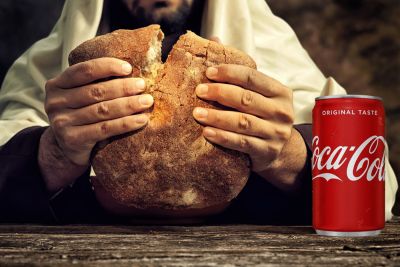 If you'll permit us an aside: as we were researching this story, one interesting question came up in the ULC discussion room here and we decided to do a little bit of extra credit research. Coca-Cola is so insanely sweet... could Jesus actually have safely consumed a can if one were miraculously teleported to the Holy Land?
First-century Judea did not run on cane sugar. The sweetest substance Jesus likely could have encountered would have been honey, but that may have been a rare sweet treat. Judea's everyday sweetener was date syrup, known as silan, pressed largely from the prized dates of Jericho, a town the Gospels place him visiting directly. The historian Josephus noted that the best dates pressed into something almost as sweet as bee honey, and it was far more accessible.
Gram for gram, you may be surprised to learn, both options beat Coca-Cola by a wide margin. Bee honey runs about 82 grams of sugar per 100 grams; date syrup comes in around 65 to 70. A 12-ounce can of Coke holds roughly 39 grams total, diluted into carbonated water. So no... a Coke is not so sweet that it would have killed Jesus. In fact, it's less concentrated than what he'd have already been drizzling on his bread.
We aren't entirely sure how he would have felt about printing his name on the can... but he doesn't immediately strike us as the kind of guy who needs to plaster his name on everything.
The fizz from the carbonation, however, may have given him a major shock.
What Does a Soda Can Have to Do With Faith?
Back to the deeper question, and it has little to do with any single keyword. Algorithms increasingly serve as gatekeepers of acceptable religious speech, deciding for a multi-faith customer base what counts as sacred and what counts as inappropriate, often without a human ever reviewing the call. Some companies build faith into their brand on purpose, a pattern that the ULC has traced in its rundown of surprisingly religious corporations. Coca-Cola has a unique challenge here. As perhaps one of (if not the) most recognized brands on the entire planet, it is responsible for satisfying the tastes of, well, everyone on Earth. Their filter, apparently designed to satisfy everyone by pleasing no one, appears to have done the opposite.
This is hardly the only recent flashpoint over uneven enforcement of religious expression. Around the same time, a college student made headlines after claiming religious bias over a graded essay, a reminder that questions about who gets to police faith, and by what standard, keep surfacing in classrooms and code alike. For a ministry built on ordaining people of every belief and none, the deeper question has nothing to do with whether an algorithm loves Jesus, and everything to do with whether any algorithm should be arbitrating faith at all.
Should companies moderate religious expression on consumer products at all, or should anything short of harassment be fair game? When a filter treats every faith unevenly, is that bias, incompetence, or just what happens when nuance gets handed to code?
43 comments
-
 Donald G Magel
Our Emissary of Satan is the anti-christ named Trump. He drinks Diet Coke to maintain his big beautiful body.
-
 AnnaMarie Ingrassia
um...ok, so...WWJD ??? If the opportunity came up in the 40 day/40 night episode of Jesus fighting satan's temptations in the desert, did he refuse to share a coke w/ satan? would the healer of all, feeder of the hungry, shelter of the homeless, welcomer of those from foreign lands, etc... refuse to share a beverage with who/whom/whatever? I doubt it. In this case, I would follow Jesus. BYW...My belief is that Jesus did not die FOR our sins...but rather BECAUSE of our sins !
secondly...is coke anti-christ or anti-hispanic?...I know hundreds of male babies are named Jesus ...phonetically pronounced "hey-zeus"... AND sharing with any "king" is rather a bold assumption ...of course, unless someone of the present administration paid coke's data employees off OR one might be on 'payroll' to have such algorithms thrown in or out... but even if it is all algorithms, why would Jesus be rejected and satan not for the same religious reasons?
If a rose by any other name still smell as sweet...maybe coke's rose is called satan.
-
 Brent
Brent
I would share a Coke with Satan - forgive & forget, I say. And remember, it was Bill Hicks who died for our sins (or at least did better stand-up comedy than anyone else in the New or Old Testament).
Peace. Love. Understanding.
-
 Najah P Tamargo
Najah Tamargo-USA
I don't drink soda....so there you have it!!!!
-
 Cyril R. VanKeirsbelk
I am more concerned about the high fructose corn syrup in US Coke than any slogans they print on the can.
-
 Susan Patricia Gold
So many companies these days put slogans, etc on their products and I feel it is for click-bait only. There are food stores that will not put Hitler on cakes. The same with Bud Light and Dylan Mulvany. If a person wants to do a commercial why do we have to label that person. Why couldn't Bud Light and Dylan just do the commercial without the trans label. I feel this goes for most things these days. "The first woman," "The first Black," "The first trans," - the list goes on. Just like we label ourselves, for example, Irish-American, or Italian American. When I was growing up we were just Susan, Vlasta, etc. Each one of us came from different cultures and religions yet none of us labelled each other.
-
 Patricia Ann Gross
Nothing to see here, just AI algorithms run amok. Social media does it all the time. I misspell a word in a Google search, and I get ten million ads all throughout social media about the word that was the mis-spelling, and nothing about the corrected word in the next search.
-
 Rev. Kev
Just another story of some people purposefully trying to find something to gripe about.
-
 Michael Dwayne Cooper
Just drink Pepsi
-
 Rev. Miche'al Yosef Dixon
Subject to hair fires if you drink Pepsi.
-
-
 Ari Joseph Bertine
The glitch in the system: a corporation trying to kowtow to everyone by cutting out the parts it thinks will start fights. Filtering it at all was an idiot move to begin with. Who cares if someone orders something vulgar or profane? It's going to reflect on that individual, not the company. But Coke has no common sense, as we all saw with the formula change debacle. Any company that can make THAT big a blunder simply cannot surprise me with any future stupid moves.
-
 Chris
Chris
Exactly. But just like the Bud Light hullabaloo over one single can printed for a Trans person, some people have to have something to be offended about. Otherwise they can't claim to be a victim.
-
-
 Pastor Wm. Dawson
Wow there is just so much that can be said about this it is really unreal on how you people claim to be Christian but has no idea of what Christian or Christianity actually means and it's not what you actually think it is it is so much more and so much different you people worry about the carnal aspect of everything what does this word mean what does that word mean why does Christ not appear on a Coke can that just foolishness that has nothing to do with the word of God or Christianity you need to wisen up read the scripture and actually learn what God's word really says quit trying to take it and twist the word of Christ around to meet your standards that's not what God does he doesn't meet your standards you have to meet his and he cares less and less about what you think about what can go on a Coke can then you could ever imagine it doesn't matter whether Coke has Satan on it or Christ on it everything that we do say and believe in in carnal aspects is all bad anyway just quit focusing on everything that everybody else thinks and believes in and just focus on the scripture and what God's word says read your Bible constantly always studying the word of God rightly dividing the word of Truth come on people it's not that hard you're just afraid you're afraid to show your inner beliefs and your trust and reliability on God you're afraid to show it outwardly and if you're afraid to show that outwardly God will not show it to you your salvation is at hand try to pick the right side and do what the word of God says to do and it does not say to fight about what word means what on a piece of man-made material this really is upsetting especially for a pastor that is totally immersed into God's word I can tell you right now it does not matter to me what is printed on anything I tried to take into the body what is good that way what comes out of the body is also good remember what comes out of your mouth it's from your heart and if you're fighting over silliness it's not towards salvation it's not to let people know that you believe in God it's just that you believe in fighting over silliness which wise enough everybody we all know this world is getting evil and more evil by the day it is getting more dangerous and harder to live in this world as each year goes by it should tell you something if it does not I feel sorry for you and your soul
-
 Charles Edward Brown
I do not drink anything from Coca-Cola as I am 100% a Pepsi customer. Therefore Coke can support Satan all they want as Pepsi comes home with me to my home where Jesus has been King since I got old enough to know his love 70 years ago.
-
 Steven Ferrell
If it was a glitch in the system, one might have to wonder if there system could have a glitch in the making of the product?
-
Chris
This is just like the Starbucks controversy when people calling themselves Christians were calling for boycotts because a publicly traded company didn't feature Jesus on their holiday cups. Some people look for any reason to foment hatred and division, even if they have to make mountains out of anthills to do it.
-
 Rev Ned
Not with the AntiChrist POTUS 47, NEVER!!
-
Charles Edward Brown
You know nothing about Donald J. Trump. Just go back to your sandbox and stay out of the adult conversation’s.
-
 Maximillian Martin
trump is trash!!! And I know some things about him that haven't been revealed yet!!!!
-
AnnaMarie Ingrassia
I also, maxilliian martin!
-
-
Chris
I know what's in the news, what I've seen personally, what he's said and that's more than enough to know Donnie Boy has nothing to do with Christianity. In point of fact, he is decidedly Anti-Christ because he says and does things that are directly in opposition to the teachings of Christ.
-
-
-
 Geoffrey C. Olive
It’s all mumbo jumbo!
-
 Bishop William Dusenberry, DD
The Christian God, promised those, to whom he dictated the content of the Christian/Hebrew Bible, that he’d never drown everyone on Earth — again — so everytIme we see a rainbow, it reminds us of the Christian God’s mercy. Thank God (the Christian one) for both Satan and “If in the Christian Heaven, we do not meet - I hope we both enjoy the heat.” We Pantheists don’t have to rely on Satan one way or the other.
-
 Rev. Carol M Anaski-Figurski
To the original ? Would you share a coke with Satan? My answer is yes. & so would Jesus. Whats going on? There are 3 distinct times in the bible where Jesus talked to Satan 3 times & mentions Satan in the bible about & times total. Interesting concept.
-
 Justin Adam Kalm
The idea of sharing a Coke with Satan takes me back to the classic “I’d like to buy the world a Coke” commercial. https://youtu.be/guJ8NvKw-6k.
-
-
 Christian
In some parts of the world, Christian children are dragged by their hair into the street, chained to a metal post, soaked in fuel, and set on file, alive.
Remember them while you drink GMO sugar acid from red cans. And endure your first world problems while the dead childrens' mothers are violated and sold off as slaves in human trafficking.
" For our struggle is not against flesh and blood, but against the rulers, against the authorities, against the powers of this dark world and against the spiritual forces of evil in the heavenly realms. "
-
Chris
And in other parts of the world, non-Christian children are treated much the same. In fact, people of all beliefs and even no beliefs are treated differently the world over. This controversy has nothing to do with Christianity.
-
 James Trenton Smith
Slavery is the same... no matter your back-ground. I think we can all understand that. But, you are wrong. The people that are mentioned in THIS post are specifically being targeted because they are Christian. Incidentally, they are people of color as well... Maybe that detail will elevate the urgency. I mean we only have Christians being murdered all over the world. Entire schoolhouses full of children taken as slaves, fathers murdered, mothers raped. While we fight for "freedom" all over the damn world. So let me guess... you want sources right... lmfao. Got them.
-
Chris
Wow. You really didn't get my point, did you? First, this specific post is about not being able to print certain things on a soda can. Nobody is "targeted." It has nothing to do with children being killed. Second, I never once claimed Christian children aren't being tortured and killed. I simply pointed out that others of different beliefs are as well. After all, a school in Iran was deliberately targeted by the US, killing 120 Iranian children, simply for being Iranian. Your concern over Christian children is touching, but if you're not also concerned with other children suffering, it becomes hypocritical.
And, slavery? Seriously? Where did you pull THAT from?
-
-
-
 Dr Dennis Chevalier PhD, DDvin
Christian,
Praise be to God; King of the universe, for his will be done!
Dr. D.
-
-
Dr Dennis Chevalier PhD, DDvin
Do we really have nothing better to deal with than this??
Dr. D
-
 Rev. BH
Coke should have realized how controversial this campaign would end up. Every knucklehead would submit some test name or phrase. (Any profanity getting printed?)
-
 Lynnea Urania Kaylor
Through the years, I've used Coca Cola for 2 things: cleaning rust off of toilets and scale from battery terminals. I suppose Satan could use the cleanout. Cheers, you devil you!
-
 Colleen McAllister
Much ado about nothing. These things happen randomly whenever machine intelligence is used. Machines do not get subtleties of use. I once had an electronic typewriter that flagged the name Jesus but allowed Satan to pass. I saw no conspiracy. Simply one of many shortcomings of non-human intelligence.
-
Geoffrey C. Olive
Anything to do with any religion has no business being on anything on sale to the general public that isn’t of religious origin! Can you imagine Jesus or God sausages? On the other hand I might buy a few rolls of Jesus or God toilet paper provided there was a face on each sheet, or Roman Catholic suppositories? LOL!
-
Lynnea Urania Kaylor
Apart from the "God sausage" connection with that debate involving James Talerico, it looks like the French had already imagined those sausages. https://www.france-voyage.com/gastronomy/rosette-jesus-lyon-sausages-539.htm . I also noticed that the toilet paper to which you refer already can be found on Etsy but I still wonder how that works since nobody I know has actually seen God's face except in the guise of someone on the street in need of help. As for those presumably "Catholic suppositories," we had a name for them back in high school: "Prosody". You can be sure that they were guaranteed to be organic... and they were "mild".
-
Rev. Miche'al Yosef Dixon
Seriously?🤔 obviously you need to look into sales practices as far back as 1600s Christianity, judism and pagan marketing have been around d. Coca-Cola earliest marketing plays was using Santa Clause (Christianity) to sale the product.
-
-
 Douglas Robert Spindler
You sure like sharing a Coke with mythical creatures.
-
 Merlin
We do everyday. It’s called ego.
-
 ServantOfJudgement
You might be right on that one
-
-
 Sir Lionheart
My gardener, who I don't think is an illegal immigrant, is not going to be happy. He’ll see it as racial discrimination that his name can’t be printed on a can. 🤷
He’s got a great sense of humour and really enjoys telling me he loves everyone. I know what he’s getting at. 🤗
🦁❤️
-
 Nicholas J Page
I would drink a Coke with Santa but not Satan

This should not be even a story in my opinion. I think that everyone should focus on actual things that are in need instead of talking about sharing a soda with Satan.