

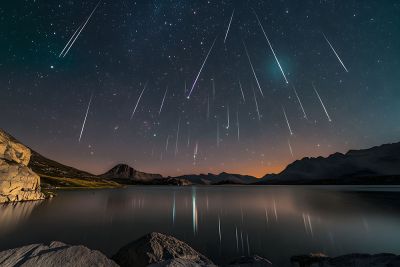
 The annual Perseid meteor shower peaks this week, and for a few nights the sky puts on one of its best shows: up to a hundred streaks an hour, bright enough to catch from a backyard. People have watched this same show for thousands of years, and across nearly every tradition, they reached the same conclusion: these aren't just ordinary rocks.
That conclusion exploded over the millennia into doctrine, architecture, and in at least one case, the holiest object on Earth.
What Is Actually Falling From the Sky?
The Perseids are debris from Comet Swift-Tuttle, a 16-mile-wide ball of rock and ice that swings through our part of the solar system roughly every 130 years. It's a messy visitor, shedding chunks in its wake that linger in Earth's orbit and burn up about fifty miles overhead when we pass through each August.
Fun Fact: Swift-Tuttle itself is more than twice the size of the asteroid, Chicxulub, blamed for killing the dinosaurs. Astrophysicists have called it "the single most dangerous object known to humanity". If it were to collide with Earth (and it comes frighteningly close), its impact would be 27 times more powerful than that of Chicxulub! We're probably safe for at least a thousand years yet, though.
Ancient sky watchers had none of that information, though. All they saw were hundreds of mysterious streaks of light appearing and vanishing in an instant, so every culture built a story to explain it. Here's where that instinct led four of them.
Why Do Christians Call Them the Tears of St. Lawrence?
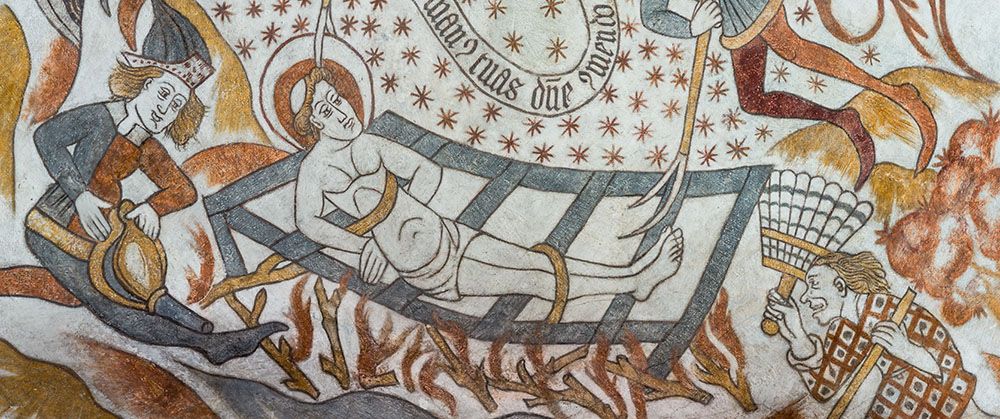
Lawrence was a deacon in Rome. When Emperor Valerian demanded he hand over the wealth of the Church, Lawrence reportedly distributed the treasure to the poor instead. Furious, the authorities martyred him on a large gridiron on August 10th, 258 AD, right around when the Perseids peak every year. He is, fittingly and grimly, the patron saint of those who work with open flames.
Catholic and Orthodox folk custom fused the two events, and the meteors became known as the "tears of St. Lawrence," a name still used across parts of Europe today.
Did Ancient Egypt Worship Iron From the Sky?
Long before smelting reached Egypt, King Tutankhamun was buried with a dagger forged from meteoritic iron. A 2016 lab analysis confirmed the blade's nickel and cobalt content matches meteorite composition almost exactly. Iron was rarer than gold at the time, so the ancient Egyptians used a fitting description for this mysterious cosmic alloy, translated as "iron of the sky."
That phrase shows up in hieroglyphic texts a century after Tutankhamun's death, suggesting the Egyptians knew exactly where their most prized metal came from.
Is Islam's Holiest Object Actually a Meteorite?
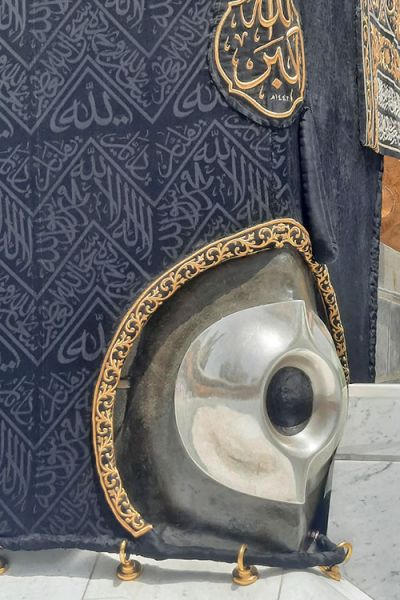 Set into the eastern corner of the Kaaba in Mecca is al-Ḥajar al-Aswad, the Black Stone, kissed or touched by thousands of pilgrims during Hajj, marking the start and end of each of the ritual's seven circuits. Islamic tradition holds that the stone descended directly from paradise and that it will testify on the Day of Judgment for those who touched it sincerely. It is venerated as a sacred marker, not worshipped, since Islam forbids idolatry. A long-running, unconfirmed hypothesis proposes it's a meteorite. Around 605 AD, a young Muhammad is said to have settled a violent dispute among Meccan clans over resetting the stone during the Kaaba's reconstruction, laying it on a cloak so every clan could share the honor of lifting it into place.
Did Ancient Rome Import a Goddess Made of Space Rock?
The year was 205 BC, and things were not looking good in Rome. Hannibal's army had torn through Italy for over a decade. That summer, a shower of falling stones was interpreted as a bad enough omen that Roman priests consulted the Sibylline Books, its guarded collection of prophecy. They came up with a solution: bring the goddess Cybele from her sanctuary in Anatolia, and Hannibal would be driven out. Rome sent a delegation, received a black, cone-shaped meteorite that Cybele's own priests identified as the goddess herself, and placed it into a temple on the Palatine Hill. Two years later, Rome finally defeated Hannibal at Zama.
The same instinct appeared in Ephesus, where the temple of Artemis housed a strange-looking stone that the locals swore had been dropped to Earth by Zeus, a belief strong enough that a city official invoked it to calm a riot... a story you can still read today in the Bible's Book of Acts.
What Do These Falling Stones Have in Common?
The pattern that keeps surfacing is continuity. A newer faith arrives, and rather than erase what a site already meant to people, it absorbs and reinterprets it. The Kaaba was sacred to Arabian tribes long before Muhammad, the way Samhain survived inside Halloween instead of disappearing under it, or the way this site has traced other holidays back to pagan roots hiding under familiar names. Christianity hits a version of the same tension with relics: as a look at the history of crucifixion shows, physical authenticity is almost always contested while devotion stays real.
None of this requires choosing between faith and physics. A meteorite can be a rock from space and a genuine point of contact with the divine, depending on who is looking at it and why. People have always looked at fire falling from the sky and reached for meaning, long before anyone could explain the chemistry.
So tonight, if the sky is clear, step outside and watch for a while. Somewhere between the science and the story is where most of human belief actually lives.
Does knowing a sacred object's physical origin change what it means to the people who venerate it? And when a newer faith absorbs a site or symbol from an older one, does that continuity strengthen the tradition or complicate it?
22 comments
-
 Tierney Tully
Nice article. One big correction. The Perseids don't "swing through" our part of of the solar system, earth "swings through" it in its annual orbit. Hence, the yearly meteor shower.
-
 Patricia Ann Gross
I found this interesting, only because I have always been interested in outer space. The legends that go along with some of the artifacts is also particularly interesting, including Stonehenge and Easter Island construction prior to any equipment capable of accomplishing it in less than a few hundred years. It also tickles me at how some people take it off into apocalyptic projections. Humans are certainly an interesting species.
-
 Hector Luis Moctezuma
A recent issue of National Geographic describes in detail themes of the dinosaurs, recent discoveries, and gross misunderstandings perpetuated by film and other cultural popular trends. It is quite enlightening. What does this have to do with meteors? Cogito ergo sum is misleading. A truer statement would be: the Universe is. Was. And will be. We weren't. Are. But may not always be. It is up to us. The fact that we are aware of these two statements, clarifies much of out philosophy and religious belief. A somber thought? Perhaps. But here's the golden surprise: we are made of the same material as the stars. It is obvious why we feel an affinity to celestial things such as meteors.
-
 Jeffrey Randall Wirth
Nice!
-
 Steven Ferrell
God is in charge of the universe. When He decides, it will end.
-
 Dr. Zerpersande, NSC
Absolutely no evidence for that claim, but the religiously delusional make such outrageous claim all the time. Saying such things is akin to the tics of someone afflicted with Tourette’s. One shouldn’t laugh at those afflicted with Tourette’s. Religious people are a different matter because they are voluntarily acting silly,
-
-
 Rev. Carol M Anaski-Figurski
Interesting article I love the concepts, deities from outer space. I am also so excited for the day we celebrate putting a cross on the moon. God in the Galaxies. Blest Be Amen & so mote it be. What next?
-
 Dr Dennis Chevalier PhD, DDvin
All, Checkout the movie "Barnabas 1961" and this...https://youtube.com/shorts/-qXPPnScQoc?si=fI2lF3PTTjrD5KV and this ...https://www.youtube.com/shorts/XJ6u7QE9EiQ or this ...https://www.youtube.com/watch?v=NcOYFJdpRNg and this... https://www.youtube.com/watch?v=jk9u1lUsJnM this is the actual 1961 filmed solar eq. in 1961 1 take, no special effects. and finally...this.... https://www.youtube.com/watch?v=aIzmbqCbkMM
Dr. D
-
Dr. Zerpersande, NSC
Church; Give us all your money. Lawrence: Negatory, good buddy. Church barbecues him.
Question: Does this sound like the work of a group of people that represent a loving god or a group of members from a Mexican cartel?
-
 ServantOfJudgement
Dr Z
Please allow me to correct your observation.
Emperor (Government) to the Church: give us all your money. Church dude says no and gets thrown on the fire.
God asks for willfully sacrificing the fruits of our labor. If not willfully given, God doesn't want it. Government demands it under penalty of prison or poverty.
Mexican cartel indeed, ya got that part right!
-
Dr. Zerpersande, NSC
I stand corrected. It’s just that it history is jam-packed with instances where the church has killed individuals for various reasons. I have included a link at the bottom of this message that gives quite a few. (After scrolling through these don’t forget to check a couple of sub-lists of martyrs at the bottom.)
Given that: 1- The list doesn’t include the crusades where the church ‘turned Hitler’ on people. 2- The Spanish Inquisition resulted in the death 2 or 3 THOUSAND, and that over a 100k were put on trial and sentenced to loss of property, given prison sentences, or exiled. ….you might understand why I jumped to the conclusion upon just seeing the BBQ pic.
I decided to click the article to see what nonsensical shenanigans religiously delusional whackos have gotten up to due to a meteor. Murdering people was so common in the past that I had no interest in the details of why a bunch of nitwits considered the meteors to be tears of a fully-roasted individual.
https://en.wikipedia.org/wiki/List_of_executed_people_for_religious_offenses
-
ServantOfJudgement
Let's not forget the Catholic Church laundered gold from the Jews murdered by the Nazi. I'll agree with you, powerful religion does what the humans who run it will do. Usually nothing very nice.
-
Dr Dennis Chevalier PhD, DDvin
OMG....
-
 Donald G Magel
Notre: Today's christian right elected and adore the Antichrist, Donald J Trump, convicted felon and sexual assaulter. Times change?
-
Dr Dennis Chevalier PhD, DDvin
Lost
-
-
-
-
-
-
 Reverend Paula Copp
People have been attributing phenomena in the sky as the working of the deities. Maybe there’s some truth to it, maybe not…my suggestion is that if you get a chance to see them, enjoy the sight…
-
 Nicholas J Page
No meteorite shower in England tonight or any other time 🤔
-
 Bishop William Dusenberry, DD
As a minister, in the only church (known to me) the “Secular Humanist Pantheist” denomination of the Universal Life Church in Oklahoma — actually able to prove the existence of God (because God is merely the personification of Nature — and everyone knows that Nature aka, God, exists, some of we Pantheists recite a prayer (sometimes, unless we forget to do so) as soon as we observe our Sun; “Oh great star, where would your beauty be, without those for whom you shine.” Hopefully, quite a few of my fellow ministers will recognize where this minister found this appropriate quote. And, if you do, I’ll make you an honorary member of our denomination.
-
Dr Dennis Chevalier PhD, DDvin
narcissist much?
Dr. D
-
Donald G Magel
Posted by an Mdv, PhD, DDvin, ULC honorary DD himself. Wow!
-
-
 Rev. BH
Bishop W.D. AI says this:
"Secular Humanist Pantheism blends a non-religious commitment to human reason and ethics with a naturalistic view that the physical universe itself is sacred. This worldview rejects supernatural gods, focusing instead on human welfare alongside a deep, reverent connection to nature and the cosmos"
If this states your beliefs, I'm with you.
-

I just find the article very informative and interesting. God is over everything and He will decide what comes next.