

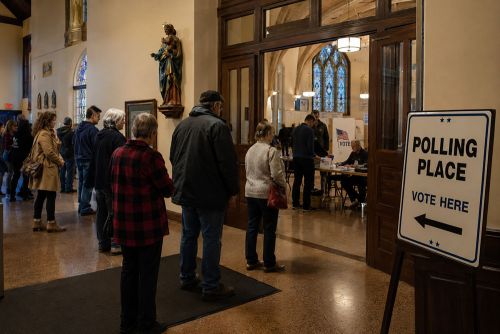
 Clergy from across the faith spectrum are re-inventing what it means to be a Church in America, particularly during election season. And perhaps nowhere is that re-invention more apparent now than it is in Minnesota where, standing outside the state capitol, ministers, rabbis, and imams pledged their sanctuaries as what one organizer called "democracy hubs" – places for voter registration, civic education, and monitoring for suppression.
The timing is pointed: President Trump reportedly plans to address the nation on television tonight to again allege that there was fraud in the 2020 election, a speech election-security experts warn is less about new evidence than it is about seeding doubt about the integrity of elections ahead of the midterms.
The announcement raises a question American faith traditions have argued over since before the country held its very first election: is casting a ballot a sacred act, or simply a legal one?
On July 7, faith leaders gathered at the Minneapolis State Capitol to launch "Faith in Us," a multistate campaign built around ballot access ahead of the November midterms. The interfaith group ISAIAH Minnesota led the event, joined by clergy representing dozens of congregations. Organizers say more than 1,700 clergy members have signed a letter urging election officials to reject federal pressure that could restrict voting.
Similar events unfolded across nine states, representing more than 1,500 congregations altogether. The letter names specific concerns: an executive order curbing vote-by-mail, and new district maps drawn after the Supreme Court narrowed the Voting Rights Act's preclearance protections. "Our churches, our mosques, our synagogues, our places of worship will become democracy hubs," said Minister JaNaé Bates Imari of ISAIAH, framing the effort as accountability rather than partisanship.
Is Voting a Sacred Duty, or Just a Civil One?
Many faith traditions treat voting as more than procedure. The National Council of Churches teaches that ballots let believers "bear witness" to Scripture's call to protect the vulnerable. Civil rights leader and longtime Congressman John Lewis, an ordained deacon, went further: "The vote is precious, it is almost sacred." That framing still echoes in today's organizing, where clergy describe voter protection as ministry, not politics.
Not every Christian voice agrees that voting rises to sacred duty. An editorial in The Christian Century, a mainline Protestant magazine, warned that "sacred" language inflates a single vote's moral weight. Evangelical commentators at The Gospel Coalition argue Scripture never mandates voting, since it isn't legally required in the United States the way it is in nations with compulsory turnout. Both camps raise the same underlying question: what does faithful citizenship actually require?
How Has Religion Shaped Who Gets to Vote?
That question has a long history, and religion hasn't always expanded access. Colonial governments barred Catholics from voting in five colonies and Jews in four, while several states required officeholders to swear belief in Protestant Christianity well into the 1800s. Pennsylvania kept a religious test on its books until the twentieth century. The same faith traditions organizing today's "democracy hubs" once justified the opposite: using religious identity to decide who counted as a citizen.
The reversal came through the Black church. After the Civil War, congregations became hubs for political organizing among newly enfranchised freedmen, a role that deepened during the twentieth century. Dr. Martin Luther King Jr. viewed Black churches as central to voter registration, and the "Souls to the Polls" tradition, born from Jim Crow-era suppression, still sends congregants from Sunday service directly to early voting sites. Minnesota's "democracy hubs" sit squarely in that lineage.
Is the Wall Between Church and State Still Standing?
The current moment adds a twist. In 2013, the Supreme Court's Shelby County ruling gutted the Voting Rights Act's preclearance requirement, and more than a dozen states passed new voting restrictions within a few years. Meanwhile, in July 2025, the IRS agreed in a court settlement that churches could endorse political candidates from the pulpit without losing tax-exempt status, effectively ending seven decades of Johnson Amendment enforcement against houses of worship specifically.
That carve-out applies only to churches, not secular nonprofits, handing faith institutions a political privilege no other charity holds. Our recent piece on the administration's push to dismantle church-state separation traces that shift in more detail, and the claims driving it echo a pattern our look at America's recurring "Christian nation" argument documents across centuries. The line between pulpit and politics keeps moving. It has never been fixed.
Is voting a sacred act, a civic duty, or a right like any other, and does the label change how seriously we treat it? Where should the line sit between clergy encouraging civic participation and churches endorsing candidates outright?
54 comments
-
 Pix Edward
I would have no issue with voter registration drives, showing people how to research their vote, organising rides to polling locations, things like that, if this country didn't have a history of using religion as a tool to seek and maintain political power. That in itself is a good reason to keeping church and state separate... It tends to add a perverse element to both when that separation is gone.
-
 Rolando Couce
GOD WANTS US TO VOTE FOR PEOPLE WHO WILL CONTINUE HIS MISSIION ON EARTH WHILE THE DEMOCRATS WANT TO REMOVE LEGAL VOTING RIGHTS AND PUT IN PEOPLE WHO WILL DO THE WORK OF THE DEVIL
-
 Rev. BH
Dr. Titles:
- Privilege (n): An immunity or benefit enjoyed onlyby a person beyond the advantaged of most.
- Right (n): That which is due to anyone by just claim, legal guarantees, or moral principles.
Since I'm not particularly advantaged, I'd go with number 2.
-
 Katie Yvonne Grogan
First let me say as a minister, according to the word of God there is a separation of church and state. The bible do not address voting at all, however their is a scripture that clarifies things, in fact several of them. In Matt 22:21, Mark 12:17 and Luke 20:25 it is quoted in scripture Jesus separates what belongs to God from what belongs to leaders( Caesar) faith belongs to God and Christ and walking in their likeness, things that are worldly(government systems), voting is one of those things. It has nothing to do with faith, we of faith understand that God can work miracles in our lives and touch our hearts to want to help others, I believe this is what the Beatitudes are about, so voting is not a God given right, it is a citizenship right of Americans born in this country and who pay taxes like others. No one should be intimidated if they choose to exercise this right as a citizen in this country to vote period. The Churches that serve God should be about the kingdom work of God according to Matthew 25:34-40, Luke 9:2, it is not of this world and does not function based upon worldly kingdoms. I think the church should continue to concentrate on the real mission in Matthew 25, because let's clear about what is happening here, the current leader and administration of this worldly kingdom has the problem with the election, and if Trump does not win, he is going to disrupt the election, because the power of the US presidency make the candidates and the person do sinful things. Trump obsession is not based on fact just pure corruption and evil. the love of money makes people do things, bad things, good things, based on their own desires. The church which is the people themselves should not be defiled with this 3 rings circus that is about to take place and if the peoples of God has dedicated their house of worship to him, they should think twice abut bringing the worldly ideas into the place they choose to collectively to worship and welcome the spirit of God to these buildings of brick and mortar and make a chose, do you want the Holy Spirit of God there or the spirit of the world?
-
 Gary Lee Underwood
Voting is a GOD given right, not a privilege.
One year my polloing place was in a metting room at a church and no one expressed a problem with that location.
The Constitution restricts government, not the people.
Separation of Church and State gets misunderstood and misused often.
I do not believe this is the proper forum for political comments.
-
Katie Yvonne Grogan
Really, but you think the church you built is? I thought the temples your congregation built was for the Spirit of the lord to come in and interact in the spirit with you spiritually? Perhaps you need to read what Jesus said in John 18:36, don't put Jesus or God in this worldly mess. The Bible says nothing about voting in worldly elections, I believe it is a spiritual book, that encourages believers to be spiritually connected to God heart mind, and soul, John 4:24, 1st Corinthians 2:14.
-
-
 Kenton Sherman McManigal
Democracy is mob rule; might (through superior numbers) makes "right". It isn't something to encourage or fetishize. There is no such thing as a right to impose your chosen politicians or "laws" on others- there's no right to govern anyone but your individual self. If I see a church encouraging people to do something they have no right to do, I'm going to distance myself from that church.
-
Katie Yvonne Grogan
You have a point, how many people live by the very rules they want to impose on others, this whole mess is going on because of one person wanting his way, who can't given himself that's for sure, good point (LOL)
-
-
 Lillian Sanchez
We are a democracy, right? We come from many faiths, yes, I'll include non-believers, colors, and creeds. Because of that I believe in strong guard rails to protect the separation of church and state. Inadequately taught American history has many wrongly believing we started out as a Christian nation. Nothing could be further from the truth. The US of A is secular nation and some among us are insisting on her playing dress up with Christian outerwear. No. Voting is sacred. Leave her alone, and you go on and make peace with your God.
-
Katie Yvonne Grogan
I agree, they are separate systems. The government needs to allow Americas to vote using the options available and lets stop the nonsense because a person or party is a sore loser and move on. If a persons God given human rights are violated then we should be concerned, and stand up for justice and fairness.
-
-
 Lester
I have a problem with churches being used as polling locations. The government determines what polling location you are supposed to use. Years ago, my assigned polling location was a church. I absolutely refuse to step foot on church grounds. I went to the local highschool instead. They allowed me to cast my ballot, but I was told it might not be counted if it was not approved.
-
 Penny Prentice-Best
I do not believe that democracy is served by bringing any particular doctrine or dogma into the political process. Having said that, I do feel that some spiritual and moral concepts that are common to most religions do absolutely have a place in our political process and in our societies. All of us benefit when we agree that it is appropriate to treat others in the ways that we ourselves would wish to be treated. Everyone benefits when we agree that honesty, trustworthiness, integrity, compassion, and generosity are valuable character traits that we expect in those we elect to serve and represent us. If we can put aside individual religious dogmas, churches can serve their congregants by encouraging them to use spiritual (not religious) discernment to vote for candidates who demonstrate a true call to serve with honesty, trustworthiness, integrity, compassion, and generosity. Churches can encourage their congregations to communicate with their elected officials and political organizations about the level of moral character they expect in those who represent them. When we inject religious bias into these conversations, we only add fuel to the divisions that already exist and we undermine the potential we have to effect real change.
-
 David E. O'Keeffe
If that happens, they can say bye-bye to their tax exempt status
-
 Ronald A Sherwood
Not an answer to the question, but It wasn't too many years ago when I would have felt comforted knowing churches were opening their doors to allow people safety when voting, but with so much "Christian" (term used loosely) support of DJT this is idea is slightly disturbing.
-
 Stephen Keener
The churches near me that have polling places use a separate room and not the actual sanctuary for the polling area.
-
Katie Yvonne Grogan
Interesting, but should the church's be so involved in worldly ideas that really have no influence on your spiritual growth? I mean after all the preachers teach to put your trust in God to provide for you and the Word and Spiritual grows you spiritually, food for thought.
The election in this country is going to get messy if a certain person or party does not win, God is not the author of confusion or mess wrote Paul in Corinthians 14:33 and in the Old Testament God creates in order Genesis, food for thought.
-
 Patricia Ann Gross
Katie,
Churches have separate facilities, usually called "fellowship halls" or "auditoriums" that are quite often rented out and used for secular and even civic (government sponsored) events. It happens in churches all over the country. A church I helped pastor in Kansas was one. The church I grew up in was another. This is not a new concept.
-
-
-
 James Richard Norby
Just a clarification, Minneapolis is a city, (which I live in). Minnesota is the state and St. Paul, our twin city, is where the capital resides. In regard to voting? I have voted in church basements more than once. I consider voting a sacred honor and an important constitutional right given to every citizen over 18. I am 70 years old and I have only missed one vote in my adult life. For me it is my civic duty to vote in EVERY election.
-
 Ari Joseph Bertine
Good for those churches. That is what a church should be doing, helping the people in its community. Voting has as much to do with religion as eating and sleeping does, which is nothing, but churches that believe that they have an obligation to the people in their communities help those people with necessities of life. Voting is absolutely a necessity of life.
-
Katie Yvonne Grogan
Uhm, but is this election really about the work of the Kingdom of God that Jesus speaks of, and voting is not something Jesus or God speaks on, but the issues of a person heart.
Food for thought
-
-
 Joseph Grieco
Voting is a Constitutional Right and a Duty of all citizens. Since 1972 I have not missed voting in any primary or general election - even when I had to get an absentee ballot because I was away in the military or out of town on business. When I lived in New Hampshire, I also attended the annual Town Hall meetings where I lived. When I was a kid, voting sites included church basements, school assembly rooms and gyms, and numerous other locations. Today, my regular voting place is in the basement of the Town Library Annex near my home. I plan on going there in August for our Primary and in November for the General election. We do have the option of Early Voting, and if I take that option, I will go to the special location designated for it (a town rec center). My concern with Churches and Elections is too many pastors wear their politics on their sleeves. They come up with reasons for candidates that are often questionable, especially when one looks at who they are "suggesting". If they want to jeopardize their tax exempt status, let them. Let them talk about Social Justice, Constitutional Rights, and other topics and let their parishioners make their own decisions based on facts.
-
 Steven Ferrell
As long as they are following the constitution and only allowing LEGAL AMERICAN CITIZENS to vote, I don’t care what building is used. If they are going to let ILLEGALS and noncitizens vote, they should be stopped.
-
 Thomas Denney
Nowhere in the US are non-citizens allowed to vote. Saying anything to the contrary is straight out lying to create fear among the population. Last I checked, lying, especially to vulnerable people who trust you, is morally reprehensible.
-
-
 William M Buzanoski
What has happened to the Separation of Church and State???? 😔
-
 Pastor Bobby Roy
As an ordained minister, I see voting through the lens of Jesus’ teaching in Matthew 22:21 — “Render unto Caesar what is Caesar’s, and unto God what is God’s.” In America, the right to vote is something our government gives to its citizens. Returning that participation is part of giving back what belongs to our nation.
Romans 13:1–7 also teaches that lawful civil authority is established by God, and that faithful citizenship includes honoring the responsibilities that authority places on us. When America grants us the ability to choose our leaders, participating becomes both a civic duty and an act of obedience to Christ’s teaching about respecting rightful authority.
So while voting is not a religious right, it can still be a religious responsibility — not because Scripture commands voting, but because Jesus commands us to honor the authority we live under. We give to America what is America’s, just as we give to God what is God’s.
-
Katie Yvonne Grogan
I be glad when we can have a election without all this nonsense again.
-
-
 Reverend Paula Copp
Voting is a Constitutional right and a civic duty! It is not now, nor has it ever been, “faith based”…
-
 Rev. Dr. Dennis Chevalier, Ph.D; DD
It is a privilege enjoyed. By citizens of this great country. It is neither faith based. Or a duty.
Dr. D
-
Katie Yvonne Grogan
Agreed
-
-
 Dr Dennis Chevalier PhD, DDvin
Voting is neither a duty nor a faith based rite. It is a privileged enjoyed by a citizen.
Dr. D.
-
-
 ServantOfJudgement
Does the atheist have a right to vote?
If a citizen who's an atheist can vote, then voting is not a religious right.
Democracy hubs in sanctuary cities boil down to helping illegal aliens vote. Considering this article is out of Minnesota, the flagship of fraud, we can put it down now they'll have more votes than voters. I suppose a godless liberal church can resurrect the dead for voting purposes and lay them to rest again till next election.
-
 Michael Hunt
There is zero evidence of wide spread voter fraud or illegal aliens voting in federal elections and there are 3 states where non-citizens are allowed to vote in local elections, not state-wide elections.
https://ballotpedia.org/Laws_permitting_noncitizens_to_vote_in_the_United_States
Your beliefs regarding democracy hubs are based on falsehoods.
-
Katie Yvonne Grogan
Yes
-
-
-
 Douglas Robert Spindler
If people believe there is a God why can’t they believe Trump won the election in 2020? The evidence for both is the same, there isn’t any.
-
ServantOfJudgement
You've actually got a point Douglas. If Christians believe God chooses our leaders for his reasons, the 2020 election results were given the ok by God.
-
Katie Yvonne Grogan
The Scriptures proves that God does choose every leader in many scriptures, that is something the preachers teach that is not true, there have been some horrible people who have made themselves leaders.
-
-
-
 Michael Burton
This is a Trump ploy. Please remember the office of the President of the US is the only one not directly elected by the people. We have this little problem called the Electoral College. All it takes is a little diddling in a few states, and the whole shebang goes off the rails; remember Trump trying to get the 11000 votes for Georgia, and it's on tape! An amendment to eliminate the EC has been introduced, but needs to be passed
-
ServantOfJudgement
No Michael. That's in place to ensure large population centers don't dominate and dictate to the rest.
For example, population centers would control the entire country negating all other votes. There would be no point in holding any elections other than in the city.
In essence it protects the minority and marginalized.
-
Michael Burton
No Judgment. Under the Constitutional requirement, each state is allocated one electoral vote for each congressional delegate plus two for its two senators. In my state, Washington, we have 12 delegates to the EC. We have 10 congressional districts and 2 senators. The congressional districts are drawn according to population; the senators are elected statewide. It is the drawing of those congressional lines that can get sticky. Gerrymandering is a process where state legislatures draw the lines for the congressional districts in order to gain a majority of like-minded members or to deny certain voters any possibility of gaining a majority. Nothing in any of these processes ensures cities or rural areas a protected vote.
-
-
-
 Stephanie A Willey
Your vote is your Constitutional right. And your responsibility to your local, state, and federal government. Democracy is not a spectator sport. It needs your participation, your vote. Religion should have nothing to do with it.
-
 Robert Gagnon
The act of voting is purely political, Religious organisations tend to influence their followers to help their personal situation.
-
Katie Yvonne Grogan
You have a point there. the bible warns against church leaders who are influenced by the love of money and material comforts.
-
-
 James Richard Munro
Don't believe religion and politics should mix. But we all know they do. My theory is, if you don't vote, then don't complain if your candidate doesn't win.
-
Rev. BH
Going into any building, church or not to vote, is not mixing religion and politics. I have no fear of getting instantly converted by entering any church or temple.
-
-
 Najah P Tamargo
Najah Tamargo-USA
Voting is a Constitutional right! Not a religious one. And I don't believe any religious clergy should attempt to promote one canidate or another. I still belive in SEPARATION OF CHURCH AND STATE! No religious entity has the right to tell us who we should vote for. It is up to US, as Americans, to choose who is the best person for the job. And I am NOT going to listen to Trump rehash and regurgitate the whole 2020 voting nonsense. He lost. That's that!! Do your research, check out the people running, use your brains, not your religion, then cast your votes.
-
James Richard Munro
As an American citizen, everyone of voting age has the right and duty to vote. But you only get one vote. Are you listening democrats?
-
Joseph Grieco
So far the only documented cases since the 1980s of people who have voted more than one time in any given election have NOT been members of that party.
-
James Richard Norby
As a democrat I have never considered voting more than once. I think it would be very challenging in my state of Minnesota to vote more than once. The few cases of people voting twice have actually voted for DJT! Are you listening Republicans? BTW, even your gerrymandering efforts won't save you in the mid terms. Your unpopular president and do nothing congress are polling at historic lows!
-
Rev. BH
I'd think the more places to vote the better. A church, an American Legion, the senior center, the town hall, the high school - they're all just buildings, Lester. ("I absolutely refuse to step foot on church grounds.")!
-
-
 Rex Alan Ebnit
💯 Couldn't have said it better myself.
-
Rex Alan Ebnit
Comment removed by user.
-
Katie Yvonne Grogan
Well said!
-
-
Rev. BH
Hey gang, don't miss Trump's big speech tonight (endlessly) rehashing his 2020 election defeat. Make some popcorn, a favorite beverage, sit back and enjoy the comic farce!
-
Dr Dennis Chevalier PhD, DDvin
In the article it asks": is casting a ballot a sacred act, or simply a legal one?"
I don't think it's going to be any of the above, it is a privilege enjoyed by citizens of this country.
Dr. D

President Trump reportedly plans to address the nation on television tonight to again allege that there was fraud in the 2020 election, a speech election-security experts warn is less about new evidence than it is about seeding doubt about the integrity of elections ahead of the midterms. Tells me all I need to know.
Jesus teachings consistently emphasized that his kingdom was spiritual rather than political. He resisted attempts to be drawn into earthly political conflicts, advocating instead for internal heart transformation and devotion to God Rather than lobbying or trying to overthrow the oppressive Roman regime. Jesus focused on addressing individual sin, systemic hypocrisy among religious elites, and caring for the marginalized. Jesus’ followers were instructed to pray for their leaders and live peacefully, prioritizing the "Kingdom of God" over earthly political systems. We all know That unlike to Jesus of the Christian faith, that the leaders of this religion crave power over compassion and the god they follow is called, “Wealth” And their holy trinity is, “Power” and “Greed.”
The problem with Trump is (aside from being the embodiment of one part Antichrist) they he believes and is probably correct, that he could, “Kill someone in the middle of Downtown Manhattan in broad daylight and get away with it.” His idea of leading is bullying and abuse those he believes are lesser. He only ever thinks about Wealth, Power, Greed, and who he has to appease to get it.