

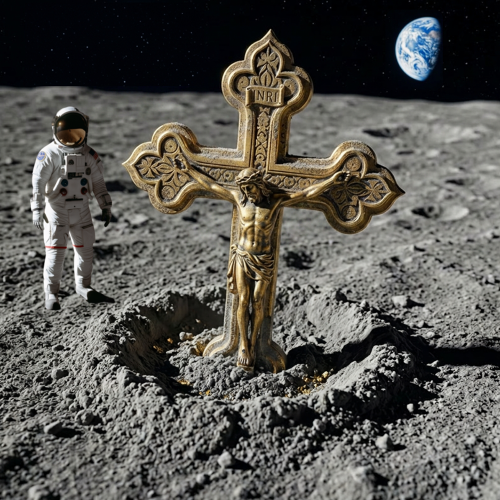
 Humans have carried religion into space since before the first moon landing. As we reported here, Buzz Aldrin secretly gave himself communion in the lunar module hours before Neil Armstrong took his famous first steps, and Catholic astronauts received the Eucharist aboard the Space Shuttle Endeavor in 1994. Catholic activist and cryptocurrency enthusiast Justin Park wants to take that history further, by leaving something behind.
His nonprofit, the Cross on the Moon Coalition, is trying to raise the money to land a physical cross on the lunar surface, an offering he describes as consecrating the heavens themselves.
Who Is Trying to Send a Cross to the Moon?
Park is a Catholic computer scientist from Dubuque, Iowa, who studied aerospace management at the International Space University and later worked stints at NASA Ames and NASA headquarters. He founded the coalition in 2024 after a dream in which his late mother, who died of cancer when he was a teenager, appeared to him as an angel.
The mission, dubbed HOPE-1, calls for a robotic cross that would unfold atop a lunar lander and livestream itself back to Earth. Getting there is the hard part: landing a single kilogram of payload on the moon costs several hundred thousand dollars, and Park originally priced the full mission near $40 million.
The coalition has raised only a small fraction of that so far, much of it derived from Park's own bitcoin earnings, and he has floated shrinking the cross to a single foot, or swapping it for something lighter still, a communion wafer.
Is It Even Legal to Put a Cross on the Moon?
In one sense, yes. The 1967 Outer Space Treaty, ratified by more than 110 countries including the United States, bars any nation from claiming sovereignty over the moon through occupation, use, or any other means. It says nothing about leaving objects behind.
Apollo astronauts left flags, mission patches, and memorial markers on the lunar surface decades ago without triggering a treaty violation, because none of it came bundled with a claim of ownership.
Religious objects specifically have already made the trip. A hundred microfilm Bibles rode down with Apollo 14 in 1971, carried by astronaut Edgar Mitchell for a NASA prayer group called the Apollo Prayer League. Later that year, Apollo 15's David Scott left a full paper Bible resting on his lunar rover's dashboard, where NASA believes it likely remains today.
What is less settled is what happens once a mission looks less like a personal keepsake and more like an organized, funded campaign to physically mark a piece of the moon for one faith. The treaty's ban on appropriation was written with nations in mind, and legal scholars still disagree about how far it reaches when a private coalition is doing the planting.
There is also, by design, no court or regulator up there to settle the question. Space law relies almost entirely on countries policing their own citizens and companies.
That is where the U.S. government still has a foot in the door. Any American launch needs federal authorization and ongoing oversight under the treaty, which means the coalition's mission would ultimately need a green light from federal regulators before a rocket ever left the pad. Whether that counts as a government endorsement of a religious symbol, or just routine paperwork for a satellite launch, is its own church-state question tucked inside the bigger one.
Why Is This Getting Attention Now?
The coalition's ambitions have drawn new notice because of who it runs alongside. It appears on the roster of Freedom 250, a Trump-aligned network of Christian organizers behind events like this month's Great American State Fair on the National Mall, and Park has said the coalition is "aligned with Trump's efforts to bring more prayer to America."
He has volunteered at Freedom 250 events himself. The group's hope for a wealthy patron even has a name attached: Park has said he would like to recruit Elon Musk as both funder and convert, joking the world would be better off if Musk found faith and became an evangelist too.
Is This Evangelism or Overreach?
Supporters see something moving in the attempt. Fellow Catholics and Christians have told reporters they understand what the cross represents and want to see the project through, and Park frames the mission as a monument built with the same tools used to explore the cosmos. "God is leading us into space," he told the San Francisco Standard.
Others are less convinced, and not only within the space industry, where Park has said reception has been cooler. Advocates for church-state separation see something familiar in the mission's Freedom 250 ties: a favored faith reaching for public symbolism with an administration's blessing, this time past the atmosphere entirely.
The moon, like a courthouse lawn or the National Mall, belongs to no single nation or creed. Landing a cross there, even a small one, raises the same question a monument on Earth would: whose faith gets to claim shared ground, and what does that mean for everyone else who calls that ground theirs too?
What Does This Say About Faith in Public Life Right Now?
The moon cross is a strange new entry in a familiar argument. ULC readers have already watched this administration's allies test the line between church and state here on Earth, and it is a pattern worth following whether or not Park ever gets his cross off the ground.
It also is not the first time a tech billionaire has been asked to bankroll an unconventional Catholic project. Peter Thiel found himself fielding uncomfortable questions from the Vatican after funding a very different kind of theological spectacle. For anyone curious how the moon has already carried religious meaning, Buzz Aldrin's lunar communion is a good place to start.
Should any single faith be allowed to plant a permanent religious symbol on a body that belongs to no nation and no creed? And if a cross on the moon crosses the line, where exactly does that line sit?
110 comments
-
 Rolando Couce
THE CROSS IS AN UNHOLOY SYMBOL ONE OF THE TEN COMMANDMENTS THALT NOT HAVE ANY GRAVEN IMAGES OF ME AND NOT TO WORSHIP IDOLS COME ON PEOPLE READ AND STUDY YOUR BIBLE
-
 June Whalen Gonzalez
I think the idea of a cross on the moon is dumb. It's a collosal waste of monies - better used to alieve the suffering of people.
And IF we are determined to leave stuff behind - then every religion should be represented.
-
 Geoffrey C. Olive
Once again I ask, in simple terms please explain how your god or gods understand every single thought, in human brains, written and spoken words in every single language in every single book, recorded physically, digitally, on the Internet, or anywhere else to interpret who or what is fit to go to your heaven or hell! If that isn’t answered in a scientifically acceptable way, why should I have to accept it as correct when physics, chemistry, biology and particularly geology have much better logical and provable answers? It would make far more sense to say no one knows than to use religious beliefs as the only truth when science debunks religion! I have always agreed that there have been many so called “prophets” who have predicted the future, sometimes correctly, rather like fortune tellers in fairgrounds who rely on simple extrapolations and probing conversations prior to their predictions! Surely if they could be believed wouldn’t they work for the government rather than fairgrounds? With them, it’s a case of if you believe them you’ll believe anything! I don’t think I would be wrong in predicting that sometime in the near or distant future humans will walk on Mars! Does that make me a prophet? Of course not!
-
 Rev. Miche'al Yosef Dixon
I read your request and I can answer that; however, i would expect attacks as a heretic and the very ones you are challenging don't want to hear the truth science and faith work hand and hand. Darwin was a devout Angelican of the church of England. Those we call Divine creator aka Gods (and simply trying to type the word "Gods" just now the type autocorrect keeps refusing to allow an "s" behind "God" it took me 32 tries to trick it.) They if in fact exist as I and ours believe. Are at an evolutionary level like humans are to prime apes. As scientific example. The apes can learn to understand our language and what we want and we learned there language to tell them (see; Doctor Dian Fossey's science notes) However they ask each other that same question about us you're asking. However, grant you they get to see, touch, and ask us that question in person, whereas us humans only a few ha e gotten that privilege and the two that ask questions stuck mute and blind for their question.
We believer in air exists but can't see it, touch it, smell it, or test it. We feel the effects of air moving However its no difference than when we also feel effects of a bomb explosion which is superheated air moving. Atoms we believe in can't actually be seen are touched and only computers create images basically guessing what atoms look like. Same techniques used by Hubble Telescope a Computerized Generated Image (CGI). So,age old fact science is based on faith as much as believers of deities.-
Geoffrey C. Olive
It seems your lack of scientific knowledge has to be replaced by religious gobbledygook! Are you unaware of liquid oxygen and other properties of elements and compounds? Your arguments don’t make any sense whatsoever!
-
-
-
 Rev. Fr. Craig Goral D.D.
But there is already a Masonic Lodge on the moon. Tranquility Lodge #2000.
-
 Danielle Elizabeth Ostach
Hey, as long as option is open for every faith to put something up there for $40,000,000 it would be great way to help fund space programs. Just need equal rights for every religion to do the same.
-
 Pastor Bobby Roy
I look at this $40 million mission to put a cross on the Moon through the teachings of Jesus Himself. Christ never chased symbols — He chased people. His ministry was built on feeding the hungry, healing the sick, lifting the poor, and restoring the broken.
In Matthew 6:1, Jesus warns us not to practice righteousness “to be seen by others,” and in Matthew 25:40 He teaches that serving “the least of these” is serving Him directly. Those verses make it clear: faith is lived through compassion, not spectacle.
A cross on the Moon isn’t sinful — but it isn’t Christlike stewardship either. Jesus wouldn’t invest $40 million in a symbol floating above the Earth. He’d invest it in the people living under that Moon who need help, hope, and healing.
To me, that’s the heart of the Gospel: not reaching the Moon, but reaching our neighbors.
-
 Walter Eugene Powell Jr
We have to actually go to the moon first! I know tvat was a Government lie that we landed on the moon. Tve Russians beat us into space so we had to one up them. And we have been living that lie ever since.
-
 Teresa Louise Barberot
Christ never required graven objects to honor him. Our Faith in Him and allowing the Holy Spirit from the Father & Son into our hearts for his wisdom & guidance is sufficient. $40 Million of Charity from the Heart could go a long way to help so many in need the same way Jesus did. ✝️🙏🏻💜
-
 Robert Hauck, MD, FAAP
What an anti-Christian proposal!! Park betrays the basic teachings of Jesus who modeled charity and caring for one another. Imagine the benefits of $40 million if invested in feeding the starving, providing early education, immunizing infants and children in 3rd world countries. Park's plan smacks of idolatry and self-promotion.
-
 Joseph Grieco
A question regarding the statement of Aldrin giving himself communion. Aldrin had been a Freemason and authorized to establish a Lodge on the Moon. At the time (and still to this day) Roman Catholics cannot be in Communion with Holy Mother the Church while being a Mason. So, I'm throwing a flag on the play of the claim for self-communication.
Regarding the Cross, if Justin Park wants to pay NASA to drop him off on the Moon so he, and he alone, can personally install the cross, I say let him. Then he can arrange for his pickup when he's done.
-
 Rev Ned
If someone wants to spend their money sending a cross to the moon, let the idiot. It’s sad that they don’t want to make the world a better place. You know, feeding the hungry, housing the homeless, etc.. That said, it’s their money and they can spend it as stupidly as they want.
-
 Brent
Brent
Christian chauvinism? What a surprise! This is why I thank that Palestinian Jewish dude (aka Jesus) daily that I've been saved from all that silliness.
Jai maa Kali!
-
Geoffrey C. Olive
I thought JC was the first xtian! Or was it Disciple Pete (Paul?)?
-
 ServantOfJudgement
Brent, Jesus Christ is a Jewish Israelite. The Philistines invaded Israel early in their ownership of their land. The illegal aliens were quite fond of chopping up Israelites. God told Israel to eradicate them but Israel did not.
Today the Philistines are called Palestinians and yep, they still love chopping up Israelites.
-
 Donche Andonov
Comment removed by user.
-
-
-
 Reverend Paula Copp
Wouldn’t the money earmarked for space travel be better used to feed the hungry? You know, like the christian savior did?
-
 Rev. Kev
This article isn't really about space travel. It's more about self-promotion and a testament to how humans love to waste resources.
Real space exploration is what science researchers do. Not the billionaires looking for more ways to make a buck. Real space exploration is about helping mankind. Right now we are polluting our environment and killing people in the process to dig and pump out as much of the natural resources as we can. We have a finite amount of literally everything here on Earth. No matter how you slice it, it will all be gone if we don't find other sources.
Our solar system has a rather large asteroid belt loaded with floating minerals that could be extracted without harming a single biosphere. If we put as much energy into a project like that as we do trying to send billionaires into space for funsies we could stop strip mining the Earth. Space is also filled with something we really need here: water.
And, of course, there are the dreams of futurists who pondered colonizing other worlds before we overpopulate this one to extinction.
Researchers at the ISS have discovered that making things in low G environments allows for making new alloys that are stronger and lighter for use on Earth. Medicines have been developed that offer hope. There are projects looking into crop cultivation and other life sciences. Both for use here and possible, long-term space travel in the future.
None of this will be achievable with the Musk sci-fi stories he tells the rubes to get them to buy his stuff. It will take real academics and forward looking pilots not simply seeking fame or fortune, and who understand the real risks now for possible rewards for all life in the future.
The side benefits of all this cannot be fully predicted. As space-faring technology improves, we get the fruits of those new inventions. The race to get us to the moon and build a space station had spinoff innovations. Power hand tools were created to help astronauts make repairs with those clumsy gloves of EVA suits. The modern crash helmet that motorcycle riders should wear was created from the quest to make a safe and comfy space helmet. Those shiny blankets emergency recue personnel use to wrap around people in need were developed out of the space program. That's a very small list. The full list is lengthy. Which leaves one to only imagine what some researcher may discover and develop for general use while trying to figure out the answer to a future problem. For all we know, there is some lichen or compound on another planet or moon that could cure some form of cancer.
In short, if the right people are given the opportunity to do REAL science then everybody can benefit. Unfortunately, that means cutting greed out of the equation. And greed seems to be a deadly vice people worship at the moment.
-
-
 Lynnea Urania Kaylor
It's inevitable. I'm sure that people will put not only crosses on the Moon at some time, but also crescents, stars of various faiths, even the Dharmic wheel. We might even see Shamanic implements at some point. There's precedent of sorts when Buzz Aldrin held a communion observance for himself back in 1969 when he was there, coming with Neil Armstrong "in peace for all mankind."
-
Geoffrey C. Olive
I’d quite like to see an Amazon, Costco or a Mars This Way 👉🏾 sign there! LOL!
-
Lynnea Urania Kaylor
You very well may get your wish. LOL!
-
-
-
 Debra Susie Nagle
I don't think you should put a cross on the moon.
-
Geoffrey C. Olive
I don’t think you should put a cross anywhere!
-
-
 Bridget Kielas-Fecyk
Then I guess they won't have any problem with Muslims putting a symbol of Islam up there? And Pagans putting a large Pentacle sigil up there? And the Satanic Church putting the sigil of Baphomet up there as well? If one religion is allowed to do so, then all religions should be allowed, that simple.
-
 Shango MasterExorcist, D.D.
The Moon is sacred according to a majority of the religions in the history of the world. It is an act of blasphemy against Her to send a representation of any instrument of torture, e.g. guns, guillotines, Roman Crucifixion crosses.
-
ServantOfJudgement
The cross of jesus is an instrument of salvation. It's all perspective based. Since it's a Christian doing it and not a Roman emperor, we'll use the Christian perspective.
-
-
 Ronald A. Wilson
It's called mind control of the masses - I vote NO: God did not create Religion - Man Did - No disrespect intended
-
Geoffrey C. Olive
Simple question - why do humans need to believe there is a supernatural god or gods? Simple answer required!
-
ServantOfJudgement
I don't need to believe there's one. It's obvious there is a designer. Like, a no-brainer.
I'm a mechanical engineer, controls engineer and professor. I design, build and program things to replace humans in factories.
Big time no brainer. Somebody made us.
-
Geoffrey C. Olive
By saying there is a designer you are restricted to only one when there is no reason why it couldn’t be a multitude of ‘gods’, and who or what created it or them! The simplest answer is the most likely- zero gods, just atoms and molecules combining randomly until a self replicating combination occurred! Why is that so difficult to understand that a god or gods have to be invented?
-
Rev. Kev
By claiming to be a designer and engineer, Mr. Padded Resume announced he sucks at his job. Human designers operate on the idea of creating a design that is the most simple and effective to overcome operational failures in the future. The more widgets and geegaws involved, the more something can go wrong.
There are articles aplenty from credentialed engineers to explain why organisms like primates are extremely, poorly "designed" if anyone claims they are. It says the so-called designer is just making it up as he or she or it goes and has no idea what they're trying to achieve. At best, we are little more than entropy machines.
The use of the term "no brainer" sums the entire concept up very nicely.
-
ServantOfJudgement
Oh kev, I must have touched a nerve. The hive mind always responds with insults when intellectually challenged. I'm grateful for the talents God gave me though it's a burden at times.
Without a statement of intent from the designer or detailed schematics and instructions, one can never be certain if something is functioning as designed. Did you know some things are designed to fail?
These credentialed engineers you speak of, how were they able to determine the intent of design of life forms they don't think we're designed? Furthermore, how did they determine the design is flawed without knowing it's intent? Because of this basic truth I've exposed, we can toss those studies right out and count the engineers who designed them as fools. Logic is brutal to the fool is it not?
Just as an infant can't differentiate the difference between a circle and a square, grown men and women struggle against that which is obvious to the mature thinker. We're living in a designed cosmos, even if the children can't see it.
-
Rev. Kev
SOJ:
LOL (and I mean that literally). I didn't address my comment to you because I don't take you seriously. It's a waste my time trying to have a fruitful discussion with you. Even this current example of your bloviating was hilariously ironic. Feel free to ignore my future comments.
-
ServantOfJudgement
That's because I crushed your argument kev. An engineer explaining why a design is flawed that has no concept of intended design will get fired and walked out of a factory in 5 minutes. That guy is an inept idiot.
And you entertain such nonsense and whimsical wishful thinking.
I'll not ignore your comments or anyone else's. I like to learn how people think. You lefties always dismiss people away and I think I know why after studying them here.
By the way, I was just answering a simple question from Geoffrey when you attacked me. You chose conflict rather than discussion.
"God hath chosen the foolish things of the world to confound the wise; and God hath chosen the weak things of the world to confound the things which are mighty"
-
 Michael Hunt
Except you didn't crush his argument. The intent of our "design" would be to create a living organism. If we were designed for that purpose, there are many flaws in how we were designed that leads to us being prone to injury, disease, and illness which cuts lives short.
https://www.sciencedaily.com/releases/2026/07/260709160641.htm
There is no evidence of intelligent design and at this point there's more than a century of scientific evidence debunking the intelligent design theory and supporting evolutionary development.
-
Rev. Kev
I have to admit I was truly devastated by his bone-crunching logic of "I'm right and you're wrong because I say so." No recovering from that.
Even though he screwed up on understanding that if something is designed, it's totally possible to figure out what it was designed for (intent/purpose). We can also figure out something can be made of several building materials, including alloys or pigments not found naturally. In other words, contrasting the constructed design with what occurs naturally.
Trees, rocks, chihuahuas, planets, stars, people = arise from natural processes. Chairs, cars, paintings, gods = made by people.
And someone with enough education and critical thinking skills can figure out if the design is flawed. Like, if it breaks down or breaks apart and ceases to function. If it's supposed to print words and only belches out ink blots. If the code was poorly written. Things like that.
Accidents have been studied after the fact to see if the cause was a design or construction flaw.
Then we have the fact that ID got a good spanking in the Kitzmiller v. Dover Area School District trial. It was ruled it wasn't even science.
Which, again, tells me Mr. Padded Resume is being less than forthright in his abbreviated Curriculum Vitae.
Uh, oh. I fear another, impending defeat from the ironclad "I'm right and you're wrong because I say so." :::shivers in a corner:::
-
Rev. Kev
P.S. going to my previous comment, we also know a design flaw is in having more than necessary to accomplish the desired goal. Good design is elegant in its simplicity. People are loaded with extra stuff and junk DNA. Which makes total sense when viewed as the result of natural processes. But makes no sense when allegedly designed and assembled by a supposedly "intelligent" Creator that knows all and can do all.
-
-
-
-
ServantOfJudgement
That's right Geoffrey, a single designer. You know how we can look at a painting or hear a song and tell this artist or that band created the work? This is why we know one person directed the writing of the bible and why one person designed the cosmos along with the life we're stewards over.
You could be right and I could be wrong. Intelligent design and self creation are equally impossible and absurd yet here we are arguing about it. That's weird.
-
Geoffrey C. Olive
Who designed the bible according to you? I thought the books were selected by some bloke called King James! Many possible ones were never chosen for some reason? What about the Dead Sea Scrolls? Do they support the bible? Please educate me as I can’t be bothered to waste time on a religious book of fables and fantasy!
-
ServantOfJudgement
King james had the original hebrew old testament translated into English along with the Greek books from the new testament.
Today one can translate them for himself or check any suspicious translation for themselves, all languages are available.
Some find the miraculous stuff had to swallow. Other miraculous stuff we can do today with technology and I suppose one day we'll do some of the really weird stuff.
From my angle, evolving from a lung fish is pretty darned miraculous on its own.
Unfortunately only death will reveal the truth, or not....
-
-
-
-
Michael Hunt
No-brainer as in you have no brain if you think it's obvious there is a "designer" who created the universe? That seems rude to accuse people of.
Personally, I've seen more evidence to support the lack of humans being "designed" by a mystical creator than I have seen proving a creator. As Rev. Kev notes, if we were designed, our designer was pretty inept.
-
ServantOfJudgement
I do think that Michael. If that means I don't have a brain, imagine the things I could do if I did have one!
It doesn't bode well for you guys though. You're arguing with a dude without a brain and aren't doing a very good job at it.
As far as I know, the term no brainer is a non offensive way to express the ease of making a choice or deciding something. It's not intended as an insult. I'm an old fashioned country boy and not in tune with tear filled culture.
No offense intended.
-
Michael Hunt
I'm merely poking fun at your "no brainer" hyperbole, SoJ. No offense taken.
However, your assertions do not hold water when held to scientific standards and study. There are so many hoops you have to jump through and miracles you have to believe in order to conclude that the universe must have a creator.
"You know how we can look at a painting or hear a song and tell this artist or that band created the work? This is why we know one person directed the writing of the bible and why one person designed the cosmos along with the life we're stewards over."
The leap you make here stating that because we can be familiar with an artist's work, there must be a divine creator. There's no connection between the two things at all.
-
-
-
-
 Lester
Fear...
Simple enough?
-
-
 John Casillo
will it be a plastic jesus?
-
Geoffrey C. Olive
Should be made from old car tires rather like the Michelin Man!
-
-
 Jennifer Roussel
I believe they should take that $40 million and take care of the poor and homeless. That's what Jesus would do. Remember the loaves and fishes? I'm fed up with people and their personal religious agenda.
-
 John A Carreiro
Hi, That maybe your belief and as good as it sounds it is not your money to do with as your please. Tell me, do you have any knowledge that this man does not already give support money to assist the needly, of earth? If indeed you are fed up with people and their personal religious agenda then move to where people have no personal agenda to offend you. In the United States we have thing called freedom. Freedom to help those in need or freedom to ignore those folks. In Matthew 19:21, where Jesus tells a man to “go, sell your possessions and give to the poor, and you will have treasure in heaven” if he wants to be perfect. This command is part of a conversation in which Jesus is addressing the man’s desire to follow Him fully. The verse emphasizes a radical act of generosity but it is not a commandment in selling all one’s possessions and giving the proceeds to the poor. In doing as Jesus suggested, it was just a way, for this believer, to demonstrate this person's complete commitment to God. In the same general context, Matthew 6:3 (part of the Sermon on the Mount) gives a related but more general instruction, “But when you give to the needy, do not let your left hand know what your right hand is doing”. This verse focuses on the manner of giving again not a commandment to give how one should give in secret, without seeking recognition. These instructions, given by Jesus, are not specific commands to give to the poor they are instead, advice on being a better believer. You must missed the part in the teachings that God created human beings with free will. Also if I may to warn you that Jesus did state, “For in the same way you judge others, you will be judged, and with the measure you use, it will be measured to you.” I don't very much if you are a true disciple of Jesus or even a believer at all. God Bless Rev J
-
Lester
You're right. If these people want to spend their money raising a cross on the moon, who are we to object?
Similarly, I want to place a pentagram in the holy sepulcher of the church, in Jerusalem. I have the money. Any objections???
-
-
ServantOfJudgement
You should take your 40 million dollars and give it away Jennifer.
-
-
 Rev. Dr. Robert Allan Roush
What is the problem with this? There's an American flag on the moon. This is, in general, more inclusive than that. On the other hand, why spend all that money when those bucks could be used to do the work of the religion on earth - such as helping people.
-
Geoffrey C. Olive
That poses the question whether all that money could actually eliminate religion! I would definitely support that! LOL!
-
-
Donche Andonov
It’s stupid and a waste of money. God and Jesus would/could do it if they wanted but obviously don’t want to…
-
 Vee
Vee
I'm sure Jesus would be stoked to learn that a memento in His honor costing millions and millions and millions of dollars will be installed before feeding and clothing the masses and caring for the sick and injured.
-
Rev. Kev
What an absolute waste of money. We have an ever-increasing issue with homelessness and food insecurity that so-called "christians" could help with that money. But why be concerned about the welfare of others, and help the poor and needy like the Bible teaches, when it can be blown on an idiotic, self-serving show of "Look how holy and righteous we are"?
Is there some teaching of Jesus that I missed that proclaims a person or group wins extra Heaven Points if they hoist totally useless pile of metal on the moon or other bodies in space?
I can imagine some alien ship passing by within view of that cross be be like, "Those humans are so violent they even leave their corpses on their moon."
-
 Ari Joseph Bertine
40 million dollars that could have helped save lives, and someone decided to use it to mark a public landmark. Humans are ridiculous. As for "consecrating" the moon, that's been done millions of times over by giving it names, worshiping the goddesses it symbolizes, giving offerings to it and making holy water with it. So basically, a man with profound mental illness is spending all that money on a memorial for his mother, because he can.
Using the Impact Calculator on FeedMyStarvingChildren.com, a one-time donation of $40 million would provide 137,931,034 meals, which would feed 377,893 children for one year.
What an utterly selfish person.
-
 Rev. Lindsay
For me a crucifix, it's a really ugly thing. Catholics worship them which is idolatry. Then it's blasphemy for displaying Christ on the cross as if he never rose and hangs him to an open shame. It's amazing Catholics can't realize this blasphemy that brings shame upon the sacrifice and makes it looks as though he never rose again or finished redemptions' work. This is showing a maimed still suffering Christ, not a triumphant, victorious one over sin and death. It shows you want to honor God by putting a cross on the moon but this doesn't really honor God much at all except that someone remembered the cross but no one will see it for the most part and it was done all wrong so why bother? This really a highly religious object not a object of honor of the cross. We don't need religion on the moon just a empty cross that reminds us he is risen. Maybe if you wanted to you add a He is Risen sign and an empty white robe instead. At least that could be set up there in honor to Jesus Christ and what he's done, nota cross of shame.
-
Geoffrey C. Olive
We don’t need religion anywhere let alone on other planets and the rest of the universe! The god virus is a human concoction to control the ignorant masses!
-
Rev. Lindsay
Comment removed by user.
-
Rev. Lindsay
Being anti-religion or anti God by trying to condense your current view to saying is common. People take this attitude because they are largely ignorant. Take a look at this scripture whether or not you believe the bible is true in John 3;18 - He that believeth on him is not condemned: but he that believeth not is condemned already, because he hath not believed in the name of the only begotten Son of God. It essence it's saying we are already lost if we haven't accepted Jesus Christ into our lives. Jesus Christ was God born into the form of a man with the intention of dying for your sin so you could call on him and ask for forgiveness and truly be forgiven. That's why it says in this scripture without accepting him we are already condemned because we never repented and asked God to forgive of our sins. Just one sin will keep us out of heaven. If we don't acknowledge that we are sinners recognizing it and ask for forgiveness now this is where the condemnation comes from. We just don't want to admit we are sinners. When we don't it blocks us from this realization of our need to be saved from our sins. You may feel like you're testifying to the world that religion is false, it's all a hoax, etc, but really the world isn't listening. This is a personal choice to stay condemned willingly or take ahold of this freedom from sin and condemnation. If you can understand me and accept Jesus Christ and repent it means a whole new life and a new hope for you you never knew existed
-
Geoffrey C. Olive
I could say you are largely ign****t because you know virtually nothing about the geology of the earth! Are you aware of, for example plate tectonics or the mineralogy of volcanic magma, sedimentary and igneous rocks? Give me provable scientific evidence of your religious beliefs and I will believe them, but as the biblical stories cannot be proven, please don’t keep expecting rational science to agree! I accept that the biblical people actually existed, but not what they claimed to be evidence of supernatural gods, angels, etc as written by religious prophets long after!
-
Rev. Lindsay
I have no idea why you brought up geology. I think you are not understanding what I meant about being ignorant. It wasn't intended as an insult whatsoever. It just means not knowing a fact is my understanding of being ignorant. It's not about the person. I'm sorry you took that the wrong way I'm not religious, I have a personal relationship with God which started when I was about ten. I read this story in the bible in Luke 18;10-14 at ten years old - Two men went up into the temple to pray; the one a Pharisee, and the other a publican. 18:11The Pharisee stood and prayed thus with himself, God, I thank thee, that I am not as other men are, extortioners, unjust, adulterers, or even as this publican. 18:12 I fast twice in the week, I give tithes of all that I possess. 18:13 And the publican, standing afar off, would not lift up so much as his eyes unto heaven, but smote upon his breast, saying, God be merciful to me a sinner. 18;14 I tell you, this man went down to his house justified rather than the other: for every one that exalteth himself shall be abased; and he that humbleth himself shall be exalted. When I reached this part of verse 14 - this man went down to his house justified
I realized he was forgiven. I said to myself if I pray the same prayer God should forgive me too. I prayed God have mercy on me a sinner, in Jesus name. When I did I immediately felt a blessing touch the top of my head and move to the bottom of my feet. This called a touch of the holy spirit. It's soft good feeling kind of like electricity I can't fully describe. At that point i knew God was real. We don't believe things until we see them but I can assure angels are real and the bible is true. There are millions of people around the world that feel God every day just like I described. Don't miss out come to him and ask him to be in your heart every day! Start the journey!-
Geoffrey C. Olive
The word “ignorant” can have more than one meaning depending on the context! It can be factual or insulting! Care is required before using it!
-
Rev. Lindsay
yes you do, but it's not a big deal at all as I explained. It's not an excuse.
-
Geoffrey C. Olive
Explanation after the comment or event should not be necessary!
-
Rev. Lindsay
Neither was your comment.
-
-
-
-
-
-
-
 Michael S. Russell
Great. Ok. No problem. I'm going to see about putting an SOS Brigade logo (Haruhiism) right next to it with a banner that has the iconic "God Knows" big enough to be seen with a telescope. They want to plaster their religion all over and claim some fame then EVERY religion should do the same exact thing. Doing it because he had some religious fever induced dream of his deceased mother being an "angel" and telling him to do this is pretty screwed up mentally. I would hope that he never gets the funds, but knowing how people can become so blinded when they hit a religious fever he'll probably get it in no time. What a waste of money that could go towards helping those in need.
-
 Alexander Clarke
Proof that there is no limit to human stupidity.
-
 George Soria
Is Christianity simply a religion, or is it a way of life meant for all humanity?
Jesus did not limit His message to a nation, a denomination, or a select group of people. His invitation was to everyone. He taught love over hatred, mercy over judgment, humility over power, and justice over oppression.
So why do we allow religion to become a source of division instead of a force for unity?
Before humanity celebrates planting another flag on the moon, perhaps we should first learn to stand together here on Earth.
Billions of people claim faith in God, yet we continue to tolerate war, poverty, hunger, corruption, and injustice. We elect leaders who serve themselves instead of the people. We watch the vulnerable suffer while too often remaining silent.
Jesus taught that whatever we do for “the least of these,” we do for Him. He called us to love our neighbors, care for the poor, welcome the stranger, seek justice, and be peacemakers.
Perhaps the greatest challenge facing humanity is not a lack of technology or intelligence. It is whether we are willing to live the values we already profess.
Faith is measured not only by what we believe, but by how we treat one another.
-
Ari Joseph Bertine
For some people, like the man in this article, Christianity is clearly a way to show off and earn praise from those who like to curry the favor of wealthy showoffs.
-
-
 Charisse Tenewitz
Having been raised Northeast American /European Cradle Catholic, I can say that this is either southern or Midwest Christian nationalist Catholic type nonsense.. I have recently learned that region makes a difference in RC practice. Having gone to 13yrs of catholic&Jesuit education, the first thing they would smack me upside the head with is “wouldn’t that money be best served helping those in need here on earth?” So I have to ask, who is his bishop? What parish is he from? This is such an outlandish waste of resources that I can’t believe it would be sanctioned by his church/parish. Trust me the RCC is no saint lol & I haven’t actively practiced in forever, but someone should have sat this man down bc this is an embarrassment. Doesn’t he think, if he believes in the trad afterlife, that he will be questioned with why such a gross use of funds for an ego driven pursuit instead of helping “the least of my brothers?” Lolol He needs to go to confession & hopefully get some guidance lololol… and maybe check his hard drive too while they are at it 👀👀
-
 Patricia Ann Gross
Well said. I doubt that Pope Leo approves either.
-
 Therese M. Boehlert
Pope Leo has PLENTY of money via the Vatican, and plenty of property surrounding it, has he sep up makeshift buildings or tents for immigrants? Is do please post here
-
 Rev. BH
Therese, the money is not his personal bank account. The pope cannot write checks against Vatican holdings any more than you can against the entire holdings of Bank of America and Citizens.
Secondly housing for immigrants? Sadly, ICE would show up immediately guns blazing.
-
-
-
-
Rev. Miche'al Yosef Dixon
First; Neil Armstrong already been there did that. He left a crucifix hanging on the United States of America flag they left. Second; Yeshua Ha'Messiah (your Jesus the Christ) one of last commands was, "Go forth preach the gospel to all the creatures in all the heaven, all the creatures on all the Earth and to all the creatures in all the Earth." So, the messages on the space probes were all Christian based on that verse in event intelligent life forms find them. And gave rise to the Lizardmen (Silurian) in the Earth legends. So, if he wants to waist $40M let him. Third; Son Life station owned by Jimmy Swagert Ministry in baton rouge Louisiana has a satellite on orbit following the same federal protocols this article mentioned. Anything else launched even to the moon must follow same federal protocols.
-
Geoffrey C. Olive
People seem to forget that the cross was a piece of Roman equipment with the sole purpose of execution! Xtians have given it a symbolism that has not been given to other forms of execution, for example the electric chair, noose, guillotine, etc! Would society accept the wearing of these symbols? I think not! So why should the cross be acceptable for the achievement of a moon landing?
-
 Daniel Todd Kamm
Lots of weird nonsense here, so I'll add my 2 cents.
There is already a lot of garbage on the moon. Past (and current) Project designers and the men who actually landed or set foot on the moon saw no problem with leaving their trash, urine, feces and potentially reproductive urges upon achieving the moon.
No air. Next time someone takes "one giant step" it's likely to be in pooh. No gravity. Next time someone gets a face full of flying pooh?
No religion either.
If people have the kind of money to engage in stunts like placing a religious symbol on the moon, the same people have the kind of money to contribute to the ills we already face down here, and that is a much more compassionate choice.
Besides, no air, no gravity. That cross is gonna get smacked with flying pooh and then it's gonna float up, turn upside down, spin around and the next time we look at our one and only gorgeous natural satellite, the man in the moon is gonna look like Linda Blair in the Exorcist.
Peace, Out, Reb tk
-
 SDA
SDA
Good take, but there is gravity on the moon. The moon has about 1/6 of the gravity of Earth. A 200 lb. man weighs about 33 lbs. on the moon.
-
Daniel Todd Kamm
Much appreciated!
I had my annual physical this week: I'm almost 65... I weigh 170... my MD is like 12 and more worried about me than my own parents were.
I plan to pass this along to him!
Peace Out...tk
-
-
-
ServantOfJudgement
Perhaps it will serve grave marker for mankind if we let the atheists and antichrists blow us up or wipe us out with gene edited humans, food or bugs.
-
 Nicholas J Page
Why is the question?? Americans love to waste money 💰 Put it to better use like feeding the homeless build new shelters for them.
-
 Katie Yvonne Grogan
So true!!!!!!!
-
-
 Douglas Robert Spindler
The Bible strictly prohibits making and worshipping idols. And this one would be a $40 million one. What the Bible does tell Christians to do is help those who need help What an unchristian thing to do.
That $40 million could help a lot of people in need. Instead these Christians want to create and worship and idol that’s 250,000 miles away.
-
Katie Yvonne Grogan
You are correct, which makes you wonder are these people really believers. I believe it is God and our Lord Jesus who said do not worship idols are make graven images to be worshipped, Exodus 20:4-6 and to worship our God in the heart, and care for the poor who will always be with us, John 12:8, Matt 26:11 Deut 15:11. It appears these people are idol worshippers the cross did not save them, it can do nothing just like any other graved image. I do not think the US or any country should try to put anything on the more, they would mess it up just like they have caused global and other issues on the earth, the same Creator made.
-
-
Geoffrey C. Olive
Put what you like on the moon so long as it includes an atheist symbol and other belief symbols that represents everyone on the planet! The moon belongs to all of humanity!
-
SDA
The moon belongs to humanity? Seriously? In what way does humanity have some innate right to claim ownership of the moon? The moon does not belong to anyone, though I suppose you could ascribe possession to a creating deity. Someone above says the moon belongs to the Moon Goddess. Maybe it's the secret refuge of the Tooth Fairy, the Easter Bunny, and Elvis.
-
Geoffrey C. Olive
What other earthly species has worshipped the moon or anything? Maybe possession is the wrong word to express a belief unique to humans but I am unaware of any other living thing that worships anything or believes in a god or gods! LOL! Maybe there’s a chimps church in an unexplored jungle somewhere?😂
-
Lester
Unaware would be the important keyword here. I am not aware of animals having religious beliefs, but it wouldn't surprise me all that much. After all, some animals mourn their dead.
-
-
Lester
Elvis?!?
Now you're just being ridiculous!!!
-
-
ServantOfJudgement
As a joke I was going to ask if the atheist symbol was a thermonuclear mushroom cloud. I thought I'd AI it first, just to see ya know?
lol, I was sooo close!! The atomic symbol!!!
Christians gave us the airplane then the atheist installed machine guns and nukes!!
-
-
 Najah P Tamargo
Najah Tamargo-USA
The moon, and all other astral planets, belong to the universe and it's creator. Not to a particular belief system. Shouldn't we spend that money feeding the hungry, housing the poor, and other things that Jesus would do?
-
Charisse Tenewitz
Agree 100%
-
 Bishop William Dusenberry, DD
That Christianity owes its origin (and, successes) to a suicide — and most Christianity considers suicide a sin, renders this entire issue “silly.” Those wearing a suicide around their necks, “knoweth not what they doith.”
-
ServantOfJudgement
A few suicides are documented in the bible. Pride and fear was the primary motive of most. Judas Iscariot's suicide was due to shame and guilt. Naturally, Jesus Christ was tortured and murdered by the children of Satan.
Most Christians don't know how God handles the suicide of a Christian. Because God didn't directly speak on the matter, we'd need to study the document to determine his thoughts.
Only Hollywood and her victims think Christians think suicides are hellbound.
-
-
-
 Pix Edward
Many things the current regime has thrown money at would've been much better suited as programs to give the poor a hand up.
-
Katie Yvonne Grogan
Yes, you are correct. The moon was created by God the creator who created the moon, the moon is a lunar light placed up in the heaven to light up the earth and it is there for every human being, animal, birds, insects, creepy crawling things that the creator made. It is utter nonsense and just another example of people using the Word of God and faith to make money. I agree our government should be concerned with helping with high housing cost, insurance issues, food, medicines and other things humanity needs instead of this nonsense.
-
-
 Dr. Zerpersande, NSC
Wish I had Musk’s money. As soon as the cross was in place, down it would come.
-
ServantOfJudgement
You may have predicted the cause of the first interstellar war!
-
Dr. Zerpersande, NSC
That wouldn’t even qualify as interplanetary.
-
-
-
 Cindy L Edgar
I have a suggestion then put a pentagram up there why not you want to put across up there so we should all be allowed to put a pentagram to represent the pagan on the moon.
-
Ari Joseph Bertine
I mean, the moon itself represents a lot of pagans, so there's really no need. This fellow is putting his microscopic gang tag on the biggest religious symbol in existence, which is like a high-school prom-goer trying to use an airplane bottle of vodka to spike an ocean-sized punch bowl. If he wants to waste his money going down in history as someone who would rather toot a horn than feed starving children, this is definitely the way to do it.
-
 Elizabeth Jane Erbe Wilcox
I’m sure there will be responses along the lines of, “You’re free to build your own rocket and fly it to the moon to carry out your wishes to put a pentagram on the moon.” As for me, I think the money could be better spent on the earth for things like human rights, ending poverty, ending human trafficking and abuse, homelessness, etc.
-
-
Cindy L Edgar
Leave you so called cross on earth leave the Moon alone that is the Moon goddess how Dare everyone think the Moon belongs to Christianity.
-
 Keoni Ronald May
Roman Catholic - Doctrine of Discovery ?
-
 Sir Lionheart
I don’t see what the issue is. Mankind can place whatever it wants on the moon, or any planet. Haven’t we already send audio recordings, pictures, etc into outer-space for whomever finds them to decode? One day we might find something left behind by another intergalactic race millions of years ago of whatever they worshipped. I wonder if they worship anything, if they exist, or is religion just an Earth humankind thing? It would be hilarious if we found an object one day on the moon, or a planet, that resembled the 5 pointed pentacle Wicca uses, left behind by intergalactic aliens. 👽
🦁❤️
-
 Brien
Brien
ROFL, haven't recent attempts to land anything on the moon met with less than successful results? Jesus crashes into the moon, film at 11...🤣🤣🤣
-
Katie Yvonne Grogan
Comment removed by user.
-
-
 Juan Rolón Rosario
Personally, I see no problem with having a cross on the moon, although I suppose other religions would want to do the same. In any case, God is everywhere—both in our lives and in this vast universe.
-
Charisse Tenewitz
You don’t see any problem wasting money on nonsense while “the least of my brothers” are suffering here on earth??
-
ServantOfJudgement
Charisse, you've never spent money on something even you would consider wasteful?
Why didn't you give that money YOU wasted to some of the suffering brothers on earth?
-
-
Geoffrey C. Olive
No! God is only in the minds of the religiously afflicted who cannot think for themselves!
-

You have already polluted the earth. Isn’t that enough? Religious symbols belong in the church and in private homes. Otherwise you are simply provoking hate. I get that some religions believe that nonbelievers are the enemy. But that hate and destruction religion has brought to earth should be the shame of this planet alone. Let’s not take the hatred anywhere else. Let it stop with this planet alone. How many people have fought and died in the name of god? Of religion?,Of a species that is so emotionally stunted that it craves attention and domination. That is our shame. That is our folly. That is what we must evolve from and not drag it into the universe.