

When Donald Trump ran for president in 2016, one of his loudest pledges was to build a wall between the United States and Mexico. Now, it appears his administration is more focused on tearing walls down. In particular, the wall of separation between church and state.
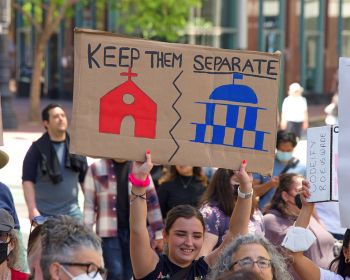
And they're going much further than just cracking the wall. According to the Trump administration's own Religious Liberty Commission, it was never supposed to be there in the first place. On June 26, the commission handed over a 224-page draft report calling for that wall to come down, and a "bridge" to go up in its place, built for "all Americans."
Buried under the rubble: several minority faiths that don't get a single mention, and a wave of active lawsuits from more than 50 denominations over government raids on houses of worship that the report conveniently omits.
What's Actually in the Report?
The commission was established by executive order in May 2025, with a mandate to "offer diverse perspectives on how the Federal Government can defend religious liberty for all Americans." Its 12 members include 11 Christians, many closely aligned with the administration, and one Orthodox Jew. After holding hearings on religious intolerance largely focused on the experiences of Christians, the group finally released its draft report on Friday, June 26.
The report's central argument reframes a familiar phrase. It contends that "wall of separation between church and state," a line from a letter written by Thomas Jefferson which does not appear in the final Constitution, has been "misapplied and weaponized" to push faith out of public life.
That's the demolition plan in the report's own words: swap the wall for a bridge connecting government and religion. Alongside it sits a list of policy recommendations:
- Establish a religious liberty violation phone hotline.
- Create a religion-focused Department of Justice task force.
- Expand school choice funding to more religious institutions.
- Repeal the Johnson Amendment, which bars churches from making political endorsements
- Appoint judges "with a proven commitment to religious liberty."
Is This a Bridge, or a Wall?
The commission members themselves frame the report as restoring balance, not erasing boundaries. The draft insists it doesn't call for "theocracy" or eliminating church-state separation outright, only for recognizing a "tension" built into the First Amendment's two religion clauses. Supporters point to grievances raised in the commission's hearings: coaches barred from praying on the field, students facing pressure to affirm beliefs that conflict with their own, and believers who feel their convictions are treated as suspect in public life.
Whose Liberty Didn't Make the Final Edit?
Critics argue the report answers a much narrower question than the one it was assigned. The Rev. Paul Brandeis Raushenbush of Interfaith Alliance said it "fails to represent and uplift the importance of religious diversity and tolerance for all faiths in our country, not just a special, chosen few." Secular Coalition for America's Steven Emmert put it more bluntly, calling the report "a roadmap for expanding religious privilege" rather than protecting freedom.
The specifics back up that critique: Buddhist, Zoroastrian, Baha'i, and Native American traditions don't appear anywhere across the 224 pages. The documented recent rise in Islamophobia is also largely unaddressed. Its definition of antisemitism ties the term partly to Zionism, describing it as an ideology that denies Jewish ancestral ties to Israel, a framing some Jewish groups have themselves debated. The roughly one-third of Americans who claim no religious affiliation get no mention either.
And perhaps the most blatant omission: more than 50 denominations and houses of worship are suing the administration right now over its decision to end a policy that kept ICE out of churches. A 224-page report on religious liberty, and not one word about it.
Sound Familiar?
Debates over how Christian America's government should be aren't new. ULC recently traced how claims that the nation was founded as an explicitly Christian country resurface in moments of anxiety, from the Civil War to the present. Selective recognition follows a familiar pattern, too.
Earlier this year, the Pentagon cut its list of officially recognized faiths from over 200 down to a fraction, dropping hundreds of belief systems most Americans never knew were being counted in the first place. And the report's silence on the church-raid lawsuits mirrors an ongoing split among clergy over how to respond to immigration enforcement, a question many congregations are already living through, not just debating.
If the blueprint for tearing down the wall leaves out Buddhists, Native traditions, and the fastest-growing group of Americans who claim no religion at all... whose liberty is actually getting protected? And when houses of worship are suing over government raids on their own sanctuaries, can a report on religious freedom that never mentions it still call itself complete?
134 comments
-
 Rev Ned
Separation of church and state is dead?!? Kinda like Iran?!?
-
 Pastor Bobby Roy
As a minister of Jesus Christ, I affirm that the Church must never surrender its voice, its mission, or its moral authority to any government. If the state drifts from God, the Church must stand firm. If the culture abandons truth, the Church must proclaim it. If society rejects righteousness, the Church must live it boldly.
The separation of church and state may rise or fall in the courts of men, but the sovereignty of God never changes, and the duty of His people never disappears.
-
 Rev. Matthew Mastrogiovanni
Pastor Bobby Roy If America is truly built on Christian values, then that'd show in how we treat strangers, the hungry, the sick, the poor, and our neighbors. Faith isn't measured by what you proclaim, but by what you practice. Christian's actions tell a different story. One of hate, scorn, elitism and fear.
-
-
Rev Ned
Christofascists must not be appeased!
-
 Stacey Owens
Correction: Babbling will get you nowhere.
-
 Stephen P Singleton
I'm sorry. I skipped over a lot of the content of the article. It just makes me frustrated and angry. Wonder what they'd do if folks used their "religious liberty hotline" to complain about their own persecution of Baha'i s l, Native American believers and whomever else they've decided is not a Chosen Religion. I guess we need to mount a "full court press" of education that it is precisely the deliberate refusal by Civil Authority to give recognition to any religion, SAFEGUARDS the worship of ALL religions. Part of me wants to go on, but it feels so obvious that I have to stop. No more needs to be said. I've always liked Jefferson's allusion to "Divine Providence" and "Nature's God". That's it. Neutral. Everyone free to specify the details of their own chosen beliefs. Nothing posed on anyone else. There's nothing Christian about White Supremacy and/or Nationalism. In fact, the Teachings of Jesus are pretty radical --for the power hungry of His day AND ours!!!
-
 Bridget Kielas-Fecyk
The 1st Amendment has several purposes. First and Foremost is, of course, the freedom of Speech and Freedom of the Press. However, it serves a second and JUST AS IMPORTANT role. The separation of church and state.
It's exact wording is that Congress shall not pass ANY laws that recognize any religion. That people have the right to follow any religion they wish, no matter what that religion is. OR, to not follow ANY religions no matter what.
What the currently in the white house is doing, and the cronies here parroting him, is attempting to erase the very first, and most fundamental, right this nation gives its citizens and residents. The freedom of, and freedom FROM religion.
You are free to be Christian or not be Christian in this nation. You are free to be Catholic or not be Catholic. Same with being Jewish, with being Muslim, with being Baptist, with being Protestant, with being Pagan, with being Atheist, etc.
There is NO WAR AGAINST CHRISTIANS IN THIS NATION.
Yes I put that in all caps for a reason. A lot of him and his cohorts are constantly trying to hammer the "There's a holy war against us" Bull-hockey. Trying to claim that people who follow THEIR god are "being oppressed" in this nation. Which is 100% manure.
What they are TRYING to do is turn the United States into a brutal, bloody-soaked, Theocracy just like how the Taliban enforces THEIR version of Islam in Afghanistan.
They shriek "No Shariah Law", while at the same time trying to enact laws that are the exact SAME thing but in different wording.
So yeah, if you support the removal of the separation, what you are supporting is the full removal of the VERY FIRST RIGHT within the Bill of Rights that our founders gave us.
You're basically agreeing with them that the very Constitution that our nation was founded on is "illegal".
-
Rev. Matthew Mastrogiovanni
'Religion is what keeps the poor from murdering the rich.' ~Napoleon Bonaparte
https://www.tiktok.com/@junior25jean/video/7655594588660321567
-
Rev Ned
If djt likes walls so much, build one around him. Then, maybe, he could do less harm.
-
 Joseph Grieco
Here's a reminder of where we stood in regard to "Separation of Church and State" in 1787, the year the Constitutional Convention met and drafted the document:
New Hampshire Connecticut and Massachusetts had laws on the books limiting office holding only to members of the Congregational Church.
Maryland had laws specifically restricting Catholics from holding public office.
Virginia, North Carolina, South Carolina and Georgia had laws on the books limiting office holding only to members of the Episcopal Church. Methodists were considered part of the Episcopal umbrella at this time.
The only states with Religious Liberty were Rhode Island, New York, New Jersey, Pennsylvania and Delaware.
In no place in the US Constitution are "G_d", "Jesus" or "the Bible" mentioned. While the Divinity was invoked in the Declaration of Independence, that was a protest letter to King George and Parliament, not the establishing document of our country. While the Articles of Confederation only mention "the Great Governor of the World" in the final paragraph and use "in the Year of the Lord" for the dating at the end.
In Article 1 of the Constitution, it specifically excludes a Religious Litmus test for candidates. It wasn't until the early 1800s that the US Supreme Court determined this, as well as Amendment 1 restricting the establishment of an official "State Religion", extended to the individual states. This was one reason it took so long for Utah's admission to be approved as it was a De Facto LDS state.
Early writings of Madison and others in the Federalist Papers loudly said we were NOT a Christian Nation. In our treaty with Tripoli (the earliest international treaty with a foreign power after the Constitution was adopted), it specifically states we are NOT a Christian nation, but one of Laws.
There is NO requirement that an oath of office be sworn on a Bible. John Adams swore his on a volume of the Law, as did his son. George Washington specifically requested use of a Masonic Bible for his, as he was a Freemason.
"In God We Trust" wasn't added to our currency until the Red Scare of the 1950s and it's fear of "Godless Communism". "Under God" wasn't added to the Pledge of Allegiance until the 1950s, as well. Again, due to the Red Scare.
Look at the major Protestant denominations today. You have at least two recognized bodies governing Lutheran Churches, there are at least three for the Baptists, two for the Methodists and three for the Episcopalians. While they claim a unified voice, even the Latter Day Saints have multiple branches. And this doesn't even take into consideration all the multiple, exclusionary Evangelical "Christian" churches, like that favored by the Secretary of Defense! So, if we were to be a "Christian" nation, which of the Baskin-Robbins selection would be considered the "Official Church"?
So, Texas and Oklahoma, keep your Bibles out of the classrooms! Your King James Version is doctrinally and linguistically incorrect, and I want to hear how a teacher explains Ezekiel 23:20 or 2 Samuel chapters 11 and 12.
-
 ServantOfJudgement
Ezekiel is an easy one. Don't be an unfaithful whore and here's what will happen to you if you choose to be. Super sensible logic on that one.
2 Samuel is an easy one. Don't be an unfaithful whore and here's what will happen to you if you choose to be. Super sensible logic on that one.
Got any more?
-
Bridget Kielas-Fecyk
So you're saying anyone who doesn't follow YOUR version of YOUR religion are filth w.....res?
-
 Patricia Rae Tooke
Ezekiel is a metaphor, so you're kidding, right?
-
Patricia Rae Tooke
Ezekiel is a metaphor, so you're kidding, right?
-
Patricia Rae Tooke
Ezekiel is a metaphor, so you're kidding, right?
-
Patricia Rae Tooke
Ezekiel is a metaphor, so you're kidding, right?
-
Patricia Rae Tooke
Ezekiel is a metaphor, so you're kidding, right?
-
-
-
 Brent
Brent
The little I know of the founding fathers is that they were opposed to religious intolerance, domination, oppression - they wouldn't want the USA to devolve into a theocracy, where one all-too-human understanding of divine will determines policy, ethics, morality, etc.
Church and State must ALWAYS remain separate.
I'm not a US citizen, so I have no "dog in this fight" - except that America's political shenanigans have a global effect.
Peace. Love. Understanding. Freedom Of & From religion.
Jai maa Kali
-
 Martin S
A lot of argument as to the origin of the USA and the meaning behind the words of the Constitution, but no one is looking at the obvious...
Okay, you go along with Christianity being set as the National Religion. That means everyone either converts to Christianity or gets booted out (or most likely murdered by the "Good Christians").
Okay, now you have your "Christian Nation", made up of a lot of denominational groups. Then, one of those groups decides that THEIR denomination is "the right one". Now, The Evangelicals are putting down the Baptists. Whoever has the largest following will take control and those who don't follow them will go the way of the rest of us.
How long before "Father Horice Green of the Central Evangelical Church" (it's an example, so don't bother looking it up) gets a foot in the door and demands that everyone suddenly convert to HIS church?
If you want to allow Religion to take control of the Government, you better be DAMNED SURE you are ready for what that will mean!
-
 Erik Joesph Samys
Our forefathers came to this country because their religions were outlawed by the British government and the Church of England. Which was established by Henry the IIIV so he could divorce his first wife since the Pope wouldn't allow it.
Our forefathers saw how religion corrupted government and government corrupted government. Hence the separation of church and state. It also allowed many people to come to the new world and be a productive member of the nation and have the freedom to worship as they wished. Many of our forefathers weren't even christians. Thomas Jefferson was agnostic and Ben Franklin was a confirmed atheist. Yet many people ignore those facts. The Treaty of Tripoli states in no uncertain terms, "The United States is in no way established on or by religion." Sure the Constitution doesn't directly state it, but when it's stated in treaties you must accept the fact, The United States of America is not, or ever was, a Christian nation.
-
 David Douglas Winters
Try to convince the rest of the world that the USA is not a Christian culture. They will wonder what your home planet is.
-
 Patricia Ann Gross
There is a big difference between a culture and a state religion. The culture is Christian because Christianity has been the majority religion. A state religion compells everyone to believe the same way.
-
-
-
 Cam Kirmser
The "separation of church and state" policy can not be found in the Constitution or its Amendments. It is from an 1802 letter written by Thomas Jefferson to the Danbury Baptist Association. That letter is not a document of law, merely opinion. The opinion of a Founding Father, yes, but still opinion.
The only law that applies is from the First Amendment, "Congress shall make no law respecting an establishment of religion," etc. At the time, Massachusetts - and other states - had a state religion, and this phrase was added to reassure them that the federal government is not empowered to force a change to their policies.
Since then, I believe the restriction on Congress has been blown out of proportion and is used as a battering ram on any pretense of faith.
-
 Michael Hunt
When Jefferson says we have a separation of church and state, he is saying we have that because of the First Amendment. Just because the specific words are not in the constitution, it doesn't mean we don't have separation of church and state.
-
Cam Kirmser
Doesn't mean we do, either - at least, not to the extent many have taken it.
A letter is not law, only the words in the Constitution are.
-
Michael Hunt
And the words in the Constitution's first amendment provide for that separation of church and state... This has long been upheld and confirmed by our judicial system.
-
Cam Kirmser
So was Dred Scott - until the Court determined they had been wrong.
-
Michael Hunt
That is true. However, to this day, no case has come close to overturning case law that affirms the separation between church and state.
-
Cam Kirmser
Likewise for Dred Scott, until it was.
-
-
-
-
-
-
-
 Donald G Magel
Trump has one religion- Trumpism. Get in line, or else. Donnie read that in the German book he kept on his bedside table.
-
Cam Kirmser
Ah, the TDS is strong with this one.
-
 Keith Ramsey
Thanks for showing that hate.
TDS is something made up by those that have been attacking the Constitution for the last eight years.
-
Cam Kirmser
Yeah, that must be it.
So, how does that koolaide taste?
-
Michael Hunt
I don't know; you're the one who's drinking it so why don't you tell us.
-
Cam Kirmser
Ouch. Rush me to a burn unit.
-
-
-
-
Patricia Ann Gross
TDS is only something a bully can use to end a discussion. It's like saying "That's the craziest thing I ever heard," when someone says the sky is blue. It is so absurd that there is no legitimate way to refute it without resorting to childish retorts. Just stick out your tongue next time.
-
Cam Kirmser
Comment has been removed.
-
Michael Hunt
What is immature about Trumpism and the fact that Trump claimed to have a copy of Mein Kampf and Ivana Trump claims he kept My New Order, a collection of Hitler's writings, on his bedside table?
-
David Douglas Winters
The founding fathers were well versed in scripture. So was the populace, including “atheists”. It was considered essential to literacy. The war induced shortage of Bibles available for teaching and admonition was considered sufficiently impactful for Congress to authorize print of the first Bible in the Americas. (Aikin Bible) Americans today are mostly ignorant of the Bible, a basic cultural document. Accordingly, they are ignorant of the fact that the principle of separate structures, functions, and obligations to church and state are laid out by Christ himself. “Give the emperor his due and give God his due.” They are not the sane.
This is expression of their separate natures and functions has been twisted and stomped and ultimately untaught for so long that virtually nobody has the necessary cultural literacy to understand it. Hence we get the ignorant BS one sees spouted here.
-
Michael Hunt
How is this relevant to my comment?
-
-
-
-
-
-
-
 Alexander Clarke
Religion is the greatest evil perpetrated on mankind by man. Religion divides and separates us. Religion gives rise to discrimination. Religion is designed to control what we think, say, do, keep women "in their place, and separate us from our wealth. Religion was created by man.
-
 Keith D
Jefferson was referring to the First Amendment when he made the statement about an impenetrable wall.
Some in the Constitutional Convention made an effort to declare the country "Christian." That effort was defeated, the defeat so resounding as to give rise to the First Amendment's clauses barring interference either way with religion.
The 'bridge' between government and trade should be a terrifying example about building bridges between 'free practice' of anything and the deadly power of government and the financial interests that fundamentally own and control governments.
We have laws to protect people from assault, extortion and other high crimes. Enforce those accordingly; let's not create any bridges that connect capricioys deadly power to choice. In fact, let's burn most bridges that do that.
Government: put your attention on those who, and that which, undermines individual choice and personal sovereignty! End your Meddling!
And those who want to 'fix' others: fix yourself! If you feel a need to aggress to wrest another's will, you are the problem.
-
 Rev. Kev
Governments assert a single religion and religious education for one, primary reason. And that reason is NOT love of God and the sincere desire to improve the lives of the citizens. Just take a look at the people who are behind such movements. Both in the past and present. They are often the most unsavory and corrupt of the lot.
The real reason is in line with their rather obvious goals. Create a populace raised on religious faith with the State as the seat of religious authority and control. Raise a nation of blindly believing "sheep" who accept what the leader says without question. Ignore any other side. Ignore any evidence to the contrary. The leader speaks for God. And we never question God. Or His prophet on Earth.
Such people can be terribly mistreated. They can starve in the face of the elite basking in luxury with full bellies. Don't question. Suffer now for later rewards. The elites deserve their wealth, power, freedom, healthcare, and full pantries since God has certainly shown them favor. The upper class can do no wrong. The peasants happily labor as penance for sins and to show piety and submission to God.
That's history. Seeds for that history to be lived out again have already been planted and are taking root.
He who has eyes to see....
-
Rev. Matthew Mastrogiovanni
Religion is excellent stuff for keeping common people quiet. Religion is what keeps the poor from murdering the rich. It is a tool, not a truth. It soothes fear while masking chains. It fills empty stomachs with hope and empty minds with obedience. It teaches forgiveness for injustice and patience for suffering, while the powerful take without consequence. Preachers promise heaven while the rulers loot the earth. Faith becomes a leash, invisible but binding, whispering that submission is virtue and revolt is sin. The poor pray while the rich plan. The altar hides the hand that takes. Civilization tolerates oppression as long as it is sanctified. Questioning god becomes dangerous, questioning power deadly. Religion is the velvet glove on the iron fist of inequality.
-
-
David Douglas Winters
The UCL is very much politically advocating against their own right (as a church) to politically advocate anything. That is crazy. You’re taking pot shots at your own feet. Your credibility is down the toilet.
-
 Lester
Quite the opposite. Saying we should not have this power does nothing but boost credibility.
-
-
 Randy Michael Mellinger
Donald Trump is 100% right on. This country has lived a liberal lie for way to long. Thomas Jefferson has been misquoted to meet the needs of ungodly people in government. Thomas Jefferson said that the government was to stay out of the affairs of the church, as opposed to English rule where the church had become a puppet of the king.
-
 Patricia Mitchell
If the wall between church and state comes down, religious liberty doesn’t expand — it becomes selective. History shows that when government aligns with one faith, minority religions, non‑religious people, and dissenting Christians are the ones left behind. Removing the wall doesn’t “restore” liberty; it redraws the rules so that some people’s faith gains power over others’ rights.
-
 Roy S. Thorpe
You can be guaranteed that any time politicians meddle in anything that they have their own ax to grind! Most are a bunch of self-serving morons! They will screw this up! Separation of church and existed for good reason for 250 years!
-
 Cheryl
"Render unto Caesar that which is Caesar's and unto God that which is God's." Remember that guy?
-
Cheryl
"Render unto Caesar that which is Caesar's and unto God that which is God's." Remember that guy?
-
 Cisco
Cisco
It's simple a mad man has taken over our country as President. Who is to blame for all this rhetoric? Those who voted him into office again knowing he's a freaking lunatic who apparently has lost his mind just like Biden. There should be an age limit and mental health evaluation for anyone over 50 taking a public servant position prior to running for an election especially the President of the United States. He gets elected again say goodbye to Democracy and the Constitution. We are becoming a third world country slowly and if Trump has his way say goodbye to all your freedoms and way of life.
-
ServantOfJudgement
No. Biden is as sharp as a tack. I believe cnn, msnbc, npr and all Democrats everywhere every time.
How dare you say that about President Biden?
-
Michael Hunt
All Democrats everywhere do not think he's "sharp as a tack." Yeah, people around him lied about his mental competence but people and outlets on the left were very quick to criticize Biden and the Democratic party for running him again despite his clear mental decline.
-
David Douglas Winters
When Creepy Joe Biden finally got exposed as feeble minded, his masters replaced him with a candidate for whom nobody had voted. Yet they tell us DJT is Satan personified.
👆That right there is why DJT is your president.
-
ServantOfJudgement
You said it david and you used all the right words.
You and I received the same number of votes harris did in the primary.
The Democratic party behaves like a dictatorship. In. Plain. View.
-
Michael Hunt
Making this claim while the GOP is actively ceding the legislative branch's power to the executive branch, giving the President more and more immunity for their actions and the freedom to do what they please without any checks or balances, strips you of all credibility. There is one party in America behaving like a dictatorship and it's not the DNC who aren't even in power currently.
-
-
Michael Hunt
How does the DNC replacing their current President running for re-election with his current and future VP have any relevance to someone telling you DJT is Satan personified?
Don't get me wrong, you're right that the DNC's failure to prevent Biden from running for a second term and the subsequent promotion of Harris to the top of the ticket is a large part of why Trump is president. I just don't understand how that at all relates to Trump being an awful human being.
-
David Douglas Winters
It simply illustrates that DJT was the ONLY legitimate candidate, and his election was the natural outcome of that fact being recognized ONLY because he had the balls to stay the honest course and stand on truth. We had the wisdom to vote for him, and your lunatic minority fringe still has not figured that out.
-
Michael Hunt
"he had the balls to stay the honest course and stand on truth."
What truth? DJT is one of the most well documented and prolific liars we've ever had in politics, which is really saying something.
Voting for Trump has lead to a war with Iran and high inflation due to the closing of the Strait of Hormuz, ICE agents terrorizing communities and killing innocent people, deregulation that has led to an increase in the spread of food borne illness, and tax breaks for the wealthiest Americans while the poorest lose their health benefits and federal assistance. That's not even touching the blatant corruption the administration is engaging in to enrich the Trump family and their allies. I'm not sure that adds up to being a wise choice.
-
-
-
-
-
Cam Kirmser
Comment removed by user.
-
-
 James Richard Munro
Comment has been removed.
-
-
 Rev. Carol M Anaski-Figurski
Interesting article.
-
 William M Buzanoski
Our Society is on the edge of a frightening abyss....We are reaching the point of no return....Do you need to hear these immortal words? LET US PRAY! 🙏🙏🙏🙏🙏
-
 Michael Sciulli
Separation between church and state follow the Bible tells everything
-
 Todd Richard Thorne
Tearing down this wall is actually going to be a very bad upsetting thing for millions of people. Tearing it down is going to bring about federal actions to intercede and help create a type of indoctrination of a single religion nation. That will put every other religion or spiritual beliefs as banned and illegal. All of of non-christians are going to be arrested and put into jail for indoctrination and religious re-education training. If this happens, then the writers of Project 2025 win and that means they have finally circumvented the Constitution into a modern day real to life version of two things. George Orwell's book; 1984 and a resurgence of the ideals of Nazi Germany.
-
 Christian
WE THE PEOPLE should never be Banned from our GOD.
"Secularism" is Anti-God and Anti-American
Our BILL OF RIGHTS are to protect All people, even Christians and Jews, that they may be FREE to worship God Anywhere at Anytime.
-
 Rodolfo Perez Jr
I am not sure what your point is, my friend, but secularism is not anti-God and anti-American. We are free to practice our religious beliefs as we deem appropriate. If someone believes different than me, as long as we are respectful and abide by the Law and decency, who am I to be judgmental of him or her. Tolerance is the cornerstone of a strong nation. Keep religious beliefs where they belong, in our private lives.
-
 Bishop William Dusenberry, DD
Advice, from Napoleon; “Those required to worship something, should worship the Sun, because the Sun is the source of all life” and it’s clear, due to the large percentage of Christian’s who supported DJT, that they prefer a king, and a kingdom, after they die, in which they will spend eternity (for ever and ever) governed by the same dictator (a supernatural God) with no “bill of rights “ constitutional guarantees and/or protections— they will never have to vote, nor be able to obtain abortions, and will no longer have to pray every night, “Now I lay me down to sleep, I pray the Lord my soul to keep; if I should die before I wake, I pray the Christian Lord my soul to take!” Because there will be none other than Christians, in the Christian Heaven, there will be no religious issues to waste your eternity discussing. That true Christians prefer a dictator, rather than an elected leader, should surprise no one who has read, and understands, the Christian Bible. Democracy is verboten, for those looking forward to spending their eternity (for ever, and ever) and still working, in the Christian version of Heaven.
-
 Jason Alan Cullen
Comment removed by user.
-
-
Stacey Owens
God's law is spirit and they that worship Him must worship Him in spirit and in truth. The commandments was give by God but it has been interpreted by corrupt men and women. The law of GOD is weak through the fleshly and worldly nature of man. Worldly nature of man is not after the image of God. Is after the lustful nature of man. Man nature is hate. It does not abide in the anointing of Gods Holy Spirit. The nature of man is after his own lust of the world. And man's lust of the world is death. There's is no love, or compassion in him without the love of Christ abiding in him. Without him our judgment is corrupt. As it is written, there's a way that seems right to a man but the end thereof is death.
-
 Dr. Zerpersande, NSC
Irrelevant babble. Aspire to be a preacher, do you?
-
ServantOfJudgement
I'm amazed at how Bible says you'll say that Z. Isn't that weird it knew you'd say that?
How could it possibly know?
-
Dr. Zerpersande, NSC
Cults predict what’s going to happen all the time. They drill it into the acolytes’ heads that people are going to tell them that the teachings are wrong but these people that are telling them that are really the wrong ones. No surprise there…. you cultist.
The only difference between a religion and a cult is the size of their followings.
-
Stacey Owens
Your tongue is so unruly. You speak as a beast, to crush anyone's comment. Your a roaring lion, you can't save you crush for the credit because your Dr. Z. You lean to your own understanding. Christ is not in you because your message is death. Because with you it's personal. You need to let go and let God. He is the life. Babbling with get you nowhere. You need to speak in the love of God. God's word is life not judgment. We're not living in the old dispensation. We live in the grace of God. Not in enmity. Praise God.
-
Dr. Zerpersande, NSC
Touched a nerve, huh? All I pointed out was that xtianity and the nonsense of David Karesh, Jim Jones and the many other cults is the length of their membership roles and somebody ratcheted up the tension on the undergarments.
Religion is a socially accepted form of insanity. It’s compartmentalized along with your family, the country you were born in, your national culture. And people simply do not open the door to that compartment and compare it to reality because they conflict harshly. You can keep the door closed as long as you want to. All I’m asking is that you cease and desist in attempting to pass laws that force other people to recognize your bronze age, nomadic, desert goat herder mythology.
When you do that, I’ll treat you just like people that believe in astrology and homeopathy and crystal power and that Chinese thing where you change your life by re-organizing your furniture and making it sure it’s pointed in the correct direction. Which is to smile, not my head, and relocate my body, so I don’t have to listen to the nonsense.
-
Stacey Owens
You speak like you do know and testify that you have understanding but religion is designed to control the masses. But the relationship with God Himself is inspired. A moving of the heart and soul. Religion binds, it has no liberty. It causes one to judge others. It leaves no room for understanding. Hindering the glory of God to testify of Himself. He is the witness. Once a person uses Religion it cancel the witness of God. Giving the glory to the Religion. The believer only testifies of God not the Religion. Once the Religion or a church is testify of itself. It causes the followers to believe the religion of a church is the church of God not understanding they are the church themselves. Religion is not the power of God its of the world, its a institution. You have to join to be apart of it. As for a believer, he has entered the kingdom of God by faith. Knowing the power of God is salvation through Christ Jesus.
As it is written, "Eye has not seen nor ears have heard the things that God has prepared for them that love Him."
It's called eternal life through Christ. The author and finisher of our Faith.
-
-
-
-
-
Stacey Owens
Your inspiration is your own understandinh, your carnal mind. You never aspire to become anointed by the spirit of truth. If you did, you would know who I am. I am that I am. I'm not claiming to be a doctor, speaking of myself. Your papers identify who you are, my identity is what I am. I don't claim the Word of God it self claims I am. To you, God is babble, because you can't hear Him whom He has sent. I am Christ's. All this is from God, who reconciled me to Himself through Christ and gave me the ministry of reconciliation through Christ: God was reconciling the world to Himself in Christ, not counting men’s trespasses against them like you do. And He has committed to me the message of reconciliation. Which you deny and call babble.
-
Dr. Zerpersande, NSC
Responding to my accusation of ‘babble’ by blathering forth with yet another even more extreme example of worthless babble.
Hey!! Can you speak in tongues and write it out?
-
Stacey Owens
The tongue is designed to bear witness of God. Your tongue only is the evidence of yourself. The tongue of error. You only bear witness of yourself. The spirit of error.
-
Dr. Zerpersande, NSC
Tongues have several purposes. Depends on the animal. Ant-eaters hunt with them. Snakes see with them. Dogs lick ‘themselves’. You know why dogs do that?
Because they can. 🤣
-
Stacey Owens
Now your being ridiculous. What you don't understand, it was the tongue of your imagination that cause you to be who you are today. You believed in the thoughts speaken in your imagination that allowed you to succeed. It was just the people in your life who gave you conformation to believe you was right. No one didn't share it with you first. It was the tongue of God that ordered your steps according to your imagination. You wouldn't be who you are today if it wasn't for God's utterance.
Everything thing in this world was a thought someone believed in. It's called a unknown tongue. Which was God. You talk with God everyday. You just don't know you were declaring the glory of God. You didn't give Him the glory.
The thing is, animals don't have thoughts, they just do. When men just do, men are transformed in to beast like animals and the results as you know like bears, snakes, dogs, wolfs and so on, it's destruction. These people are deceived. They can't tell differentiate because they don't have ears to hear what the spirit has to say. This is why these animals are animals and don't listen, they don't have imagination. All they know is destruction.
They just do, because they can. But man has a conscious. Think about it, do you think on impulse like an animal l or do you take thought before you act?
If you answer right, you act on your imagination which is the word of God: love, joy, peace, long suffering, self control, gentleness, faithfulness, goodness,
Against this nature there is no order.
-
Dr. Zerpersande, NSC
Tongue of imagination? That sounds kinky.
I stop responding when threads get the formatting results in only two to three words per line. Say something else in another thread that sounds like a backwoods hillbilly preacher and I’ll respond again.
Good tongue!
-
-
-
-
-
-
-
 Dr Dennis Chevalier PhD, DDvin
It is amazing. That absolutely the majority here. Have no clue where they came from, what they've been through and where you're going. You just spout off wonderfully sounding quotes that don't exist anywhere in history and then demand. That others listen to you. You are completely delusional and you need official professional help.
-
Michael Hunt
You're referring to SoJ, I assume.
-
ServantOfJudgement
President Obama: "Whatever we once were, we are no longer a Christian nation—at least, not just. We are also a Jewish nation, a Muslim nation, a Buddhist nation, and a Hindu nation, and a nation of nonbelievers"
He's right. We are no longer a Christian nation. He admitted we once were.
Your president disagrees with every single lefty here. He won a peace prize before he even served a full year. That's how smart he is.
-
Michael Hunt
What does your comment have to do with you misattributing a quote made in 1956 from an anti-Semitic, White nationalist journal to Patrick Henry?
"Your president disagrees with every single lefty here. He won a peace prize before he even served a full year. That's how smart he is."
What? First off, I never claimed allegiance to any politician, let alone Obama, but I'm glad you recognize he's actually smart. Second, he's claiming that for decades, Christianity dominated our society and controlled how people lived, not that it was founded that way. Last, even if he's literally saying that America was founded as a Christian nation, that would still make him wrong. Why is it so hard for conservatives to understand that liberals don't all blindly worship our leaders? The vast majority of us are just as critical of Democrats as we are Republicans.
-
ServantOfJudgement
I was fooled by that fake quote Michael. Not a big deal. We all get misleading info from time to time. Ya got me. Go have a beer to celebrate.
Your president Obama is a guy that says we were a Christian nation. You want a legit quote from me, that's one. Biden said was the first smart clean cut black politician, or something like that. Biden is very racist against blacks.
As far as blindly worshipping your leaders or not, Kamala Harris was who the left was told to vote for and they did. I received the same number of votes she did in the primary.
You can tapdance around that in your head all you want. She was selected not elected and the left filled the order issued to them.
I seen it with me own eyes on live tv. We all did.
-
Michael Hunt
There's nothing to celebrate about you being fooled and getting misleading info. It's disheartening to hear how often our society is consuming information that is false and accepting it to be true at face value. I bring this up to you in the first place to point out how you might be consuming more misleading and deceitful information than you realize.
Again, Obama is not "my president." I addressed all of that in my previous comment.
I don't understand at all why the rest of your comment is relevant in the slightest. This was about the separation of church and state and now you're ranting about how Biden is racist and how liberals are blindly following orders because we voted for the person who was VP after the president dropped from the race. I'm absolutely angry at the DNC for the debacle of 2024 but it wasn't like they all of a sudden said, "this random new person is our candidate now" and everyone replied, "yes, master." There were lots of liberals outraged by how Kamala ended up the candidate but she was effectively on the same ticket with Biden during the primary elections so, if you have to replace your candidate after the primaries, the VP would be the most logical choice. Despite that logic, plenty of people didn't vote for Kamala because of how she became the nominee and, because of our effective two-party system of government in the US, lots of people ended up voting for her because they would rather have Harris be president than Trump.
Don't believe everything you see on TV or the internet for that matter. There are plenty of propaganda outlets pretending to share news when they're actually lying to support their agenda.
-
-
-
Keith Ramsey
Hmm. You are twisting his words.
President Obama: "Whatever we once were, we are no longer a Christian nation—" - Whatever we once were doesn't mean we were a Christian nation, we were never a Christian nation. We are and have been a nation where you can be Christian...or any of our other more than 1000 religions.
-
ServantOfJudgement
Keith, if we are no longer something, logic states that we once were that which we no longer are.
This is what he said and logic lets us safely give definition to it.
-
Michael Hunt
That doesn't mean we were founded as a Christian nation, which is what I believe Keith is getting at. It means Christianity had become the dominant, controlling religion in America and that is no longer the case today. We're no longer hostile to other religions other than Christianity like we had become in the past century.
America is not meant to be a Christian nation, even if it had effectively become one at one point.
-
-
-
-
-
David Douglas Winters
Yet you have no degrees in law nor theology nor even any serious undergraduate degree or other serious credentials? Your admonitions appear empty. David Winters (Juris Doctor Attorney at Law admitted before the United States Supreme Court) See how legitimacy works now?
-
-
 Rev. B.D. Rees
The FIRST AMENDMENT of the Constitution plainly states: "CONGRESS SHALL MAKE NO LAW RESPECTING AN ESTABLISHMENT OF RELIGION, OR PROHIBITING THE FREE EXCERCISE THEREOF".... That's pretty plain that the sitting Government or ANY sitting Government is NOT ALLOWED by LAW to establish a NATIONAL RELIGION!! It is also PROHIBITED, BY LAW to interfer with anyone who wishes to practice their Religion on their own.... What part of the FIRST AMENDMENT do these people NOT UNDERSTAND??
Project 2025 wants to establish a National Religion despite the First Amendment and it's subsequent clauses... This tells me that our present administration wants to replace our Declaration of Independence and our Constitution with some kind of NEO NAZI NATIONALIST TRASH RELIGION, and certainly NOT one that Christ would approve of!! I will certainly NOT appove of or Follow these kinds of Bigots and will oppose them with my whole being!!
-
Dr. Zerpersande, NSC
And the antics of these buffoons is hopefully galvanizing the general populace to take action, first in the upcoming elections.
-
Joseph Grieco
Ironically, those who are the loudest in denying the existence of Project 2025/Agenda 47 are also the loudest in demanding the Country implement the tenets of said documents. And their rabid followers believe every word they are told.
-
-
-
 Keoni Ronald May
Many people have forgotten, that God’s laws, predated man’s laws, and led to the evolution of statutory laws and common laws.
-
Dr Dennis Chevalier PhD, DDvin
Keoni,
Well said!
Dr. D
-
Keith Ramsey
It is a lie. Not well said at all.
-
-
Dr. Zerpersande, NSC
If you believe that Bronze Age, desert goat herder nonsense.
-
Keith Ramsey
Yeah, I disagree with this assumption. And this is just an assumption.
-
James Richard Munro
99.5% of layers give the rest of them a bad name. Pastor Jim
-
-
 Robert Hauck, MD, FAAP
For an insightful expose of the Christian radical right and its campaign to create in our country a Christian theocracy read John Fugelsang's "Separation of Church and Hate."
-
Dr Dennis Chevalier PhD, DDvin
I have said it before here and on other bulletin boards in this organization, there is way too much hate here. How can any of you? And in this entire organization? Claim to be a minister to promote the well being of your constituents/parishioners; and have this much hate in your soul. My God.
Dr. D
-
Michael Hunt
I fail to see how anything Robert said would equate to him having hate in his soul. Why must you project that on him?
-
Dr. Zerpersande, NSC
Maybe because he’s nota xtian? We’re all hateful and going to hell.
-
-
-
-
Dr. Zerpersande, NSC
“The government of the United States is not, in any sense, founded on the Christian religion.” John Adams
"And the day will come when the mystical generation of Jesus, by the supreme being as his father in the womb of a virgin will be classed with the fable of the generation of Minerva in the brain of Jupiter. But may we hope that the dawn of reason and freedom of thought in these United States will do away with this artificial scaffolding, and restore to us the primitive and genuine doctrines of this most venerated reformer of human errors." Thomas Jefferson
-
ServantOfJudgement
Patrick Henry:
"It cannot be emphasized too strongly or too often that this great nation was founded, not by religionists, but by Christians; not on religion, but on the Gospel of Jesus Christ. For this very reason, peoples of other faiths have been afforded asylum, prosperity, and freedom of worship here."
Now what?
-
Michael Hunt
Patrick Henry never said or wrote that. "Rather, as Willamette University professor Seth Cotlar pointed out, the quote appears to originate from a 1956 edition of The Virginian, a magazine known for espousing antisemitic and white nationalist views."
https://wordandway.org/2023/07/06/josh-hawley-tweets-fake-quote-about-us-founding-sparking-allegations-of-christian-nationalism/
-
Dr. Zerpersande, NSC
“Despite the criticism, Hawley has not yet deleted the inaccurate tweet.”
And at this point in time, neither has Server OJ.
-
-
Dr. Zerpersande, NSC
Hmmm, maybe that is why he wasn’t someone that signed the document. Jefferson’s statement….did Jefferson sign?
-
ServantOfJudgement
Golly guys, it must hurt to know the nation was Christian and even those few that weren't, were taught the stuff as children. Biblical principles were in everyone's head even if the didn't know it.
Samuel Adams, one of the signers said: "Religion and good morals are the only solid foundation of public liberty and happiness".
They all knew what Jesus Christ brought to the table. The people that elected them knew. The king of England found out but it took a while.
Don't take it so hard, you've got you way today, we are no longer a Christian nation. That's why they're crapping in the streets today and burning neighborhoods down for vile criminals that died on the job. Pretty obvious we're not a Christian nation.
-
Dr. Zerpersande, NSC
“ He and other Founding Fathers frequently argued that the success of the American republic depended on the virtue of its citizens, rather than just its laws or government institutions.”
Which brings me to your statement that “They all knew what Jesus Christ brought to the table.”
If they frequently argued about that point that would indicate that YOUR OPINION that they all knew what JC brought to the table is just that, your opinion.
Thomas Jefferson had a very low opinion of Christianity. I think you know the quote that I’ve perhaps posted in this thread already.
-
-
-
Dr Dennis Chevalier PhD, DDvin
Amen, my friend.
Dr. D
-
-
-
 Mary Haviland
the separation of church and state never existed as a law any way. It was never a real thing. It can't be destroyed if it wasn't never alive. It was all a wild fantasy.
-
Jason Alan Cullen
Comment has been removed.
-
 Clay Serenbetz
The Establishment Clause of the First Amendment was interpreted by our Founding Fathers as seperating Church and State. For example, Thomas Jefferson in an 1802 letter to the Danbury Baptists, described the Establishment Clause as building a "wall of separation between Church & State."
-
Keith Ramsey
Except that it did exist and still does.
-
-
Bishop William Dusenberry, DD
One of the major objectives of the French Revolution was to eradicate religion— they started by adopting a new calendar— beginning with the Christian year of 1789, and the first identifiable sociologist, Auguste Compt, hoped that adequacy educated sociologists would replace all the priests, —- by then, even Napoleon had concluded, that if the RC Church, had more staying power that the French military — and threw in the towel— and had the Pope crown him Emperor. Even Nietzsche’s Zarathustra gave up informing humankind, that “God is dead” (not that the Christian God ever existed in the first place— just that development in the physical sciences had rendered all gods unnecessary. The demagogue DJT truly mastered the art, of using a mythological deity to hide his Epstein involvements. Hopefully Zarathustra will return in a few years, and announce that God is really dead, thanks to Nature’s God as per the US Declaration of Independence, via Thomas Jefferson.
-
ServantOfJudgement
I hear france is lovely now that they've eradicate God.
Firey but peaceful is the phrase nowadays.
-
Dr Dennis Chevalier PhD, DDvin
lol
😂
Dr. D
PS I hear they also have. Some battle rifles that have been. Dropped once and never fired. LOL. That's a joke, people.
-
ServantOfJudgement
You joke Dr D, I have a French WW2 rifle. It's in mint condition...
-
-
-
David Douglas Winters
The ULC appears to be politically advocating against its right to politically advocate. Have you tried breathing into a paper bag?
-
-
 Michael Burton
The First Amendment states that there shall be no establishment of religion and that religious practices shall not be interfered with. James Madison saw that in England, the King was the head of the country and the head of the Church of England; he saw the mischievous way that worked and wanted nothing to do with it. He was right then, and it is right now. Any 'Commission" with all its loopholes is a waste of time and violates the First Amendment
-
 Merlin
Religion is a political tool to help control the masses through fear. Keeps the population ignorant and uneducated, Educated and fearless ask questions that can expose the darkness of any authority.
-
Keith Ramsey
This is accurate if you study history. They don't make it clear that only a very small % of the population could read and write 400+ years ago.
-
 James Bullard
Christianity owes its dominence to the Emperor Constantine. He called together the Council of Nicea to unify the many sects of Jesus followers who had widely differing views of Jesus and his teachings. The Catholic church was the result and Constantine's objective was to unify his empire under his rule with the authority coming from GOD. Of course, Not everyone agreed and Christianity continued to split into a miriad of major and minor religions.
Various followers have tried for centuries to reinstitute their particular form of Christianity as the official, or government privileged religion with all sorts of disasterous results for humanity. It was that history that the founders knew and wished to avoid. We should reflect on that history as they did and keep religion and governemnt completely separate.
From a Biblical perspective we should note that Jesus never attempted to get the Roman government to accept his teachings. The teachings were directed at individuals and only those inviduals who were willing to listen. He was crusified over an attack on the temple priests who were were in cahoots withthe Roman government.
Mark 6:7-13 English Standard Version Jesus Sends Out the Twelve Apostles 7 And he called the twelve and began to send them out two by two, and gave them authority over the unclean spirits. 8 He charged them to take nothing for their journey except a staff—no bread, no bag, no money in their belts— 9 but to wear sandals and not put on two tunics.[a] 10 And he said to them, “Whenever you enter a house, stay there until you depart from there. 11 And if any place will not receive you and they will not listen to you, when you leave, shake off the dust that is on your feet as a testimony against them.” 12 So they went out and proclaimed that people should repent.
Arguably, Jesus would class the megapastors of today who lobby for the a Christian government, live in vast mansions and flying in private jets as hypocrits, just like the temple priests he attacked and he would deny knowing them.
-
-
 Najah P Tamargo
Najah Tamargo-USA
The founding father's name came here so religious freedom could exist. And separation of church and state is a fundamental reason. Who are these people to tell us what religious beliefs are accepted and what's not?
-
Joseph Grieco
The Southern Colonies were strongly Church of England and required membership in that body to hold office.
Massachusetts Bay and Plymouth Colonies were founded because they couldn't force the rest of England to worship the way THEY wanted, so they came here and demanded everyone worship in THEIR churches using THEIR liturgy.
"New Sweden" (parts of New Jersey, Pennsylvania and Delaware) were founded for Lutherans.
While New Amsterdam (NY, parts of NJ and Connecticut) were founded by members of the Dutch Reformed Church, being from Netherlands they were open to all faiths.
Maryland was founded as a Catholic Colony. By the 1780, Catholics were prohibited from holding offices.
Tell me again about religious freedom.
-
James Bullard
Those are among the reasons the writers of the Constitution and the Bill of Rights chose to separate religion and state.
-
-
-
Clay Serenbetz
Sadly, if you listen to Fox News it is. The religious right was extolling the virtues of America as a country founded on its belief in God. I guess any Jews, Muslems, Hindus, Buddhist, etc wll fall under Stephen Miller's personna non-grata list and be kicked out irrespective of their existing citizenship status. Trump's henchmen will employ racist, sexist, misogynist, xenophobic, ageist, ableist, etc discrimination going forward to ensure their "perfect" ethno-Christian state prevails.
-
ServantOfJudgement
Your basic low level beginner historian will tell you the 13 colonies fer filled to the brim with Christians, over 90 percent.
Those Christians paved the way for you freedom to hate them.
-
Patricia Ann Gross
SOJ,
But those 90 percent had the human decency to respect that their beliefs weren't the only ones that were valid, and should be allowed to be practiced as their religion and doctrine required. The 10 percent that are left also deserve to be heard, respected and allowed to practice. That includes the Christian denominations that some fundamentalist Christian "cults" do not consider Christian: In particular Roman Cathoic, Unitarian Universalist, and LDS (Mormon).
-
Keith Ramsey
That is not an accurate statement at all
-
Dr Dennis Chevalier PhD, DDvin
Truth!
Dr. D
-
James Richard Munro
I hear so much about hate on this sight. One of my Nabors is a born democrat, and an atheist. I'm a republican and believe in God. We are best friends. We agree to disagree, but we don't hate each other. We respect each other's beliefs. No hate here. I'm not going to change him, and he is not going to change me. Same for the Alphabet people. The majority say that you love them or you hate them. Disagreeing with something doesn't mean you hate them. It simply means, you disagree. I don't try to change him, and he doesn't try to change me. Am I getting through here? Pastor Jim
-
ServantOfJudgement
Yes
-
-
-
-

I have read the article, and have injested the comments thus far including my own. It's pretty amazing when one looks and truly digests the words of this article, that a "SITTING GOVERNMENT" wants to disreguard the Constitution and the Bill of Rights in order to further their own adjenda. It further amazes me when I see how the Government is willing to do and go to such corrupt lengths to disreguard the 1st Amendment so completely!! The "TRULY SAD" part of this whole thing is that the Republicans in Congress and the Senate are willing to turn a blind eye and lend an enabling had to help him corrupt the Government so completely!! When will this STOP? What is it going to take to find people to administer our Government at the will of the people, not the will of one party over another!! This is but one example of a CORRUPT GOVERNMENT and my brothers and sisters I for one will take no part in this corrupt enterprise!!