

The name came to him on the way to a funeral wake: Cindy Lou. He heard it over and over, though he had no idea who Cindy Lou was.
The man behind the wheel was Rob Gutro, a meteorologist who worked at NASA's Goddard Space Flight Center. He believed someone who had died was trying to pass along a message. At the wake, he approached his colleague, Cynthia O'Carroll, and told her the name he'd been hearing. She began to cry. "My dad used to call me Cindy Lou," she later told The Washington Post.
Gutro, who has since retired from NASA, has written books about ghosts and says he can communicate with the dead. His scientific training hasn't dissuaded him. "I'm a scientist, so I have to prove everything," he told the newspaper.
It's the sort of story that might make you wonder how someone devoted to science can also believe in ghosts. But new research suggests something surprising: Americans who combine religious faith with independent, scientific thinking may actually be more likely to believe in ghosts, curses, and other supernatural phenomena. Why?
What is a "Secular Rationalist"?
Researchers from Baylor University, Carson-Newman University, and American University examined responses from 1,812 Americans in the 2025 Baylor Religion Survey. Their study, published in Social Forces in July, found an unexpected combination of beliefs.
The researchers measured what they call "secular rationalism," which sounds as though it ought to exclude religion entirely. Here, though, secular describes where someone looks for answers, not where they spend their Sunday mornings. People who score highly on this measure say science is the way to understand the world, morality should be grounded in reason rather than religious teachings, and individuals should interpret spiritual questions for themselves instead of deferring to religious authorities.
Someone can therefore believe in God, go to church, and still think the pastor shouldn't get the final say on what is real.
Among respondents who believed in God, 40% of those embracing secular-rationalist ideas scored highly on a measure of belief in magic, compared with 19% of those who rejected those ideas. Among people who attended religious services, the figures were 28% and 19%. The questions covered six supernatural phenomena, including ghosts, curses, and communication with the dead; those percentages don't refer to ghosts alone.
The association disappeared among people who didn't believe in God or never attended services. The intriguing group, it seems, consists of those keeping some religious beliefs while reserving the right to decide for themselves which other supernatural possibilities to accept.
Interestingly, our previous reporting on the spiritual beliefs of religious "nones" found that even Americans who reject organized religion frequently retain beliefs in spirits, magic, and the afterlife.
We suspect this new research might be particularly interesting to ordained ministers of the Universal Life Church, many of whom maintain spiritual beliefs while also placing a high value on personal independence, science, and freedom of thought. Dear reader, does this sound like you? And if so, what does that say about your relationship with the supernatural?
Who Gets to Believe in a Ghost?
Religious authorities have spent centuries drawing boundaries around the supernatural. An angelic visitation may be welcomed as a miracle. A séance might be condemned as forbidden magic. The person reporting an encounter might not find the distinction so obvious.
The family of John Wesley, who later founded the Methodist Church, ran into this problem in the winter of 1716. Strange noises shook their rectory in Epworth, England: knocking, footsteps, clattering, and groaning. The family nicknamed the supposed culprit "Old Jeffrey." Wesley's mother, Susanna, first suspected animals, but later became convinced the sounds had no ordinary explanation.
The timing was awkward. Wesley's father had recently preached against local people consulting folk healers and diviners known as "cunning men." Now his own household was entertaining the possibility of a ghost. John, away at school during the disturbances, collected the family's accounts afterward and retained a keen interest in supernatural reports throughout his life. And he wouldn't have to look too hard...
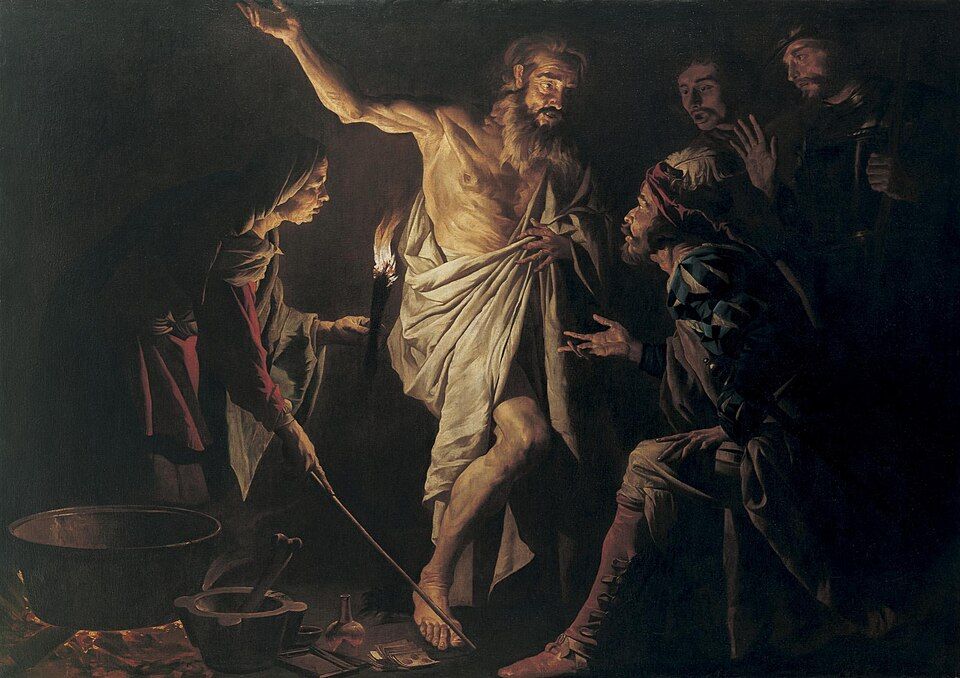
You may be surprised to learn that the Bible itself includes a ghost story. In 1 Samuel 28, King Saul, terrified by an approaching army and unable to get an answer from God, secretly visits a medium in Endor, despite having previously outlawed mediums himself. He asks her to summon the dead prophet Samuel. When Samuel actually appears, the medium lets out a scream. Samuel then delivers some terrible news: Saul and his sons will die the following day. Saul collapses in terror.
And the ghost, as it turns out, mostly got it right. The Bible later recounts how Saul and three of his sons perish in battle against the Philistines. Wounded by archers, Saul falls on his own sword rather than risk capture. Another son, Ish-bosheth, survives and eventually succeeds him. In 1 Chronicles 10:13, Saul's decision to consult a medium is explicitly condemned as a sin. Apparently, even a genuine encounter with the dead could be considered a terrible transgression.
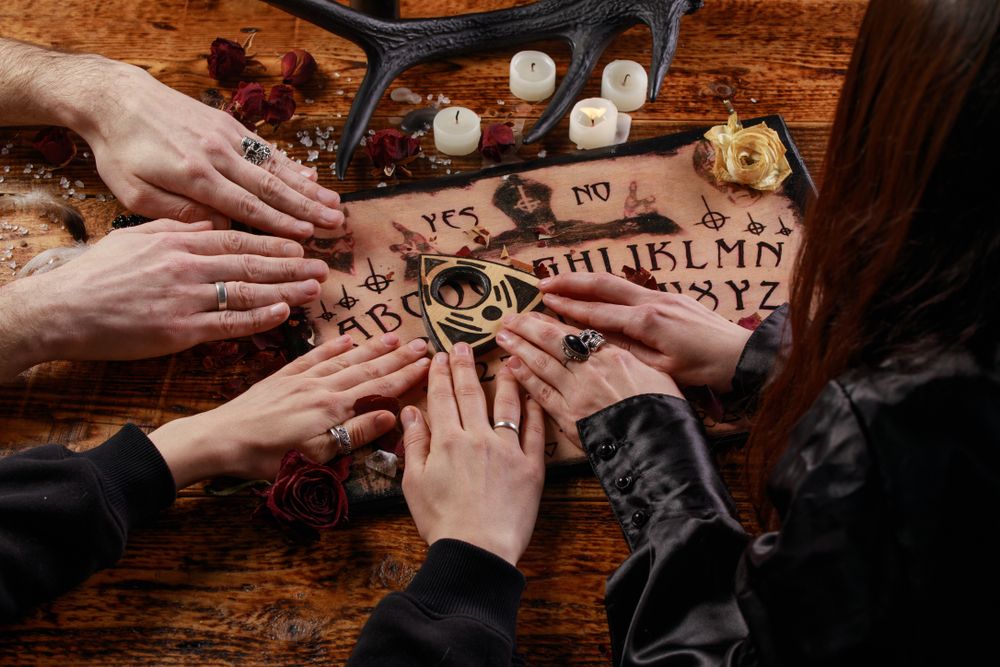
Of course, divination hasn't disappeared in the thousands of years since Saul's supposed encounter. Our own ministry store even carries a wooden divination board and pendulum for those interested in seeking answers to life's mysteries through supernatural means.
Not everyone in the religious establishment is comfortable with the possibility of ghosts. The evangelical Christian ministry Got Questions rejects the idea that deceased human souls might wander the earth, suggesting that supposed hauntings may instead involve demons impersonating the dead. Its warning is blunt: "The demons surely laugh at the spiritual mass-deception that exists in the world today."
Similar concerns about demonic influences are at the heart of ongoing Christian disagreements over Halloween, with some believers warning that celebrating the supernatural can invite dangerous spiritual forces into people's lives.
But other Christian authorities are considerably more receptive. Catholic priest Father Dwight Longenecker, who has investigated reported hauntings himself, recalls meeting a widow who claimed her deceased husband appeared in her living room every evening, carrying his customary cup of cocoa. After considering similar accounts, Longenecker concluded that "there are indeed such things as ghosts." Although he also warned that supposed spirits could be demons in disguise.
The Catholic Church itself teaches that human souls survive death, but has no general doctrine declaring that ghosts haunt houses. And yes, the Church officially performs exorcisms, although those rituals address demonic activity rather than departed human souls. The Catholic Catechism is unequivocal about trying to contact the dead: "All forms of divination are to be rejected," it declares, explicitly prohibiting the use of mediums and attempts to summon departed spirits. Believing a deceased loved one might appear is one thing. Attempting to summon them is quite another.
Such prohibitions haven't stopped people from experimenting with the supernatural, as evidenced by the growing popularity of online spellcasting and curses
When the Dead Come Home
Elsewhere, encounters between the living and the dead have long been woven into accepted religious practice.
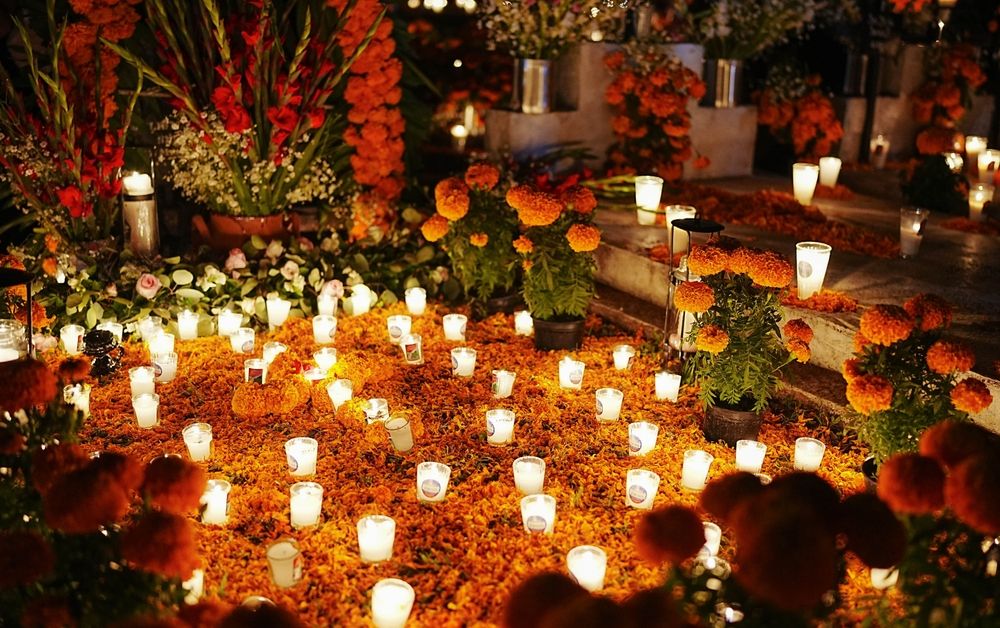
In Mexico, Día de los Muertos, or Day of the Dead, brings families together to welcome the spirits of deceased loved ones. In communities that observe the tradition, families lay out favorite foods, candles and marigold petals to help guide the returning souls. The celebration blends Indigenous beliefs with Catholic observances around November 1 and 2. For participants, the visit is generally an occasion for remembrance and reunion rather than fear.
And in Malaysia this August, thousands gathered for the Hungry Ghost Festival in Bukit Mertajam. Worshippers offered prayers and gifts before an enormous paper figure of Da Shi Ye, the Guardian God of Ghosts. The festival draws on Buddhist, Taoist and Chinese folk religious traditions, with particular attention to spirits who have no living relatives to remember them.
"The main purpose is to look after wandering spirits," organizer Lee Kim Fong told the Associated Press.
These ceremonies are established traditions, rather than the independent magical beliefs measured in the American study. But they offer a useful contrast: A spirit's return can be understood as a cherished family visit, an obligation to the dead, a forbidden act of divination, or a frightening haunting, depending on the religious framework people bring to it.
For American Spiritualists, meanwhile, communicating with the dead isn't some forbidden curiosity. It's a foundational element of their religion. The National Spiritualist Association of Churches declares: "We affirm that communication with the so-called dead is a fact, scientifically proven by the phenomena of Spiritualism." The organization's insistence that communication with the dead has been scientifically proven is particularly striking, given the new research exploring how people reconcile scientific thinking with supernatural beliefs.
Belief Without Permission
Consider the competing messages religious believers receive. One pastor warns that ghosts are demons in disguise. Another priest believes they're departed souls. The Catholic Church forbids summoning the dead, while Spiritualist churches consider communicating with them an expression of faith. So who's right? The Baylor researchers found that people who trust their own judgment on such questions, rather than simply accepting religious authorities' answers, are particularly likely to embrace supernatural beliefs when they also retain religious ties.
For one believer, the dead belong in heaven, hell, or purgatory, not wandering around an old house. For another, an encounter with a deceased relative might feel entirely compatible with prayer and belief in an afterlife. Trusting science to explain a thunderstorm doesn't necessarily stop someone from wondering what happened when a familiar voice seemed to speak in an empty room.
The personal pull of these experiences is hard to overlook. In a 2023 Pew Research Center survey, 38 percent of U.S. adults said they'd felt that someone who had died was trying to communicate with them. Thirty percent reported personally encountering a spirit or unseen spiritual force. Belief in ghosts isn't confined to people who reject science, and it doesn't sit neatly inside any one religious tradition.
Which brings us back to the wake where Cynthia O'Carroll heard that old nickname. Gutro interpreted what happened through his belief that the dead can send messages. For O'Carroll, the words carried something even more immediate: a reminder of her father.
With Halloween approaching, we want to hear your stories. Have you ever seen a ghost, felt the presence of someone who'd died, or experienced something you still can't explain? Tell us what happened in the comments.
78 comments
-
 Dr Dennis Chevalier PhD, DDvin
Attention all Christians on this blog look at the topics that we have and how fast responses have added up from the top of Pagan rituals evil remnants and deviant actions. It shows all the Pagan and deviant believers on this blog site. This should alarm you and scare the hell out of you as well as invoke pity for they are and when they die hell is the only destination left. This is why we have such a problem here on this site with all of the naysayers, the deviants and the delusional fake bishops and fake pastors who claim to have flocks and have never preached a day in their life nor had they given their life to the LORD the Creator of everything. They have never given from their very life to those who have less. I say stand up now Reply below reply to my message and see what happens. They will go ape sh$* over this. Get over what is risked here and those who reply who don’t claim the one true God is everything. Take a stand for if you don’t stand for something you’ll fall for anything.
Dr. D
-
 James Riggle-Johnson
Umm… The Universal Life Church is not simply a Christian Church. It is a conglomeration of almost everything. If you expected to find only Christian topics here, you are in the wrong place. Save yourself.
-
Dr Dennis Chevalier PhD, DDvin
Apparently I wasn't talking to you
-
-
 Patricia Ann Gross
Dr. DC.,
How does a topic around "Ghosts" imply deviant actions? Prior to 1960s, all references to the Holy Spirt, were Holy Ghost, which some denominations still use (by the way). I'm not sure what your point with this condemnation is. Much of the discourse on this thread has been associated with Christian spirituality.
-
Dr Dennis Chevalier PhD, DDvin
I have no clue as to what the hell you're talking about nor do I care to I told you to leave me alone and I damn sure meant it
Dr. D
-
-
-
 Dr. Zerpersande, NSC
So the ‘NASA aspect of the story, the thing that caught my attention in the newsletter I received, gets one good paragraph taking flight into the usual b.s. related to ghosts?
And even then the coincidence relied on the frequent use of both first and second names when the second name is ‘Lou’.
Superstitious nonsense that, is of course, very relevant to the religiously delusional worldview of some folks.
-
 Jennifer Roussel
I have been able to communicate with the dead since childhood. I am not frightened by it. I was raised in a fundamentalist church and learned early on not to speak of it. In the past few years, I have talked to two of my brothers that I was very close to and to my granny who I loved dearly. Those are only a few examples. One woman told me that I had demon possession. She is one of the most promiscuous women I've ever met. I don't give her opinion much credence.
-
 Sir Lionheart
Without a doubt, the brain is indeed a very complex organ. I had a very religious aunt that told me she spoke to her God every day, and even insisted she got replies from it, bless her. I know she meant well, that’s all that mattered, and she obviously got a great deal of comfort in her daily ritual until she passed on.
🦁❤️
-
-
 Truebluebethy
I have learned to be quiet and to listen to the messages that come to me from my creator. I also understand that messages, nee thoughts which come to me are the energetic expressions of the people, places and things who send them. If my deceased brother, Alan, pops into my head, I know he has come to share his love with me, or to give me a specific message. There are others who I don't know who come to me, to work out stuff for themselves and for me as well. We are all so deeply interconnected. It took me 35 years of commited meditation, working with a spiritual teach and cleaning out my own soul to humble myself enough to be quiet, and out of it I received a great trust in myself and what I know to be real and what is fictional. I really like the way this article was written because it's so true, we must trust ourselves.
-
 Dudley Stephen Baker-Beall
I expect many of us have had the hairs on the back of our neck react to something we can't explain, but just dismiss as as imagination. I did have one encounter in the 1970's on the beach in front of my family home in East Sussex. I heard the voices of some fishermen coming ashore, but it was dark and misty, and I couldn't locate them. Knowing that beach all my life, I knew exactly where every boat was hauled up the shingle beach. The followin g morning I mentioned it to one of the local fishermen, and he confirmed no one had left or arrived the previous evening, but that he too had heard the voices about an hour later than my experience. A year later, a noted British playwriter who had a scientific background wrote a TV drama called The Stone Tapes, and I continue to wonder if there could be a grain of sand in it... https://en.wikipedia.org/wiki/Stone_Tape_theory
-
 CJC
I laugh when I see someone's job title being used to lend an air of credibility to them. "a meteorologist who worked at NASA's Goddard Space Flight Center."
-
 Sheila Ann Murrey
Yes, I believe in ghosts, maybe not the Ghostbusters type, but certainly in the psychic phenomena and energetic kind. I have had too many different experiences to think otherwise. But I don’t dabble or seek out these kinds of things. I’m a dowser when needed. The Bible teaches us to be discerning of the spirits. As well as, that God is omniscient, omnipotent, and omnipresent. And that Christ Jesus sent us the Holy Ghost/Holy Spirit to teach and comfort us after He ascended to heaven. Thus, I don’t put God or Spirit in a box. The Creator who created EVERYTHING has the ability and means to make an apparition appear if it serves the Creator’s purpose. Who am I to limit or question that? The Bible is clear that no man knows the mind of God.
-
Truebluebethy
I like your response.
-
-
 Shawn L. Rhodes
I believe in God and God alone. Anything pertaining to ghosts and other forms of life I don't believe in.
-
Sir Lionheart
It really is fascinating, isn’t it, that many people love to believe in their particular God with no exceptions? Mankind has always had this insatiable appetite for believing in a supernatural deity ever since early man insisted the Sun was a god, possibly because they didn’t know where it went at night and had a need to worship it to make sure it kept showing up every day. I know that’s a silly humorous comment but I wonder if there is any truth in it? 🤷
🦁❤️
-
 Peter Neve
So what did Saul see?
-
 John Parks
Saul visited the witch of Endor in disguise. She conjured up from the ground, the spirit of the prophet Samuel. Saul bowed down in fear and would not look upon the apparition of Samuel. The witch then realized this man on the ground was the king. The full story is found in the Bible - 1st Samuel ch. 28
-
-
Patricia Ann Gross
Prior to the mid-1900s, the Holy Spirit was called the Holy Ghost. The name change occurred primarily because referring to a "Ghost" in worship tended to scare children. God is a Spiritual being, which by definition is a Ghost.
-
-
 Charles L. Witherell
For many years I worked at a large San Francisco university medical center in the cardiology department. At the time of this story our cardiology clinic shared space with the rheumatology service, and we’d often encounter our colleagues from the other service as we worked.
There was an especially well-loved and renowned member of the rheumatology faculty there. Though in his late nineties, he kept a nearly full load of clinic patients, always the most complex ones, still published on contemporary topics, too. And he held afternoon reviews for the rheumatology residents and fellows, always attended to overflowing. Every day, the clinic’s head nurse told me, he’d be the last to leave, lugging a bulging briefcase. In the waiting room his portrait smiled down, higher than all the others. I’d never met this man, but I’d often wished to.
Came the day. I was in my exam room, working late myself, when the man in the picture whizzed by my open door, briefcase in tow, headed for the garage elevator. I stood, hesitated, then made for the door, only to find he was already out of sight beyond the entrance corner.
The following morning I tracked down the clinic’s head nurse. “Darlene,” I said, “I finally met your chief emeritus. Almost.”
“Uh…when?” she asked.
“Last night, but he scrammed before I could get out of my room and catch him. What time’s he come in today?”
She drew me around the corner to the bulletin board. “Chuck, did you see this?” she asked, her eyes narrowed, and gestured to the notice. Topped by his portrait and his birth and death dates was an announcement of a memorial service for him. He’d died four days before I saw him, heading for home for the last time.
-
 Patti Anne Lisenbee
I have had several interactions with ghosts. For a while, I lived in an old home converted into four apartments, and we upstairs had frequent interactions with spirits, good and bad. I used to be a White Witch, so I would converse with the ones in my apartment. I've had to banish bad spirits too, and had some mischievous spirits as well. I hung my large cathedral wind chimes inside my apartment, and one night they went off. But it was only one tube, not all of them. I got up and walked to the chimes and saw the hanging ringer was striking only one. I yelled, "Stop it!" and it abruptly quit. I then, in a calm voice, said if they wanted to stick around and rest a while, they could, but let me get some sleep! My computer chair would spin some on its own and settle, as if something heavy sat in it. After a while it would rise again and turn back, and I would know the spirit had left. I believe in spirits, though I am an atheist. When my grandfather died, I was in Alaska, and he visited me briefly. I still do some of my habits from my days as a White Witch. I have a lot of stories I could tell!
-
 Rev. Kev
IMO the very fact that the entire topic of ghosties and demons and other things that go bump in the night lacks any sort of consensus across religions and cultures tends to indicate this is all about human psychology and subjective beliefs over anything objectively real.
-
Peter Neve
As an ordained Minister I am also a Parapsychologist (not a ghost hunter) I have degrees in Psychology and Neuroscience and have for 40+ years dealt with many situations and investigations. What so called ghost hunters do is dangerous, they go into situations where not only psychologically damaging, but also psychically. They do not prepare spiritually to add protection to themselves.
Over the years I have spoken in youth clubs about the use of spirit boards and trying to contact spirits. Do I believe in ghosts, not Ghostbusters type ghosts, but spirits who have chosen to stay earth bound, also spirits who have been placed on earth to do evil.
The Bible mainly the Old Testament Isaiah 8:19 — Why consult the dead? This is particularly relevant because it directly questions the practice: “Why consult the dead on behalf of the living?”
The passage encourages people to seek guidance from God rather than from mediums or spirits.
Saul contact Samuel, or attempted and a woman saw the ghost of Samuel, Samuel spoke to Saul and foretold his defeat and death. The account is remarkable because the biblical narrative describes an apparent communication between a living person and someone who had died. Leviticus 19:31 — Do not consult mediums The King James Version says: “Regard not them that have familiar spirits, neither seek after wizards…”
I think the account of Saul and the medium of Endor is especially worth examining. It raises a fascinating question: does the text describe a genuine appearance of Samuel, a deceptive spirit, or something else? The passage has been interpreted in different ways throughout Christian history.
The main reasons given are that these practices were considered disloyal to God, that people should seek guidance from God rather than spirits, and that such practices were associated with religious customs the Israelites were commanded to avoid.
Deuteronomy 18:12 (KJV) says: “For all that do these things are an abomination unto the LORD.” The passage doesn't explain that contacting the dead is impossible, nor does it give a scientific explanation for why it shouldn't be done. Instead, it presents the prohibition as a matter of religious law and faithfulness to God.
Some Christians also connect these warnings with passages about deception by evil spirits, but that is a broader theological interpretation rather than the explicit explanation given in every passage. And there's a distinction worth keeping in mind: the Bible's prohibition is a religious teaching. It does not, by itself, establish scientifically whether mediums can communicate with deceased people.
If the Bible says not to contact the dead, does it also teach that the dead are capable of communicating with the living? The story of Saul and Samuel in 1 Samuel 28 is central to that question, and it is worth examining closely rather than assuming the answer in advance.
So according to the Bible what is a ghost and where do they come from?
The account says in verse 14 that Saul recognised Samuel from the woman's description.
In verse 15, Samuel asks Saul: “Why hast thou disquieted me, to bring me up?” — 1 Samuel 28:15 (KJV) Samuel then speaks to Saul and predicts what will happen to him. This is significant because the story depicts Samuel as a deceased person who appears and communicates with someone who is still alive.
However, the Bible doesn't call Samuel a ghost in the modern sense. It identifies him as Samuel, the deceased prophet.
The spirits of the dead — the Rephaim Several Old Testament passages use the Hebrew word Rephaim to describe the dead or the shades of the departed. For example, Isaiah 14:9 describes the realm of the dead as stirred up to greet the fallen king of Babylon. Isaiah 26:14 also refers to the dead, while verse 19 speaks of the dead living again. These passages portray the dead as part of the biblical understanding of the afterlife, although they don't necessarily describe ghosts wandering around haunted houses.
Angels and other spiritual beings, which are not necessarily deceased human beings. There's also an important translation detail. The King James Version sometimes uses the word ghost in expressions such as Holy Ghost, where it means spirit, not a deceased person haunting a location.
My main point is this: the Bible contains accounts of apparitions and spiritual encounters, but it doesn't teach that every reported ghost is the spirit of a dead person.
And here's the question I think is particularly relevant to my interest in parapsychology: if Samuel could appear after death, what does the Bible suggest happens to the spirits of ordinary people after they die? That question takes us into some very different biblical passages about death, the soul and the afterlife.
-
Jennifer Roussel
I would like to add that Samuel was a "prophet" meaning he could "see" outcomes. What makes him different from a psychic?
-
Peter Neve
The main difference between a psychic and a prophet is where their claimed knowledge comes from and what they believe their role is. They can appear similar because both may claim to know things that other people do not, including information about the future. 1. The Psychic A psychic claims to gain information through unusual mental or intuitive abilities. • Precognition — knowing about events before they happen. • Telepathy — receiving information from another person’s mind. • Clairvoyance — gaining information without using the ordinary senses. • Mediumship — communicating with the dead. A psychic might offer readings, investigate unusual experiences, or try to help people understand their past, present or future.
- The Prophet A prophet is traditionally someone believed to receive a message or revelation from God or a divine source. • Deliver messages they believe come from God. • Warn people about the consequences of their actions. • Call people back to their faith and moral responsibilities. • Predict future events, although prediction is not their only purpose. A prophet’s authority comes from the belief that they are communicating a divine message, rather than simply using a psychic ability. What does the Bible say? The Bible makes some interesting distinctions between these roles: • Prophecy — In 1 Corinthians 12:10, prophecy is listed among the spiritual gifts. • Divination — Deuteronomy 18:10–12 warns against practices such as divination and consulting the dead. • Samuel — In 1 Samuel 28:3–20, King Saul consults the medium of Endor, who brings up the figure of Samuel. The narrative presents this as an extraordinary encounter, although Christians interpret its precise nature differently. • False prophets — In 1 John 4:1, believers are told to test the spirits rather than automatically accept every spiritual claim. The Bible does not say that every person claiming supernatural knowledge is necessarily a prophet of God. It repeatedly raises the question of how genuine messages should be distinguished from false ones. Could a prophet also be psychic? From a my parapsychological perspective, the two categories can sound similar. Imagine three people who independently claim to know that a disaster will happen tomorrow: • Person A, a psychic, says they received the information through precognition. • Person B, a prophet, says God revealed the disaster to them. • Person C, a researcher, records the prediction before the event and later checks whether it was accurate.
The first two offer different explanations for the experience. The third investigates whether the prediction was genuinely made in advance and whether it was specific enough to count as successful.
From a scientific perspective, a claimed experience does not establish its cause. Even an accurate prediction would not, by itself, prove that its source was psychic ability or divine revelation.
The key difference A psychic is generally defined by the ability they claim to possess, whereas a prophet is defined by the divine message they claim to deliver. The two categories can overlap: a person might claim to be both a prophet and a psychic. But religious traditions may reject that overlap, particularly when psychic practices involve divination or contacting the dead.
A question worth exploring If a biblical prophet predicts the future, how would we distinguish that experience from what a modern parapsychologist calls precognition? The experience might sound similar, but the explanation given for it is very different.
-
-
-
 Laurie L Biggs
I believe in ghosts and have "felt" their presence. No, I have not "seen" one, but there are several instances where I have felt them. When my mother passed away two years ago, I had a dream my mother passed away, but I ignored it. But the feeling was insistant. About 2 weeks after she passed away I looked her up in the obituaries and sure enough she had passed away 2 weeks before, like I had originally thought. (My family didn't tell me she passed.)
Was it her ghost that came to me in my dream to not only let me know, but to also say goodbye and she was okay?
I've also felt two of my cats that have passed recently. There are times when I'll be either sitting on my couch or laying in bed and will feel, what I thought was my new two cats only to realize they weren't even in the room. But I felt my bed indent and have heard their meow, which was very different than my current ones. When I'm watching a movie, sitting on my couch the same thing happens.
Again, is it the ghost of my beloved cats that passed recently? No one and I mean NO ONE I have found can explain it and personally it doesn't matter. What matters is "I" believe it's them and no one can tell me different.
-
 Tom Acierno
Laurie, you do not need an explanation for an answer that clearly rests in your heart. When you are awakened by paw prints on your bed or the feeling of a small body lying next to you and gently nuzzling you, it is your cat(s). I know because the same thing happens to me, and it is REAL. For me, this knowledge is not just an understanding, it is also a responsibility; when it is my time to cross over, which comes closer each day, I plan on making sure the spirits/souls of all the adopted pets my wife and I have had over the years, and there are many, go with me on my journey; after all, they showed us their love while they were alive, and even in death they chose to be with us, how could I possibly abandon them. Tom Acierno
-
 Rev. BH
You will kill your pets?!
-
Tom Acierno
Rev BH, Thank you for your question and allowing me to clarify my statement. My wife and I no longer have any living pets. Upon my passing, if it is possible, I will search for the spirits of any deceased earth bound pets, who have been part of our family over the years, and take them with me. The purpose is to make sure they are safe, which is what my wife and I have done throughout their lives with us.
-
Rev. BH
Tom, forgive my jumping to unwarranted conclusions. My reading was a bit too cursory.
-
Tom Acierno
Rev BH, I am quilty of doing the exact same thing. It’s all good! Peace, Tom
-
-
-
-
-
-
 Kirsty Hermiston
We have ghost animals in our home. Our earthy cats will sit and watch the ghosts run up and down the stairs. I have napped before and in that space in between worlds, I felt I had 3 cats and a dog sleeping with me on the bed. When I woke up, my bedroom door had been closed, the entire time so no one could have come in. And we don't have a dog. But one did pass in a fire here before we moved in. There is a shadow figure here too, He is a totally different issue. Many people have come here and all of them go to the same spot and tell me its negative. We cleanse that area, have crystals there etc.. My daughter calls him her roomate
-
Patricia Ann Gross
Thank you Kirsty,
I have the ashes of my beloved Angel (her name) a 3-1/2 lb teacup poodle that literally saved my life. Unfortunately, I could not save hers when she started having seizures from a brain tumor at age 11, so we did what we had to do to end her suffering, as she was losing her eyesight and was in such terrible pain that she attacked anyone trying to pick her up to comfort her. There are times I feel her nestled next to my neck when I am missing her, which was what she did when I first met her, and was what made me fall in love with her in the first place. I am certain she is telling me I did the right thing.
-
-
 Ralph Bradlee Fullerton
I saw my grand mother the moment she passed away...I was in Alaska, she passed in California...Yes. I believe 🙏
-
 Rev. Carol M Anaski-Figurski
Interesting article .Blest Be Amen.
-
 Ari Joseph Bertine
The header, "Belief Without Permission" is particularly chilling. Imagine someone actually thinking they have a say in what someone believes! We can advise someone when we have knowledge to share with them that contradicts their beliefs, but they don't need anyone's permission to believe or disbelieve anything. Rethinking your beliefs because you have received information that made you re-examine your beliefs is wise; someone telling you that you should or shouldn't believe something because it's against the rules is a frightening step over the sacred boundary of the human skull. We should believe what we believe because everything we know about it leads to the conclusion that it's true, not because someone told us that we are required to.
-
Rev. BH
Seems like many of us believe in ghosts. Interesting ...
Not me.
-
 Cam Kirmser
Do I believe in ghosts?
No.
-
 Carl Anthony Glenn
Hebrews 9:27, 2 Corinthians 5:8, Luke 16:22-23, Philippians 1:21-23 and Mark 5: 1-20... (Quote)The Bible affirms that there are no “ghosts” as wandering human spirits on earth; instead, the dead are immediately in their eternal destiny, and any “ghostly” activity is the work of demons, not departed souls. (Unquote)
-
 Roy S. Thorpe
Seeing spirits not so much! Feeling the presence of spirits is a whole other matter! An old book" The illusions and delusions of the supernatural and the occult " is a great explainer! The ability to feel life is usually acquired although some may be born with it! Some have it and some don't! There are those that do know what I'm talking about while the others are oblivious to the vibrant world around them! Best advice is to shut up and listen! And not only with your ears!
-
 Matthew Scott Trueblood
I am what one might call a 'skeptical believer'--I believe that 80-90 percent of paranormal experiences can be explained rationally. That leaves 10-20 percent of many, many experiences that cannot. Those deserve attention. And honestly? There is just so much we do not know. making the possibilities fascinating. Interesting article. Thanks! Scott
-
 Steven Louis Clark
Yes I do believe in ghost for I have been a sensitive all my life and have seen those who have passed on and some I knew in life and they seen me as they looked at me also, I had a friend see one that I saw too
-
 Reverend Paula Copp
I believe in ghosts because I’ve had many experiences with them. Of course, I’m a witch, so that’s par for the course.
-
 Nicholas J Page
I personally don't believe in ghosts having never seeing one.My.late mother often saw the spirits of dead people when she was a matron for oap homes and often said to me it's not the dead that can hurt you but the living
-
 Wesley Richard Hunt
A wise woman.
-
-
 Keith D
I've had a number of undeniable experiences.
Decades ago, I was a Mormon, and went on a mission. Mormon mission areas have presidents. I left the mission field, on completion, in1982. Some decade later, my mission president crossed my mind. I mentally made fun of something he did after he completed his presidency. Immediately, I felt as if I were criticizing him in his presence. In fact, I felt him present. I backtracked and noted that he was a great individual, which he was. Later, opening old mail, I learned that he had been ailing. I called, because the description was that he was 'day to day.' As it turned out, he had died very close to the time of my 'encounter.' I absolutely felt as if he had come to visit me. And it would have been just like him to swing around and check on me.
My Dad died in 2007. This isn't exactly a ghost story, because this experience happened shortly before he died. He had been in hospice for quite some time, and it was clear he wasn't going to last much longer. I couldn't get to his bedside--life had me wrapped in knots. So I 'went to him' in my mind's eye. It felt absolutely real. I spoke to him, apologized that I couldn't make it. I also had to make apology for someone else he would have wanted on hand, who was also tied in knots. At the end, I bade him fare well, and kissed his forehead. It was at the end of the encounter when I realized how utterly real that 'impossible' conversation had been. I wasn't religious at the time.
Twice since my Mom died in 2009, women I've known have said something or made a face that they never said again, didn't remember, and were utterly uniquely something my mother did or said. I think there are less impressive incidences of this, but those left me agape.
I love the forest. And it feels like the forest loves me. Many times on hikes, a breeze came in an 'impossible' way, and I felt loved. Once, I came across a hunter and his kill, an early season bow hunt doe. I'm not anti-hunting, and I do eat meat. But something was terribly wrong. I made nice with the hunter and left. As soon as I was out of his sight, around a bend in the trail, I stood and asked what this oppressive feeling was. I felt a tugging, like an animal in a snare... tugging, pause, tugging, pause... Not quite panicky, but an awful feeling. As I moved into the experience, I recognized it as the deer. She didn't understand what had happened. I spoke to her: "You've done your thing here. It's time to let it go." No reaction. I said it a couple more times, and then I had a sense of her perking ears, as if she recognized someone speaking to her; I had her attention. I said it again. And then I sensed that she got it. And I went on my way. A week later, I responded to another sense of ... almost wailing. In that same place. It wasn't the deer. It was ... the forest, the mountain, some collective of beings. I moved into it. It was like they had lost their favorite pet. I was stunned; I'd never guessed that a forest had such feelings. But confirmed. And I had my chance to ask about hunting and eating meat. I asked if I should quit, since it was such a disturbance. A reassuring tone: "No. Cycle of life. Just ... respect!" It's hard to describe, but before the word 'respect,' it was as if all things tuned in and focused the word. Like a shout without the rancor, but with the power. A week after that, the doe visited me while I was driving and listening to the news. LOL. "I'm good. See? Thank you." I almost cried on the spot.
Many years, I tried to understand what this feeling and consciousness is that I've always known but had been disssuaded from exploring. Now I consider myself oriented towards a shamanic mindset, and the kinds of magic that I think are the essence of Divinity. I'm not limited to shamanic thinking. I haven't fully committed to any order or religion or similar.
All through my life I've had experiences that spooked me out. Mostly, 'the spook in the room.' I still don't know what to make of most of it. ...except now I don't chalk it up to bizarre psychological matters. I see it for an experience with the unseen--or the quasi seen--and yet real. And when I feel a presence, I ask what is the meaning of their visit, rather than just wishing I could disappear.
In the world of magic and spiritualism, if one is well taught, one is aware of things to protect against, and things not to tinker with frivolously.
"Respect!" the forest said to me. Indeed. A solumn but joyous respect and gratitude. No matter what belief system one comes from, these seem to be core rules. It doesn't mean you aren't decisive. It doesn't mean you come weakly or performatively softly into a discussion. It doesn't mean you don't slaughter and eat the animal, or destroy an argument. But respect.
-
 Barbara Harris
Welcome to the world of shamanism, Keith D. You feel the energy of that which is around you. So many others are to busy with their lives to sense the energy. Being respectful of this energy is very important. Thank you for sharing.
-
Sir Lionheart
When you talk about shamanic or psychic energy, I think it’s important to distinguish between the scientific meaning of energy and the way the word is used in spiritual practices.
In physics, energy is a quantifiable property of a physical system. We can measure it, calculate how it is transferred or transformed, and test the predictions arising from our understanding of it.
People can certainly experience sensations, emotions and feelings of connection during shamanic practices. I’m not disputing that they have those mindful experiences. What I question is the interpretation that these experiences are caused by a special form of psychic or spiritual energy.
To establish that such an energy physically exists, we would need to define precisely what it is, identify measurable effects it produces, and demonstrate those effects under controlled, independently repeatable conditions.
Calling something “energy” doesn’t establish that it is a physical form of energy, any more than calling an intuition “psychic” proves that psychic abilities exist.
I think we should distinguish between what someone experiences, what they believe it means, and what we can actually demonstrate to be true.
So, if this “energy” really exists independently of your beliefs about it, what “measurable effect” would convince someone who doesn't already believe in it know that it's real?
Presumably you are using the word “energy” metaphorically?
Interesting comment though Barbara.
🦁❤️
-
Sheila Ann Murrey
The Institute of Noetic Science (IONS) and The Monroe Institute, as well as Dr. Raymond Moody have and continue to study these subjects and you may be interested in checking them out.
-
Patricia Ann Gross
Sir LH,
Your quest for "demonstrable" or "measurable" proof is insatiable, and it makes me wonder, do you believe anything unless it can be proven? If I tell you of a thought or a dream I had, how do I prove it to you. It takes energy, and the action of neurons in my brain, which can be measured but not transcribed, so what would convince you that a dream I had was a dream and not just something I made up? Dreams and uncoroborated eye-witness accounts have little credibility in a court of law, but if enough people say they saw the same thing, the credibility increases. I have had "out of body" and supernatural experiences that cannot be explained any other way. Some were in medical situations where anesthesia could have been a factor, but I have also had dreams of traumatic events that I saw on the news 24 hours later, only happening to someone else, not the ones in my dream. At one time I was likely having a bleed into my brain (i.e., having a stroke), after a tumor was removed, I saw someone sitting at the foot of my bed talking to me, that nobody else saw. In times of great stress, I have heard God speak back to me while praying like God was in the room with me. If you have ever had a panic attack, how do you measure that energy: the butterflies in your stomach and other neurological sensations that happen? I'm sure that some sort of EEG or other brain activity sensors can do that, but the timing makes it impossible to accomplish, even in a controlled study scenario.
Part of the wonder and excitement in this world is in the mystery of things we do not yet know, and may never be able to prove. I am so sad that you cannot embrace that whih cannot be explained.
-
Sir Lionheart
Thank you for your thoughtful comment, and I’m sorry to hear about the medical situation you had. I think you’ve possibly misunderstood my position slightly. My quest for demonstrable evidence isn’t insatiable; it’s simply a way of distinguishing between what we know, what we have good reason to believe, and what we merely suspect might be true.
Of course I believe things that cannot be proven with absolute certainty. Very little in life can be established with 100% certainty. I make judgements based on the available evidence, the reliability of the information, and how well an explanation fits what we know about the world. I’m perfectly comfortable saying, “I don’t know,” when the evidence doesn’t justify a conclusion.
If you tell me you had a dream, I have no particular reason to doubt you. Your experience is your own, and I have no reason to assume you’re making it up. But believing that you experienced something is different from accepting your explanation of why it happened.
The same applies to out-of-body experiences, visions, precognitive dreams, and hearing a voice during prayer. I’m not suggesting that you didn’t experience these things. I’m asking whether the experiences themselves establish that something supernatural caused them.
You mentioned the activity of neurons and the energy involved in brain function. We can measure aspects of that activity, but I agree that measuring a brain’s electrical activity doesn’t automatically reveal the subjective content of a dream. However, the fact that an experience is difficult to measure or reproduce doesn’t establish that its cause is supernatural. It simply means we have limitations in what we can currently establish.
There are plausible neurological explanations for many extraordinary experiences, including vivid hallucinations, out-of-body sensations, and hearing voices. Sleep-related processes, changes in brain function, medication, anaesthesia, and medical conditions can all affect perception. Given your description of a possible brain bleed and previous tumour surgery, I would be particularly cautious about interpreting the vision you experienced as evidence of an external or supernatural presence. That doesn’t mean the experience wasn’t real to you; it means we should distinguish the experience from what caused it.
Your example of dreaming about a traumatic event before seeing it on the news is interesting, too. But to establish precognition, we’d need more than a striking coincidence remembered afterwards. We’d need a way to document predictions beforehand, test them against chance, and reproduce the results under conditions that rule out ordinary explanations. Otherwise, we cannot reliably distinguish genuine predictive ability from coincidence, selective recall, or the way memory connects events after they happen.
And I agree with you about mystery. The world is full of it. But I don’t see mystery as a reason to abandon critical thinking. I see it as a reason to keep asking questions.
Not knowing how something happened doesn’t mean we can conclude that God, psychic energy, or another supernatural force caused it. That would be an argument from ignorance: treating the absence of an explanation as evidence for a particular explanation.
I can appreciate the wonder of an unexplained experience without deciding that its cause must be supernatural. In fact, I think there’s something wonderfully honest about admitting that we don’t yet know.
So, please don’t mistake my willingness to question an explanation for a refusal to appreciate an experience. I’m not asking you to prove that you had your experiences. I’m asking what evidence allows us to determine their cause.
I don’t need to dismiss the mystery. I simply don’t want to mistake the mystery for an answer.
🦁❤️
-
Patricia Ann Gross
Sir LH,
I didn't mean to imply that mystery is a reason to abandon critical thinking. As one who is an avid researcher with a complete understanding of the scientific methods, both deductive and inductive, I agree that critical thinking comes first. Even after the deductive/inductive answers are discovered, sometimes, the mystery still persists, because it only uncovers more questions. I have often used those methods on the mystical experiences I have had, both in dreams and meditation, and for some have brushed them off as coincidence (the traumatic dream was especially disconcerting for a time, but that was one of the coincidences), and others as my own conscience processing what needs to happen next. Others don't fit any of the explanations, and are things I continue to research and discern.
If you don't want me to mistake your willingness to question for a refusal to appreciate an experience, please quit attacking every person who mentions God and insisting on demonstrable evidence of God's existence and referring to them as delusional people with serious mental illnesses. It is a tired argument. One of the mysteries of the spiritual is there is no demonstrable proof, but it provides the demonstrable proof that there is a force out there we have yet to "scientifically" discover and measure.
-
Sir Lionheart
Thank you for clarifying your position. I think we agree that unexplained experiences can be fascinating and that scientific inquiry often raises more questions than it answers.
However, I disagree with your conclusion that the absence of demonstrable evidence for the spiritual somehow provides demonstrable proof of an undiscovered force. An unexplained experience establishes that we don’t yet have an explanation; it doesn’t establish that a supernatural force caused it. The honest answer may simply be that we don’t know.
I’m not dismissing people’s experiences. I’m questioning the conclusions they draw from them. There’s a difference between accepting that someone genuinely experienced something extraordinary and accepting their interpretation of what caused it.
Regarding your comments about my interactions with others, I certainly don’t intend to attack people for holding religious beliefs. Nor do I believe that religious belief or mystical experiences automatically indicate mental illness. However, when someone presents supernatural claims as established facts, I believe it’s reasonable to ask what evidence supports them. Questioning a claim isn’t the same as attacking the person making it.
If I’ve sometimes expressed my scepticism too confrontationally, I accept that this can hinder a constructive discussion. Nevertheless, I won’t abandon critical thinking simply because a subject is personally meaningful to someone.
I’m happy to remain curious about life’s mysteries. I simply believe there’s a difference between acknowledging that something is unexplained and claiming we know its cause.
An open mind considers possibilities; critical thinking helps us determine which possibilities the evidence actually supports.
🦁❤️
-
Patricia Ann Gross
Sir LH,
Actually, I think we are saying the same thing, only using different words and metaphores about the "unexplained."
I also accept your explanation of how your interactions are intended. My point in the discourse was to let you know that they are coming across as extremely close-minded, to the point that even if you were presented with complete and total proof, you wouldn't accept it because the concept/proof of a "force" rather than a simple (or even complex) explanation is not something you would accept.
-
Sir Lionheart
Perhaps we’re closer in our thinking than either of us initially realised!
However, I think you’ve misunderstood one important aspect of my position. I’m not opposed to the possibility of discovering an unknown force, whether simple or complex. If compelling, independently verifiable evidence demonstrated its existence, I’d have no hesitation in accepting that evidence and revising my understanding accordingly.
My scepticism isn’t about refusing to accept something new; it’s about distinguishing between what we can demonstrate and what we currently believe or suspect.
I’m always willing to change my mind when the evidence warrants it. Indeed, that’s precisely what I believe critical thinking requires of us.
Perhaps we can agree that remaining open to possibilities is important, but so is having good reasons for accepting them as reality. 😊
🦁❤️
-
Patricia Ann Gross
Sir LH,
Indeed we are! Even now, long held theorums have been disproven when new technology and new discoveries are uncovered. Unearthing remnants of ancient civilizations and realizing that what we know about their lifestyles and capabilities were off by a few thousand years continues -- think Stonehenge and Easter Island. Even the Egyptian pyramids defy the technology of the times they were built, yet that is a mystery we all seem to accept. The evidence is there, and we are pretty sure when they were built given who is buried there, but the technology we understand to have been there at the time does not compute with the construction that was done. There will always be mystery and unknown things, but here we are and we go on. Some people choose to believe it is a cosmic accident, and others choose to understand there is some driving force that put it all in action and can continue to intervene through mystical communnications that some call divine revelation. Perhaps each of our brains are just wired to understand somethings better than others, which begs the question: Who or what did the wiring?
The only reason I have to doubt how open your mind truly is, is your responses to Keith D, also within this thread, about quantum theories. Honestly, I never understood some of the chaos theories that were becoming commonplace about the time I finished my bachelor's degree, but then my logic tends to be a little more linear. As I have matured, I have embraced thing a that are more inductive than deductive. Mass data sets of information all pointing in the same direction, however, got us to the notion that there are direct lines between certain causes and effects where they do not exist because of other factors that were not considered.
-
Sir Lionheart
I agree that new discoveries can overturn long-held assumptions, and that’s precisely why I value science. It doesn’t claim to know everything; it continually revises its understanding as new evidence emerges.
The pyramids and Stonehenge are remarkable achievements, but I wouldn’t say they defy the technology of their time. We have considerable archaeological evidence about ancient engineering, even if some details remain uncertain. Not knowing every detail of how something was accomplished doesn’t necessarily mean the technology is beyond our understanding.
As for who or what wired our brains, that’s certainly an interesting philosophical question! Evolution provides a well-supported explanation for how our brains developed, even though many questions about consciousness remain unanswered.
I also agree that we must be careful not to confuse correlation with causation or overlook factors that influence the results we observe. That’s another reason to keep questioning our assumptions, whatever our personal beliefs.
I don’t claim to have all the answers, and I’m perfectly comfortable with uncertainty. My position is simply that we should distinguish between what we know, what we have reasonable grounds to suspect, and what we believe might be true.
Perhaps our common ground is greater than our differences: we both recognise that there’s much left to discover. Where we differ is in whether an unexplained mystery gives us reason to believe in a supernatural explanation.
And I suspect that’s a difference we can respectfully agree to disagree on. 🤗
🦁❤️
-
-
-
-
Truebluebethy
Comment removed by user.
-
Keith D
Lionheart, Sheila posted a good answer.
As a Master Electronics Engineering Technician, radio and RADAR, retired, I'm well aware of apparatus for measurement. I also know that electricity happened before anyone invented a meter. The Electromagnetic radiation and the doppler effect in all wave propagation was known before they could explain it, and so did time delay in a reflected or refracted signal.
The concept of gnosticism (little g, as separate from the Gnostic quasi Christians of the first couple of centuries of the Common Era) notes that as to things of Divinity and Spirit, we have no commonly accepted means of perceiving and interpreting the energy that they most definitely do present. Thus, one is called to experience for self, partly because of this, but also partly because no one can really describe it adequately.
It is a scientific problem, that there is no such apparatus besides personal experience and a commonality that experiencers have. ...and it's just fine to be skeptical. Just like all other perception, we 'see' through filters of expectation and apparently relevant experience. This is true of psychic sight and hearing (etc.), and I've watched psychics who 'see something' misinterpret it disastrously. I've watched two individuals rather destroy themselves by seeing a fragment and jumping to conclusions. It's very sad.
You're in a religious and spiritual discussion territory. I'm a bit amused at the fact that you are bringing notions of hard science and leaving it at skepticism rather than going on to genuine curious inquiry. But ok, you challenge us. It's good exercise.
Meantime, let me point up that it's unscientific to assert that what can't be proven doesn't exist. Not all atheistic sorts have that view. Maybe you do; maybe you don't. If you do, I invite you to open to the possibility, without necessarily expecting or assuming to embrace it or accept it without due evidences satisfactory to you. This is the nature of religion and spirituality, and why a free country MUST take a secular view without animosity to the sacred outlook.
It's also the nature of Divinity to honor free will. My grasp, such as it is, of Divinity is that half of the purpose of life is to challenge the will to see truth no matter how arcane.
-
Sir Lionheart
Thank you for your thoughtful response Keith. I agree that we should remain curious, that skepticism is not the same as closed-mindedness, and that asserting something doesn’t exist simply because it hasn’t been proven would be unjustified. But I think you’re making a few comparisons that need closer examination.
First, electricity and electromagnetic radiation are not good analogies for psychic energy.
You’re quite right that electricity existed before we invented instruments to measure it. But electricity wasn’t discovered merely because people reported feeling an invisible energy. It produces consistent, observable effects on the physical world. Those effects could be investigated, quantified, and reproduced. Eventually, instruments were developed to measure them, and mathematical theories were established that made reliable, testable predictions.
The same applies to radar and the Doppler effect. These phenomena weren’t accepted because people had personal experiences they interpreted as evidence of invisible forces. They were investigated through observable effects that could be measured and independently verified.
The important distinction is that the absence of a measuring instrument doesn’t prevent something from existing, but neither does it provide evidence that something exists.
Second, what exactly is meant by psychic or spiritual energy?
In physics, energy is a quantifiable property of a physical system. It isn’t simply a feeling, an atmosphere, an intuition, or a sense of connection with one’s surroundings.
I’m perfectly willing to accept that people genuinely experience powerful sensations during shamanic practices, meditation, or other spiritual experiences. But experiencing something and correctly identifying its cause are two different things.
We know that human brains can produce powerful sensations of presence, intuition, emotional connection, and certainty. The fact that someone experiences these sensations doesn’t, by itself, establish that they are detecting an external energy that other people cannot perceive.
If someone says they can feel an energy that exists independently of their own mind, the reasonable question is: what distinguishes that energy from the subjective experience of feeling it?
Third, personal experience isn’t a substitute for independent verification.
You mention that people who report psychic experiences sometimes misinterpret what they perceive. I think this is a particularly important observation, because it demonstrates precisely why personal experience needs to be examined critically.
If two people report similar experiences, that establishes a similarity in their reports. It doesn’t necessarily establish that their interpretation of those experiences is correct, or that a previously unknown form of energy exists.
People from different cultures and religious traditions report experiences they interpret as evidence for very different, sometimes mutually incompatible, spiritual beliefs. The sincerity and intensity of those experiences cannot, by themselves, establish which interpretation, if any, is correct.
Fourth, I don’t claim that everything currently unexplained is impossible.
As an atheist and someone who values scientific inquiry, I don’t claim to possess knowledge of everything that exists. There are undoubtedly things we haven’t yet discovered or understood.
But there’s an important difference between acknowledging that something might be possible and having good reasons to believe that it actually exists.
I’m entirely open to new evidence. If someone can demonstrate a previously unknown phenomenon through reliable, independently repeatable experiments, I’ll happily examine the evidence.
However, being open-minded doesn’t mean treating every proposed explanation as equally plausible until it has been disproved.
Finally, you suggest that I should approach these subjects with genuine curiosity rather than simply with skepticism.
I would argue that asking what a claim means, what evidence supports it, and how we might distinguish a correct explanation from an incorrect one is precisely what genuine curiosity looks like.
So I’d genuinely welcome an answer to one straightforward question:
What specific, measurable effect does psychic energy produce that can be independently demonstrated and distinguished from ordinary physical processes and subjective human experience?
I’m not asking you to explain everything about it. I’m asking what evidence would allow us to establish that the phenomenon exists in the first place.
If such evidence exists, let’s examine it. If it doesn’t, then surely the intellectually honest position is to acknowledge that psychic energy remains an unsubstantiated claim, rather than treating it as an established fact.
That’s not hostility towards spirituality. It’s simply the difference between respecting someone’s right to hold a belief and accepting that belief as a demonstrated fact.
🦁❤️
-
Keith D
In answer to you 'one question,' you're asking for something, a measurement that can be made by an instrument or pattern that is consistently and objectively identifiable and reliable. No doubt, you're looking for piles of data. Empirical evidence.
As noted before, there are institutes that are working that angle. I'm not really equipped or connected to the expensive apparatus (universities with funding from the very rare objective sources of funding) to offer much in that regard.
But let me ask a rhetorical question: physics these days has more or less accepted quantum mechanics. And it's working with it creating predictable results. And it looks a LOT like ancient Hindu comprehension of prana. The spiritual world is all abuzz with 'quantum physics,' and it does hint at explanation of psychic and even psychokinetic phenomena. Do you accept quantum mechanics despite its only 'proofs' being arcane mathematical pyrotechnics?
And then there's the big debate in the research about quantum everything. What if the ones suggesting a consciousness, perhaps even a collective consciousness, or unconscious, is what makes it go?
Rumi, the noted poet and philosopher of Sufism, described us approximately thus: "You are not a drop in the ocean. You are the entire ocean in a drop." So goes the translation, anyway, and I think the attribution is reliable. So, without solipsism, what if we are all whole consciousnesses utterly connected, and our individuality and individualism are part of the function of ... 'God'? 'The' consciousness that is and drives all things... ? I've kinda gone Taoist on you now.
There is no way to prove these things. Is it all psychological, as you seem to suggest it might be? I sure can't prove it isn't. LOL, but what if 'the soul' IS psychology, psyche, consciousness with impulses? ...an experiment in physicality and a physically based consciousness that is challenged to connect into the wider? What if this whole thing is an experiment to discover what limits and median time frame and causes to 'see' rule in a physical world? ... the biggest, widest data set ever?
So this is the kind of thing I play with. I not only play there. I find a lot of truths here. There is quite a sensation, and then you discover you know things you can't know and understand things you can't even begin to explain, but ... it works in life and physical world, and on research, the understanding bears out with other theoretical or material patterns. It does things to you. There is connection but also a vague pseudo-separation.
My purpose in life has more to do with helping people deal with the throes of awakening that to prompt awakening. ... or even to guide it. So I'm not really trying to convert you or anyone--that's way too much religion for me. I just share the notion of consciousness far beyond what we call the psyche, and then chips rather fall where they may.
-
Sir Lionheart
Thank you for explaining your thinking. I appreciate that you’re not trying to convert me, and I agree that consciousness and the nature of reality are fascinating subjects. However, I think we’ve moved away from my original question, so let me clarify my position.
First, quantum mechanics.
Yes, I accept quantum mechanics, not on faith, but because its predictions have been repeatedly tested and confirmed through experiments. Its mathematics produces predictions that can be compared with measurements of the physical world and has enabled technologies that demonstrably work.
However, accepting quantum mechanics doesn’t mean accepting every philosophical interpretation attached to it. It doesn’t establish that consciousness creates reality, that we share a collective consciousness, or that psychic energy exists. These are separate claims requiring their own evidence.
Second, prana and quantum physics.
A resemblance between ancient spiritual concepts and modern physics doesn’t establish that they describe the same phenomenon. If prana is proposed as a literal physical energy, what measurable properties does it possess, how does it interact with matter, and what evidence distinguishes it from known physical processes? Without answers, the comparison remains an analogy, not a scientific demonstration.
Third, consciousness.
I agree that consciousness remains fascinating and that we don’t fully understand it. Perhaps our current understanding will eventually change considerably. I’m open to that possibility. But not fully understanding consciousness doesn’t establish that it exists independently of the brain, that a collective consciousness connects us all, or that supernatural energy operates through us. Possibility and evidence are two different things.
Fourth, your personal experiences.
I don’t doubt that your experiences feel meaningful or that you sincerely believe you’ve discovered things you couldn’t ordinarily know. What I question is the interpretation. How do we distinguish psychic perception from unconscious pattern recognition, information we haven’t consciously registered, coincidence, or selective recall of successful intuitions?
If an ability genuinely allows someone to acquire information through an unknown mechanism, surely we should be able to investigate it under controlled conditions that rule out ordinary explanations. I’m not claiming we already know everything. I’m asking how we determine which explanation is correct.
That brings me back to my original point.
I’m perfectly happy for people to explore spiritual ideas, contemplate collective consciousness, and find personal meaning in their experiences. But when someone claims that psychic or shamanic energy exists as a real phenomenon in the physical world, I think it’s reasonable to ask what evidence establishes its existence. I don’t claim that everything not yet demonstrated must be impossible. That would be unjustified.
My position is simpler: I distinguish between what we know, what we have good evidence to believe, what remains possible, and what we merely speculate might be true. I can entertain an idea without believing it exists. I can acknowledge that consciousness remains incompletely understood without concluding that supernatural forces must therefore be involved.
You describe your approach as exploring ideas and discovering truths through experience. I respect that as a personal approach to life’s mysteries. But if an insight is to become an objectively established fact rather than a personally meaningful interpretation, we need some way of distinguishing a correct conclusion from an incorrect one. Otherwise, how do we know we’ve discovered a truth rather than simply found an explanation that feels right?
I’m genuinely interested in that distinction, because it seems to be where our approaches seem to differ.
Thank you for this respectful discussion. 🤗
🦁❤️
-
Keith D
Epistemology is the bugaboo of ... all science--anything that can be called science. Quite a few 'weirdos' that science--such as it is and was--rejected turned out to be right.
What is monumental to me, and also concerning, is the awakening that I see world wide. I don't want to see one person's 'awakeness' determine--even as much as it already does--what rules 'must' be applied to everyone. My experience with the forest and the mountain told me one thing; someone else comes away, somehow, with a different message, almost opposite. Perhaps this is exactly how it's supposed to be... almost a world of alternate worlds.
What I pretty well know is that coercion, outside of defense and enforcement of certain kinds of agreement, is anathema to the 'free will' intention that must necessarily rule. ... which so many religions just can't wrap their heads around...
The problem ALWAYS with religion, public policy, and every other notion of 'political science' or collectivistic socio-economics is that someone gets to rule. And someone must submit to rule. Power games are allowed. A godly world would eliminate that.
So would a merely psychologically healthy world. As above, so below.
-
Rev. BH
Great discussion gents. But I have to go with my friend Lion on this one. A wonderful source for serious, researched and validated information on this subject and many others is the magazine "Skeptical Inquirer". As it makes a point again and again, they are not a group of denialists, but rather skeptics who may be proven wrong by repeatable ,verifiable facts. Their motto is "Exceptional claims require exceptional proof." Not exceptional belief.
-
Patricia Ann Gross
Keith,
Thank you for your part in this discussion, and I would like to weigh in with your discussion of religion and free will with one simple comment: Christians (and other Abrahamic faiths) all believe that God gave humans free will, it is the dogma and doctrines of those religions that are trying to take that free will away through cooersion. The thought is that without free will, there is no conscience nor any need for a soul, which according to most doctrines, is the [yet scientifically undiscovered] part that distinguishes humans from the rest of the animal kingdom.
-
Keith D
Thanks for your own participation, Patricia.
And I agree: my use of the word, 'religion' is perhaps too casual, semantically vague. And yes, it's the doctrine and dogma to which I refer, and the power structures that churches form--'socio-economic' power structures.
Some of it is an attempt at virtue and making the arcane available. Some of it is for one or more kinds of undue self-entrichment.
-
-
-
-
-
Keith D
Thanks, Barbara. The experiences are a treasure. Very appreciated and enjoyed. Sometimes pointy, like a spear! LOL ... but ... the point is always valid and worth knowing.
-
-
Truebluebethy
Keith D! Yours is a beautiful post.
-
Keith D
Thank you. I'd do the prayerhands emoji, but that doesn't seem available on the PC view version of the forum.
-
-
-
 Gwendolyn Lord
I believe in all aspects of the supernatural. However, I believe that most ghosts should be left alone. Why? Because if one has lived a decent life, one does not haunt after death. Of course I have read the stories of those who came to say goodbye, such as husbands during WWI, or children who died in plagues coming to bid farewell to a parent. But these are exceptions. I have seen ghosts myself. Cannot say I felt positive about the experiences. When we pass from this realm, we need to on to the next.
-
 Colleen McAllister
I have had many encounters in my life. Many of them are dreams. From the moment of death to weeks after, the dead appear in my dreams to tell me that they are safely on the other side. I have also seen physical glimpses of people that are not physically there. In one house I lived in it was a constant thing. Ghosts or demons? No idea. But I would not summon them. I have always been able to discern when evil is near. Most of the ghosts I saw felt like recordings of past events. Although a church involved, Bible following Christian I believe what I experience, not what religiou leaders tell me. Believe or not, it is your choice.
-
Barbara Harris
The dreams of being visited by those who have recently died is not uncommon. There are even times when a deceased loved one will kiss you in a dream. Are we connecting to an alternate realm during those dreams or is it our way of dealing with the loss of a loved one? I don't know, but I know when my late husband came to me three nights in a row in a dream it did help to bring closure.
As to ghosts - well, we are all made up of energy and as Einstein said, energy can't be destroyed, only changed. So, I definitely believe in any energy that may remain being visible or noticeable by people who are sensitive to it. I work in a very old mining town. Many people died in mining accidents, fires that swept through the town, gunfights and things like that. I have felt the energy of those who are still trying to resolve what happened to them several times. Would I try to call up the dead. No, it is no different then calling a friend at 3 AM when you know they are trying to sleep. Just plain rude.
-
Dr. Zerpersande, NSC
Now seeing people who aren’t there… this might be truly clinically be an exampke of delusional episodes.
-
 Michael Dalton
I have had experience both visual and dreams. Some I sensed: Joy, others Fear. Dreams have forewarned of family death, without identification, as if to give me a heads up of the future to come. Loss of a love one extremely close proximity to dreams. Some I felt gifted, some lost souls (visuals). Have no idea where they came from but appreciated them all the same.
-
-
 Lawrence A. Benson
Are not Jesus Christ, his mother Mary, and all the canonized saints in fact ghosts that Catholics pray to?
-
Dr. Zerpersande, NSC
Well, they believe Jesus is god. His mother and the canonized saints, well, they would be souls in heaven. Seems ghosts are the ones that spend time screwing around with humans on earth.
This is just my view of what others say. And I think people that believe this nonsense are crazier than an outhouse rat.
-
-
Dr Dennis Chevalier PhD, DDvin
'The Catholic Catechism is unequivocal about trying to contact the dead: "All forms of divination are to be rejected," '
leave the dead alone !
Dr.D
-
Patricia Ann Gross
Dr. D,
But Catholics invoke the Saints for intercessory prayer..... Isn't that a contradiction to what you are saying? Canonization of sainthood is done posthumously.
-

I know people who can speak to spirits and do. Some people are born with the gift. Using things like Ouija Boards can be bad. You never know what you’ll get, and you may never get rid of it. So yes, I believe spirits walk the earth. I don’t know why they do, but they do. I, however, do not believe all these Christian pastors who say God is talking to them. I think most of them are talking to their own ego. Some of them are simply running a long con job to become rich, or to establish their own kinkd of kingdom because the crave power.
James,
I agree with you mostly, but I have had discussions with people deeply intrenched in multiple denominational doctrines that agree, that there is a spiritual gift of mysticism, which is a topic I am considering for a PhD dissertation. I have been deeply moved by stories of mideveal mystics, like St. Teresa of Avila (in particular). Some of her experiences have been shared by many people, and when inquiring with a seminary professor who happened to be someone who was well educated on the topic, it is one of the spiritual gifts recognized by the Catholic Church. I am hoping to reconnect with her as I start my dissertation process. Her exact words to me, when I explained my own experiences was, "Don't be afraid, it is a gift. Embrace it and learn about it."