

Whenever we post a blog about the rainbow flag, we invariably see discussions in the comments claiming the rainbow’s “true” origin as a co-opted Christian symbol. We decided to do the research to chart exactly where the rainbow-as-symbol began, and how its meaning has shifted across time and space. Without further ado, here is the comprehensive social history of the rainbow:
Where Does the Rainbow Begin?
For most of human history, the rainbow was viewed as some sort of a celestial force or entity, but what it precisely meant to any given group of people has varied wildly throughout it's colorful past.
1800 BCE – Mesopotamia
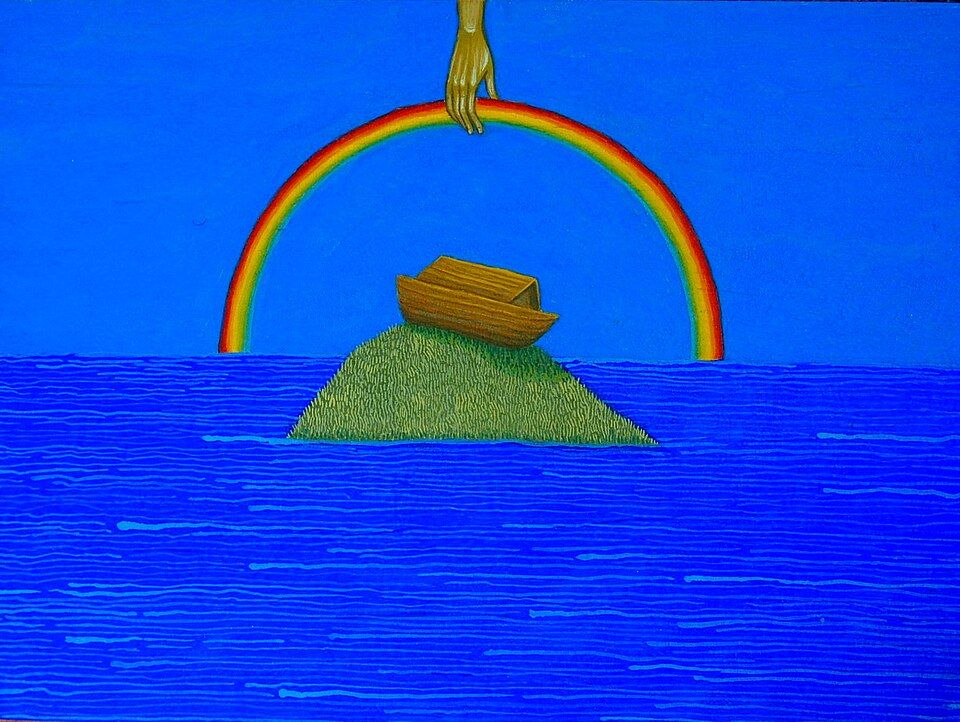
Many believe the rainbow's first symbolic appearance comes from the Biblical story of Noah, but it actually predates that story by more than a thousand years. In the Epic of Gilgamesh, a Sumerian poem about the king of Uruk, a great flood is sent by the god Enlil to silence a noisy humanity when he was trying to nap. After it recedes, the goddess Ishtar holds her colorful necklace up in the sky before the lone survivors and their animal companions as a promise never to allow such destruction again. Sound familiar?
1500 BCE – India
In the Hindu tradition, the rainbow is known as “Indradhanush”, meaning "Indra's bow." Indra, the king of the gods and the god of thunder and storms, was said to use the rainbow as his weapon, firing bolts of lightning from it across the sky. In Sanskrit literature, the rainbow's colors were each associated with different elements of the natural world, embedding it in a rich symbolic vocabulary that persists in Hindu culture today.
1100 BCE – China
In early Chinese cosmology, written records indicate that the people of ancient China often viewed the rainbow as a dragon-like creature in the sky. In some descriptions, the creature is viewed as inhabiting the space where Yin (female, earth, darkness) meets Yang (male, heaven, light). While some positively viewed the rainbow as a sign that the two great cosmic forces were interacting, in some other texts it suggested a heavenly disturbance and could be an omen of disorder on the horizon.
750 BCE – Greece
Here, the rainbow pops up again in an epic poem. In The Iliad, among other texts, the rainbow is frequently used to symbolize the goddess Iris. In Greek mythology, Iris serves as the messenger between Mt. Olympus and Earth.The arc of the rainbow disappearing into the clouds mirrored her journeys ferrying messages back and forth.
550 BCE – Jerusalem
Most scholars agree the bulk of Genesis was written in the 6th century BCE. In this Hebrew version of the flood story, God instructs Noah to build an ark to survive alongside his family and two of every animal. After the purge, God vowed never to flood the earth again, creating the rainbow as a sign of his promise.
250 CE – Central America
The Mayan people largely viewed the rainbow as a dangerous and often harmful force in the universe. They understood it to be a living entity, a great serpent that emerged from caves or springs. Because the rainbow was thought to cause illness, especially vulnerable pregnant women and young children were warned to avoid looking at them.
Much later, in the same region, the Aztec people would begin to tell of their own colorful sky-serpent god: Quetzalcoatl. Quetzalcoatl was occasionally described as a servant to the goddess Ix Chel, which some translate as “Lady Rainbow”.
Unknown – Australia
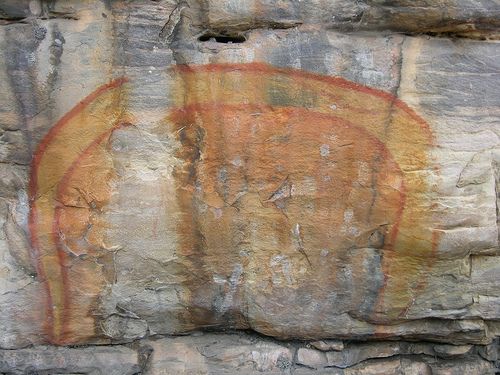
Speaking of serpents… Ancient cave paintings in Northern Australia are believed by some to depict a gigantic rainbow serpent known as Wagyl or Yurlunggur, among other names, viewed as an omnipotent being associated with both creation and destruction. Because so much of Aboriginal history was handed down orally, it has proven difficult to precisely date much of their spiritual mythos... though some scholars have theorized that these paintings are nearly 8,000 years old. If those paintings are indeed that old, and are depictions of the rainbow serpent God, the Aboriginal people may be able to lay claim to holding the oldest known rainbow myth on Earth... and possibly the world's oldest continuous religious tradition. Move over Mesopotamia!
700 CE – Scandinavia
In the Norse cosmological tradition, the rainbow appears as “Bifröst”, a burning, shimmering bridge connecting the human world of Midgard to Asgard, the realm of the gods. Unlike the rainbows of other traditions, Bifröst was not a symbol or an omen, but a physical structure. According to tradition, Bifröst will ultimately shatter at Ragnarök, the end of the world, as the giants finally cross it to wage their final war against the gods.
1100 CE – Europe
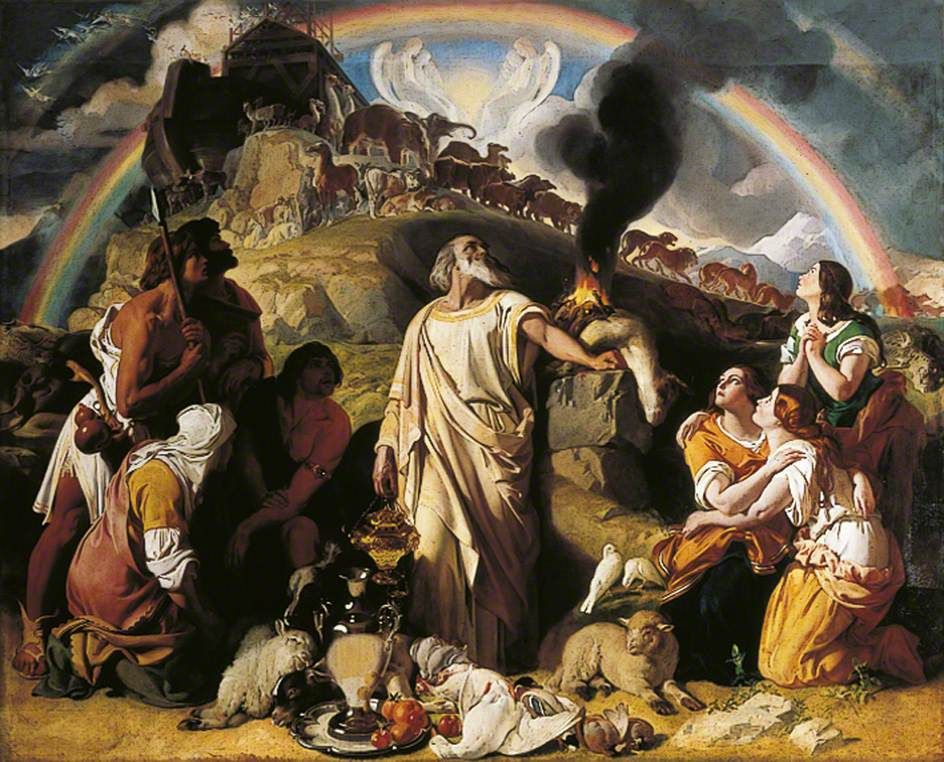
As Christianity spread across medieval Europe, the Biblical rainbow retained its covenant meaning but took on new visual power in religious art and iconography. In depictions of the Last Judgment, a subject that preoccupied artists across the continent, Christ is frequently shown seated on or within a rainbow as he presides over the fate of souls. The image drew directly from the Book of Revelation, in which a rainbow encircles the throne of God. Its prevalence in these paintings arguably cemented the rainbow as a symbol of promise and hope within Christianity forever.
1200 CE – North America
For the indigenous people of North America, the rainbow made frequent appearances in their stories, playing varying roles for different tribes. For the Ojibwe, the rainbow was born when the god Nanabozho decided to paint the 'boring' white flowers, only for the birds to steal the colors and paint the sky with them instead. The Achomawi tell a tale of how the Spider Brothers wove the first rainbow in the sky, ending the long winter (which is why spiderwebs reflect prismatic colors).
From Heaven to Humanity – The Big Shift
If you had to pinpoint any one major pivot point in the rainbow's existence as a symbol anywhere, the most fitting choice may be one Enlightenment-era experiment that would upend everything.
1665 CE – England
Isaac Newton's experiments with a glass prism changed how the Western world understood the rainbow. By passing sunlight through the prism and projecting the resulting spectrum onto a wall, Newton demonstrated that white light was not pure but composed of every color simultaneously, each bending at a different angle when it passed through a medium like water or glass.
Fun Fact: After this experiment Isaac Newton was the one who ultimately declared which colors were in the rainbow (red, orange, yellow, green, blue, indigo, and violet). He considered a few other divisions, but ultimately decided that it should be split into seven pieces to correspond with the seven musical notes.
1820 CE – England
More than a century later, the poet John Keats would mourn Newton’s discovery, accusing him of destroying the poetry of the rainbow by way of explaining it scientifically. Keats' accusation appeared in his poem Lamia, which contained the lines now paraphrased as the charge that “philosophy had clipped the angel's wings and unraveled the rainbow”, a sentiment that would encapsulate the Romantic movement as a lyrical rebuke of the Enlightenment.
1939 CE – United States
When Judy Garland sang “Over the Rainbow” in The Wizard of Oz, the song was nearly cut from the film before release. Gay audiences claimed it as their own, hearing in it something beyond its literal meaning. Garland herself became one of the defining gay icons of the twentieth century. Her death in June 1969 came just days before the Stonewall uprising, a proximity the community has never forgotten. This was arguably the beginning of the association between the LGBTQ+ community and the rainbow.
1960 CE - United States
As the counterculture movement took shape across America, the rainbow became part of its visual vocabulary. Its appeal was straightforward: the rainbow was natural, it was free, it belonged to nobody, and it contained every color at once. In a movement defined by a rejection of conformity and an embrace of unity across cultural lines, that last quality carried particular weight. Rainbows appeared on concert posters, painted vans, and album covers, less as a deliberate symbolic claim, and more as an instinctive reach for an image that already said what the movement was trying to say.
1969 CE – Chicago, IL
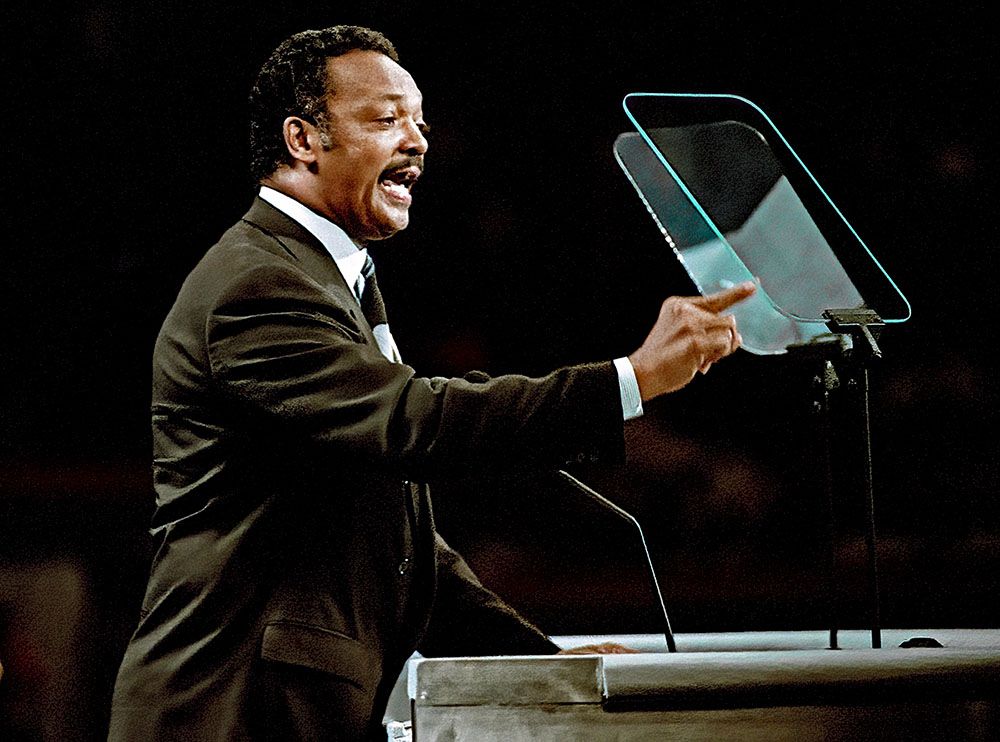
Fred Hampton, the 21-year-old chairman of the Black Panther Party in Chicago, organized an unprecedented alliance of groups with little obvious reason to work together: the Black Panthers, the Young Patriots Organization (working-class white men), the Young Lords (a Puerto Rican gang and later civil rights organization), among others. He called this new group the "Rainbow Coalition" because it brought together people of every color under a shared political cause (helping the marginalized escape the trap of poverty). Reverend Jesse Jackson later drew on Hampton's framework, delivering his much-celebrated "Rainbow Coalition" speech at the 1984 Democratic National Convention and continuing that work through his own National Rainbow Coalition after his unsuccesful presidential run.
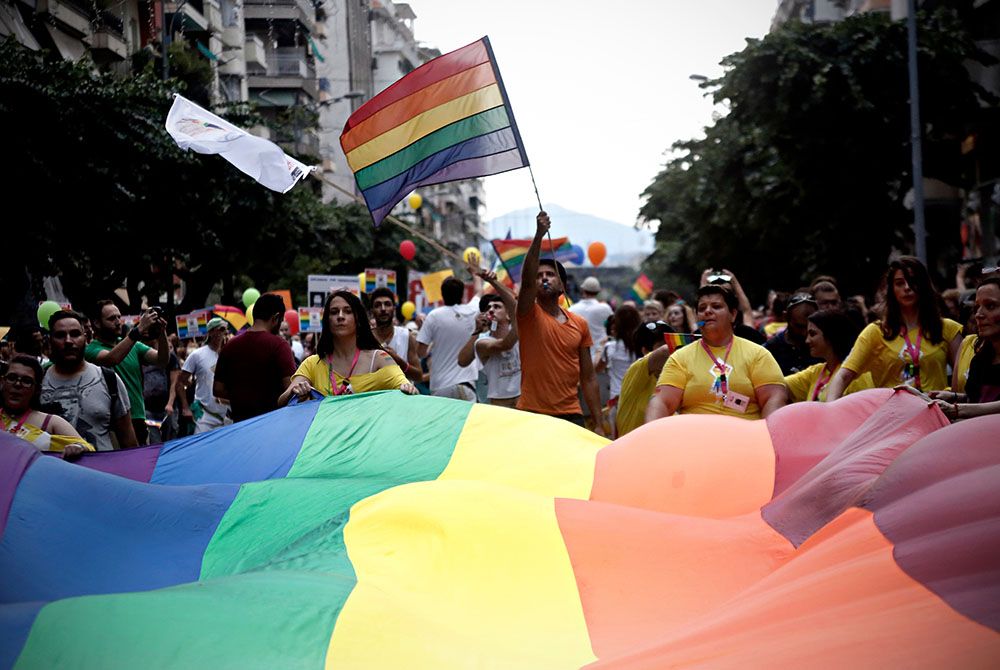
1978 CE – San Francisco, CA
The rainbow flag as most people now know it was designed by Gilbert Baker, a gay artist and activist in San Francisco, at the request of Harvey Milk, the city's first openly gay elected official. When asked about his inspiration, Baker stated his desire to select a symbol that could represent the wide spectrum of the community. He also acknowledged he was influenced by the rainbow's prevalence within the Hippie culture of the 1960's. While he never pinpointed Judy Garland's song as a deliberate inspiration, he did cite She's a Rainbow by the Rolling Stones as one.
The original flag had eight stripes, each assigned a meaning: pink for sex, red for life, orange for healing, yellow for sunlight, green for nature, turquoise for magic, blue for harmony, and violet for spirit. The pink stripe was removed because the fabric was too difficult to source at-scale, and the turquoise stripe was dropped so that there would be an even number of stripes to divide the flag in half in a more aesthetically-pleasing way, leaving the six-stripe version that became standard worldwide.
1994 CE – South Africa
When Nelson Mandela was inaugurated as South Africa's first democratically elected president, the country needed a new story about itself. Archbishop Desmond Tutu supplied one. He began using the phrase "Rainbow Nation" to describe a South Africa that could hold its many races, languages, and cultures together under one identity without erasing any of them. Tutu himself would later say that the “Rainbow Nation” had become a fiction used to avoid confronting persistent inequality.
1985-2005 CE – United States
The rainbow has also come to symbolize loss in American culture. Since the 1980s, a poem called The Rainbow Bridge has circulated widely in vets offices and animal shelters, first on small paper cards and, later, via chain emails. It describes a meadow where deceased animals wait for their owners before crossing into the afterlife together. Though it’s one of the most reproduced English poems of all time, nobody knows precisely who wrote it.
The second meaning emerged from online communities of people who had experienced miscarriage, stillbirth, or infant loss. By the mid-2000s, these communities had begun using the term "rainbow baby" to describe a child born after such a loss, the idea being that a rainbow appears after a storm: beautiful because of what preceded it. Like the Rainbow Bridge poem, the phrase had no single author and no founding moment. It grew organically because it named something that people needed a name for.
2018 CE – Portland, OR
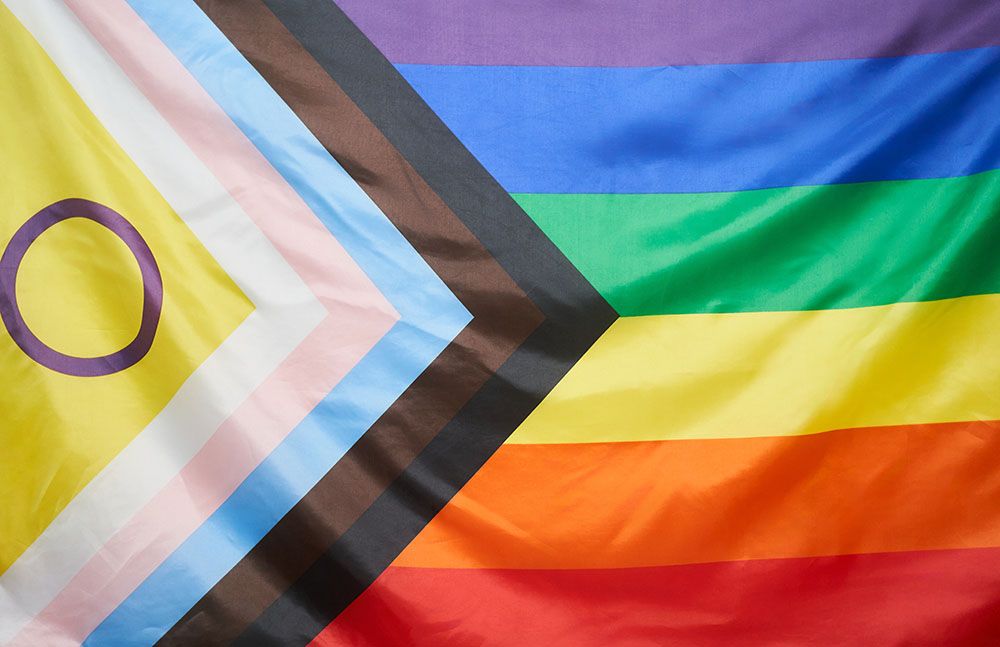
In 2018, graphic designer Daniel Quasar released a redesign of the pride flag that has since become widely known as the Progress Pride Flag. Quasar added a chevron on the left side of the original six stripes, incorporating black and brown stripes to represent LGBTQ+ people of color, alongside the blue, pink, and white stripes of the transgender flag. The chevron shape was deliberate: pointing to the right, it suggested forward movement. In 2021, Valentino Vecchietti added an intersex-inclusive circle to the design, and that version has been adopted by a growing number of organizations and governments.
The rainbow, it turns out, is still being written. What does it mean to you?
46 comments
-
 Cheryl
Thank you for telling me what you believe. If your reality is determined by the left brain and mine by the right brain, who's to say who is 'right' or 'wrong'. We will all find out in the great bye and bye.
-
 Justin Adam Kalm
Great article, though it left out an interesting tidbit I learned from reading the book “God, An Anatomy.” In the Genesis story, when God puts his bow up in the sky, there is another interpretation, since at the time “bow” was frequently used in religious texts as a euphemism for penis. So when you look up in the sky and see a rainbow, you can imagine that you are seeing God’s resplendent multi-colored dong. Happy Pride, indeed!
-
 Bishop William Dusenberry, DD
To quote, perhaps, the greatest description of eternity (yet to be known, by this budding philosopher) Nietzsche’s — “eternal recurrence” (examine this concept in “Thus Spake Zarathustra”) — because once you have, if you don’t understand it, you’re probably a literal believer in Noah’s Ark.
-
Cheryl
In Genesis 9 we see 'rainbow' mentioned three times. It seems to me that this is God's reminder to us of where we live now and that the rainbow is one of our connections to Him. I say this because the colors span the Visible Spectrum which defines our three-dimensional life. Her we have chosen to live out the consequences of having chosen the Tree of the Knowledge of Good and Evil, 3-d in duality. The rainbow colors are also represented in the chakra system, which I believe anchors our spiritual bodies to our physical body, as well as to the other bodies in our solar system and beyond in 3-D. As far as WHEN this was first mentioned, I'd say whenever Genesis was written. But when did it become a reality? I'd say when the first humans appeared on this planet.
-
 Sir Lionheart
Thank you for telling us what you like to believe. The reality is that they are just colors as a result of the chemical composition of the sun. If we had been revolving around a different star the colors could have been different. Basically, thats all it is. Chakra’s are just another human construct created by new-age cults that love to screw with those that don’t have the capacity, or ability, to use logic and reason.
🦁❤️
-
Cheryl
Thank you for telling me what you believe. If your reality is determined by the left brain and mine by the right brain, who's to say who is 'right' or 'wrong'. We will all find out in the great bye and bye.
-
Sir Lionheart
My reality of spectral analysis is based on known science. It’s basically Science 101. I think i learned that in 8th grade, and used spectral analysis later in life in my aerospace profession.
Right and wrong, decision analysis, can be theorized, tested, and proved. It’s how science works, and it’s how we got to the moon. Left and right brains have nothing to do with it, but thank you for allowing me to give an explanation.
🦁❤️
-
-
-
-
 Rev. B.D. Rees
It simply means to me the Pride of having a symbol that represents the community I identify with. The Rainbow flag is just as important to me as a Gay man as the American flag is to me as a citizen of the United States. I live and identify as both, even though there are some Religions and government officials that would stop me from being both!! The Rainbow has always instilled a sense of PRIDE if you will in all of our Gay Communities so, if someones Religion says that the Rainbow is their symbol, God told me to share with others and still be PROUD of who and what I am, a Gay man and a Christian.
-
 Patricia Ann Gross
Well said, Rev. B.D.
-
Rev. B.D. Rees
Thank you Patricia...
-
-
-
 Geoffrey Ian Meeson
In the UK the 7-colour rainbow became a symbol of support for the National Health Service (NHS) and NHS staff during the recent Covid pandemic - you would often see it in peoples windows, etc, especially during lockdown.
-
 Laura Manson
What a wonderful article this is! I really enjoyed reading it! Thank you!
-
 Randy Michael Mellinger
Sorry to say the account of Noah is incorrect, Genesis 7:2-3 states that Noah was to place on the arc 2 unclean animals male and female, 7 clean animals male and female, and 7 birds male and female.
-
 Rev. Miche'al Yosef Dixon
"1800 BCE – Mesopotamia Many believe the rainbow's first symbolic appearance comes from the Biblical story of Noah, but it actually predates that story by more than a thousand years." As an archeologist I find this statement interestingly wrong. Scientific study has proven the "great flood" happened approx. 3500 to 3000 BC. The story of Gelgamesh and Noah are the same story from different cultures but happened at same time. Sumerians wrote it down 1800BC in clay tablets and Hebrews write it down but the papirus oldest copy approx 800BC. Although I'm not thrilled with the LGBT community using the rainbow I still can see it as it's original meaning given by YHWH, not to destroy the human race even if they plug into sin again. Next time He will burn the Earth to cinders. Rev. 20
-
 Rev. Kev
"Scientific study has proven the "great flood" happened approx. 3500 to 3000 BC."
Really? That's news to me. I am not aware of any contemporary science that affirms that. Any sources you can cite from a relevant science or academic journal? I'd love to see the data that led to that finding.
-
-
 Lynnea Urania Kaylor
I recall this conversation from a social media site:
Christian Guy: "You Gays stole our rainbow! It's a Christian symbol! Give it back!" Gay Guy: "We didn't steal the rainbow. You threw it away when you insisted that everything had to be White."
Harsh social media vitriol? I suppose. But I do see a point here. The belief that Christians should desire that the rainbow be trademarked by them (or even perhaps their own denomination and let the lawsuits fly) assumes the same level of privilege that White Supremacy assumes. The difference between them pertains to the objects of their perceived privilege--whether it's what's perceived as a religious symbol particular to one religion that innately symbolizes it to the exclusion of all others or whether it's the power implied in the so-called "White Man's Burden." The former case has been pretty well debunked by this article. The latter is debunked by the many contributions of those of other races and those of mixed race. Clearly, the "White Man's Burden" should really consist of a purgation of prejudiced hearts from generations of false teaching that one race is better than all others.
-
 Randall William Fox
Early summer, 1977, Lincoln Nebraska: A buddy and I are riding bikes, one of us pulling a trailer, heading to a university research farm that his girlfriend managed. Halfway across the 35 mile distance a powerful storm overtook us and we had nowhere to hide, we just had to ride it out. More than once the wind and rain nearly drove me off the pavement. Just as the storm was relenting we reached the only significant hill on the route, it was brick, and it was covered in slimy mud. I reached across and grabbed my buddy's handlebar stem and together we got him and the trailer with it's load of gardening tools up that hill! We were still laughing about our conquest when the sky broke and on the trailing edge of that thunderhead that had just walloped us was one half of the most brilliant rainbow I seen in my 70 years. It came out of the top of the thunderhead on the right side just like a cyclist might signal "see ya" to a companion who can't keep up...
-
 SDA
SDA
To me the rainbow means sunlight is shining through water vapor in the atmosphere. It's beautiful to look at just like a great many things in the natural world.
-
 Cea Noyes
The lovely part about rainbows in nature is that they belong to everyone. The wonderful thing about rainbows as symbols is that they belong to everyone who shares the concepts that symbol stands for. Multiple symbolic rainbows exist, each with its symbolic meaning. As with much of life, context is everything! I wish you all rainbows to color your life with meaning!
-
 Harold William Bartlett Radl
A lovely article. Thank you.
-
 James Riggle-Johnson
It’s interesting to see how Rainbows were perceived throughout history. It has inspired superstition, myths, gods, and representations for thousands of years. I don’t know about the rest of you, but I still look for one every time the sun is out while rain falls.
-
 Brother Peter
This has to be one of the most comprehensive posts the ULC has written in a long, long time. Congratulations to the writer. A great read.
-
Laura Manson
I agree, it’s extraordinary and I really enjoyed reading it and also the thoughts that it has generated!
-
-
Sir Lionheart
So the question of this topic asks: What do rainbows mean to us all.
To me, it reminds me of the beauty of science that determines the complexity of our suns elements that we can determine using a spectroscope, seeing the colours in a spectrograph. We simply use spectroscopes to determine the elements/compositions of galaxies, and other stars. Basically, that’s it.
🦁❤️
-
Bishop William Dusenberry, DD
During my missionary-endeavors with funny-mentalists, whenever the topic of the Christian/Heberew’s God drowning all of humankind (there were then 12,867,445 humans— which included 867,923 fetuses) then I ask potential ULC’ers, how they ever could worship, and adore, a God who was the greatest mass-murderer in the Christian Bible. The typical reply - that was the Old Testament in which God did that, and the New Testament (written by who knows who) the now Christian Bible makes no reference to the former Hebrew God, who went through a metamorphosis when he decided to have a son. How to you reconcile that, Sir Lionheart?
-
Patricia Ann Gross
Bishop WD,
Then your funny-mentalists were exactly wrong. The Christian Bible still contains the original Hebrew texts (depending on the denomination, some more than others), so the entire Torah is still there which includes this narrative. I don't have a good reply for your question, except, it was a story that passed down through thousands of generations that explained how the world came to be, while humanity still thought the world was flat and the sun revolved around the earth. The creation narrative significantly mirrors what science has "discovered" through archeological studies, (except for the timeline of course), but remember, these people could not count beyond the digits on their hands and feet, so the concept of thousands or millions of years would be totally meanignless. There is plenty of archeological evidence of a "great flood" as fish fossils have been found in mountain ranges, high above any contemporary or historical water lines.
There are still many questions humanity has no answers for, so the concept of a power/being greater than ourselves as the "Great Creator" is still a valid concept.
-
Rev. Kev
"The Christian Bible still contains the original Hebrew texts (depending on the denomination, some more than others), so the entire Torah is still there which includes this narrative."
Just for the sake of accuracy, no original texts of any part of the BIble exist. There are very old fragments of some texts, but some are exceptionally small and none are original manuscripts.
"The creation narrative significantly mirrors what science has 'discovered' through archeological studies"
Not certain as to what scientific "discoveries" are being referenced here. The Biblical creation account lacks any sort of scientific basis. The stories laid out are etiological myth.
"There is plenty of archeological evidence of a 'great flood' as fish fossils have been found in mountain ranges, high above any contemporary or historical water lines."
While Creationists still use this to support a Great Flood a la Noah, it is not true. There are many fossils on mountains. No argument there. But geology gave us the reason for that. Modern mountain ranges are the product of plate tectonics. Land once on a flat plane are pushed up over centuries. Land that was under a long gone ocean, lake or flood plain will carry the signs of former life up with that process. Hence, fossils of aquatic life can be found on the sides and peaks of mountains formed in those areas.
There are fossil fields of aquatic life in the center of the U.S. because there used to be a large, inland ocean located there. We can also find fossils of plants and animals that lived in water or forested areas in deserts across the globe due to an ever-changing Earth where land masses have risen and fallen, where entire plates of the Earth's crust have traveled, and the weather has changed over and over.
As with a totally explicable rainbow, these findings were once framed in religious narratives to explain what people could not understand in earlier times.
Even the religions, themselves have changed over time as gods and goddesses come and go. Even Adonai evolved from a god in the Canaanite pantheon who ruled only over the Hebrew people and could be overruled by other gods of other city-states (such as the triumph of Chemosh over Yahweh in 2 Kings 3) to some creator of a massive universe as humans continued to progress and learn that such a universe even exists.
All of which is summed up in the pithy statement that 'the only constant in the world is change'.
-
Patricia Ann Gross
Rev. Kev,
For the sake of accuracy, no texts existed prior to those discovered known as the Dead Sea Scrolls in the caves at Kumron. Prior to that, the stories were saved strictly by an oral tradition, meaning the stories were passed down by word of mouth through generations.
Many different copies of the Gospel texts (both those that were canonized and those that were not) have been located and pieced back together. There are multiple copies of all of them, as, like the Hebrew texts, they were first passed down by oral tradition between the time Christ died and sometime later in the first century. None of the manuscripts were created by the apostle that bears their names. The letters of Paul were also transcribed into multiple copies that remained. As one would expect with human intervention and creative license, these are not "carbon copies" of each other, as some tried to embellish the stories to their own liking or biases, and some thought they could make the story more compelling, but then again, who knows what was going on in the mind of the scribe at the time. I have known personally people who have attended excavations of the home churches of Paul, and some were in better shape than others, so, the most we can say is that we have a best aproximation of what the "original" transcriptions at the time of the Council of Nicea contained.
-
Rev. Kev
Greetings Patricia:
Let me just start by saying I very much enjoy reading your various comments on all the different topics.
OK. So we are still left with what I wrote, originally. No original texts exist.
With no originals, one could not honestly assert how close any surviving texts are or not to the originals. It is also why various denominations interpret texts a certain way apart from others.
As you so eloquently pointed out, there is usually a gap between the origin of a story and the time it finally gets written down. Leaving a lot of room for changes as the faith, the churches, and cultures evolved and syncretized.
I wasn't aware that any sites that have been excavated have been firmly identified as a home church of Paul, specifically. I know that early churches have been discovered, some in former houses within a certain date range. But not so specific. Where can I find information on that? I did a quick search but came up empty.
The first time any books of an official canon are listed is the Council of Rome in 382. And that only for the New Testament.
For some reason, many people think Nicea had something to do with the canon. It didn't. It covered fun things like addressing Arianism, fixing the date for Pascha, and elucidating the Pentarchy, among a host of items on the agenda.
Hope you are having a great week.
-
Patricia Ann Gross
Rev. Kev,
If you are serious in knowing about the excavation sites and the full archeological data available, the best source is the Biblical Archaelogical Society at https://www.biblicalarchaeology.org/ I use this site as a resourc for my current PhD program, and one of my seminary professors (who is Jewish) is a regular contributor. It is historically and scientifically sound, and one of the best resources available on the Dead Sea Scrolls. There is a very small/reasonable subscription, but well worth it is you are an avid historian/archaeologist.
The Council of Nicaea, did contain discussions of which writings were to be considered "authoritative," although it did not decide on the canon. That was scattered throughout the fifth and sixth century by different councils/meetings of a disparate community.
-
Rev. Kev
Patricia,
I never ask for something if I am not serious. I want to know about things. You mentioned something and I don't know about it. So I ask in order to learn.
Since I mentioned I tried searching for information and could not find it, I was hoping you could offer a link to the specific article on this excavation, or at least give me details -- such as the exact location and lead archeologist or institution -- that would allow me to find the information.
I've read the writings associated with the first seven Ecumenical Synods, of which Nicea 1 and 2 are a part. No discussions on which writings are authoritative or not in either one.
Nicea 2 did look at books, but the official canon had already been declared by this date (787 CE), so authority wasn't an issue of discussion.
They examined the non-canonical book The Acts of John -- which was attached to the iconoclast controversy -- to officially declare it heretical and dismiss the arguments the iconoclasts were making.
If you think I am in error and can offer a citation to enlighten me, that would be reasonable and acceptable. I am always aware I can be wrong about things and will adjust accordingly if presented with the data.
-
Patricia Ann Gross
It is my understanding that there were several counsils and synods between Nicaea 1 and 2, and the canon was decided in the early 400s (like around 428, is the date that comes to mind).
Dr. Carolyn Osiek, RSCJ was one of my seminary professors, and she did several lectures and seminars while I was at Brite Divinity School about "walking in the footsteps of Paul," where she literally followed his missionary journey throughout the region, and participated in digs in Corinth and possibly Rome. She has also written commentary for the New Interpreter's Bible from some of the excavated fragments that were either found on those digs or are within the archives at the Vatican on some of Paul's Letters, and written exegetical books on some of them as well. She retired from Brite, and is now the provincial archivist for the Society of the Sacred Heart, US-Canada Province. You may want to get her book "Families in the New Testament World: Households and House Churches (Family, Religion, and Culture)" which is available on Amazon. She also wrote a a commentary series on the "Shepard of Hermas,' which just missed the canon. Her commentary on the Phillipians and Phelemon are also good reads. You can find all of these if you just search for her on Amazon.
She was my professor 20 years ago, so I don't fully remember where the digs were, and all of her credits, but she was a very inspirational part of the reconstruction of my faith during seminary.
-
-
-
-
-
Sir Lionheart
I cannot reconcile how mankind likes to create narratives to support their god other than mankind likes to believe in omnipotent deities and so will create narratives to support their god in its manic cruelty rather than upset it. 🤭
🦁❤️
-
Rev. Kev
"the now Christian Bible makes no reference to the former Hebrew God"
It actually does.The stories of Jesus outline a man raised in the Jewish faith and who taught that the Law of Moses was to be followed until "Heaven and Earth pass away". He affirmed portions such as the law to stone disobedient children (Matthew 15:4 and Marl 7:10). The God to which Jesus continually refers is the God of the Jews.
Many Christians at this point will cite the passage where Jesus said he came to fulfill the Law while making two errors. 1) Before the "fulfill" part Jesus states he did not come to abolish the Law. Kinda silly to read it as he did not come to abolish the Law but he did come to abolish the Law. And, 2) The term "fulfill" means to do what the Law commands. So, keeping the law is fulfilling it.
As time progressed, the Christian authors made some changes in a campaign to put some distance between the early Christian communities and Judaism as the latter fell into great disfavor with Rome. Such as painting Pilate as a more compassionate leader who didn't want to crucify Jesus and who is reported to have held a completely fictional vote for the people to decide who was to be pardoned. A story which also introduced the early idea of Jesus as the sacrificial scapegoat.
By the middle of the first century CE there was no small number of people who saw how bloodthirsty and heartless the God of the Tanakh was as compared to the changing Christology of their Saviour. Which are the factors behind the formation and rather successful growth of the Marcionite church, in which Jesus was sent by the True God, or Monad, to teach seekers about the truth of the Demiurge, or "god of this world". Marcion created a canon of the Bible (probably the very first Christian canon) to prevent any reference of Jesus being in league with the Demiurge. He only had select epistles and an edited down version of the Gospel of Luke. He rejected the entire OT. Much in the way of his writings and liturgical practises were destroyed when his beliefs were ruled to be heresies in about 208 with the rise of proto-orthodox Christianity. But enough has survived that scholars believe much of his works can be reasonably reconstructed.
-
Patricia Ann Gross
Rev. Kev,
I think he was talking about the New Testament, which does not describe the "wiping out of civilization, except those on an Ark, etc. which would be wrong. The Christian Bible (at least all I have read) contain both the Hebrew scriptures which have all of the good, bad, and ugly stories of a "jealous" God and a rebellious following who could not get their act together and a "new covenant" ushered in by Christ, which describes a God of mercy and grace.
-
Rev. Kev
I assumed he was referencing the New Testament and framed my response accordingly. That's why I gave NT references and spoke of Jesus, and early Christian history.
I just tossed in the bit about Marcionism to illustrate that even early christians saw some difference to the father of Jesus and the OT God. So they had to make large adjustments to accommodate that belief.
-
-
-
-
-
 Colleen McAllister
To me a rainbow will always stand for a promise from God, the Creator of everything, that He is still there caring for us. It represents His promise to stick with us. In effect a RAINBOW represents HOPE
-
 Rolando Couce
I AM SORRY THE RAINBOW SYMBOL IS NOT THE MOST POWERFUL SYMBOL BECAUSE SYMBOLS DONT MEAN ANYTHING THE MOST POWERFUL THING INS THSI WORLD IS THE LOVE OF GOD THAT HE BESTOWED UPON US
-
 Rev. BH
Rolando All Caps, here's a symbol $ I think it means something, right? How about % or &. Symbols.
-
Rev. Kev
Methinks the $ symbol is currently the most powerful symbol in the world.
-
Randall William Fox
& might be the symbol of inclusion, abundance, or growth. % seems cold to me, a symbol of dispassion concerning incremental growth or decline in all things, especially when combined with $.
-
-
-
 Douglas Robert Spindler
Things change over time including flags. Issac Newtown came up with 7 colors for the number for colors in the rainbow and the people who’s created the Pride flags decided to do the same.
-
Patricia Ann Gross
Douglas,
The original Pride flag only had six colors, they consolodated the indigo and violet to the purple stripe.
-
Randall William Fox
In grade school (1960s) we were taught that there were 3 primary colors (Red, Yellow, Blue) and 3 derivative secondary colors (Orange, Green, Purple) in the rainbow. Also, cycling has the "rainbow" bands or stripes of world champion in descending order: Blue, Red, Black*, Yellow, Green. The Olympic rings use the same colors as do other sports. *technically a shade and not a color
-
-
-
 Nicholas J Page
I had seen an article this morning on Google and it stated that a rainbow had 7 stripes of colour and the Gay Pride Rainbow has 6 stripes also yes rainbow bridge is for our pets we call them family or fur babies no one knows who wrote it but it's often used when our pets go to heaven a lovely story is think

Dunno who has dibs on claiming it. That said, I do know that MAGA Christofascist Republicans are terrified of rainbows on things like beer cans etc..