

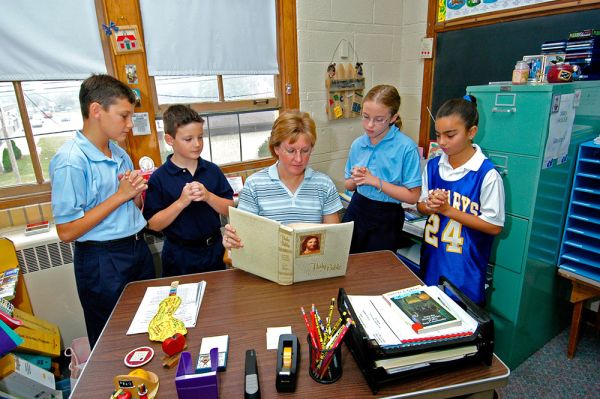
 BREAKING NEWS: Texas just did something no state has ever done. Moments ago, the State Board of Education voted to require more than 5 million public school students to read Bible passages as part of their mandatory English and literature curriculum – the first requirement of its kind in the nation.
The board wants folks to think of this as cultural literacy. But critics say, if you look closer, it's something else.
What Bible Passages Are Now Required Reading?
The proposed reading list included several biblical passages spanning every grade from kindergarten through senior year. For younger students, the primary translation is the International Children's Bible (ICB) — a simplified Protestant text the publisher describes as designed for "new Bible readers of all ages and abilities to understand God's Word." The King James Version appears at 8th and 11th grade. Catholic-approved translations don't appear anywhere on the list. Texts from any non-Christian tradition — the Quran, the Vedas, the Bhagavad Gita — are nowhere to be found.
Here are the required Bible passages specified on the just-passed list:
- Kindergarten: The story of "Jonah and the Whale" was initially proposed but was ultimately removed from the final list.
- 1st Grade: The story of "Noah's Ark" was initially proposed but was ultimately removed from the final list.
- 2nd Grade: David and Goliath (1 Samuel 17: 1-25, 32-50 ICB)
- 3rd Grade: The Story of Daniel in the Lion's Den (Adapted Children's Bible)
- 4th Grade: The Necessity of Humility (Luke 14:7-11)
- 5th Grade: Moses & Exodus (Exodus 3: 7-11; 14:15-18, 21-29 NIRV)
- 6th Grade: Do Not Be Anxious (Matthew 6:25-34 ESV)
- 7th Grade: The Shepherd's Psalm (Psalms 23 KJV), and The Eight Beatitudes (Matthew 5:1-12 KJV)
- 8th Grade: To Everything there is a Season (Ecclesiastes Chapter 3)
- 9th Grade: The Parable of the Prodigal Son (Luke 15:11-32 EST)
- 10th Grade: The Book of Job (Job 1:7,11,14,19,28,38-42 NIRV)
- 11th Grade: Adam & Eve (Genesis 2 and 3 NIRV)
- 12th Grade: The Definition of Love (1 Corinthians Chapter 13 ESV)
Regardless of which Protestant translation appears at which grade level, a common thread runs through all of the passages: none uses a Catholic-approved text, and none draws from any non-Christian tradition. The International Children's Bible, the primary translation across the elementary grades, was developed by and for Protestant readers. The King James Version, which arrives at 8th grade and returns in 11th, carries a longer and even more charged history. As University of Texas religious studies professor Chad Seales points out, it was the standard version used in American public schools until the 1950s – which explains why parochial Catholic schools exist in such numbers... Catholic parents built their own schools precisely because they didn't want their children receiving Protestant biblical instruction on the public dime.
Rabbis in particular have rejected the curriculum's "Judeo-Christian" framing , pointing out that even Jewish scripture is being filtered entirely through translation choices made by and for Christians.
History, it turns out, has a way of repeating.
Who Is This Really For?
The 2023 law that set this process in motion required at least one mandatory book per grade level. The board chose to propose 5 to 15 books per grade instead – nearly 300 titles in the original draft. Even the board member who championed the final version acknowledged it: "There is not one other state that will have a required reading list as robust as this," he said. The law gave the board an inch; they took a mile.
Then there's the question of what survived the cutting process and what didn't. When the board trimmed around 100 titles from the original proposal, Alice Walker's Everyday Use was cut. Frederick Douglass' What to the Slave Is the Fourth of July? was cut. Booker T. Washington's writings? Cut. Most of the Bible passages stayed. With America's 250th anniversary a week away, the board's choices are telling: they removed the most celebrated Black American meditation on what "independence" actually means, and kept so many Bible verses.
The diversity problem runs deeper than religion. Critics from both parties raised concerns about the underrepresentation of women, Hispanic, and Black authors throughout the list. Board member Tiffany Clark, who voted against the new list, didn't mince words: "The booklist is not diverse, and if these are the same classical literature pieces which has ranked us 44th in the nation for third grade reading, we have failed students." At the same meeting, the board voted to eliminate the sixth grade "World Cultures" course entirely – part of a broader social studies revamp that deemphasizes global history in favor of explicitly Texas and American content.
Teachers aren't buying the cultural literacy framing either. The Texas Council of Teachers of English Language Arts – drawing on surveys of over 2,600 educators – found that in almost every grade, the list would be "mathematically impossible" to teach within a standard school year. While teachers are still permitted to teach books outside of the list, many fear that there simply won't be enough classroom hours to add any additional material on top of the statewide mandatory list.
"The required reading list's attempt to standardize readings is unhelpful and counterproductive to the real needs of students and educators," said Sumya Paruchuri, a recent graduate of Texas public schools. Teacher Frank Strong was more direct: "For the first time, I face the prospect of teaching a state-mandated text list that tells some of those students that their faiths, their families, and their cultures mean less to our country than those of their classmates."
A More Complex Book Than the Curriculum Admits
Harvard Divinity School professor David Holland, who teaches a course on scripture and American politics, put it plainly: choosing a Christian translation of texts shared with Jewish tradition inevitably privileges certain theological readings over others. Teaching the Exodus story responsibly, he said, would require students to grapple with how the same passage inspired Black freedom movements and, simultaneously, justified the displacement of Native peoples. As Seales adds, "I don't know how in the world a public school teacher would be qualified to help a student understand all the nuances involved in scriptural interpretation."
The curriculum's defenders are asking teachers to present scriptures as historical documents while using devotional translations and sourcing material from a televangelist's media company. Those things don't sit easily together.
This Didn't Come out of Nowhere
Today's vote doesn't stand alone. The state of Oklahoma spent $6 million putting Bibles in classrooms last year. Texas already requires the Ten Commandments to be displayed in every public school classroom, following a controversial law upheld by a federal appeals court earlier this year. The state has also expanded school prayer periods, and authorized chaplains to counsel students. Mandatory Protestant Bible readings are the next step in a pattern that looks increasingly like a deliberate effort to Christianize Texas public schools.
For families whose children are Muslim, Buddhist, Jewish, Hindu, or simply not religious, the question isn't only legal. It's personal. When the state requires a child to read one tradition's sacred text – translated through that tradition's own theological lens – the message being sent isn't subtle.
Is mandatory Bible reading a question of cultural literacy, or religious imposition?
117 comments
-
 Rev. B.D. Rees
This is a subject that I as an individual can't broach without some sort of Anger, and certainly a lot of thought provoking distain toward those in the Texas legislature that even thought this was a brilliant idea. Who in the "NETHER REGIONS OF THE UNDERWORLD" would even entertain the idea of playing a Sunday school teacher in our Public Schools!! What if the Teacher is Jewish?, is she or he going to teach the children from the Torah?? What if the Teacher is Muslim, will he or she be teaching from the Koran?? You see where I am going with this.... These so-called Law-Makers are FORCING their idea of Religion not only on the Students, they are FORCING their brand of Religion on Educators that may not even be of their Brand of Faith they are trying to FORCE FEED to children!! BRAINWASHING 101.....
These people are supposed to be the REPRESENTATIVES OF THE PEOPLE, and they are following thier cult High Priest on wheels in order to fulfill their idea of "PROJECT 2025"!! What a waist of Humanity they must be.....
-
 Pastor Bobby Roy
If Texas truly wanted children to know the Bible, they would teach it honestly, humbly, and in context — not through a Protestant‑only list, not through a televangelist’s media company, and not through a curriculum teachers themselves say is “mathematically impossible” to teach .
But when the state uses the Bible to elevate itself, God Himself will tear down what they build.
Because the Lord does not bless forced faith, political religion, or man‑made revival.
He blesses truth. He blesses humility. He blesses repentance.
And He blesses those who refuse to let His Word be weaponized.
-
 Geoffrey C. Olive
Please don’t include me in your all!
-
 Robert James Ruhnke
Oh look, Texas has gone full Taliban and is pushing its own kind of sharia law onto the public at large.
-
 Brien
Brien
ROFL!!! You know only a few of us will get that comment.
-
-
 Andrew Keith Dupree
Our Biblical Christian belief has been Perverted and Severely Adulterated of the Words set forth by our Lord Jesus, His Father GOD and the Holy Spirit! Be Aware this is all demonic influence in this Spiritual WAR we are living in right now!!
-
Andrew Keith Dupree
I cannot fathom the Work or the Word of my savior to all this Demonic hate and rhetoric! I will pray for you all!!!
-
Geoffrey C. Olive
AKD Don’t include me or any other atheists in your prayers!😂
-
-
-
 Jillian Michelle Winsor
Lawsuit lawsuit lawsuit. Demand study of the Quran if this is about cultural literacy in a secular school paid for by tax dollars.
-
 George Picoulas
As a teacher I'd add other Bible passages, like: Lot having sex with his daughters; how to treat slaves; the status of women; and of course God's megalomania, genocide, cruelty, vindictiveness, pettiness, incompetence, petulance, etc. etc.
Catholic: don't read the Bible; Evangelical/Protestant: selected versions; Any thinking person who reads the whole Bible would dismiss the notion it's the word of any god worth worshipping.Though, it's not necessary to know everything. If you learn your neighbor tortures puppies you don't need to know they go to church, give to charity, or anything else they do. Same with the Bible
-
 Ari Joseph Bertine
Needs a massive class action suit from Christian parents whose children's religious rights are being violated by forcing a specific version and interpretation on them, not to mention all the non-Christians.
-
 John Arthur Pierce, Jr
While your thesis highlights valid concerns about modern cultural shifts, a rigorous historical, legal, and sociological examination reveals several critical counterpoints that challenge your core premises.
The Legal Scope of Abington School District v. Schempp (1963) The assertion that Schempp effectively prohibited religious instruction or eliminated moral guidance misinterprets the legal boundaries established by the Supreme Court. The Court did not ban the Bible or religious texts from public schools. Rather, Justice Tom C. Clark explicitly noted in the majority opinion that the Bible is worthy of study for its literary and historic qualities. The ruling stated that objective education about religion is entirely constitutional when presented as part of a secular program. The decision did not seek to eliminate moral authority, but rather to protect religious liberty by preventing the state from coercing children into devotional practices that might conflict with their families' private beliefs.
The Distinction Between Sectarian Doctrine and Universal Morality Your argument relies on the premise that morality cannot exist or be taught without the framework of a supreme religious authority. However, ethical philosophy and modern educational practice demonstrate that foundational values—such as honesty, justice, empathy, and civic responsibility—are not exclusive to any single religious tradition. In the decades following 1963, public schools did not abandon moral instruction; instead, they transitioned to "Character Education" and civic ethics frameworks. These programs teach students the practical necessity of moral behavior based on human dignity, mutual respect, and social cooperation, allowing a pluralistic society to find common ethical ground without favoring one theology over another.
The Historical Context of the 1782 Aitken Bible The invocation of the Aitken Bible as proof that the Founding Fathers opposed a strict separation of church and state overlooks the specific historical and economic circumstances of its publication. The Continental Congress’s endorsement of Robert Aitken's work in 1782 was primarily a response to a wartime economic crisis. The British embargo had cut off the supply of imported books, creating a shortage of Bibles. Congress endorsed the project to support a domestic printer and satisfy market demand, not to mandate a national curriculum. Governing Body Distinction: This resolution was passed under the Articles of Confederation. The U.S. Constitution and the First Amendment were drafted years later (in 1787 and 1789, respectively) by a different body of framers. These architects deliberately chose to omit religious endorsements from the nation's supreme legal framework to ensure the new federal government remained neutral in matters of faith.
The Shared Responsibility of Moral Formation The claim that parental moral guidance is entirely ignored if not reinforced by formal school curricula minimizes the enduring power of foundational social institutions. Sociological data suggests that schools have never been the sole or even primary arbiters of a child's conscience. The family unit, churches, temples, and local communities remain the primary crucibles for moral and spiritual development. Furthermore, the sweeping conclusion that secularization has produced "morally ignorant adults" is a subjective cultural evaluation. Many historians and ethicists argue that the past sixty years have seen significant moral advancement in areas such as civil rights, institutional accountability, and global humanitarianism.
In conclusion, while the desire to anchor societal behavior in an unyielding moral foundation is understandable, the framework of a pluralistic democracy requires a different approach. The proponents of the separation of church and state are generally not seeking the elimination of morality, but rather the protection of equal dignity for all citizens. In a nation comprised of diverse religious minorities and non-religious individuals, utilizing public funds and state authority to elevate one specific sacred text compromises the very religious freedom the founders sought to protect.
-
 Bishop William Dusenberry, DD
All little kiddies need to be conditioned to (AKA, taught) so that they learn, all that they “”need to know” about how they should interact with their siblings, parents, neighbors, peers, and everyone else they interact with throughout their lives, is the Hindu-based “Golden Rule” (which, according to the scuttle-buck of that era, originated with Zarathustra. Anything in the Thomas Jefferson version of the only real authentic bible, can be found in Jefferson’s Bible, most of which is based on the Golden Rule, not Holy Ghosts, Virgin Mary’s, and/or saint this, or devil that. I’m the titular leader of Oklahoma’s Universal Life Church (the Secular Humanist Pantheist denomination) and I approve of this message. And, yes, you can order a copy of Thomas Jefferson’s Bible, from the ULC.
-
 Rev. Deborah L. Halstead
There are many things I enjoy about living in Texas, the Bible-thumping an its influence on state politics is NOT one of them!
This move pushing the Bible into public classrooms makes me think of the Indian Boarding Schools "From the 19th through the mid-20th century, the U.S. government operated hundreds of church-run and federally funded boarding schools. The explicit goal was the forced assimilation and cultural erasure of Native American children. These schools separated children from their families, forbid them from speaking their native languages, and subjected them to severe abuse. The Department of the Interior has conducted investigations into this system to address its intergenerational trauma".
I am really glad that I do not have children,or grandchildren, in school at this time!
-
 David Douglas Winters
The indignant “Separation of church and state” proponents are not truly in pursuit equal treatment or dignity of anything. Their actual goal is much more simple. They seek equal and absolute elimination of all moral authority, no matter what the source. This fact is obvious and self evident from [Abington School District v. Schempp (1963)] and its aftermath. “ABINGTON SCHOOL” prohibited religious instruction. Religious instruction was essentially the only moral authority taught in U.S. public schools.
This decision did not merely amend, replace, or diversify, lessons of moral authority. Instead, resulted in total elimination of moral instruction. Consider why. With no accepted supreme moral authority, no moral position, no matter how “common sensical, could be universally acceptable to all. Only American cultural consensus with the immovable rock of common Christian moral principles allowed any morals to be taught at all. Ergo, no Christian moral teaching resulted in no moral instruction. It is that simple. This is no mere conjecture. Observed historical fact bears me out.
If morality is not taught in the schools, morality taught at home will be ignored. (After all, what do parents know? The students, administrators, and teacher’s unions, popularly agree that parental expertise is valueless.) If simple morality is not addressed in formal education, it is not taught at all.
Hence, for sixty years we have taught no moral principals and thereby created morally ignorant adults. (Please do not venture to argue the invalidity of this observation. Such a “view” is obvious blindness.) How can anyone be surprised?
Elimination of the Bible from curriculum in our schools amounted to elimination of all moral guidance. Attempts to replace it with other sources of moral authority universally fail. CONGRESS recognized this when it authorized the first printing of the Bible in the United States by Robert Aitken and recommended it as follows:
"Resolved, That the United States in Congress assembled, highly approve the pious and laudable undertaking of Mr. Aitken, as subservient to the interest of religion as well as the progress of the arts in this country, and being satisfied from the above report, of his care and accuracy in the execution of the work, they recommend this edition of the Bible to the inhabitants of the United States, and hereby authorize him to publish this recommendation in the manner he shall think proper."
This quote can be found in every copy of the Bible authorized by Congress. Apparently our founding father’s view of “separation of church and state” was not as draconian as some would have us believe. Their approach worked. Ours has not. This is our moment to humbly re-think. David Winters, Attorney at Law
-
 Patricia Ann Gross
David,
Since when is it the school's place to teach morality? Since when is it the school's place to teach basic discipline? Since when is it religion's place to define either? Where are the parents in all of this? My parents were taught these things by their parents, and they taught my siblings and me, and I taught my children, and they taught my grandchildren. Basically, we were taught to respect others' boundaries, be nice, don't bully, don;t get in fights, do what your teachers tell you to do without talking back, and respect your elders. Most of us turned out fine, and none of us have gone to jail, shot up a school, or became crime bosses, warlords, or ran cartels. Accountability starts in the home, with the parents. The problem is not the schools, or even the various religions. It is that PARENTS don't want to take the time and trouble to teach their children these things.
Also, the generations that are emerging have a lot of very good kids in them, so your statements are not all-encompassing. Children need to be held accountable for what they do, by their parents, by the schools, and by their religions. Otherwise they turn 18 without ever being held accountable for what they did, and expect everything handed to them just for asking and without consequence. All have had their hands tied because of generations of abuse, and new methods have either not worked or not had the time to be developed and taught. I had my share of belts across the backside growing up, as did most kids of my generation, but parents are put in jail for that now (and in some cases rightfully so). The most valuable lessons I taught my children were how to pick their friends, so that they would not be adversely affected by those that would encourage them to get into trouble. They both had their issues, but I was lucky with both of them.
This is not a church-state issue, it is simply an accountability issue. Each generation of parents want to not do what their parents did to them in the way of punishment (belts to time-outs to who knows what these days), and perhaps the pendulum needs to swing back a little bit. If you listen to the parents, every school is full of "perfect angels," even the ones that bully and terrorize the other students, and will threaten to sue the school and teachers if they say any differently. Therefore the school systems buckle. The problem is systemic, and like I said, no one thing is going to fix anything. Parents have to step up, and so do the schools. Churches need to stick with the spiritual guidance.
I have seen good teachers and coaches get run out of their jobs and careers by parents of some of those "perfect angels" who were people I loved very much, so if I sound pretty wound up about this, that's why.
-
 Rev. Miche'al Yosef Dixon
I have a 90% disagreement with that argument. I've explored the religious and non-religious realm for over 45 years. In every single non-christian religion and atheist they still hold on to the "Mosaic Moral Codes" of Judaism. Even Muslims in the Quran. Anton Dave's Church Of Satan follow the same Catholic morals he was raised while rejecting the Catholic main doctrine. Wiccan practice like Catholics while rejecting the Father God with textbtelling to worship Father and Mother equal. Same 4th Commandment of Moses. 1990 I had an atheist beside me in combat praying to God he claimed he don't believe in. The laws of the united state are based on Mosaic Law the constitution is based on Bible Morals. The LGBT group wouldn't get their panties in A bunch that Christian churches reject them. if they were not trying to keep Christian Morals then live your life and ignore the churches objections. What Texas is doing is no different than Cortez telling the natives convert to catholic or die.
-
-
Rev. B.D. Rees
The people who pass these kinds of laws make my skin crawl!! They are indeed the lowest form of politition that can be found under the "Rock with Trump"!! HOW DARE THEY even begin to think that their brand of Neo-Nazi religious tripe should be taught in "Public Schools"!! They are the first ones to say that "Drag Queens" reading to children is indoctrinating them into the LGBTQ+ community, THEN THEY PULL THIS KIND OF CRAP!! Same thing Boys and Girls!! Now listen, I am a Proud Gay man who is also a believer in the teachings of Christ, However, this kind of "White Christian Nationalism" is going way too far!
-
 Leslie A. Hulberg Née Tomasura
This should not be happening in a public school! Not everyone subscribes to a Christian faith and not everyone subscribes to a faith at all. It’s improper for these people to shove their beliefs down the throats of others! I’m certain there will be future backlash for unwarranted and inappropriate behavior such as this. Perhaps it needs to be addressed in the courts as does Hegseth’s decision to stop recognizing 180 different faiths in the military. Who is he to determine what is right? It doesn’t matter if he’s the head of the DOD (regardless of the fact that he wants it called the DOW). It sickens me to no end what people will do in their twisted life to others who don’t follow their same beliefs.
-
Leslie A. Hulberg Née Tomasura
This should not be happening in a public school! Not everyone subscribes to a Christian faith and not everyone subscribes to a faith at all. It’s improper for these people to shove their beliefs down the throats of others! I’m certain there will be future backlash for unwarranted and inappropriate behavior such as this. Perhaps it needs to be addressed in the courts as does Hegseth’s decision to stop recognizing 180 different faiths in the military. Who is he to determine what is right? It doesn’t matter if he’s the head of the DOD (regardless of the fact that he wants it called the DOW). It sickens me to no end what people will do in their twisted life to others who don’t follow their same beliefs.
-
 Rev. Kev
I think it's a stupid, poorly planned, and poorly executed idea. Undoubtedly the brainchild of people who can't see beyond their own theological and political noses. I would wager in an attempt to convert the masses to their brand of Christianity. You know. The whole "get the kiddies converted and the rest will follow" routine.
A part of their Master Plan to make America home of the poorly educated and easily led masses.
Oblivious to some facts. Such as not everyone shares their myopic version of the faith. Still others do not share any version of their faith. Neither group at all likely to join in with what they see as heretics, heathens, or the misguided superstitious.
All this will do is cause needless conflict. In the end, it will be for nought given that so many people these days are more likely to become a "none" after they mature.
-
 Joseph George Freas
We have many blessings in the United States of America. One of them, which was laid down for all of us was leaned upon within the U.S. Constitution, among other respected articles along the way via (scholars, writers, theologians, ministers and priests, atheists even). One thing that needs to be deemed sacred is the separation of Church & State. Yes, the federal government should be kept out of individual state affairs but, when it comes to a state governing its people, this why parochial schools exist.
If parents want to send their children to a religious school, there certainly are a variety of them available. From the Quaker Friends Schools to Catholic schools and from Orthodox to Reformed. There is no shortage of private institutions. But I see what is happening here now. The Republic of Texas, in all its glory, is trying to allow cash-strapped parents (and Fundamentalists) to save school tax by receiving their Bible-thumping education rather than pay the astronomical fee for a private parochial institution.
I don't believe Texas has given much thought and consideration to those children and/or parents who are not Christian. There is a wide variety of other faiths that are represented in the United States, today. This was supposed to be the 21st century, not the 19th century where it is assumed every American is also a Christian.
-
Ari Joseph Bertine
I think they've given them a lot of consideration--the point is to convert them or drive them away. This is 100% a government endorsement of a specific religion, so they could not care less about anyone else.
-
-
 Tami Tabone
To me, this has nothing to do with Christianity, and everything to do with politics and Christian Nationalism. If parents want the Bible taught to their kids, they can choose a Christian school, or send them to Sunday school or Bible study. If Christianity is being forcefully taught in school, that is infringing on the rights of others. If it is an elective for hs students to study highlights of various religions, i would be fine with that. But forcing people to study one relgion is not in everyone's best interest. And I have seen folks bring up school shootings thinking it might resolve some of this, but school shootings have happened at the hands of Christians and others, so i really don't believe forcing religion is going to help all the hate. If anything, it might add fire to the flame.
-
 Dr. Zerpersande, NSC
So now there will be mandatory attendance to religious circle jerks in Texas?
-
 Penny Prentice-Best
If the reading of a selection of Bible stories or verses is genuine cultural literacy, then various versions of the Bible must be included, Catholic, Mormon, Jewish, Standard Revised, King James, and so on. Also this should be accompanied with discussions of the different perspectives that these texts represent. This level of literacy education is more appropriate for junior high and high school age young people, not children in early grades. It is very clear that the mandate in Texas is Not about genuine cultural literacy, rather it seems to be a back door method of inserting the religious views of a particular group into the public schools. The individuals supporting this scheme might want to consider how they would react if a different group were to insert readings of their holy texts into every public school at all levels. Do unto others as you would have it done unto you. Just because a group claims the "Christian" label does not give them automatic clearance to insert their religious views into public classrooms uninvited. This is manipulative and controlling behavior that defies separation of church and state.
-
Geoffrey C. Olive
No more religious potentially indoctrinating so called “facts’ should be added to any classroom curriculum! Religion should not be taught in any public school unless as related to factual history such as about the Crucifixion, Reformation, wars, etc!
-
-
 JaZe
JaZe
Will they ever include anotations explaining from which tradition/culture/ancient religion christian teachings emerged from? Because a great deal of it was introduced as a 'me too, we also' to gain a footing in the populations.
-
 Neal VanDeRee
I would simply like to echo what American's United has said on this topic:
Is America a Christian Nation?
Some Americans think so. Christian nationalist activists and right-wing television preachers often claim that the United States was founded to be a Christian nation. Even some politicians agree. If the people who make this assertion are merely saying that most Americans are Christians, they might have a point. But those who argue that America is a Christian nation usually mean something more, insisting that the country should be officially Christian. The very character of our country is at stake in the outcome of this debate.
Religious extremists say America was founded on Christian principles. This is a myth. Religious extremists and their allies insist that the United States was designed to be officially Christian and that our laws should enforce the doctrines of (their version of) Christianity. Is this viewpoint accurate? Is there anything in the Constitution that gives special treatment or preference to Christianity? Did the founders of our government believe this or intend to create a government that gave special recognition to Christianity?
The answer to all of these questions is no. The U.S. Constitution is a wholly secular document. It contains no mention of Christianity or Jesus Christ. In fact, the Constitution refers to religion only twice in the First Amendment, which bars laws “respecting an establishment of religion or prohibiting the free exercise thereof,” and in Article VI, which prohibits “religious tests” for public office. Both of these provisions are evidence that the country was not founded as officially Christian.
“Congress shall make no law respecting an establishment of religion, or prohibiting the free exercise thereof;”—First Amendment to the U.S. Constitution
Is America A Christian Nation?
The Constitution is a secular document.
The Founding Fathers did not create a secular government because they disliked religion. Many were believers themselves. Yet they were well aware of the dangers of a powerful state backing or requiring an official religion. They had studied and even seen first-hand religious wars and persecutions in Europe. During the American colonial period, alliances between religion and government produced oppression and tyranny on our own shores.
Some colonies had officially-established churches and taxed all citizens to support them, whether they were members or not. Some limited public office to Christians, and dissenters faced imprisonment, torture, and even death.
These arrangements led to bitterness and sectarian division. Many people began agitating to end compelled support for religion. Those who led this charge were not anti-religion. Indeed, many were members of the clergy and people of deep piety. They argued that true faith did not need or want support from the government.
Respect for religious pluralism gradually became the norm. For example, when Thomas Jefferson wrote the Declaration of Independence, he spoke of “unalienable rights endowed by our Creator.” He used generic religious language that all religious groups of the day would respond to, not narrowly Christian language traditionally employed by nations with state churches.
While some of the country’s founders believed that the government should espouse Christianity, that viewpoint soon became a losing proposition. In Virginia, Patrick Henry argued in favor of tax support for Christian churches. But Henry and his cohorts were in the minority and lost that battle. Jefferson, James Madison, and their allies among the state’s religious groups ended Virginia’s established church and helped pass the Virginia Statute for Religious Liberty, a 1786 law guaranteeing religious freedom to all.
No, the USA is NOT a Christian nation.
One of the things that makes America great is our diversity.
Neal VanDeRee, Officiator
The Church of Perpetual Life 950 South Cypress Road, Pompano Beach, FL 33060
https://www.Perpetual.Life
-
 Maria Elisa Koch
State and Church was suppose to be kept separate, why are they changing it now?
-
 Douglas Robert Spindler
Just because you never heard of it, didn’t mean it didn’t happen. Try doing just the slightest bit of research to educate yourself, you will find out you are wrong.
-
-
 Patricia Mitchell
I understand the argument for cultural literacy, but mandating one religious text in a public school system — while removing key voices like Frederick Douglass and Booker T. Washington — doesn’t expand literacy, it narrows it. If the goal is understanding culture, then students should encounter multiple traditions, not just one.
Teaching the Bible as literature is fine when it’s part of a balanced curriculum, but requiring it while excluding other faiths and removing women’s perspectives feels less like education and more like ideological steering. My concern isn’t with the Bible itself — it’s with the lack of neutrality and inclusivity in a public institution meant for everyone
-
 Harvey Zeller
I understand the pro forma complaint but individually, some of the selections are quite attractive.
-
 Susan Patricia Gold
I feel this crosses the line between faith and religious teaching that should remain in the hands of places of worship and parents. Public schools are just that: Public. We have all faiths in the public classrooms. Does Texas not have any Muslim, Hindu, Buddhists in their schools? What happens if a teacher is very devout in Christianity and one of the students is Hindu? I saw it happen in my daughter's classroom some years ago when a Hindu student was told she was "stupid" by her and my daughter's teacher. The teacher deliberately went out of her way to make her feel unwelcome in the classroom. My daughter, Bless her heart and may her memory be a blessing since she died at the age of 18, took the student under her wing and, yes, my daughter was vocal but with respect, told the teacher that her behavior was unacceptable and we are all G-d's children and should be treated with respect. The teacher did stop after that remark. I witnessed this first hand as I was the parent who went along on the field trip.
-
 Michael Dwayne Cooper
Yeah!!!!! Its about time. People need to know of God's existence. None of us are perfect but if we don't get saved by Jesus we're hopeless. Now some kids are learning about the true God. This needs to go nationwide, especially in New York and California! If you don't have Jesus you should accept your loving savior ASAP. Jesus is returning soon and he wants nothing more than have the creation he created choose him. Accept Jesus and you accept a good life in eternity. Jesus humbles himself to save the creation he loves so much.
-
Susan Patricia Gold
And what happens if the student is Jewish, Muslim, Hindu or Buddhist? Those religions do not believe in Jesus as Christians do. Do we exclude them? Remember Michael public schools are just that: public. They are to serve all students no matter what religion. If a parent wants their children to have religious instruction and read the Bible then send them to the religious school of their choice.
-
-
 ServantOfJudgement
I cant think of a better, well rounded historical document written with eloquent perfection to introduce students to. It contains all things for all people and is relevant in anyone's day to day life.
No other document in existence can educate from the bottom up, top down and inside out simultaneously. It consistently employs the most effective method of teaching even today. What miraculous book that has the power to define itself to the reader.
It contains scientific facts which the USA only recently discovered. Governments and organizations world wide then adopted biblical practices to deal with these new discoveries of ancient knowledge.
It's the only book in its class. None other can approach it's lofty place in cosmic history and human instruction. Not one.
-
 Sir Lionheart
Thank you so much for your sense of humor. You do have me intrigued though with what you reference about scientific facts the USA only recently discovered. I’m assuming it’s not the Adam and Eve fallacy that the science of DNA genetic studies has disproven, or the age of the Universe.
I always feel so sorry for Galileo who was incarcerated for the rest of his life for accurately proving we are not a Geocentric System (everything revolving around the Earth) of which the clergy objected to because it went against the churches teachings, because they new best having a direct connection to their god. 🤭
🦁❤️
-
ServantOfJudgement
For sure lh.
Long before we'd invented microscopes over in Europe, which Christianity paved the way for, the bible warned us of various pathogens. As we know, science says nothing exists until it says it does. I think the US civil was was when doctors first got a whiff of the bible's blood born pathogen fairy tale and paid attention to it.
Thank God the CDC, FDA, medical facilities, corporations and the willing public know about coexisting with various pathogens and have adopted the ole goat herder approach to the problem. I guess they made it law. You got to wash after handling blood.
Isn't it weird it took 4000 years for science to catch up with a bunch of dummies chasing goats?
I think it's weird.
Feel no sorrow for Galileo. That Christian searched for knowledge according to his God's instruction. Joy is the one you're looking for. God told us to discover his universe.
-
Sir Lionheart
1) The Bible never says disease is caused by invisible living organisms.
Germ theory makes a very specific claim: diseases are caused by microorganisms that reproduce, spread between hosts, and can be identified and studied.
The Bible never makes that claim. Instead, it speaks of disease in terms of:
- ritual uncleanness,
- visible symptoms,
- natural afflictions,
Someone reading the Bible alone would not be able to infer the existence of bacteria or viruses.
2) The hygiene rules were part of a religious purity system.
For example, in Leviticus, many things that make a person “unclean” have nothing to do with infectious disease:
- childbirth,
- menstruation,
- touching certain animals,
- certain foods,
- and contact with a corpse.
Modern medicine would separate these into very different categories, whereas the biblical laws group them together under ritual purity. That suggests the primary purpose was religious rather than medical.
These type of practices have been learned and introduced into all forms of human societies over the millennia of time, and not just by religious Christian peoples. I’m sure it didn't take long for many early cultures to realize that “the gods would punish them” if they didn’t symbolically wash themselves because those that didn’t would become “afflicted”. I’m sure that’s how they saw it with not knowing what was really happening until modern day times when pathogens were discovered. Many would see disease and afflictions as a curse from their god.
🦁❤️
-
-
-
 Amy Varela
The bible teaches us that the idea of the monotheistic god of Abraham was more than likely made up by insecure men who were intimidated by the powerful imagery of female deities in ALL of the other religions. They made him a genocidal, misogynistic, racist monster who gave certain men authority over everyone else, with women having about as much worth as livestock.
It cannot have been "inspired" by an all-powerful, morally superior being. The Abrahamic god is either morally degenerate or completely useless. My evidence: babies born with cancer.
-
ServantOfJudgement
Amy, god didn't invent roundup, pour it on or corn then give our children roundup ready cornflakes every day.
Man did that one plus many others to himself.
We're in a fallen world corrupted by man. Things are not running as designed.
I'd revisit the Bible if I were you. I've been studying it for a while now and nothing you've said is in the document.
You have to believe it's the word of God to comprehend it though. Without that, I could see why you've gotten it wrong.
-
Robert James Ruhnke
The Bible is one of man’s biggest written and rewritten corrupted follies of all time. Its original meaning is lost to fundies like you, SOJ. Too much politics has corrupted the book.
-
-
-
-
 Rev. Carol M Anaski-Figurski
It's a miracle! blest be Amen So mote it be & shalom! It's so awesome.
-
Susan Patricia Gold
And what happens if the student is Jewish, Muslim, Hindu or Buddhist? Those religions do not believe in Jesus as Christians do. Do we exclude them? Remember Michael public schools are just that: public. They are to serve all students no matter what religion. If a parent wants their children to have religious instruction and read the Bible then send them to the religious school of their choice.
-
-
 Rev. BH
Forcing impressionable children into any belief or acceptance of adult demands should be called by what it is - grooming.
-
Douglas Robert Spindler
That is exactly what it is.
-
Patricia Ann Gross
Rev BH,
So... how is a child supposed to learn stuff? Like talking, tying their shoes, reading, writing, and being kind to one another? Or do you consider these things "grooming" too? Not saying that I agree with teaching The Bible in school, because I don't. But there are things that are appropriate to be taught in schools, and other things that are better left to the homes and the churches. Or do you want to take away the learning at home too?
-
Rev. BH
Patricia, your response is a logical fallacy known as Whataboutism: If a school forces a god upon children, "whatabout" forcing reading, writing and 'rithmatic upon them? Same thing? Of course not. You know better. (And where did I mention taking away home learning? Straw Man)
Yes, I'll teach my kids how to tie their shoes (a useful skill) so they don't trip and fall down. Maybe later we'll talk about gods, spirits, ghosts and bogymen i.e., mythology, if the question arises. But when a school decides which god/religion an impressionable child is to believe in, they are overstepping their bounds.
-
Patricia Ann Gross
Rev BH,
I agree with you, but when you said, "Forcing impressionable children into any belief or acceptance of adult demands ..." it sounded a lot like you were including the parents as well, unless you don't consider family chores or curfews "adult demands."
-
Rev. BH
I consider family "chores or curfews" parental requirements, not adult demands. I think we can wrap up this tangential chat, Patricia.
-
-
-
-
-
Bishop William Dusenberry, DD
All anyone should be required to know, is that all supernatural-based religions are “human-made” (usually by male humans). The only known explanation of how humans, got to be where we now are in the Cosmos, is provided by Nature — so Nature should be studied to try to find out anything about anything. Order, and read, “The Savvy Convert’s Guide to Choosing A Religion” (which includes the Universal Life Church) — which should be required by anyone — who actually “needs” a supernatural-based religion. And, remember while you’re doing so, the advice of Napoleon; “If one needs to worship anything, worship the Sun, because the Sun is the source of all life.”
-
Amy Varela
I believe in the earth, because there is evidence that the earth exists. There is also evidence that life comes from the earth. Anyone who has ever planted a seed knows this. The earth, along with light and warmth from the sun, and water make life possible. No supernatural beings or books of myths and fairy tales required.
-
-
 obere mchugh
Another good reason to never live in texas for sure, my children will never have christianity forced on them ever as a witch and a high priest with a "church" who does public out reach and cover's misconception's about witchcraft to the public i will never accept or indorse this horrible attrocity. no way should any religion be taught in school well more specifcally speaking in public school that is for religious schools church services and or at home with parents reading bible if that is your thing but no it should not be in public schools to which is why it was faught so hard to get rid of mandatory school prays and other by those whom are not christians leave it out of school.
-
 Pastor Xal
Don't leave our brothers and sisters alone to fight this battle! VOTE! You can help turn this fascism around.
-
ServantOfJudgement
Schools in America started in churches. Sorry but you benefit every day because of that.
-
Geoffrey C. Olive
SoJ, mainly to promote their religious beliefs to the ignorant masses!
-
-
-
-
Douglas Robert Spindler
Students absolutely love reading the Bible. One of their favorite verses is Ezekiel 23:20. "She lusted after lovers with genitals as large as a donkey's and emissions like those of a horse."
And young boys especially like the citing the treating women as property and women submitting to men/boys.
-
Geoffrey C. Olive
Why would they prefer reading that nonsense when real porn is so readily available?🤔😂
-
ServantOfJudgement
That verse describes what happens to a whore Geoffrey. It also describes what happens to a nation that turns its back on God as the USA has.
You can either read the verses around the one Douglas cherry picked to see what God does or watch the evening news.
-
-
ServantOfJudgement
Comment has been removed.
-
 Michael Hunt
America has never been a Christian nation, even if Christianity has been the dominant religion.
It's disgusting that you continue to attach MAP to LGBTQ+ even though you very well know that there is no acceptance of pedophilia within the queer community. If your Christian "God" does exist, he looks down upon you with shame for failing to live up to his teachings.
-
ServantOfJudgement
Michael, at our nations birth we were over 90 percent Christian. I've read up to 98 percent. That's why God is in our declaration of independence and identified as the source of all human rights, not governments.
It's on paper, we can read it without the need for translation. It's written in perfect English.
You can disagree with president Obama if you like, it won't change anything. We are no longer a Christian nation.
In the 60's it was G. It's slowly grown into LGBTTQQIAAP. I think that's the latest acronym. It's very clear to me the work isn't complete nor will it ever be.
We're giving children the power of consent over their gender and therefore sexual presence. It's a small thing to give them the power of consent to have sex. That's when you'll see I'm right. That's when you'll get a bigger acronym, even if you personally find it disturbing. People and organizations are spending money to do as I predict.
Jesus is in opposition to the entire acronym in all stages of its evolution. He'll have harsh words with me about other stuff I've done but not this one.
-
Michael Hunt
Gender is not sexual presence or even preference. It has nothing to do with sexuality. Is it how you present yourself. By no means is it giving children the consent to engage in sexual intercourse. That's completely fabricated by you to justify your disdain of the LGBTQ+ community.
Yes, the Declaration of Independence does mention God to support their belief in liberty from the Crown. It is not the US Constitution which actually sets up our government and defines what it is. The Constitution makes zero mention of God or any deity except when expressing the right to freely exercise your religious beliefs. If we were intended to be a Christian nation, Christianity would be noted in the Constitution but it was intentionally not written to support a theocracy and expressly prevents the state from sponsoring one religion over the other.
"Whatever we once were, we are no longer just a Christian nation; we are also a Jewish nation, a Muslim nation, a Buddhist nation, a Hindu nation, and a nation of nonbelievers." Obama was saying that Christianity is no longer the pervasive religion found in our country and now it is a nation for all faiths.
If you're considering a Christian nation to be one where the predominant faith is Christianity but the government does not have a national religion, I would agree by that definition America was a Christian nation. However, when I read Christian nation I think of a state where there is a national religion based upon Christianity and Biblical law rules over all. We have never been a Christian nation if we are using my definition of what constitutes a Christian nation.
-
Douglas Robert Spindler
Once again you are grossly mistaken and have fallen into believing the propaganda instead of the truth. The cult brainwashing you have received had turned you into a bigot and someone who is no longer follows the teachings of Jesus and the bible. You might lust to be a LGBTTQQIAAP. God and Jesus teachers us to love everyone including LGBTTQQIAAP. But for some reason you feel you can sin and disobey God.
-
-
-
Douglas Robert Spindler
ServantOfJudgement
When has America EVER been a Christian Nation? Seems you are the one trying to sensationalize the headlines by telling lies. What does God tell us in the Bible about people who lie?
-
-
-
Rev. Carol M Anaski-Figurski
It's a miracle! God does have a place in schools. Teaching Ethics & Morals is essential to growth & development.Tnaks be to God. blest it be Amen.
-
Rev. Carol M Anaski-Figurski
It's a miracle! God does have a place in schools. Teaching Ethics & Morals is essential to growth & development.Tnaks be to God. blest it be Amen.
-
Pastor Xal
Please explain how one religion imposing it's text is a miracle? Were parents asked if this is what they wanted for their children? Did their elected school board members clearly define their agendas? This is Project 2025 100% There are more religions than Christian and forcing children to "learn" one and excluding all others is grooming, not a miracle
-
Douglas Robert Spindler
Rev. Carol M Anaski-Figurski You are right. And looking at the picture above it's only for the white children. You really want to force young Texans having slaves and beating them is a good moral value? Or that men should have dominance over women?
Do you teach young women moral values from the Bible? When you get to Ezekiel what moral are you teaching with the passage, "There she lusted after her lovers, whose genitals were like those of donkeys and whose emission was like that of horses".
Do you really think the morals the Bible teaches in Deuteronomy are acceptable? Men raping women? Isn't that what Jeffery Epstein was doing with those young women?
-
Dr. Zerpersande, NSC
Cow chips
-
 James Richard Munro
Reminds me of a bumper sticker I saw a long time ago. God. Public schools through him out. Russa let him in.
So sad. When I read that, I felt so ashamed. Not of America, but what public schools have become.
-
-
James Richard Munro
Instead of removing a comment, why don't you simply say, not approved. Sounds like you are censoring people's comments. Does not apply to the above comment. Says he /she removed it
-
 Dr Dennis Chevalier PhD, DDvin
I've already address ed this...they don't care. The demons here outnumber the Christians 4 to 1
Good luck
Dr. D
-
Robert James Ruhnke
Demons lol. How fundamentally projective of you. Yall have spent the last 2000 years butchering non Christians and yall wanna call the rest of us demons, man of many degrees? How ironic.
-
-
-
 Jimmy Moon
When I grew up we read a Bible verse or two every day. I never heard of kids bringing guns to school and shooting student and teachers. I'm sad you people don't miss those days. More Bible and less killing.
-
Robert James Ruhnke
These same shooters more often than not ID as Christian. Christians were committing hatred and violence when you were a kid too, they stood against civil rights and progress and used the Bible to justify their hate. A little girl had to be police escorted into school for her safety. What you miss is a selective memory that ignored the normalized evil Of the day.
-
Patricia Ann Gross
Jimmy,
But there were bullies that constantly terrorized kids who they thought they could, or kids that were just different from some of the other kids. There are probably more people who post on this blog were victims of such bullies than are not. There was also not the same number of households who had guns, and left them out where kids could get at them. I lived on a ranch, and we had guns, but they were in a place where the only way we could get to them was if our parents got them down and gave them to us, and that was only when we were going out for some activity where they were teaching us how to use them safely (usually during hunting season).
-
-
 Robert Hauck, MD, FAAP
One more bold, audacious (and un-Constitutional) move to convert the U.S. into a Christian theocracy. Why am I not surprised it's happening in Texas?
-
Rev. Miche'al Yosef Dixon
Although this is wrong on so many levels; it's not new no matter what the deniers say, America is founded primarily by Protestants and non-Christians not welcome. Christian teaching was in schools from the start, in fact church buildings with the preacher and Sunday school teachers were the first public schools. My Grandmother was a teacher at the Baptist Church/Public School outside Amite, Louisiana until early 1980s. As stated in article Catholic Church opened "private" schools for the Catholic children. The original "American Flag" is white field with rising sun and three purple crosses (North, Central and South Americas) resting on the sun. This flag hung on the wall behind every the teachers in every classroom until mid-1980s suddenly they vanished. They making mandatory what use to be taken for granted as normal. When I taught Parenting Course in prisons the DOC made it clear "no religious beliefs are to be taught in your course." So, I researched and pooled all the common elements of every religion and removed all terms linking them to a religion. Similar teachings could be employed by finding a common story motif and linking the different books related to them. If equality truly was the goal, which I seriously doubt it is. After centuries of infighting over the subject both sides are too far with bee up their butt to tolerate the other. Hell, they don't have the education to know the true meaning of words they throw around as insults and shoot downs.
-
Geoffrey C. Olive
I thought America was already the homeland of native Americans long before any Europeans, including Vikings, ‘discovered’ it!
-
 Scott Smith
I have searched and can find no mention, copies, or facsimiles of the flag you mention. Given your timeline of the 1980s, I doubt it has been erased from history so easily. Would you please send more detailed information regarding this flag?
Thanks...
-
Scott Smith
I found this:
The flag that was removed from Louisiana classrooms in the 1980s was the Confederate flag. This decision was part of a larger movement to address civil rights issues and promote equality within educational environments. The Confederate flag is widely recognized as a symbol of oppression and racism, which led to its removal from public school settings.
-
-
-
 Keith D
Clearly, a violation of the First Amendment's Establishment clause. It indoctrinates at a potent age for such indoctrination. The indoctrination is to a view that some reasonably enough say doesn't exist: "Judeo-Christian," a term coined to describe Jews converted to Christianity.
For those who nevertheless accept the notion of Judeo-Christian, no problem, right? Well, lol, it'll be only about ten seconds before a big fizzin' match arises over some dogmatic twitch.
The Founders of the US debated establishing a religion, specifically, Christian. They rejected the notion so resoundingly that we got a strong amendment forbidding it. And tgat amendment has been what the Supreme Court calls 'incorporated,' meaning that it limits not only the Federal Government, but State and local governments as well.
History should be taught in ways that show how religion and religious culture have contributed both positively and negatively to the wider dynamics in the weorld. But that's not suitable at the tender ages indicated in the legislation--an obvious effort to do exactly what the Catholic Church was pushing at the time of Rousseau: Chirch takes the kid at 7 YO and brings them back at 17 Sick stuff! Yes, with ANY teligion, not just Catholicism and ZioChristian flavors.
-
 Reverend Paula Copp
It’s Texas…enough said… good christians, one and all 🙄
-
 Mary Smith
The Reverend M.K. Smith
My concern isn’t that students learn about the Bible. My concern is who is teaching it and how it’s being taught. The Bible is one of the most influential books in history, but it’s also one of the most interpreted. Without proper training in religious studies, teachers may unintentionally present one denomination’s beliefs as fact, rather than teaching the Bible in its historical, literary, and cultural context. Public education should inform students about religion, not encourage them toward a particular religious interpretation.
-
Brien
So, forced religion is ok? No matter who's teaching it, it is still forced religion. I remind parents that they have the right to homeschooling options. Public schools get money per how many students are enrolled. Remove your child and homeschool. Their education will be better for it.
-
Dr Dennis Chevalier PhD, DDvin
Forced religion implies they are living it. Here they are just learning about it.
Are you claiming that when learning about slavery they are indeed slave masters or slaves themselves?
Dr. D.
-
Brien
You are trying to compare fiction to reality. Slavery was a terrible part of our history. You know what else is a part of our history? People murdered for refusing to believe in someone else's make believe deities. Now, are they going to teach that? If you wish to debate me on the benefits of brainwashing children please step up. I live to take on zealots.
-
Pastor Xal
"just learning about it"? From which Bible edition are they learning? Are the children exposed to the cultural differences and changes throughout the 5k+years of biblical history? Forced religion is when schools MUST not schools MAY. That does not imply anyone is living "it". Whatever you wanted it to be in your post.
-
-
-
Dr. Zerpersande, NSC
I don’t care if it’s the Pope or a homeless guy with a handwritten sign, it shouldn’t be happening. I’d prepare my kid why those stories are nonsense and have them sounding like Young Sheldon every time the teacher brought up the subject.
-
Dr Dennis Chevalier PhD, DDvin
Box of rocks
-
Dr. Zerpersande, NSC
The pope and/or the biblical stories are dumber than….??
-
-
-
Douglas Robert Spindler
The Reverend M.K. Smith
You have a valid concern and for nearly 1,700 years biblical scholars cannot agree what books should be in the Bible Synod of Hippo and the Councils of Carthage and the meaning which is why we have over 50,000 Christian religions today. And the argument continues to this day with the most Christians refusing the accept the latest addition to the Bible, The Book of Mormon.
-
Dr. Zerpersande, NSC
Comment removed by user.
-
-
 Najah P Tamargo
Najah Tamargo-USA
Unless your child attends a parochial school, no body should have religious doctrine shoved down their throats. I find it repugnant, vile and a violation of church and state!
-
Bishop William Dusenberry, DD
Parochial means narrow minded; and, just because a child’s parents are narrow minded — because that’s how they were raised, doesn’t give narrow minded parents the right to do the same thing to their little kiddies. We live in the era of science — ergo, no longer need to use made-up mythologies to explain reality. All kids have the right to select the religion that best meets their needs — but first to survive in the scientific era, one should be taught basic science — so that they’ll never need any religious mythology.
-
David Douglas Winters
You make it obvious that you are neither scientist nor lawyer. Perhaps that is why you dabble and expound beyond your ken into these fields using such intemperate language.
I, on the other hand, am both scientist and lawyer. So permit me to speak with the authority you lack.
If morality is not taught in the schools, morality taught at home will be ignored. (After all, what do parents know? The students, administrators, and teacher’s unions, popularly agree that parental expertise is valueless.) If simple morality is not addressed in formal education, it is not taught at all.
Hence, for sixty years we have taught no moral principals and thereby created morally ignorant adults. (Please do not venture to argue the invalidity of this observation. Such a “view” is obvious blindness.) How can anyone be surprised?
Elimination of the Bible from curriculum in our schools amounted to elimination of all moral guidance. Attempts to replace it with other sources of moral authority universally fail. CONGRESS recognized this when it authorized the first printing of the Bible in the United States by Robert Aitken and recommended it as follows:
"Resolved, That the United States in Congress assembled, highly approve the pious and laudable undertaking of Mr. Aitken, as subservient to the interest of religion as well as the progress of the arts in this country, and being satisfied from the above report, of his care and accuracy in the execution of the work, they recommend this edition of the Bible to the inhabitants of the United States, and hereby authorize him to publish this recommendation in the manner he shall think proper."
This quote can be found in every copy of the Bible authorized by Congress. Apparently our founding father’s view of “separation of church and state” was not as draconian as some (you) would have us believe. Their approach worked. Ours has not. This is our moment to humbly re-think.
-
Patricia Ann Gross
David,
You make some good points, but in the stories that are required for grades 2-8 how are those moral lessons? How do they teach children to love each other and not bully each other? How do they teach boys that girls are not to be picked on, and that no means no? Furthermore, how many parents, even those in Sunday School every Sunday able to explain these stories in a way that makes sense in today's culture with the issues the kids are facing today? Nearly every religion has a version of the Golden Rule, so why not use that and make everybody happy?
-
Michael Hunt
Morality is absolutely taught in schools. You're just upset that they're not specifically Christian morals now. We have freedom of religion in this country and forcing public schools to teach the Bible as acceptable morals is a direct violation of the first amendment, which you, as a claimed lawyer, should very well know. There are plenty of great morals in every religion as well as bad ones. I think it would be immoral to stone adulterers to death but the Bible suggests that is the moral punishment for the act. I also think "love thy neighbor" is an amazing moral, though not one unique to Christianity alone.
-
Douglas Robert Spindler
@David Douglas Winters Have you attended or taught in a school in the past 60 years? Morality is ABSOLUTELY beet taught is schools. If you go back 60 or more years the morality that was taught is schools was white male Christian supremacy. The morality I was taught at the Christian church I attended would not allow Black, Chinese, Mexicans or anyone who was not white. Women had to be subservient to the men. And young girls and women who were sexually assaulted or rapped were told they deserved it and ordered not to report it.
I can’t believe anyone would want things to be that way anymore. But I’m more and more about people like you what want to bring back segregation and dominance over women.
-
Douglas Robert Spindler
If you have to brag "I, on the other hand, am both scientist and lawyer" you are probably neither. You are the winner of the Dunning-Kruger award.
-
-
-
David Douglas Winters
Elimination in 1963 of the Bible from curriculum in our schools amounted to elimination of all moral guidance. Up until that relatively recent point, it was routine. Attempts to replace it with other sources of moral authority universally fail. CONGRESS recognized this when it authorized the first printing of the Bible in the United States by Robert Aitken and recommended it as follows: "Resolved, That the United States in Congress assembled, highly approve the pious and laudable undertaking of Mr. Aitken, as subservient to the interest of religion as well as the progress of the arts in this country, and being satisfied from the above report, of his care and accuracy in the execution of the work, they recommend this edition of the Bible to the inhabitants of the United States, and hereby authorize him to publish this recommendation in the manner he shall think proper."
This quote can be found in every copy of the Bible authorized by Congress. Apparently our founding father’s view of “separation of church and state” was not as draconian as some would have us believe. Their approach worked. Ours has not. This is our moment to rethink.
-
-
Sir Lionheart
It should be treated with just as much disdain by parents as it would be if their children were expected to study other mythical stories as truth from the Quran, Book of Mormon, Vedas, etc.
🦁❤️
-
Rev. Miche'al Yosef Dixon
Thanks by calling them "Myths" you admitting there's truth to them. Archeology text book introduction page "All Myths and Legends have a bases in a true event."
-
Sir Lionheart
A myth, Mr Dixon, is a traditional belief, usually featuring God‘s (plural), heroes, or supernatural events, that is held by many, without any clear factual basis of their reality.
🦁❤️
-
Rev. BH
Rev. MYD -The earth sits upon the back of a turtle. Basis in fact? Noah's rickety hand-made arc held thousands of animals and food for all. Basis in fact?
"All Myths and Legends have a bases in a true event." All? no. Some, maybe. Myths are made up by sky gazers sitting around campfires, authors, dictators and kids.
-
-
-
Rev. BH
You can always count on Texas for the odd paring of open carry of guns and the forcing of the bible onto kids.
-
James Richard Munro
Texas law stats, to open carry, you must have a concealed carry license. Go figure.
-
Dr Dennis Chevalier PhD, DDvin
no it doesn't!
-
James Richard Munro
I stand corrected. The change became official in 2021. You no longer need the permit.
-
-
Douglas Robert Spindler
Texas needs to enact a cancel carry law for the Bible. Like a penis, just because you have one doesn't mean you need to show it to everyone.
-
James Richard Munro
Maybe those of you that had yours removed so you can pretend to be female could keep it in a box? Show on demand?
-
-
-
Geoffrey C. Olive
It’s probably Tedsar*e’s way of justifying the biblical eye for an eye statement!👎
-
-
 Nicholas J Page
I have said before no religion should be forced on to anyone so many faiths now someone would protest
-
Bishop William Dusenberry, DD
99% of funny-mentalist parents force their two year olds (even younger) to “learn by heart” — “Now I lay me down to sleep;I pray the Christian Lord my soul to keep; if I should die before I wake; I pray to the Christian Lord my soul to keep.” What this does to a two-year-old mind —lasts for a lifetime— is it brainwashing? You betcha. Should it be classified as child abuse? In the USA — only if done by non-Christian parents. There’s no “freedom of religion “ as long as little bitty kiddies, can be brought-beaten into one mythological religion or another.
-
Rev. Deborah L. Halstead
That prayer always scared the crap out of me as a child!
-
-

This is inherently wrong. Why is it that Christianity feels the need to dismiss and disrespect every other religion on the face of the planet? Are Christians so unsure of their own identity and morality that they don’t want to go through life (and eventually death) alone in their faith? Is this a case of misery loves company? Why do people look outward for compliance rather than inward? If others are of the same belief system, you don’t need to shovel it down their throat, they will come to you. In this day and age when most of the planet can read for themselves, and are capable of making decisions on their own, who are Christians to say “only this system of belief is correct and everyone else is wrong?” If anything, I would claim perhaps an older faith than Christianity as a higher probability of being the correct faith. If you really think about it, even Jesus wasn’t a Christian. He was a rabbi. That doesn’t say “Christian” in my book. I have never heard another Christian call anyone from a Christian denomination “rabbi.” Correct me if I am wrong.