

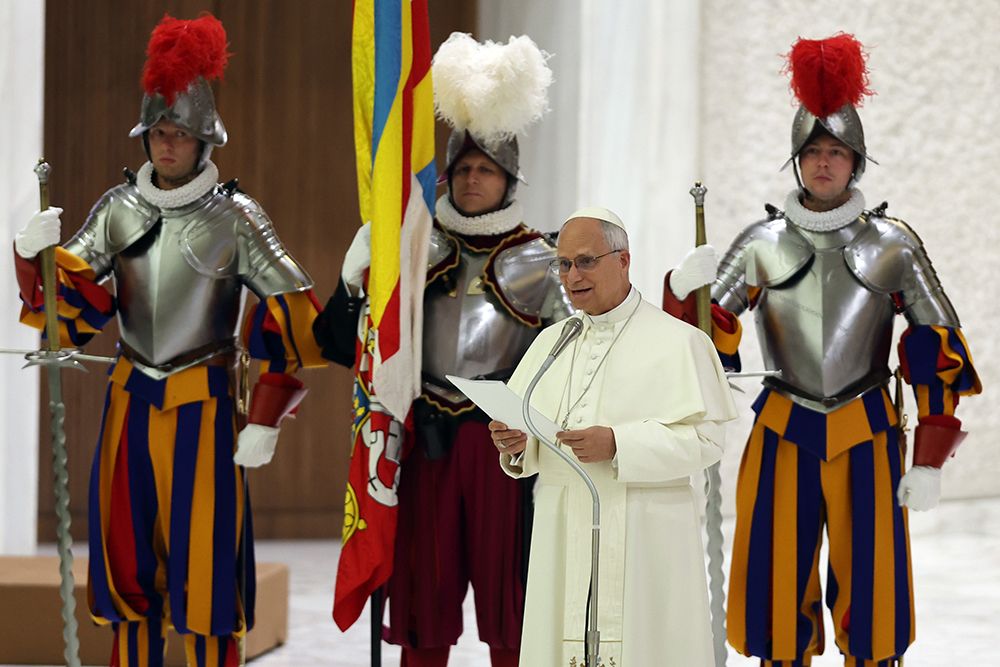
In 1095, Pope Urban II called upon European Christians to take up arms and reclaim Jerusalem from Muslim rule. Those who answered his call were promised spiritual rewards, including the remission of sins. The resulting military campaign became known as the First Crusade.
More than 900 years later, the current pope is delivering a very different message.
Speaking to an international gathering of religious leaders in Assisi, Italy, on October 27, Pope Leo XIV issued a sweeping condemnation of warfare conducted in God's name.
"There is no such thing as a 'holy war': only peace is holy," he declared.
The statement comes amid ongoing conflicts in Ukraine and the Middle East, where religious leaders and political figures have invoked divine authority to justify military action.
But Leo's declaration presents an uncomfortable historical question. If there are no holy wars, what are we to make of the countless wars that religious authorities have spent centuries declaring sacred?
When Killing Became a Christian Duty
According to the medieval chronicler Fulcher of Chartres, Urban II assured prospective crusaders that those who died fighting would receive immediate remission of their sins. His account also has the pope declaring, "Christ commands it."
The consequences were devastating. In 1096, crusading bands massacred Jewish communities along the Rhine. Three years later, Christian armies captured Jerusalem and slaughtered many of its Muslim and Jewish inhabitants.
Raymond of Aguilers, a Christian priest who accompanied the First Crusade, described the city littered with bodies. He celebrated the bloodshed as a "just and splendid judgment of God."
Writing in support of the Knights Templar, an order of Christian warrior-monks established during the Crusades, the influential theologian Bernard of Clairvaux declared:
"The Christian glories in the death of the pagan, because Christ is glorified."
The Crusades eventually expanded beyond battles against Muslim rulers. In 1209, Pope Innocent III launched the Albigensian Crusade against the Cathars, a fringe Christian religious movement in southern France that the Catholic Church considered heretical. The campaign resulted in widespread massacres and the destruction of entire communities.
Historical estimates suggest that between one million and nine million people died during the Crusades in the Holy Land between 1095 and 1291. Medieval historian Rebecca Rist places the likely toll closer to five or six million, including Christian and Muslim soldiers and civilians killed during nearly two centuries of warfare.
(Un)friendly Fire
Consider Joan of Arc, the 16-year-old French peasant who claimed that heavenly voices had instructed her to help restore the French king to his throne during the Hundred Years' War against England.
"I have done nothing save by revelation," she told an ecclesiastical court in 1431.
Joan helped inspire French military victories, but the English-backed court condemned her for heresy and burned her at the stake. Nearly five centuries later, in 1920, the Catholic Church canonized her as a saint.
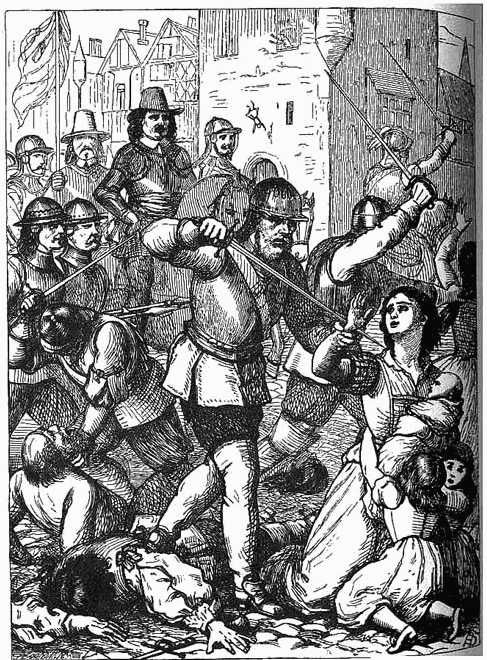
Internal religious divisions became considerably more destructive during the Protestant Reformation.
In August 1572, Catholic forces and mobs massacred French Protestants during the St. Bartholomew's Day Massacre. Historian Mack P. Holt estimates that approximately 4,000 Protestants were killed in Paris, with another 3,000 murdered elsewhere in France. When news reached Rome, Pope Gregory XIII ordered a celebratory thanksgiving service. He also commissioned a commemorative medal depicting the destruction of the Protestant Huguenots.
The Thirty Years' War, fought from 1618 to 1648, was even more destructive. Beginning amid disputes between Catholic and Protestant powers, the conflict expanded into a struggle involving many of Europe's major states. An estimated five to eight million people died, most of them civilians, with starvation and disease accounting for much of the devastation.
Christian religious conviction also influenced England's military campaigns in Ireland.
In 1649, following the massacre of Royalist defenders at Drogheda, English military commander Oliver Cromwell wrote to Parliament describing the bloodshed as "a righteous judgment of God." His Protestant religious convictions helped shape his interpretation of England's military campaign in Ireland.
As we've explored previously, Christianity's history contains numerous examples of violence justified through religious belief, even as other Christians have drawn upon the same tradition to advocate peace.
Holy Wars Beyond Christianity
The Crusades may be the most famous examples of holy war in recorded history, but religiously sanctioned warfare has appeared across numerous traditions.
In Islam, the term jihad means struggle or striving. It encompasses personal spiritual and moral efforts, but historical Islamic traditions have also recognized armed jihad under certain circumstances.
In fact, during the medieval Crusades, Muslim leaders invoked jihad to rally resistance against Christian armies. Saladin, who recaptured Jerusalem in 1187, was among the Islamic rulers who appealed to religious devotion while pursuing military objectives.
In nineteenth-century West Africa, the Islamic scholar Usman dan Fodio launched his own jihad against the rulers of Gobir, in what is now northern Nigeria. He accused Muslim authorities of religious corruption and failing to govern according to Islamic principles. In a document explaining the obligations of Muslim believers, Usman declared that "jihad is a duty unanimously."
His movement established the Sokoto Caliphate, which became one of Africa's largest countries. This was a religiously justified conflict fought substantially among Muslims.
Another major African religious movement emerged in Sudan in 1881, when Muhammad Ahmad proclaimed himself the Mahdi, a messianic figure expected by many Muslims to restore justice before the end times.
Ahmad claimed divine authorization to overthrow Egyptian rule, reportedly declaring that his enemies could be purified only through force. His followers eventually conquered Khartoum and established a religious state that survived until British and Egyptian forces reconquered Sudan.
At the Battle of Omdurman in September 1898, approximately 10,000 Mahdist fighters were killed, compared with fewer than fifty Anglo-Egyptian soldiers.
The Buddhist Promise of Paradise
Religious warfare has also appeared in traditions frequently associated with nonviolence.
In sixteenth-century Japan, followers of Jōdo Shinshū Buddhism organized armed resistance against powerful regional warlords. The religious leaders of what would come to be known as the Honganji Movement encouraged their followers to fight with promises of spiritual rewards.
A banner associated with the movement proclaimed:
"Advance and be reborn in paradise; retreat and fall immediately into hell."
According to research published in the journal Public Choice, the promise of rebirth in the Buddhist Pure Land helped inspire loyalty among the movement's followers.
The Man Who Believed He Was Jesus' Brother
Perhaps the strangest and deadliest example of religiously inspired warfare occurred in nineteenth-century China.
Hong Xiuquan was a failed civil service examination candidate who claimed to have experienced a series of religious visions. After encountering Christian missionary literature, he became convinced that he was the younger brother of Jesus Christ, sent by God to cleanse China of evil.
Hong developed a religious movement combining elements of Christianity with his own revelations. In 1850, his followers launched the Taiping Rebellion against China's ruling Qing dynasty. In an 1853 proclamation, Taiping commanders accused their enemies of abandoning the true God, declaring:
"These demons are not at all human."
The Taiping armies captured major cities, including Nanjing, which became the capital of their self-proclaimed Heavenly Kingdom of Great Peace. The rebellion lasted until 1864, and by the end at least 20 million people had been killed. It's one of the deadliest conflicts in all of recorded history. Although mainstream Christian churches rejected Hong's teachings, the Taiping movement considered itself part of a divine mission. For a movement promising heavenly peace, the earthly consequences were catastrophic.
A History of Holy Wars
The following charts trace 30 historically significant religious conflicts across more than two thousand years, from wars explicitly declared sacred to campaigns in which faith motivated rebellion, persecution, or resistance.
Organized by religious tradition and historical period, they reveal how widely the phenomenon has appeared throughout recorded history.
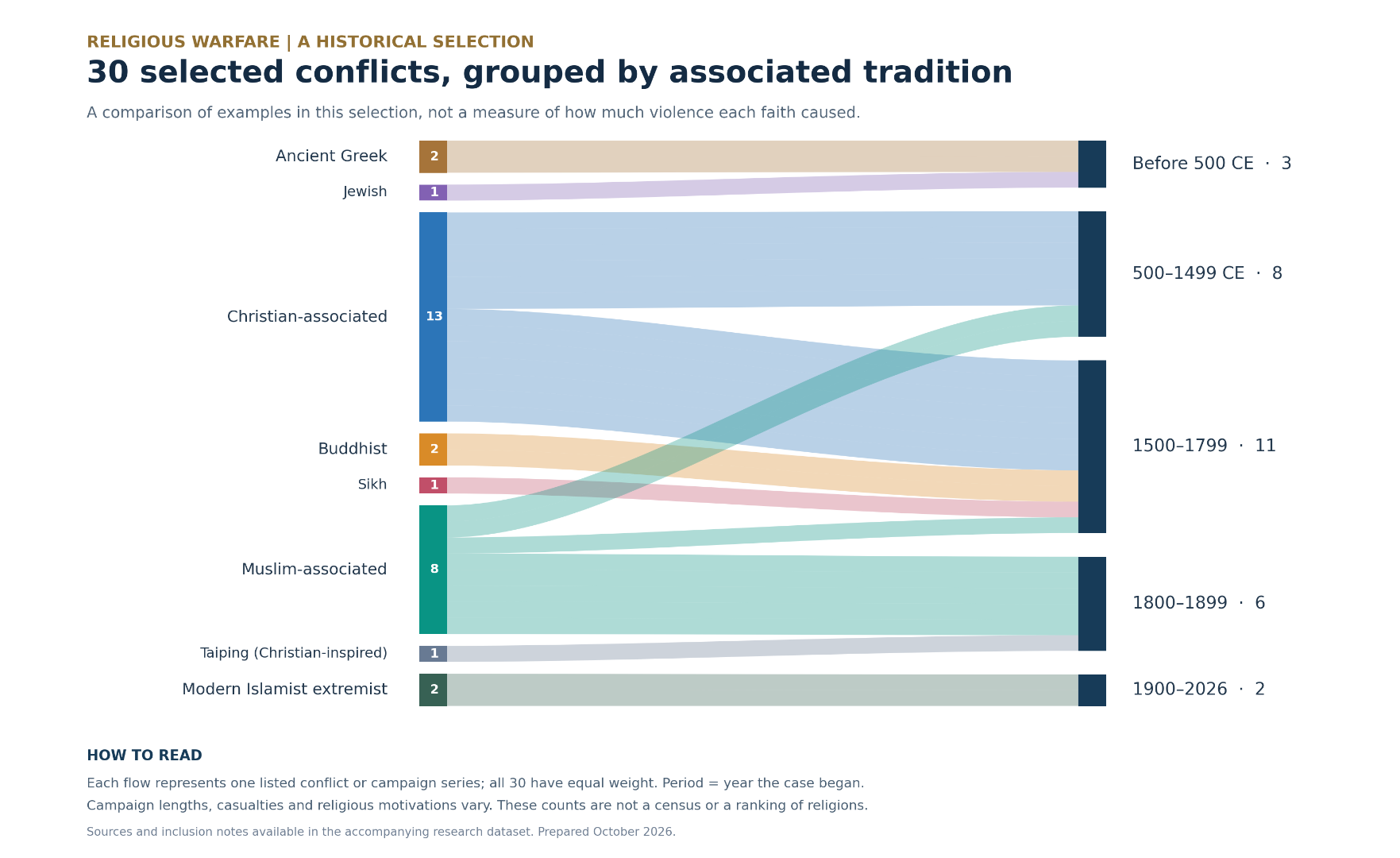
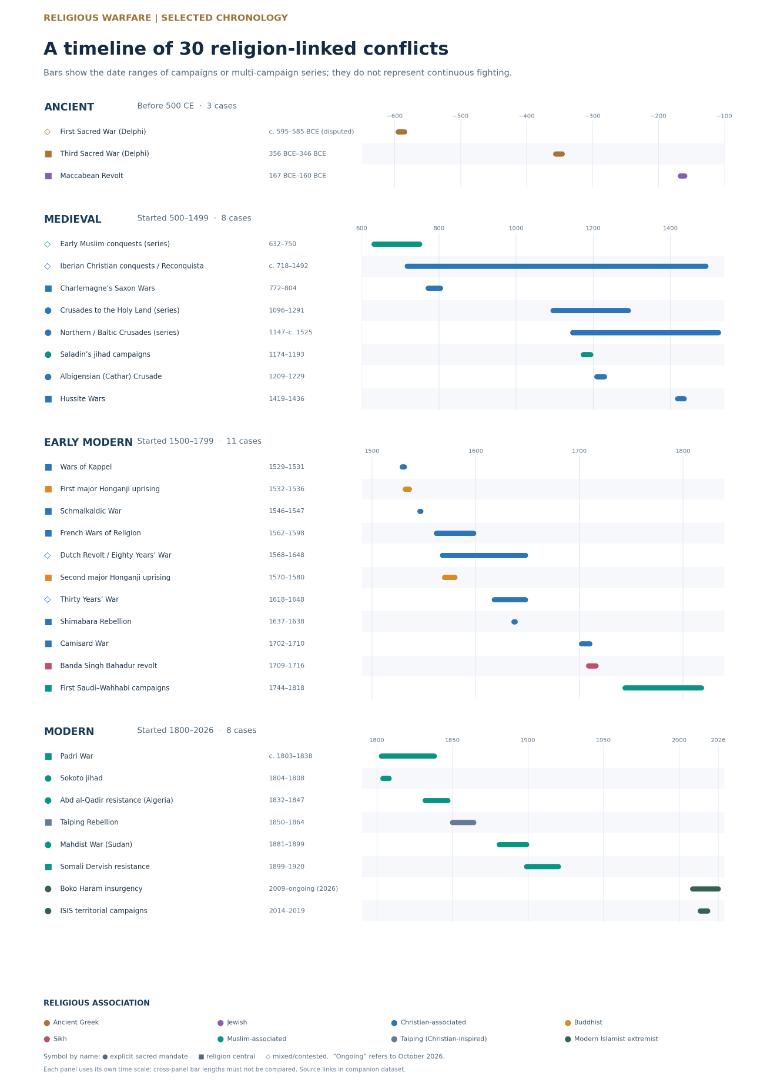
What stands out is how frequently believers fought members of their own religion, rather than followers of competing faiths. Religious warfare was never exclusively a struggle between Christianity and Islam, nor did it disappear when the medieval era ended.
The historical record also invites an intriguing thought experiment.
What would our world map look like if wars fought in the name of religion had never occurred? Would Europe have the same borders? Would the partition of British India have unfolded differently? We can't reconstruct an alternate history, but the further down that rabbit hole you go, the more you realize how fundamentally different the globe could be.
Holy Wars Haven't Disappeared
Religious warfare may evoke images of medieval knights and ancient armies, but the modern world has hardly escaped its influence.
In 1998, Osama bin Laden and other Islamist militants issued a religious declaration calling for the killing of Americans, including civilians. They described this violence as "an individual duty for every Muslim who can do it," claiming religious authority to defend Muslim lands and holy sites.
Bin Laden was the founder of al-Qaeda, a Sunni extremist militant network that sought to overthrow governments it considered insufficiently Islamic and drive Western influence from Muslim-majority countries. Three years after that declaration, al-Qaeda terrorists killed 2,977 people in the September 11 attacks.
But prominent Muslim religious authorities rejected al-Qaeda's interpretation of Islam. Muhammad Sayyid Tantawi, the grand imam of Egypt's al-Azhar, one of Sunni Islam's most respected institutions, declared that bin Laden "doesn't represent Islam." Abdol Majid Khoei, a prominent Iraqi-born Shiite scholar, likewise condemned the attacks, insisting: "No Muslim should defend them."
Five days after the attacks, President George W. Bush used some strikingly familiar language to describe America's forthcoming response:
"This crusade, this war on terrorism is going to take a while."
The terminology prompted criticism given the historical association between the Crusades and Christian warfare against Muslims. The White House subsequently clarified that Bush had meant "crusade" in the general sense of a broad undertaking, not a religious war against Islam.
 The United States invaded Iraq in 2003, primarily citing concerns about Saddam Hussein's alleged weapons of mass destruction. Iraq had played no role in 9/11, but the invasion gave Islamist militants an opening to a new battlefield. In 2004, a militant group led by Abu Musab al-Zarqawi pledged allegiance to bin Laden and became known as al-Qaeda in Iraq.
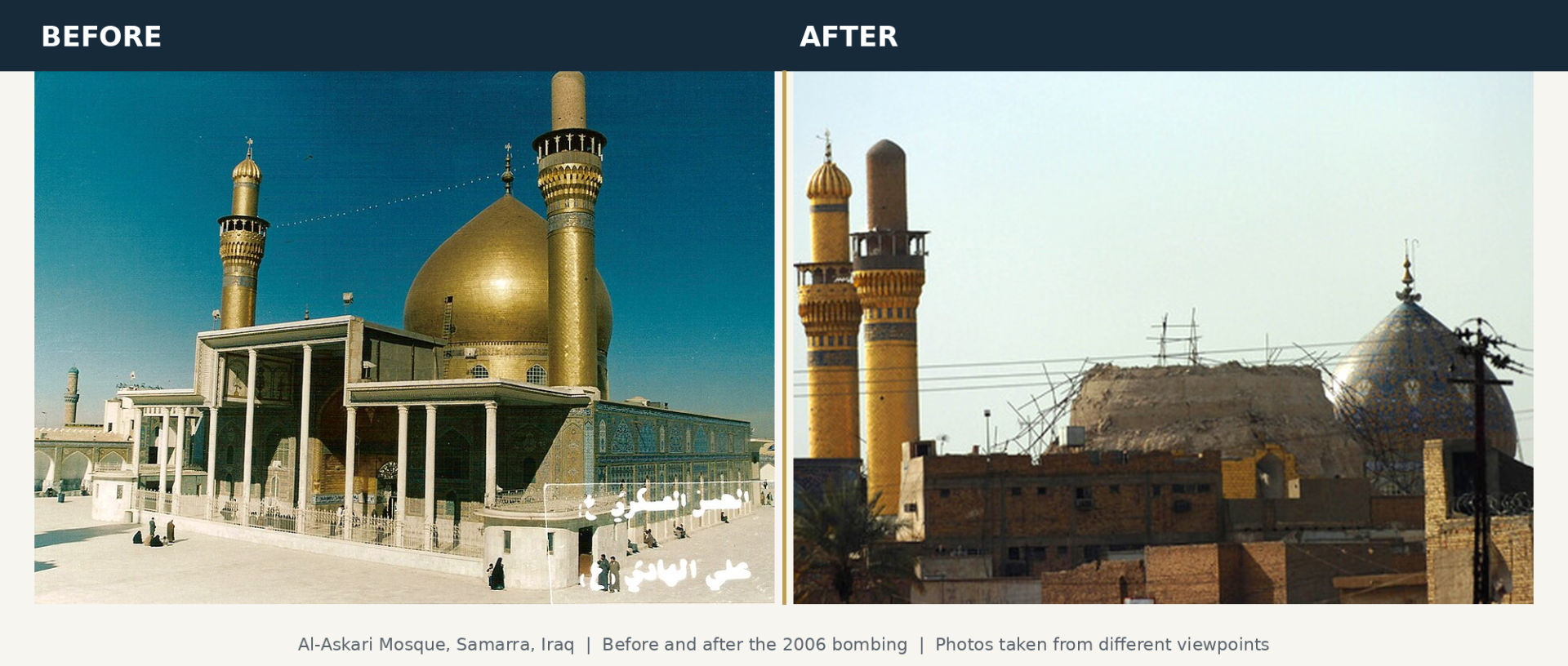
Zarqawi sought to provoke a religious civil war between Sunni and Shiite Muslims, deliberately targeting Shiite civilians and holy sites. In 2006, the bombing of a revered Shiite shrine in Samarra, widely attributed to al-Qaeda in Iraq, helped unleash widespread sectarian bloodshed.
Iraq's leading Shiite cleric, Grand Ayatollah Ali al-Sistani, called for restraint, urging followers not to retaliate against Sunni mosques. Across the wider conflict, Iraq Body Count has documented more than 200,000 civilian deaths from violence since the 2003 invasion.
More recently, in March 2024, the World Russian People's Council, chaired by Russian Orthodox Patriarch Kirill, approved a declaration characterizing Russia's invasion of Ukraine as a 'holy war.' The World Council of Churches strongly objected.
Religious rhetoric has also surrounded the continuing war involving Iran, where certain Christian interpretations of biblical prophecy and Islamic beliefs about the end times have entered public discussion.
Pope Leo's declaration therefore confronts a centuries-old argument that remains very much alive.
Who Gets to Declare a War Holy?
Catholic teaching still recognizes legitimate military defense under strict conditions, a concept known as just war theory. Leo's declaration draws a different line: a war might be morally defensible without being sacred or earning God's favor.
For centuries, religious leaders have offered their followers salvation, spiritual duty, or divine approval as reasons to fight. Other voices within those same traditions have said the opposite. The difference hasn't been merely theological. People have been asked to kill, and sometimes to die, on the strength of those claims.
If a religious leader declared tomorrow that God wanted you to go to war, would you take up arms?
41 comments
-
 Bailey McSwain
All wars are started by RICH humans... there are no 'religious' wars... rich humans start wars... wake up !
-
 Harry Scott Boggs
There are millions of souls who try hard to lock into an eternal living life mode of peace; 24/7 totally committed practitioners of pacifism up to the point of martyrdom. And it's not just a demonstration of cowardice or cynicism toward the warring class. It can sometimes be that, to one degree or another. That type of spiritual control is a magnanimous community lifting, minute-by-minute attainment of something I'll call permanent enlightenment. Though...it is attained rarely.
-
 Gureg Amun Ankh
If the pope believes in his bible and he is the closest being on this planet representing the most high, then why in the Torah it says he sent 10,000 chariots with 20,000 angelic beings to fight alongside the so called Israelites, why in 2nd Kings this god wipe the Israelites out of his site by sending armies down on the Israelites, why did he allow Abraham to fight other tribes of the land of Canaan and take a 10th of what he took and gave it to a being called by god the king of peace, Melchizedek, if this god has something to do with it than its considered holy according to this scroll, so it think the Pope is wrong or misinformed.
-
 Pastor George Day
Gureg Amun Ankh
He isn’t. You just don’t read things in context.
-
-
 Shawn L. Rhodes
I don't believe that God wanted us to use violence as a answer so no
-
 Bishop William Dusenberry, DD
There’s only one provable God, and that provable God is Nature. The more one studies (and thereby understands) Nature— the better it is for everyone on Earth — even those who are science-deprived — thereby enabling supernaturalists to keep relying on holy ghosts, and Virgin Mary’s, in their ongoing “Holy Wars” — mainly against science and those of us who know, that Nature is the only provable God.
-
 Ari Joseph Bertine
Good for Leo. I agree wth him. Nothing that glorifies violence, rage, territoriality, greed, or hatred is even in the same neighborhood as spiritual, let alone "holy". Wars in the name of religion have always been about animal impulse, with religion cited as an excuse.
-
 Geoffrey C. Olive
As far as I am concerned anything to do with religion, particularly wars, is a*se holy!😂
-
 Merle A Clark
Palestine & Israel is a holy war
-
Pastor George Day
Merle A Clark
I agree—long live Israel, the chosen people!
Genesis 12:3: “I will bless those who bless Israel and curse those who curse them.”
-
-
 Rev. Frank H Kalebich
Maybe pope Leo should worry about the war he is head of.the war where the priests and nuns abuse children in there care. Pedophiles.
-
Rev. Frank H Kalebich
This clown is the head of a cult of pedofiles. This is a fact.
-
Rev. Frank H Kalebich
Very true
-
Pastor George Day
Rev. Frank H Kalebich
Your comment is nothing more than a bargain-bin cliché—and that’s a fact too, stamped, sealed, and delivered!
-
-
 Roy S. Thorpe
War is a war is a war is a war! It's always a land grab or some moron trying to shove their beliefs down somebody else's throat!
-
 P. Keith Benefiel
Religion may be the excuse for war, but something else is usually the reason. The middle east is being fought over by Judaism, Islam and American style Christianity, but the reason is the world addiction to oil and its control.
-
 Rev. BH
Holy + War - a contradiction of terms.
-
Pastor George Day
Rev. BH
Go and tell the Muslims!
-
-
Geoffrey C. Olive
Maybe Pope Urban should be renamed Pope Suburban!😂
-
 ServantOfJudgement
The crusades are a result of Europe letting Islam infiltrate and abuse. See france now...
When the bully finally gets slapped around by the victim, it's the victim that gets punished.
You can trust it.
-
Pastor George Day
ServantOfJudgement
Toally true!
-
-
 Mary E Otahal
Citing an event from 900 years ago to undermine a modern call for global peace is an absurd logical stretch. Humanity evolves, and so do institutions. Pope Leo XIV is a critical global ally for peace, and alienating our allies because you’re stuck in the 11th century is exactly the kind of counterproductive, bullying isolationism that Donald Trump has pushed. We should be collaborating with global moral leaders to solve modern conflicts, not treating our closest partners like enemies over ancient history. Imagine trying to score political points against the Pope by bringing up the Crusades. It’s been 900 years the rest of the world has moved on. Deflecting from a message of peace just to bully a key global ally is peak toxic politics, mirroring Trump's exact approach to foreign relations. The Pope is our ally, and undermining international stability just to stay combative is a losing strategy. If your only counterargument to a call for global peace is bringing up things that happened a millennium ago, your perspective is completely obsolete. Bullying our international allies over medieval history is exactly the kind of chaotic foreign policy Trump normalized. Grow up, get with the times, and learn how to actually work with our partners.
-
 Patricia Ann Gross
Mary,
Perfectly said. Thank you.
-
-
 James Riggle-Johnson
I’m pretty sure Pope Leo doesn’t think any of these wars were Holy either. But this article sure shows how violent religion is in general.
-
Patricia Ann Gross
James,
Well said. These wars were mostly in the Midevael times. One could only hope that society has become more civilized and evolved with the times, but the fact that some of this has bled into the 19th, 20th, and 21st-Centuries seems to prove otherwise. I applaud Pope Leo for standing up and saying this. He cannot rewrite history, but he CAN certainly do everything humanly possible to keep us from repeating it.
-
Pastor George Day
Patricia Ann Gross
The Crusades in the Middle Ages were always initiated by Muslims. Review history.
-
Patricia Ann Gross
Pastor Day,
And what does that have to do with US not repeating what happened then, regardless of who started it, which was what my comment said. BTW, the war in Iran, who started that? Who invaded first? Who was the instigator and the aggitator? Before you answer, go back to earlier this year and read your current events. That is what Pope Leo was responding to. What is happening now makes us no better than we acuse them of being.
-
-
-
-
 Barbara Harris
And people have issues with me being a Pagan. I have family heirlooms that date back to when the Huguenots had to escape from France due to being hunted down and killed. As the story is written down, the Catholic priest in the town where my ancestors lived, told them to flee quickly. He helped divert the ones coming to attack, in order to give the family and their servants time to escape to England.
-
 Lori Mongillo
I agree with Leo that war may be morally justified, but it is never holy. I'm not a Christian, but I admire his statement. Religious movements , such as war, can never be justified as holy, but somehow human beings have made that a thing. Self-righteousness is the most unholy thing on this planet, yet here we are in the 21st century, still debating and dividing over religious theology. We refuse to grow up. We refuse to see that we are all sacred, and no one path can claim the favor of Spirit. It's way too simple to just live and let live. Drama is what humankind craves, and I'm afraid that will never change.
-
 Gwendolyn Lord
There is NO war that can be called "holy", regardless of cause. Death does not confer status.
-
Pastor George Day
Gwendolyn Lord
Go and tell the Muslims!
-
-
 Colleen McAllister
There have always been wars and they will continue for the foreseeable future. Humans fight when they disagree or both want the same thing. Religion is just one of the things that we war over.
Can a war ever be considered holy? I don't know, but I tend to agree with the Pope. Whatever excuse is given war is never the right answer.
-
 Keoni Ronald May
That statement, made by the Current Pope, is his current political & religious beliefs. Prior Popes, held different political & religious beliefs. In old Vatican History, Popes had children, and one had a son, who became a Pope. Crusades were sanctioned by the Popes. The Jesuits were created to kill Protestants.
-
Pastor George Day
Keoni Ronald May
Your comment is so historically accurate that many Jesuits have been friendly toward Protestants, including the late Pope Francis. Guess what!
-
-
Geoffrey C. Olive
Religion is the bane of humanity! Nothing more than that needs to be said!
-
 Najah P Tamargo
Najah Tamargo-USA
MY God considers the taking of any human life (unless in self defense of myself or my family) a sin. Yet more wars have occurred in the name of somebody's God than anything else. Father Frederick is correct. They need some fact checking!!!!
-
 Sir Lionheart
But religions are soooooo peaceful. They are full of love……assuming you join the right one at the time. 🤷 🤭
🦁❤️
-
 Carl Maniscalco
Right — as long as you join my religion …
-
Pastor George Day
Sir Lionheart
Alright, now we’re on the same wavelength! Nicely done :-) Ready to hop aboard my linguistic rollercoaster?
-
-
 Father Frederick
The Vatican has a way of making a statement without checking into history first. I have the feeling before official statements are made, a committee should review the facts before release. This is not the first time.

It would be nice if there was peace.
Muslims are slaughtering Christians in Nigeria at this very moment.