

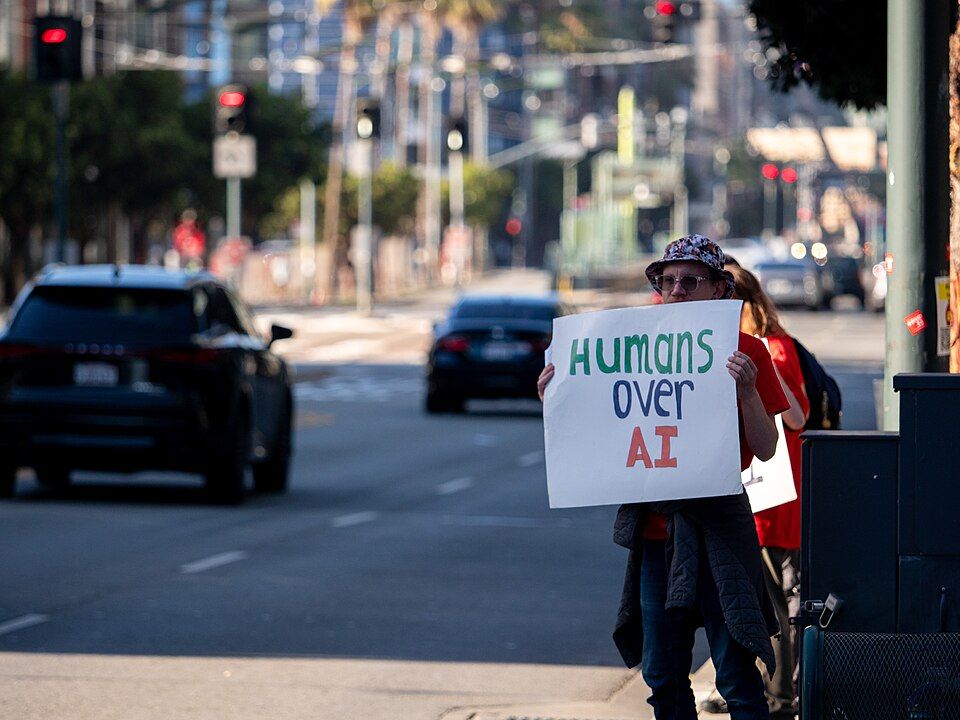
At the University of Kentucky, it's David Durman's job to help researchers prepare grant applications. When the university began encouraging employees to use tools like ChatGPT, Claude, and Microsoft Copilot, the 45-year-old administrator decided he wanted no part of it. His concern was what he would lose by letting a chatbot do his thinking.
Durman identifies as a humanist, someone whose ethical convictions are grounded in human reason and dignity rather than a belief in the supernatural. He asked the university to excuse him from using artificial intelligence on religious grounds. On September 25, it agreed.
“And offloading that labor, regardless of whether it’s taxing or not, is undercutting my ability to be a moral actor,” Durman explained in an interview with Religion News Service. The American Humanist Association, which helped him make his case, believes this is the first time a humanist has secured such an AI exemption. A humanist had persuaded his employer that thinking for himself was a protected matter of conscience.
When Reason Becomes a Conviction
Humanism has a long intellectual history and a defined set of ethical commitments. Modern secular humanism generally holds that people can live meaningful, moral lives without belief in gods or supernatural forces. It grounds knowledge in observation and reason, and ethics in human needs and experience.

The first Humanist Manifesto appeared in 1933. The third version, published in 2003 as Humanism and Its Aspirations, describes a worldview “guided by reason, inspired by compassion, and informed by experience.” It asks people to treat others as possessing inherent dignity and to make informed choices with personal responsibility. It also celebrates science as a way to solve problems and develop beneficial technology. On paper, that may sound more like a philosophy that would welcome AI than one that would refuse it.
But Durman sees a distinction between using a tool to obtain information and asking it to perform the judgment he believes he owes other people. His university work involves helping researchers pursue funding. A chatbot might draft a response or organize an application, but Durman believes that attending carefully to a researcher's particular circumstances is part of the ethical work itself. His accommodation request argued that replacing human attention with automated processing conflicted with his personal commitment to honoring human dignity.
It's an unusual definition of religious practice. Durman isn't asking to pray during his workday or wear a symbol of his faith. He's asking to keep doing an ordinary part of his job, even as his employer introduces technology it believes will make that job easier.
Not every employee who resists AI has received such an accommodating response. In August 2025, Brian Armstrong, the CEO of Coinbase (a company that facilitates the trading of cryptocurrency online), revealed that he'd fired software engineers who failed to comply with his instructions to start using AI coding tools. Armstrong had ordered employees to sign up for the technology within a week and summoned those who hadn't to a Saturday meeting to explain themselves. Some apparently couldn't offer an acceptable explanation and lost their jobs.
Armstrong acknowledged that his approach was heavy-handed, but defended it as necessary to establish that adopting AI was no longer optional at the company. Still, not everyone is enthusiastic about the technology's growing influence in the workplace. A survey published earlier this month by Elon University found that 65 percent of American adults believe that if AI makes work less meaningful, people will lose their sense of purpose and dignity.
Who Gets to Claim Religious Freedom?
For decades, Americans have argued over which convictions are religious enough to deserve legal protection. In 1965, the Supreme Court considered the case of Daniel Seeger, who objected to military service on grounds of conscience but did not profess an orthodox belief in God. The justices ultimately concluded that, under the conscientious-objector law at issue, a sincere belief could qualify when it occupied a place in someone's life comparable to traditional belief in God. The decision helped expand the legal understanding of conscience.
Today, Title VII of the Civil Rights Act requires covered employers to reasonably accommodate certain sincerely held religious beliefs and practices. The Equal Employment Opportunity Commission explains that protection can include nontheistic moral and ethical convictions held with the force of religious belief. That doesn't mean an employee can label any personal dislike a religion. The belief must be more than a political position, economic objection, or simple preference.
Employers can still decline accommodations that would impose a substantial hardship on their operations, as the Supreme Court clarified in its 2023 Groff v. DeJoy decision. For Durman, the situation was straightforward: The university concluded that he could continue his grant-administration work without personally using AI.
His exemption has boundaries. Durman must still attend meetings with colleagues who use AI, and he may encounter systems that incorporate it. The university has not agreed to become an AI-free workplace. And because this was an accommodation granted by his employer, rather than a court ruling, it doesn't automatically establish the same entitlement for other employees.
This understanding of conscience is familiar territory at the Universal Life Church. Among our ordained ministers are humanists, atheists, agnostics, as well as people who hold more conventional religious beliefs. Many of our ministers approach their calling through humanist principles, emphasizing reason, compassion, and human dignity rather than worship of a deity. Some lead humanistic weddings or memorials, where the meaning comes from relationships and promises made among living people, not a prescribed creed. Our recent explanation of secular ministry describes how that works in practice.
For those ministers, not believing in God doesn't mean that they don't personally hold anything sacred, or that they have no rubric by which to treat others. We previously covered a Pentagon decision that removed humanism and other minority traditions from a list of recognized religious affiliations. That controversy, like Durman's AI exemption, raises an old question: Who gets to decide which convictions count?
She Said No to AI First
Durman wasn't the first person to seek this kind of workplace accommodation. In fact, he got the idea after reading about Erin Maus, a North Carolina software engineer and Unitarian Universalist who received an AI exemption from her employer in May. Maus specifically objected to the environmental and ethical costs of generative AI. She spoke with an employment lawyer and her minister before making the request, which her company ultimately approved.
Maus described the strangeness of carrying on as a programmer without the automated tools her industry has embraced. “I'm writing my code and reviewing my code by hand, which seems crazy to say,” she told Business Insider. “Just two years ago, how else would you do it?” She added that she had recently completed an assignment as quickly as a colleague using AI for a comparable task, suggesting her refusal may not even affect her employer's output.
Meanwhile, Pope Leo XIV recently expressed his own broad concerns about the relationship between AI and human dignity. In his May encyclical, Magnifica Humanitas, the pope warned that when society measures human value primarily through efficiency, people risk treating themselves as problems to be optimized rather than as individuals whose relationships and experiences have inherent worth. Leo isn't calling on Catholics to reject AI, but his concerns echo those expressed by Durman and Maus.
Is Using AI Actually Inhuman?
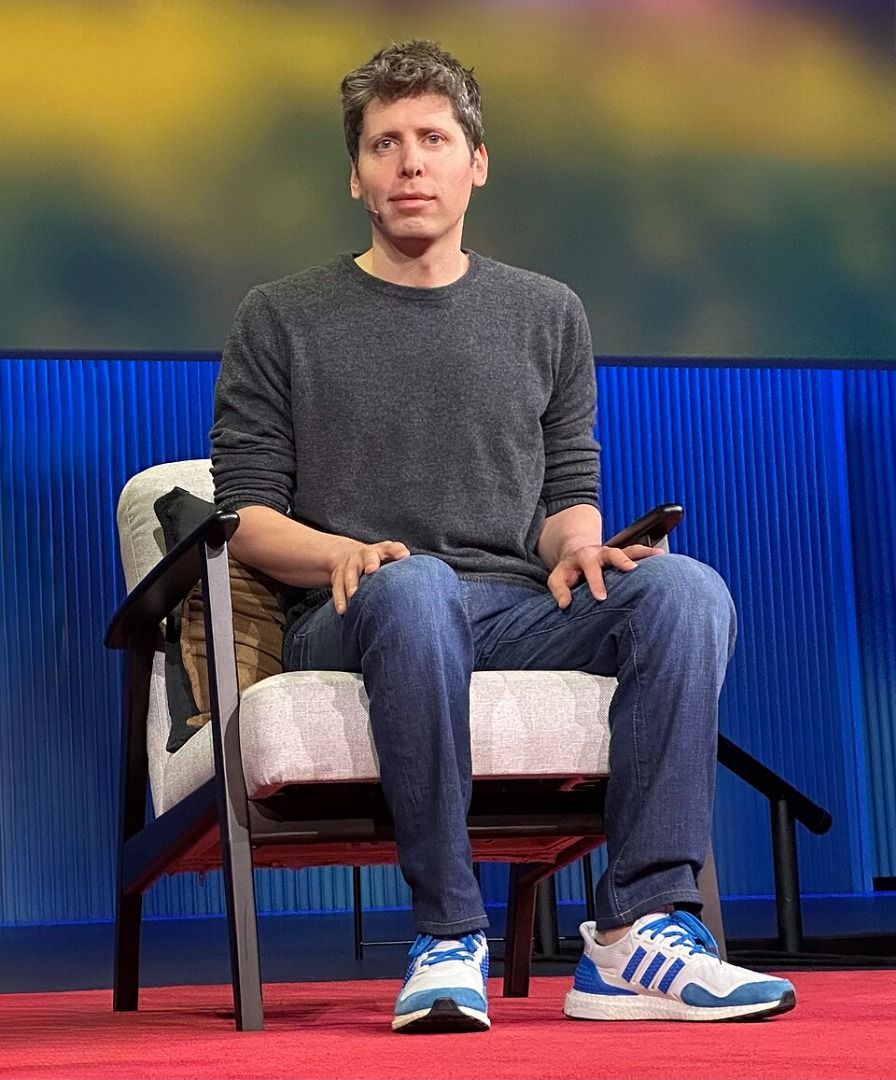
Interestingly, even Sam Altman has discovered limits to how much of his own work he's willing to surrender to AI. In May, the controversial current CEO of OpenAI described an experiment in which he let artificial intelligence write his emails, text messages, and Slack responses. He said he eventually abandoned the practice, describing the experience as “surprisingly dehumanising” and explaining that he'd realized how much people value genuine human interaction. Altman remains enthusiastic about AI's potential, but even the man helping to hype the technology discovered there were certain responsibilities he didn't want a machine performing on his behalf.
Of course, using AI doesn't necessarily diminish humanity. For centuries, people have been handing over parts of their thinking to tools. We use calendars instead of remembering every appointment, calculators instead of doing every sum ourselves, and writing to preserve thoughts outside our minds. AI may serve a similar purpose, helping someone with a disability communicate or a researcher identify patterns in data. Those tools haven't made human judgment disappear, and in some cases, they've freed people to exercise more of it. Using assistance needn't mean abandoning responsibility.
The distinction Durman draws is therefore personal as well as philosophical. He believes that the very act of wrestling with a decision is one way he develops moral character. He also makes a case, through the lens of Humanism, for the value of collaboration. His concern isn't limited to whether an AI-generated answer is correct; it's about what happens to the person who never has to reach an answer without interacting with another person. In Jewish chavruta study, partners deliberately read and debate sacred texts together, valuing the effort of questioning and interpretation alongside the answers they reach.
But his approach comes with a challenge, too: How much assistance is too much? A grammar checker can suggest a better sentence; an AI assistant can suggest an entire letter. A database can supply facts; a chatbot can recommend what to do with them. The boundary between support and substitution isn't fixed, and different people will draw it in different places.
Durman still reviews grant applications, works with researchers, and attends meetings with AI-using colleagues. The university decided he can do those things without personally relying on a chatbot. As AI becomes standard workplace equipment, how much room should employers leave for someone who believes doing their own thinking is a moral duty?
If using AI became a requirement at your workplace, would you consider refusing on moral or religious grounds?
8 comments
-
 Dr Dennis Chevalier PhD, DDvin
To all Christian ministers, In the history of science fiction as well as reality based TV there have been sections of the movie or episodes written where humanity is 'coming back' from control of AI with a fight for its life as well as us. Where all have suffered and few Preval and others will say it'll be interesting to see what happens. I'm pretty sure I'm not gonna wait for that part because It's going to be really scary.
Family, I can honestly say I am terrified of what AI can do without our knowledge before we make it stop.
Dr. D.
-
 Kathryn Diane Taft
This isn't even a religious thing at all. If anyone reading this is even using chat gpt "just for fun" or whatever other stupid excuse you have, you are crazy. Come on people, its time to dump the idiocracy. Just stop!
-
 Sir Lionheart
The beauty of AI is that it doesn’t rely on a “faith-based” structure. It uses pure intellectual factual knowledge to provide its answers. I’m sure this will not please those who only rely on faith, so AI might not sit well with them, unless they want to use its other capabilities that doesn't involve religion. It’s quite possible that people whose lives are structured around their faith might not like using AI if they see it as anathema to their beliefs.
🦁❤️
-
 Robert Gagnon
Humans interact with the world around them. Relying on a machine to perform these interactions as a tool can be helpful. But as a replacement diminishes the human experience. They mention calculators, not learning and memorising the fundamentals of math deprive us of logic and critical thinking. Not writing by hand removes the very substance of words and their meaning. They no longer teach script or cursive as it’s known , this disables our future generations from reading how many papers, notes, and books? To completely rely on a machine is not in our best interests.
-
Kathryn Diane Taft
Never mind the ai, LOOK AT WHAT WE ARE ALLOWING TO HAPPEN TO OUR COUNTRY! The principles this country were founded on are what make us the greatest country in the world. We are all just watching it crumble down around us and doing NOTHING. Shop, shop, shop, watch our nation falling like it's a crime drama on tv, go online, complain, do nothing. Why aren't you at your capitol building right now DEMANDING that that pos exits the white house RIGHT NOW!!! Doesn't matter; Dem or Rep, that man is a rapist, a pedophile, and just a criminal. WTF, man? I walk my talk. Proud to be a TAFT woman, too bad I'm not a man, i'd be president.(i dont vote for women, ever.) Soooo not sorry
-
 Brian Hand
Please stop. You need help for your TDS.
-
-
Dr Dennis Chevalier PhD, DDvin
Robert, Nowadays because of AI,and the Internet; murdered by remote control is now more possible and more real than science fiction ever would guess it to be or could be and for those of us who are in hospitals and need stroke assistance... a person by remote control can end my life or AI could simply determine the cost benefit/loss factor of keeping me alive to be too much and just turn my life support of. I'm seriously scared of this. Be afraid, Be very afraid;read Isaac Asimov's 'I Robot' and others. I'm really afraid of this and I had faced people with AK-47's shooting at me and hitting me and they were nothing compared to this.
Dr. D.
-

The record of AI ain't good. Add to that, AI only does what it's creator tells it to do. (Sort of like how our creator gave us instructions).
I stand in the camp of let AI be the researcher, but the human be the interface to society. But that said, a fellow priest in the church tried it to write a sermon, Despite a very careful instruction, it had passages mis-attributed, meaning wrong, and even changed some of the points.
I've used it for my hobby but have found it to be incorrect on many technical aspects. (You can't change physics).
Put me down for "NO" to AI.