

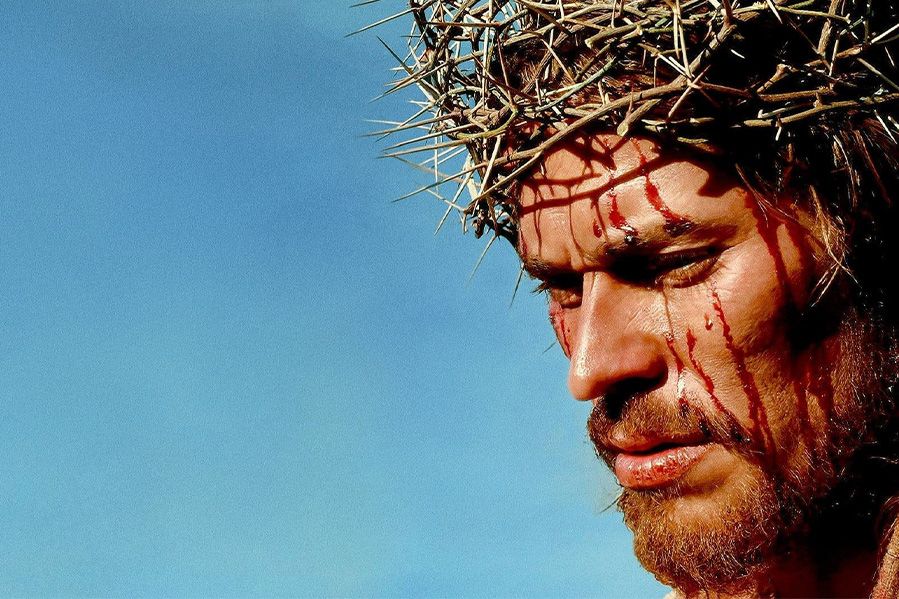
Jesus has always been big at the box office (by way of example, one need only look at the earnings of the #1 grossing Indie film of all time... Mel Gibson's The Passion of the Christ). However, Hollywood and organized religion have never had an easy relationship. Films touch the things that matter most to people – identity, death, meaning, the sacred – and when they do it wrong, people show up. Sometimes with signs. Sometimes with bomb threats.
With Christ-centric sequels from both Scorcese and Gibson in the near future (not to mention the slew of other Biblical films released each year), the explosive adoption of orthodox Christianity by young men, the controversies can only increase from here. The way popular culture embeds or distorts religious symbolism is a perennial source of friction – but few cases have generated the kind of sustained organized protest that the films below did. Here’s a look at some of the most memorable.
The Last Temptation of Christ (1988)
Martin Scorsese’s adaptation of Nikos Kazantzakis’s novel imagined Jesus experiencing human doubt, fear, and desire – including a dream sequence in which he lives an ordinary life with Mary Magdalene. The response was immediate and intense. The American Family Association organized a boycott. Universal Studios received death threats. In France, a theater showing the film was firebombed, injuring thirteen people. In Greece and other Orthodox Christian countries, the film was banned outright. Mother Teresa publicly condemned it. Scorsese and lead actor Willem Dafoe required security details. The irony is that the novel and the film are deeply reverent, exploring Jesus’s humanity as itself a theological statement.
Life of Brian (1979)
Monty Python’s satire of messianic movements caused extraordinary uproar despite the Pythons’ explicit statement that the film was not about Jesus but about people who follow messiahs uncritically. Several U.K. local councils banned it. Norway banned it entirely; a fact the film's marketing team in Sweden exploited to great effect (“So funny it was banned in Norway”). John Cleese and Michael Palin debated two bishops on live television. The film was eventually named the greatest British comedy of all time by Channel 4.
The Da Vinci Code (2006)
Dan Brown’s novel was already a flashpoint before Ron Howard’s film arrived, but the movie sent Catholic protests worldwide. The Vatican called for a boycott. Several countries banned or restricted screenings. Protestors in Thailand dressed as monks held vigils outside cinemas. The film grossed over $750 million globally, making it one of the most financially successful protests in cinematic history. The film’s central claim – that Catholic allegory and symbolism have been embedded in popular culture in ways most audiences miss – has a legitimate scholarly dimension, whatever one thinks of Brown’s particular version of it.
Dogma (1999)
Kevin Smith’s theological comedy provoked protests from the Catholic League even before anyone had seen it. The Catholic League’s president received the script before release and launched a campaign; Smith received so many death threats that Miramax briefly considered not releasing the film. It was eventually released to strong box office numbers. Smith, himself a Catholic, has said the film was written out of genuine faith and intended as a love letter to Catholicism’s willingness to update its doctrines.
The Siege (1998) and The Love Guru (2008)
Religious protests aren’t exclusively Christian. The Siege, which depicted Muslim-American communities as terror suspects, prompted protests from Muslim-American civil rights groups who argued the film would inflame prejudice. The Love Guru, Mike Myers’s comedy set in the world of a Hindu guru, was condemned by Hindu leaders who called it sacrilegious and objected to its treatment of sacred symbols as punchlines. Both cases point to a question worth asking: what institutions like the Olympics reveal about the line between religious history and cultural spectacle applies equally to Hollywood – once something sacred becomes entertainment, who gets to say when it goes too far?
Do you think religious groups have the right, or the responsibility, to protest films that offend their beliefs? And is there a line between legitimate criticism and censorship?
31 comments
-
 Rolando Couce
DONT GET MAD AT THE SINNERS THEY DONT LOVE CHRIST BUT ONE DAY THEY WILL REGRET NOT BELIEVING IN GOD
-
 ServantOfJudgement
Before I watch and show about the Bible I look at who's the star or director. If they're not bible believing Christians they'll butcher it with foolishness.
The American psycho as Moses, hahahaha, ok boomer.
-
 Sir Lionheart
Is there any refutable evidence yet that Moses was real?
🦁❤️
-
 Patricia Ann Gross
Sir LH,
It has been argued, considering the long life that Moses lived in such an ancient time, that he was not a single person, but a lineage of generations, with traditions passed down through an oral tradition, as "writing something down" meant carving it in a stone. If you've ever played the "telephone game" you would understand how this type of tradition could cause changes and embellishments in the story to make it more believable to the intended audience. Even the Dead Sea Scrolls have changes and discrepancies between the written stories, as they were transcribed from these stories. It was probably easier to depict Moses as an individual who lived centuries than to explain a lineage of the story. Believe me, there is more than enough genealogy in The Bible.
-
Sir Lionheart
Thank you for that. Yes, I agree that it is possible he might not have been a single person, which could also be attributed to the personage of Jesus, mainly because there were many people back in that time claiming to be profits of God.
Possibly the same could be true for Abraham, being as we also have no demonstrable evidence of his reality.
As for others like Adam and Eve….thank goodness for the modern day science of genetics, which has completely debunked that particular fable.
🦁❤️
-
-
-
-
 Dr Dennis Chevalier PhD, DDvin
To the Participants and Moderators,
After spending considerable time observing and participating in discussions on this forum, I feel compelled to address a recurring problem that continues to undermine the quality and credibility of the conversations taking place here.
Many contributors in this blog present themselves as authorities on Christianity, theology, biblical interpretation, Church history, and religious doctrine. Yet what becomes increasingly apparent is that a significant number of these individuals demonstrate little if any familiarity with the disciplines they claim to represent. Rather than engaging in serious scholarship, many discussions devolve into exercises in self-justification, selective interpretation, and the rewriting of inconvenient facts or they reference alleged proof that no one has or can prove yet they write as if they were right there witnessing it.
A troubling pattern has emerged. When a participant presents a scriptural reference, historical source, or documented theological position, the response is often not a careful examination of the evidence but an attempt to explain it away. Clear texts suddenly become unclear. Established meanings become endlessly fluid. Historical facts become subject to personal preference.
For example, when discussing a passage such as Leviticus 18:22, one would expect a conversation grounded in textual analysis, historical context, linguistic scholarship, and the longstanding traditions of interpretation. Instead, what frequently occurs is an endless series of unsupported assertions designed to arrive at a preferred conclusion regardless of what the text actually says.
There is a profound difference between interpretation and revisionism. Interpretation seeks to understand a text honestly. Revisionism seeks to make a text say what one wishes it had said. Too many discussions here appear to embrace the latter. What concerns me most is not merely the quality of the debate itself but the effect these discussions have upon readers. Many visitors come to forums such as this seeking information, guidance, and understanding. They often assume that those presenting themselves as knowledgeable have done the necessary study and are speaking from a position of competence. When speculation is presented as scholarship, opinion is presented as fact, and personal preference is presented as doctrine, readers are gaslighted and misled. I have witnessed some so-called ministers here cannot even count to 15 without making that act sound like it’s a “TON”.
Theological inquiry is not a game. Religious scholarship is not an exercise in inventing meanings to accommodate contemporary preferences. The texts, traditions, languages, historical documents, and teachings that have been studied for centuries deserve to be approached with intellectual honesty and respect.
I have devoted many years to the study of service before self, theology, religious history, and biblical scholarship. I recognize that sincere people may reach different conclusions on difficult questions. Honest disagreement is never the problem. The problem arises when evidence is ignored, sources are misrepresented or lied about, and conclusions are determined before the investigation even begins.
There is a difference between saying, "I disagree with this teaching," and claiming, "This teaching never existed."
There is a difference between questioning a historical interpretation and pretending the historical record says something it does not.
There is a difference between scholarship and rationalization.
The purpose of serious religious discussion should be the pursuit of truth, wherever that truth may lead. That pursuit requires humility, discipline, evidence, and a willingness to be corrected when the facts do not support our assumptions.
If we genuinely care about educating others, then we owe them more than personal opinions disguised as expertise. We owe them honesty. We owe them accuracy. We owe them the discipline to distinguish between what the sources actually say and what we would prefer them to say.
Only then can meaningful dialogue occur.
Respectfully, Dr. D
-
 Nikan Firoozye
I think the inclusion of the Siege is a little bit an aftertthought. Not a religious movie, and yes, Musliims are tired of stereotypes (why not watch 'The Four Lions' instead, a great antidote). What was also left out was that there were loads of Muslims who were upset over the Last Temptation. It wasn't just Christians who protested. Many Muslim groups thought the depiction of Jesus was heretical and protested.
-
Patricia Ann Gross
Do religious groups have a right to protest? Absolutely, so long as they are not inciting violence. It's in our first amendment rights to do so.
I found "The Passion of the Christ" to be gratuiously violent, but also, perhaps the most accurate depiciton of the passion narrative. It was hard to watch, so it is one I have only seen once, but it also brought out the significance of the suffering Christ endured at the end. Of the others, many pull from Gnostic writings, particualrly The Divinci Code, which has narratives of Christ being more of a human, but did not make the canon. Many people do not realize that Mary Magdaline also wrote a Gospel. I haven't read it (yet), but it, along with many of the other Gnostic writings, is on my list for my dissertation. I understand the Catholics' distaste as it shows a dark segment within their faith. Dan Brown's Angels ad Demons was probably more condemning than Divinci Code, but as a work of fiction, shows how diligent the Vatican is about maintaining ancient documents that are extremely delicate.
But back to the question. If pro-lifers can continuously be a nuisance outside the Planned Parenthood Clinic down the street (which provides women's services, cancer screenings, and birth control to some of the poorest in the city, but also happens to perform an occasional abortion), then a Christian (or athiest, Muslim, Hindu, etc.) group has the right to protest a religious film.
-
Dr Dennis Chevalier PhD, DDvin
"The Passion of the Christ wasn't violent because the script or director wanted it so, it is a faithful retelling of history. There is a difference. The Divinci Code and others listed were violent becaise of writers and directors for sales and vested interests for the sake of movie sales. Its best to not confuse these unless your goal was to do just that....
-
 Rev. BH
A retelling of a bible tale, not a historical document, Dr. of Many Titles.
-
Dr Dennis Chevalier PhD, DDvin
The accounts of Jesus Christ's suffering, crucifixion, and death should not be dismissed as merely a retelling of a Bible story. Such a characterization ignores the substantial historical evidence that exists both within and outside the biblical texts.
The New Testament itself contains multiple independent accounts written by different authors and preserved through thousands of ancient manuscripts. These writings describe in detail the arrest, trial, scourging, crucifixion, death, and reported resurrection of Jesus of Nazareth. While Christians regard these writings as sacred Scripture, historians also examine them as ancient historical documents that provide valuable evidence regarding first-century events.
More importantly, the existence and execution of Jesus are not attested solely by Christian sources. Non-Christian historians and writers also recorded information concerning Him and the movement that arose after His death.
Tacitus, one of Rome's most respected historians, recorded that Christ suffered execution under Pontius Pilate during the reign of Tiberius. Flavius Josephus wrote about Jesus and the early Christian movement.
Lucian of Samosata acknowledged that Christians worshipped a man who had been crucified. Mara bar Serapion referred to the execution of the "wise king" of the Jews.
These writers were not Christian evangelists seeking converts; they were independent observers whose writings provide historical corroboration that Jesus lived and was executed.
The discovery of the Dead Sea Scrolls further demonstrates the reliability of the historical and cultural environment described in the biblical record. While the Dead Sea Scrolls do not contain eyewitness accounts of Jesus' crucifixion, they confirm the accuracy of many Old Testament texts and provide valuable insight into the religious world in which Jesus lived and taught.
Today, the overwhelming majority of professional historians—whether Christian, Jewish, agnostic, or atheist—accept certain facts as historically established: Jesus of Nazareth existed, He was a Jewish teacher in first-century Judea, and He was crucified by Roman authority. Debate continues regarding the theological meaning of these events and the claims of the resurrection, but the crucifixion itself is among the most widely accepted facts of ancient history.
Therefore, to describe the suffering of Jesus merely as a "Bible story" is historically inaccurate. One may reject Christian theology. One may dispute the divinity of Christ. One may question the resurrection.
However, the historical evidence for the life and crucifixion of Jesus extends far beyond the pages of the Bible itself.
Before dismissing these accounts as fiction, it is important to examine the historical record honestly and fairly. The evidence deserves to be evaluated on its merits rather than disregarded because of its religious significance.
Respectfully
Rev. Dr. Dennis Chevalier, MDiv, PhD, DDVin, DD, and ULC Honorary DD (Yes each are real, yes I have the Holy orders installed and unlike most here I am very real!)
-
Sir Lionheart
Thank you Mr Chevalier for letting us know you are real.
I do in fact dismiss many of the stories, and fables, listed in the bible as being real, despite how many letters you have attributed to your name.
We still have no demonstrable evidence that Moses and Abraham really existed. And that there is still no real evidence that Jesus was real, although it is possible someone like him did exist. There were many people during that time claiming to be prophets.
I wonder if the god of the bible is real? 🧐 I hope not! I particularly didn’t like that brutal deity. There are better ones to select from, all created by mankind.
I too am real. Well, my mother said I was. 🤭
Lord, Sir Lionheart. BSc, PhD.
🦁❤️
-
-
-
Patricia Ann Gross
It did not have to be so graphic, but that is my opinion. I could have known he was brutally beaten without seeing the tearing of the flesh. That's all. There was a reason it was released with an "R" rating for excessive violence.
-
Dr Dennis Chevalier PhD, DDvin
I think no one had ANY IDEA just how severe a Roman scourging/crucifixion could be until we saw it; thus understanding just how much he loved us to undergo so much.
-
Rev. BH
Dr. D.C. you do know this movie was Mel Gibson's imagining of events supposedly occurring 2000 years ago and not an actual newsreel? And my comment above "a retelling of a bible tale, not a historical document" referred to the movie alone. Not the bible, not the existence of Jesus, not the veracity of his suffering and death. I accept the historical Jesus as a prophet and one who believed he spoke truth to power. But like many rabble rousers and cult leaders (aren't they all praised as messiahs?), myths grew up around him like weeds. And passed on by word of mouth and enhanced over many years before Matthew, Mark, Luke, and John wrote them down. His contemporaries did not.
-
Dr Dennis Chevalier PhD, DDvin
The suffering and crucifixion of Jesus Christ should not be dismissed as merely a "Bible story of Mel's." Such a characterization ignores the substantial historical evidence documenting these events from multiple sources, both Christian and non-Christian, and from a variety of perspectives.
Too often, people speak of the Passion of Christ as though it were a fictional narrative created solely for religious purposes. That is not the position of mainstream historical scholarship. While historians may disagree about the theological significance of Jesus Christ, the overwhelming majority agree that Jesus of Nazareth was a real historical figure who lived in first-century Judea and was crucified under Roman authority.
The accounts of Christ's suffering are not based upon a single source. The Gospel writers recorded the events, and their writings have been preserved in thousands of ancient manuscripts. Beyond Christian sources, Roman historian Tacitus, Jewish historian Flavius Josephus, and other ancient writers acknowledged the existence of Jesus and His execution. These sources were not written as Christian evangelism but stand as independent historical witnesses to the fact that Jesus lived and died by crucifixion.
The film "The Passion of the Christ" did not invent the suffering of Jesus. While it is a dramatic portrayal, it draws from the Gospel accounts, historical scholarship, ancient Christian traditions, and established knowledge of Roman punishment practices. Roman scourging was among the most brutal forms of punishment in the ancient world. Historical records describe victims being whipped with instruments designed to inflict severe physical trauma before execution. Crucifixion itself was intentionally devised by the Romans to maximize pain, humiliation, and public deterrence.
The Dead Sea Scrolls provide additional context for understanding the world in which Jesus lived. Although they do not contain eyewitness accounts of the crucifixion itself, they confirm the reliability of many Old Testament texts and offer valuable insight into the religious and cultural environment of first-century Judaism. They stand as one more piece of evidence demonstrating that the biblical world was a real historical setting, not a fictional backdrop.
I have spent many years studying theology, history, and religious scholarship. For that reason, I find it troubling when people make casual or dismissive statements about the Passion of Christ without first examining the available evidence. Books, manuscripts, historical studies, archaeological findings, and primary-source documents are widely available for anyone willing to read them.
Words matter. When public commentators reduce the suffering of Jesus to "just a story," readers often assume that such statements are based upon careful scholarship. In reality, many of these conclusions are formed without meaningful engagement with the historical record. People deserve better than uninformed opinions presented as fact.
One may reject Christianity. One may reject the divinity of Christ. One may question the resurrection. Those are matters of faith and theology. However, it is a different matter entirely to deny the historical reality of Jesus' suffering and crucifixion. The evidence supporting those events extends beyond the Bible itself and has been examined by scholars for centuries.
Before dismissing the Passion of Christ as fiction, I encourage every reader to examine the historical sources, the ancient manuscripts, the writings of Roman and Jewish historians, the archaeological discoveries, and the scholarship that continues to illuminate this period of history. Serious inquiry requires more than assumptions. It requires a willingness to follow the evidence wherever it leads.
Respectfully,
-
Patricia Ann Gross
I don't think anybody is calling it fiction. Rev BH included. My remarks, and I stand by them, are some of the graphic violence in the movie was unnecessary. Many of the Biblical stories that have been put into movies I have seen multiple times, some were truer to scripture than others, and I gloss over those discrepancies, because I have studied the historical realities. I was totally aware of the violence involved in what happened to Jesus. I only saw that movie once, and will never see it again. I am also very much aware of the historical coorboration of the stories through secular accounts, and an archeological/ forensic understanding of the process of crucifixion. If you need to see Jesus' flesh ripped off his side to appreciate the story (or if you prefer, the historical account), then that's your preferance. I also do not watch movies for a first (when I'm aware they exist) or second time that show slaves being whipped to the point of bloody welts on their backs either. That is my preference. I know that happened to him. Watching it doesn't change that.
-
Rev. BH
Dr. Dennis, I appreciate your scholarly information. I too have done a bit of research. But again you accuse me of dismissing the suffering and death of Jesus when I never said that. Again, I am talking only about a movie portrayal You realize there have been other movies portraying this incident in different ways. If I was making a movie, I could recreate this incident any way I choose. My option as a director. I would correct the error of another white, Americanized Christ. Wouldn't you?
I suggest you read Bart D, Ehrman's "Misquoting Jesus", and some Elaine Pagels. You will find these scholars interesting and revealing.
Peace, brother.
-
Dr Dennis Chevalier PhD, DDvin
and peace be to you.
-
-
-
-
-
-
-
 Christian
For all our Followers of YHVH and brothers and sisters of Yashua: Remember REVELATION tells us planet Earth shall burn up as ash and 7 Seals Open, 7 Trumpets Sound, and 7 bowls of God's Wrath will torture and slaughter all the world.
Knowing all those LEFT BEHIND, their cities, their governments, their nations and the land and oceans shall be destroyed: YOU HAVE 1 GOAL : Be True to REVELATION 21. If you find anything between you and Jesus, cast it out. If you find any hinderence between you and THE NEW JERUSALEM Christ's Cube Colony Starship, set it aside. Avoid the deceptions of medications that weaken and injure you. Prepare to wash your robes white in the blood of the lamb. Every day, read your Bible. Every day prepare for Christ's return... Every day be ready for those four horse men that bring destruction to the Earth. Every day, rededicate your mind, heart, and soul to Our Father and to His Son Yashua, Christ Jesus. Stay Salt of the Earth and be a Light of God's Love in this darkness. MARANATHA !
-
 Donald J Rothschild Jr
My favorite is Dogma. Hits the nail right on the head 😂😂😂
-
 Douglas Robert Spindler
By far the best movie is 'Leap of Faith" with Steve Martin. In this movie Steve demonstrates the actual methods used by Christians to get people to believe in God and give up their money.
Waco: The Aftermath (2023) The Shawshank Redemption Planet of the Apes Inherit the Wind Spotlight: The true story of how the Boston Globe uncovered the massive scandal of child molestation in the Catholic church. Flock of Dodos Church and The Fourth Estate (2020) No Crime in Sin (2019) Keep Sweet: Pray and Obey (2022) Trust Me: The False Prophet (2026) Sadly the LDS church is going to Federal court saying their religion, like the other Christian religions do not require them to report sexual abuse of children and they have no obligation to protect children from sexual abuse.
Wild Wild Country
Why would anyone want to be associated with the Christian religion when there is so much sexual abuse of children and church leaders are willing to cover it up?
-
Dr Dennis Chevalier PhD, DDvin
I am confused. I was a cop for 40 years, why do you think there is no dcuty to report child abuse? Religous activity or not? I can print out for you 13 federal laws that say otherwise.
-
Dr Dennis Chevalier PhD, DDvin
Here are 13 examples:
Victims of Child Abuse Act – Child Abuse Reporting 34 U.S.C. § 20341 Requires certain professionals on federal lands or in federally operated/contracted facilities to report suspected child abuse. Failure to Report Child Abuse 18 U.S.C. § 2258 Creates criminal penalties for covered persons who fail to make required reports under federal law. Crime Control Act of 1990 Public Law 101-647, Title II Established the federal mandatory-reporting framework later codified in federal statutes. Indian Child Protection and Family Violence Prevention Act 25 U.S.C. Chapter 34 Requires reporting of child abuse involving Indian children in covered circumstances. Reporting of Child Abuse in Indian Country 18 U.S.C. § 1169 Requires designated professionals and officials to report suspected child abuse in Indian Country. 25 U.S.C. § 3203 – Reporting Procedures Requires notification and reporting procedures when abuse reports involving children in Indian Country are received. Protecting Young Victims from Sexual Abuse and Safe Sport Authorization Act of 2017 Expanded federal reporting requirements for adults authorized to interact with amateur athletes who are minors. Covered Individual Reporting Requirement (SafeSport) Incorporated into 34 U.S.C. § 20341(a)(2) Requires covered individuals in amateur athletics to report suspected child abuse, including sexual abuse. Federal Contractor Reporting Requirement 48 C.F.R. § 352.237-71 Requires covered professionals working under certain federal contracts to report suspected child abuse. HHS Contract Clause – Crime Control Act Reporting Implemented through federal procurement regulations for contractors and subcontractors. Military Family Child Abuse Reporting Provision 34 U.S.C. § 20341(e) Requires reports involving children in the homes of Armed Forces members to be made to designated child welfare agencies. Federal Land Reporting Requirement The federal reporting mandate applies to covered professionals who learn of abuse on federal lands. Federally Operated or Contracted Facility Reporting Requirement The federal reporting mandate applies in federally operated or federally contracted facilities, including many healthcare and child-care settings. A Legal Note
Several items above are separate statutory provisions, while others are federal regulatory implementations or specialized reporting mandates within the same statutory framework. If your purpose is legal research, a court filing, or a policy paper, I would recommend citing the five primary federal authorities:
34 U.S.C. § 20341 18 U.S.C. § 2258 Public Law 101-647 (Crime Control Act of 1990) 18 U.S.C. § 1169 25 U.S.C. § 3203
Those are the strongest federal authorities directly addressing mandatory reporting of child abuse.
-
-
 Reverend Paula Copp
It seems to me that religion takes itself WAY too seriously! These are MOVIES, not treatises on theology. Give it a rest already!
-
 Rev. Miche'al Yosef Dixon
Aw, you left out "Jesus Christ Superstar" Gineus Book of world records use to have labelled as the Record most controversial movie of 20th Century. Anyhow, "Last Temptation Of Christ" and "The Da'Vinci Code" although much taken out of context and miss used, is actually based on Archeological history and simply remembering Yeshua (Jesus) is infact still a human being with human temptations, wants, hopes, fears, doubts or the whole point is pointless. But address the issue of Yeshua being married and having a child. This is based on physical Roman government records in the Vatican Vault that Yeshua Ben'Yosef (Jesus son of Joseph) of Nazareth born April 17 in the 30th year of the reign of Augustus Caesar (6BC) was married to Miriam (Mary) of Bethany Bat'Zakhiah (Mary sister of Lazarus) before the 1st day of April in the 24th year of the reign of Tiberius Ceasar. Leviticus has specific commands that men be married and obey the very first command given by YHWH to human kind, "Be fruitful and multiply". The standard "Christian" community tends to not want to remember Yeshua (Jesus) is a human and in one breath state, "Jesus followed all the law" but object at the fact to do so, that Jesus had to be married and having children as the law says to do. These movies(books) point this out and that scares the crap out of them. It's the truth and "you can't handle the truth!". "Dogma" hit their dogma hard and shinned a bright light with humor on the cold hard truth. For millennia the "Christian" community used witches as the go-to evil that is physical, that you can see them and use them as an abuse board, use as a Hollywood trope for evil antagonist verses the "good guys". But turn the tables everyone's butt gets hurt . Even the two examples of non-christian religion offenses went unnoticed to 99% Americans. The last "witch" the was executed in the United States of America for simply being a witch was in 1909 in New York, the law is actually still on the books if not enforced. ABC which has always been owned by Disney use to every Easter Sunday play "Jesus Of Nazareth" and it was family tradition for us to watch it. One Easter Sunday my Jewish grandfather visiting was offended by us watching it. He and I got into a heated discussion over it. As a deal so my Sister wouldn't miss the rest of one of her favorite shows I agreed to go to Synagogue every Friday evening to Saturday Evening and study the scriptures in Hebrew and the beliefs of the Hebrews. By having to bounce around between Hebrew, Pentecost, Methodist, Baptist, Catholic and Native American religious beliefs I learned that humans tend to be idiots about their beliefs getting too bent out of shape. 97% violate the very beliefs they claim to believe in. I was just in conversation with my brother: "Just watched an episode of Enterprise surprised that It got through woke censorship. Enterprise is tricked into a distress call and taken over by a group obviously a renamed Kalaban Muslims. The leader wants to kill everyone on his planet that don't agree with him, "For peace" but then tells Archer they must kill "All nonbelievers" in the Galaxy."
-
Rev. BH
People going bananas over movies and books are generally angry about everything. To a normal human being, books and movies don't arouse rioting, threats and violence. It's a personal stew of hate fear that always seeks release.
-
 Colleen McAllister
The Last Temptation of Christ makes the most moving point at the end when it makes the point that Jesus could have refused and lived a full life with all the consequences that entailed. But He didn't.
The Da Vinci Code is a wonderful piece of speculation of things that might have occurred.
Neither movie was anti-Christian. Nor were the others. All they do is make us think while entertaining us.
-
Dr Dennis Chevalier PhD, DDvin
Lets just forget "The love guru"...wow it sucked. Even Myers said it sucked!
-
 Wilberta M. Berry
The Last Temptation of Christ and The Life of Brian are my two favorite religions MOVIES. The operative word being MOVIES

Life of Brian is the shit