

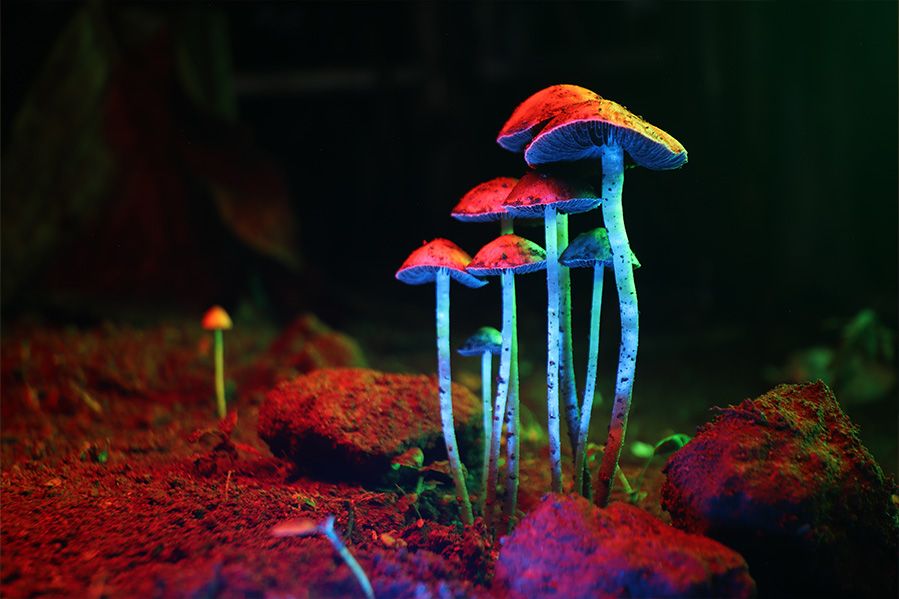
 Many years ago, researchers at Johns Hopkins University began a secret research project. They administered psilocybin, the active compound in “magic” mushrooms, to a group of clergy: priests, rabbis, ministers, and religious leaders from four major world religions. The results of the study, which were withheld for several years to protect participants’ privacy, were finally published in 2025. A New Yorker feature brought them to wider attention, and the findings are worth exploring.
When word first got out that religious leaders had agreed to participate in the Johns Hopkins psychedelic study, reactions were mixed. Now that the results are in, the picture is more remarkable than most people expected: almost universally, the clergy described their psilocybin experience as among the most spiritually significant events of their lives. Not interesting. Not useful. The most significant. The researchers used established measures of mystical experience and found that the clergy’s encounters scored comparably to or above what typically emerges in clinical trials with secular participants.
What They Said They Experienced
Several participants reported experiences that challenged their own theological frameworks in unexpected ways:
- Notably, not one of them described God as an 'old man in the sky'.
- Several described God as a kind of pure love without form or gender.
- One female minister said she experienced God as a mother.
- A Catholic priest reported that he physically transformed, during his experience, into a Hindu deity.
- Another described simply dissolving into something larger than himself, and returning with a "bone-deep certainty that everything was going to be all right."
The clergy did not report religious conversion or a shift in doctrinal belief. They didn’t come back from their sessions declaring that their tradition had been wrong. What most of them reported was a deepening of what they already believed – a sense that the mystical core of their tradition was real, confirmed by an experience they hadn’t expected.
What the Critics Say
The study has attracted skepticism from two directions. From secular researchers: psilocybin is known to be a powerful amplifier of expectation and context. Clergy going into a session expecting a spiritual experience are likely to have a spiritual experience. That doesn’t mean the experience is “real” in any metaphysical sense. From religious traditionalists: the idea that a fungus can produce the same encounter with the divine that a lifetime of prayer, fasting, and discipline is meant to cultivate seems to cheapen both.
The Open Question
The study doesn’t answer the question it raises. Whether what these clergy experienced was a genuine encounter with God, a profound neurological event, or something that can’t be cleanly placed in either category is exactly the territory that theology and neuroscience are both unprepared to settle. What the study does establish is that the connection between certain substances and spiritual experience runs straight through mainstream Western religion when given the chance. This isn’t new: archaeologists have found cannabis residue on ancient Israelite religious altars, and communities today are building entire churches around psychedelics as sacraments. The Johns Hopkins study sits in a long tradition.
If you were a religious leader, would you want to participate in a study like this? And do you think a drug-induced experience of the divine is more or less meaningful than one produced through prayer?
62 comments
-
 Arthur W Taylor
Read Carlos Castaneda's "Teachings of Don Juan" for starters.
-
Arthur W Taylor
I have taken LSD (blotter, tabs, etc.) and shrooms over 100 times in my life. I'm an agnostic. Most times, not spiritual purposes. Not all LSD is clean or fresh, so are mushrooms of they get stale over time. Kept mine the freezer to delay decomposition with both. Sunrise/sunsets/nature/fresh air/animals all ARE "God". We are god, too. It's said we are made in His image. Therefore we are from the same source as He! Yes we are. When you can feel a sunset's energy radiate through you, then you understand "God" is a metaphor of the wonder of the Universe and we are part of it. Not superior, as Western faiths teach. We are just a participant of it the Big Picture called Life. These drugs can alter your perception to even question REALITY. What is it. Just like any faith....The Truth is What You Believe. Every war/sports team believes God is on their side. Take a trip, at least once in your life...it will change your consciousness...if you have baggage in your life, then don't do it. It can inflate your negativity. If you intend to try it with an open mind to learn "what this all mean, any meaning to life?" Give it a try. You may need someone to standby and even hold your hand during your journey to the "other side". Be Well
-
 Constance Wellik
I have a lot of baggage (abuse) in my life so chemically tripping would not be healthy for me. What has been extremely helpful is 12-step meetings, particularly the Celebrate Recovery meetings I’ve attended for almost 30 years. It is a Biblically based program mixing Jesus’s Sermon in the Mount along with the 12-steps from AA. There are CR programs in over 35,000 churches world wide. That said, I have deconstructed my former faith in evangelical Christianity and am an agnostic atheist - but I still enjoy the fellowship of my recovery community.
-
 Pastor George Day
Constance Wellik
I am interested in learning more about Celebrate Recovery, as I am currently an addict engaged in a 12-step recovery program.
-
-
-
 Rolando Couce
A PRIEST ON DRUGS IS NOT A PRIEST
-
 Robert Gagnon
JC nor the devil have anything to do with it. There is a chemical filter between the conscious and subconscious which psilocybin breaks down. The subconscious contains every memory and thought ever processed by our senses. And some believe it experiences a social and possible cosmic connection. Your conscious mind can only process a limited amount of information at one time like RAM as opposed to the hard drive (sub conscious). And we can only process information at the speed and volume we received it. Accessing more information or sensations than normal is a gift with less self imposed restrictions. If your faith is so strong, a few insightful hours could be profitable unless you’re afraid of the truth that might be exposed.
-
 Jennifer R. Wiseman
I believe psychedelics not only amplify the patient's/user's own consciousness and mental staye but is a tool to connect with a greater, collective and universal consciousness.
Studies have shown an amazing ability to heal people from trauma, when properly guided.
Natural forms from plants are made by God. God gave us medicine. Why couldn't it be used as a vehicle to connect more deeply to our Source? We are spiritual beings restricted in a human suits.
That said, responsible structure should be built around sessions or ceremony and I would not recommend anyone individually using who is inexperienced or consistently in a place of depression or despair. It should also be advised to take inventory of the participants usual mental diet if you will, meaning, do they binge on violent shows? For example. With the right protocols in place this could be incredible tool in the future for not only healing but also connecting with source which actually lives within all of us.
-
 Keith D
First, Johns Hopkins is a scary arm of AMA-RockePharma, a part of the very matrix that wraps our minds in overlays that block them against Divine Sun from before birth until we quit allowing it and start peeling off the overlays. So any move it makes, its 'scientists' make, is marked as suspect. ...whether in study design, procedure, observations or 'conclusions,' there's a veritable guarantee of patents and undue profits for the MD MESStablishment.
Nevertheless, what is reported here is interesting. And it comports with valid training of seers: your experience will come to you in terms that you can understand. It won't be complete until and unless you drive further and obtain a full perspective.
These plant medicines are generally understood, within my exploration, not as a means to true connection with your infinity, but as a means of getting a glimpse. Extreme repeatitive or continuous use is likely not really going to replace putting your mind into the right gear, as it were, which requires practice, will, and clarification of the medium (thought and its evaluations and practices), removing toxic and self-defeating thought patterns.
We can get these flashes in any number of ways, and plant medicine fits the bill--rightly for some, and less beneficially for others.
-
 ServantOfJudgement
I prefer the term entheogens. Hallucinogen really doesn't plug in right.
They will definitely unlock thinking and create neural connections that wouldn't otherwise be made. Some of these connections persist permanently. They will expose the human mind to beauty and ugliness not easily realized any other way. The fear and joy of self conquer is poorly translated to the mind that's never known. The beauty of the sun crawling from its cave after a long night with a campfire and the afterglow of psilocybin is an image and feeling I never shall forget.
Entheogens will not make you a better person. Not smarter, nicer, likable or anything anyone says they will other than more experience in your life.
They will allow the mind to delude itself into whatever the person wants to believe but isn't truth.
They will let you see any god you want except the one true God. God doesn't have visitation hours and any intrusion into His privacy will result in death.
I remained "drug" free until I was 36, after my wife and I were done having kids. Since then I've consumed several types of entheogens hundreds of times, mostly mushrooms. I found no answer to life there. Only Jesus and God's spirit has revealed to me what I've been searching for all this time. The euphoria from God's spirit in my heart is more profound than anything I've ever experienced.
I'd recommend anyone who's interested to try it at least once. Don't expect truthful answers and be cautious of being pulled into your own delusion. When we open our minds, we might let things in that don't like us very much.
-
 Dr. Zerpersande, NSC
The Jamaicans would tell you not to do mushrooms ‘if ya’ have da problem, mon!’ They absolutely amplify your mental state.
-
 Thom
Thom
I would most certainly participate. I have used mushrooms in college. I have positive experiences with them. I'd like to try them on a spiritual basis. It could be most enlightening. I believe that all individuals had positive experiences. One who claimed he turned into a reincarnated Hindu Deity or saw "Holy Spirit" falls along the lines that I believe we are one entity. We are part of the universe. The more negative we are, the more negative we experience. We are all a collective of energy, solid or departed. Electrical energy doesn't dissipate it must become part of something. We stop when our solid matter becomes no longer able to sustain our existence as solid matter. But electrical energy never ends.
-
 Rae I. Duffy
I absolutely would not involve myself in this abomination and would not put my Lord to the test. Even on the cross in great agony Jesus my Lord refused a pain reducing substance when offered to Him. This is the devils work. He must be having a hey day with this one.
-
 Alexander Clarke
More proof that there is no limit to human stupidity!
-
 Miriam Gates
SMH! play with things you shouldn’t and get consequences! God does give us free will with said consequences…..but hey it’s all in the name of scientific experiments😂. Oh how creative the wicked one is and that’s who really laughing 🤣. Justification oh yes….same as other ones who was caught up in their own curiosity and lost everything, got arrested and publicly shamed…excuses excuses excuses. I just did it one time, didn’t hurt anyone, but I can’t quit, I just need it, I benefit science but but but….its your life 🤨
-
 Mary Handy Moore
Numbers 32:23KJV "But if ye will not do so, behold, ye have sinned against the LORD: and be sure your sin will find you out." Ephesians 4:27-30KJV 27Neither give place to the devil. 28Let him that stole steal no more: but rather let him labour, working with his hands the thing which is good, that he may have to give to him that needeth. 29Let no corrupt communication proceed out of your mouth, but that which is good to the use of edifying, that it may minister grace unto the hearers. 30And grieve not the holy Spirit of God, whereby ye are sealed unto the day of redemption. 31Let all bitterness, and wrath, and anger, and clamour, and evil speaking, be put away from you, with all malice: 32And be ye kind one to another, tenderhearted, forgiving one another, even as God for Christ's sake hath forgiven you.
1 Thessalonians 5:19-25 KJV 19 Quench not the Spirit. 20 Despise not prophesyings. 21 Prove all things; hold fast that which is good. 22 Abstain from all appearance of evil. 23 And the very God of peace sanctify you wholly; and I pray God your whole spirit and soul and body be preserved blameless unto the coming of our Lord Jesus Christ.
24 Faithful is he that calleth you, who also will do it.
25 Brethren, pray for us.
-
-
 John Casillo
MAYBE GOD JUST LAUGHS ALOT...WHAT WE THINK WE KNOW DOES NOT MAKE IT SO...OR DOES IT?
-
Dr. Zerpersande, NSC
ALL CAPS also doth butter no parsnips.
-
-
 Rob Johnson
As far as what the so called clergy cultural and religious conditioning affect visions. The feminist preacherette experienced god as a mother. The Hindu hallucinated he was some Hindu god. The experiment only proved conditioning affected the vision Now try ot on a group of atheists and Satanists and compare the trips. The experiment proved nothing. I did a few acid trips in my 20s and I planned my trips with music and reading. Your experiences can be programmed. Again the experiment proved except to allow psycho psychologists and doctors material write useless "scholarly" articles and I use that term loosely.
-
 Frances Gaston
You obviously didn't take the time to read carefully. The article stated the Catholic priest transformed into a Hindu God.
-
-
 Keith David Harry
I don’t know, back in the day when we did this stuff; all it did was make me laugh
-
 Lance Stephen Smolinski
I would argue that both experiences can be the same. The person having the experience to have it have to want it, if that is directly or deep down inside themselves, they want and welcome the experience. As long as they grow from it what is to make one means of achieving said experience greater than another? What of those who have experiences out of nowhere without years of prayer and sacrifice, do we ignore epiphanies?
-
 Roy S. Thorpe
A young man wrote a book about psychedelic mushrooms and peyote in the 70s. He called it " A Separate Reality"! Allowing your mind to free flow will give you dream-like reality! Similar to enhanced seeing and hearing with marijuana! Amazing but meditation can accomplish this without drugs! Alone time helps you hear His voice!
-
 Steven Ferrell
Why anyone would even take part in something like this is beyond me. But then I will not take pain medication in the hospital, after being given a certain one in the ER, that left me feeling like I was in a dream of everything going on.
-
 Dr Rohn
First and foremost, Spirituality is not altered by substance use, whether regulated by a closed study or experienced in the woods alone or with others. It is my belief through experience that psychedelics merely show the consumer of such what is possible. For one could not actually experience anything that they don't have the ability to experience. Psychedelics allow your mind and body to be free and employ more of one's capabilities without restriction. The cognitive dissonance created by years of social brainwashing places internal roadblocks (the can'ts, nevers, impossibles,) that most have come to accept, actually stop the very experiences that psychedelics allow one to experience. I would love to share this reasoning more deeply than possible in a comment to a question. A question I've yet to actually answer: one I will answer now. No, I would not voluntarily participate in such a study. Clinical studies normally subliminally suggest a specific or desired outcome. Also, statistics are easily manipulated to show a particular outcome depending on the author sharing them. Plus there's no way a clinical environment is conducive to an unaffected outcome from inducing such a powerful mind altering substance. Would you rather have intimacy in a clinic or in a more desirable location? Same thing. Psychedelics exasperate sensory perception, they can make wonder magnificently beautiful or stress and anxiety a horrible experience, which historically some never returned from. No, meditation, breathing, awareness, and psychedelics should be personal not lab experiments.
-
 Rev. Miche'al Yosef Dixon
Here's a known fact. When I was a teenager they use to be a tradition that we'd get stoned out our minds and go to the planetarium and watch the "Pink Floyd Universe Tour". You'd set in reclined chairs and on the ceiling while playing Pink Floyd's "Dark Side Of The Moon" a visual laser light tour of the universe from first person point of view. It's a billion times greater then any movie Hollywood can dream up. Spiritual or not we'll never know. The article actually touched on something I was going to mention (even gave a clink link) the Archeology finding of the Hebrew temples. It is in Scripture instructions on making the temple incense that the herb we call "Marijuana" is a ingredient in the Holy Incense for the temple.
-
 Amber
Amber
❤️ I love that album. That sounds like it was an awesome experience.
-
-
 Bishop William Dusenberry, DD
In my Oklahoma SHP denomination of the ULC, we know (don’t merely believe— because to “believe is to accept the reality, that a belief is incapable of being proven) we SHP’ers know that God and Nature are one and the same thing. Those without any awareness of astrophysics— use God, while those familiar with any aspect of astrophysics— use Nature. And, as for those with the wherewithal to believe in the supernatural— God is commonly used in place of a simple “I don’t know.” Remember “Religion is the opium of the people” — especially people to whom science is a four letter word.
-
ServantOfJudgement
Without the burden of proof we humans can say the darndest things. Luckily, God has implied laws that all must follow. That means everyone on or off this site wears the same pair of pants.
We all Believe that which we can't prove and to each, the others Belief is ridiculous.
-
Dr. Zerpersande, NSC
I have opinions, but beliefs? If I have been provided with proof of a claim I believe it. But usually ‘beliefs’ generally involve nonsense such as horoscopes, crystal power, homeopathy and god
-
Pastor George Day
I find it very hard to believe that devout Jews or Christians have participated in this nonsensical survey.
-
Dr. Zerpersande, NSC
What’s the difference between a devout Jew and a non-devout Jew? Is it kinda’ like the rare ‘True Christian’ versus the infinitely common hypocritical type?
-
-
-
-
-
 Reverend Paula Copp
Psychedelics have been used since the dawn of time to deepen their relationship with the deities. As long as the clergy members knew what they were doing, I see no problem.
-
 Barbara Harris
Back in the late 60s and early 70s psylocibin and LSD were plentiful. Some had profound experiences, others not so much and some had very bad experiences. I came of age during those times and tried them all. I never had a bad experience but I did have several that were euphoric. Mostly I could sit and write for hours. My creativity soared and many of the papers I wrote received glowing comments from my teachers when I would submit my projects.
There is a lot of research going on looking at the plasticity of the brain and how psylocibin may be able to help people with addictive personalities. In the right settings it can be a great tool.
-
 Nicholas J Page
More fool them i have no sympathy whatsoever for people knowing their taking narcotics. But then again when you hear about the clergy with choir oyster etc nothing surprises me anymore.
-
Dr Rohn
First and foremost, Spirituality is not altered by substance use, whether regulated by a closed study or experienced in the woods alone or with others. It is my belief through experience that psychedelics merely show the consumer of such what is possible. For one could not actually experience anything that they don't have the ability to experience. Psychedelics allow your mind and body to be free and employ more of one's capabilities without restriction. The cognitive dissonance created by years of social brainwashing places internal roadblocks (the can'ts, nevers, impossibles,) that most have come to accept, actually stop the very experiences that psychedelics allow one to experience. I would love to share this reasoning more deeply than possible in a comment to a question. A question I've yet to actually answer: one I will answer now. No, I would not voluntarily participate in such a study. Clinical studies normally subliminally suggest a specific or desired outcome. Also, statistics are easily manipulated to show a particular outcome depending on the author sharing them. Plus there's no way a clinical environment is conducive to an unaffected outcome from inducing such a powerful mind altering substance. Would you rather have intimacy in a clinic or in a more desirable location? Same thing. Psychedelics exasperate sensory perception, they can make wonder magnificently beautiful or stress and anxiety a horrible experience, which historically some never returned from. No, meditation, breathing, awareness, and psychedelics should be personal not lab experiments.
-
 Patricia Ann Gross
Dr. Rohn,
This doesn't just apply to spirituality. There have been studies that are compelling for the use of MDMA (Ecstasy) for people have PTSD, and trouble unlocking memories that have been locked by the trauma they experienced. As one who studies mysticism, I see this as a better use of certain psychedielics than spirituality, as unbridled mysticism has a better chance of being believed than one altered with substances. It is best to get rid of the trauma first, to open the mind, then it is free to hear the "spirit" speak.
-
 Randall William Fox
When a friend lost a spouse to dementia I started looking for similarities to PTSD and the way psychedelics bring relief to many. So many people lock into feedback loops, either by "choice" or by the force of extreme trauma. Their thoughts circle 'round and 'round like a pen on paper: sooner or later they tear through the sheet to disastrous result! Psychedelics can release someone from that endless spiral, offering an offramp towards a new path and a new destination. I doubt that it much matters how that experience is perceived, only that it is achieved. If your God is omniscient and/or omnipresent then S/He can have the glory. I'm satisfied that someone's life can be all the greater for having found some freedom from a damaged psyche...
-
-
-
-
 Sir Lionheart
As we all know, and I’ve mentioned this before, the Book of Revelations was written on the Isle of Patmos, which was well known for its Magic Mushrooms 🍄 2000 years ago, and still is today. It’s one of the most difficult books to understand, but psilocybin will do that. The author was clearly high on something. It makes me wonder what other historians were on that wrote some of the other books in the Bible when it come to someone witnessing a talking ass, and a talking snake, and someone talked about a unicorn, and a man walking on water. Yeah….right….and some people actually believe it. 🤭
🦁❤️
-
Patricia Ann Gross
Sir LH,
The same question for Aesop, who wrote a book of fables.
I am very critical of anyone who interprets and understands The Bible literally, whether they understand it to be the "word of God" or another book of fables. While I don't deny that many of the stories could have been penned by people under the influence of some substace, there is a need for any reader use critical thinking and bring in the culture and context of what is written. When you focus on the fantacy-type stories of the Hebrew Scriptures (Old Testament), that was the way stories were told in an ancient society and consistent with other, more secular, writings of the same time period.
-
Sir Lionheart
Yes, I totally agree. It’s quite amazing that people will so willingly accept what has been written in a book compiled from documents 1700+ years ago. Those scribes would have had no knowledge of the science that we have today, which is no wonder they thought everything in the sky revolved around the earth, (with the exception of Galileo), many possibly thinking the earth was flat.
I think what is preventing people from questioning the Bible is the fear they might just be questioning their god. Some are so afraid that they won’t even spell the word “God” when referencing it, opting to say G-d, or use some other cryptic spelling. 🤷
Thanks for your comment.
🦁❤️
-
Patricia Ann Gross
Sir LH,
You wrote, "I think what is preventing people from questioning the Bible is the fear they might just be questioning their god." I think that has a lot to do with it. One of the most compelling sermons I ever heard was one that gave me "permission" to question, AND to doubt, which is something some "brands" of Christianity would call heresy. When you study The Bible alongside other texts written at the same time and then compare them with what modern science has uncovered, there is a lot to be amazed at in the ancient texts. For example, with the exception of the timeline, the order of creation is amazingly correct, and of all the things created, only the order of the birds and fishes are out of whack, which is amazing since this document was composed 4,000 years ago (long before modern science concluded the order was basically the same). There are also, within the Epic of Gilgamesh a story that parallels the Great Flood, and archeological discoveries that suggest that areas that are now in mountain ranges once was covered by water. Through my studies and deconstruction, I have found that a healthy questioning often serves to strengthen faith rather than eliminate it. Others may have different experiences, but that is mine.
The use of G-d is in reference to YHWH, which was a Jewish thought that to see or speak the name of God would cause instant death. It had something to do with coming into direct contact with anything that "Holy." YHWH was an acceptable abreviation of Yahweh by removing the vowels, so some contemporary scholars have adapted the practice with G-d to respect the andcient Jewish tradition.
-
Sir Lionheart
Thank you for that explanation.
🦁❤️
-
-
Pastor George Day
Sir Lionheart
This is an ancient Jewish tradition in which the name of God is not pronounced, stemming not from fear but from deep reverence and respect.
-
Sir Lionheart
It’s really silly isn’t it? the word God is just a human constructed word to imply a deity. Should people be typing D_ _ _ y then when referring to a deity? 😜
🦁❤️
-
-
-
Pastor George Day
Patricia Ann Gross
If you received a letter from the tax authorities requesting payment of a specific outstanding amount, would you not take it literally?
Our debt to God has been paid in full. Show gratitude.
-
Sir Lionheart
Did you have a particular God in mind, Sir George? 🤭
Good to see you back.
🦁❤️
-
Patricia Ann Gross
Pastor George,
The letter I received from the tax authorities was generated and sent to me last week, not 1,700 years ago, and yes, I would take it literally. Letters written to churches 2,000 years ago, I read in context with the time, culture, and context in which it was written. My tax bill was written in the context of current tax laws, so I read it with those in mind.
In what context has God been paid? How can we ever pay God back for all we have been given? I thank God every day for all God has given me. Do you?
-
-
-
Mary Handy Moore
Yes, John was high on something. You said what you said. Here's what St. John said:
Revelation 1:10-11 KJV, I was in the Spirit on the Lord’s Day, and I heard behind me a loud voice, as of a trumpet, 11 saying, "I am the Alpha and the Omega, the First and the Last," and, "What you see, write in a book and send it to the seven churches which are in Asia: to Ephesus, to Smyrna, to Pergamos, to Thyatira, to Sardis, to Philadelphia, and to Laodicea." (Esoterically, these churches are the seven Chakra centers in our spine – from the root to the crown, 7).
Further, I asked google: Was the Isle of Patmos famous for magic mushrooms?
Google said: "No, the Isle of Patmos was not historically famous for magic mushrooms. The island is globally famous for being the biblical location where John of Patmos was exiled and received the visions recorded in the New Testament's Book of Revelation. The connection between Patmos and psychedelic mushrooms is a modern internet rumor and alternative historical theory, rather than an established historical fact. (https://www.wall.org/~aron/blog/keys-to-the-book-of-revelation/)"
That was a door the experimenters sent those clergy through, but it was not “the Door of the sheep” (John 10) whom Jesus described. He also said any other door is a thief and a robber. People who have had divine or mystical experiences know the truth of this. Those who have not, couldn’t begin to know how wrong they are to believe that the people who experienced this study were genuine experiences. (“Don’t be deceived. God is not Mocked. Whatsoever we sow, that shall we also reap.”) Slightly paraphrased.
-
Pastor George Day
Mary Handy Moore
I fully agree with that sentiment.
-
-
Pastor George Day
Good to see you again, Lionheart.
The Book of Revelation was composed during a period of intense persecution, and with this context in mind, it is not particularly difficult to comprehend. Those who claim otherwise are often inclined to interpret it with excessive complexity.
-
Sir Lionheart
Yes, John Lennon’s lyrics were written in a similar style when he was under the influence during those mystical psychedelic days. 🤭
🦁❤️
-
-
-
 Colleen McAllister
I agree with Brother Peter. These substances don't give us any knowledge that we don't already have. What they do is magnify emotions and thoughts already present. No useful information can come from such a narrowly focused study.
-
Mary Handy Moore
Compare what you say with John 10 as far as you wish. I'm interested to hear what you have to say about that considering your insight (and Brother Peter's). Thank you.
-
Pastor George Day
Hi Colleen McAllister! Great to see you again. I’ve been away and away from the keyboard for a while.
-
-
 Rev. BH
Even back in my hippy college days I was too scared to try this stuff. Thought I'd wig out!
Many of us here are religious leaders. Anyone interested in a psychedelic trip?
-
 Steve Holmes
Sign me up.
-
 Joe R Day
Fear is a virulent teacher... BH was fearful of his 'sanity'... So, he never got the chance to 'See beyond', perceived the reality of What is next and was open to the cosmos... Personally, I had no fear of the Beyond. "If one is good, I shall take two!" It was the 70's and I was open to anything that questioned my Reality. I was never disappointed lol...
-
-
 Douglas Robert Spindler
A similar experiment was conducted at Harvard with LSD. All of the participants were going to become members of the clergy. Almost all of the participants who took LSD went on to become members of the clergy and were very good at it. Overwhelmingly the participants who did not take LSD did not continue with their divinity studies and the ones that did after becoming members of the clergy soon left.
The Harvard study showed you need to take LSD to have a connection with God.
Personally I think more people make a connection with God while having sex.
-
Dr. Zerpersande, NSC
I remember reading ling ago about the idea that lots of the ‘original god ideas’ were a result of psychedelics.
Goes a long way to explain how at the end of a VERY trying day of putting up with his son’s bunchafukingbullshit he makes himself a mushroom and goat cheese sandwich and suddenly the ‘god’ gives him a solution.
And burning bushes happen all the time.
-
 Brother Peter
All of these experiences are products of the participants own mind. Deep down, it's what they want to believe.
-
 Dr Dennis Chevalier PhD, DDvin
WOW

It's too bad none of these folks in the study came in contact with an experienced traveler who has been shown things that can only be shown and able and willing to pass it down. Am I allowed to speak of the point in my mind that everything grows out of? I mean everything, time you, me? The reason it's a secret is because people become megalomaniac thinking that they create the whole universe which of course they actually do.