

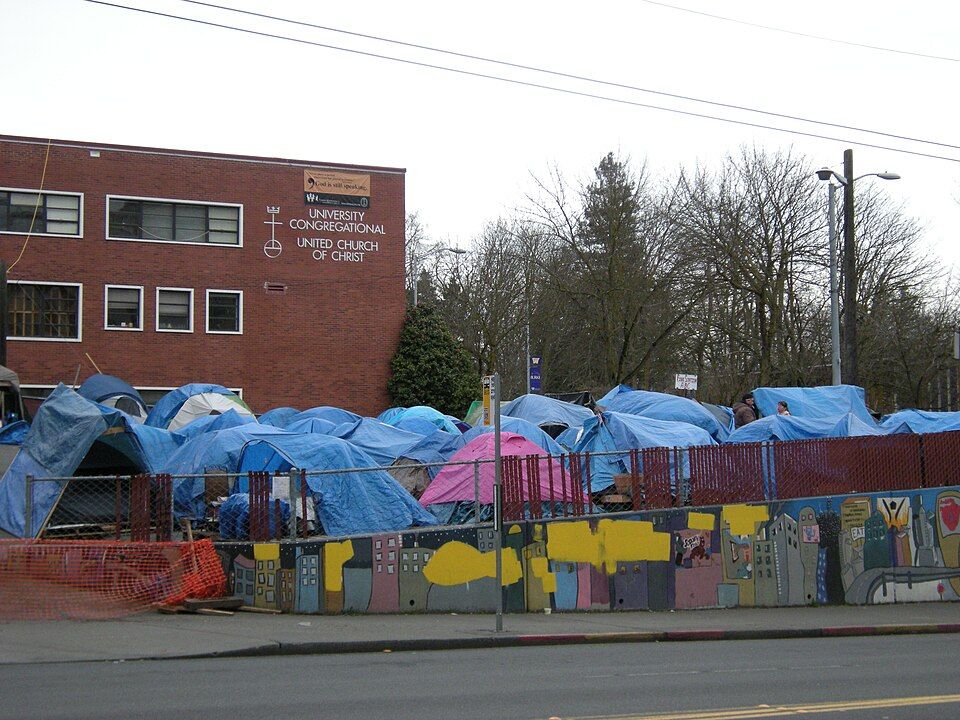
Someone had put little pumpkins outside the tents. Other residents decorated their spots with plastic flowers and American flags. On a vacant gravel lot beside the Merrimack River in Lawrence, Massachusetts, people accustomed to being moved along had begun building what felt like a home.
Then they had to pack it all up.
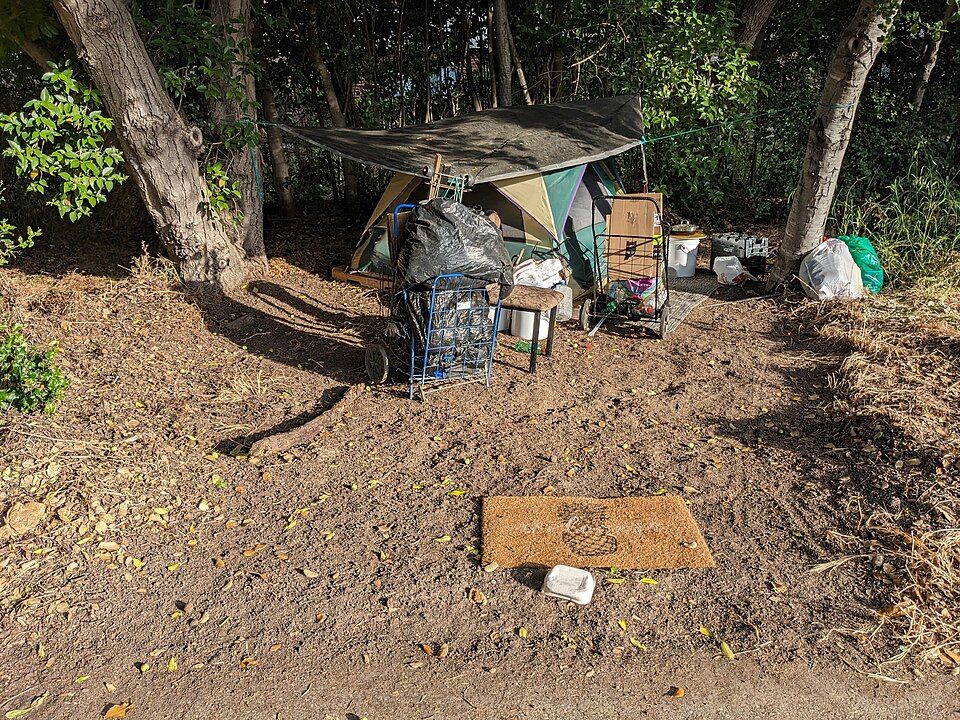
House of Mercy Church had welcomed roughly 50 to 60 homeless people onto a section of its property in late October. By early November, its volunteers were dismantling the 26-tent encampment under pressure from city officials, who were issuing $1,200 in daily fines over zoning and safety violations.
Pastor Roger Farah says his Christian faith calls him to offer people a place to sleep. Officials for the city of Lawrence say a church cannot open an unpermitted shelter just because its intentions are good. For 68-year-old Richard Bianchi, who has spent eight years without a home, the argument has a simpler consequence: he needs somewhere to go.
“We’re like family here,” he told the Boston Globe as the tents came down.
A Little Community on the River
House of Mercy was helping people without housing long before it started putting up tents. Since 2018, the church and its nonprofit ministry have served meals, provided clothing, showers and laundry, and helped people access medical care, addiction treatment and other services. Lawrence itself lists House of Mercy among the places where residents in need can get free weekday breakfasts and lunches.
Farah wanted to bring people sleeping in scattered camps around the city closer to that help. He says he spent about $20,000 getting the lot ready. Tents stood on wooden pallets, with portable toilets, trash collection and lighting. The fenced site was hardly a permanent housing solution, but it offered a place where neighbors knew each other and volunteers could find them.
Kassy Gallant, 37, told MassLive that she was no longer constantly searching for someone willing to take her in. “I can wake up, I can go to the bathroom, I can shower, I can feed myself,” she said. For a woman who described herself as a drifter, that routine mattered.
The church also brought in two shipping containers being divided into eight small transitional rooms. Farah's longer-term plan was to offer those rooms to people who were working, staying sober and saving half their pay toward an apartment. Nobody had moved into them when city officials objected, an important detail in a dispute that would soon involve fire safety.
“As a Christian, as a lover of God, someone needs to fight for those who cannot fight for themselves,” Farah told WBZ NewsRadio.
Four Violations, $1,200 a Day
On October 29, the city's inspectional services department ordered the encampment to close. According to the church, it was cited for four violations, each carrying a $300-per-day fine.The violations cited unauthorized use of the land and missing permits. Officials also raised building, sanitation, and fire-safety concerns.
City attorney Timothy Houten told the Globe that Farah had been warned not to open the camp and did so anyway. Houten pointed to the shipping containers, which he said had doors but no windows, creating a fire hazard.
Farah said the rooms had electrical outlets and smoke detectors. That wouldn't necessarily make them safe for sleeping. The containers were empty, but the tents were occupied as November approached in Massachusetts.
Mayor Brian DePeña argues that the city has a responsibility to prevent dangerous living arrangements, including those created by well-meaning organizations. He said Lawrence estimates its homeless population at more than 400 people and reported spending over $1.9 million responding to homelessness-related conditions during fiscal 2026. He wants state and neighboring communities to help carry the load.
“Compassion and compliance with the law are not mutually exclusive,” DePeña said in a statement.
The city also says it has staff who connect people with services. Houten told the Globe that some people offered assistance decline it, including housing arrangements with sobriety requirements. Authorities cannot compel anyone to accept treatment or a placement, he argued, and should not be required to permit an unauthorized tent community as a result.
Seattle's homeless outreach team reported that 83% of its shelter offers were declined during the first half of 2026. Among refusals recorded from April through June, 23% involved people seeking permanent housing, 20% involved people unwilling to share sleeping accommodations, and 15% involved people wanting to stay with a partner, family member, or friend. Those figures count offers rather than individual people, and they don't tell us what options were available to residents in Lawrence.
But what happens to someone who cannot enter the housing on offer, or cannot find an available bed tonight?
As the tents came down, one resident told the Eagle-Tribune, “Everywhere we go, they just throw us out and they treat us like trash.” Local reporting described people scattering across Lawrence. There's no public accounting of how many found indoor shelter, and city officials haven't identified a permitted replacement for House of Mercy's camp. At a City Council meeting, supporters urged officials to work with the church on a legal alternative.
When Shelter Is a Religious Duty
Farah's argument begins with Matthew 25, where Jesus praises people who feed the hungry, clothe those in need and welcome strangers. In the New International Version, he says, “I was a stranger and you invited me in.”
Jesus then identifies the people receiving that kindness with himself. For Christians who understand this as a command, hospitality is part of practicing their religion. It doesn't stop being religious because the person at the door needs a bed instead of a prayer.
That matters when a town tells a church what it can do with its own property. Federal law, through the Religious Land Use and Institutionalized Persons Act (RLUIPA), can protect religious organizations from zoning rules that substantially burden religious exercise. In cases covered by that provision, the government must show that such a burden serves a compelling interest and uses the least restrictive means available. The law also forbids discriminatory treatment of religious institutions in land-use decisions.
Massachusetts law also offers another layer of protection, known as the Dover Amendment, limiting how local zoning rules can restrict religious uses of property. In April, a state Land Court judge relied on that law to allow First Church Somerville to establish a 26-bed homeless shelter in its basement, finding that the shelter was part of the church's religious work.
The Somerville ruling gives Farah something to point to, but it doesn't settle his fight. That church proposed beds inside its building; House of Mercy put up tents, and Lawrence says the property isn't safe for overnight use. If Farah takes the city to court, a judge would have to weigh those safety concerns against his claim that sheltering people is part of his faith.
In Plano, Texas, the East Plano Islamic Center opens its gymnasium as an overnight shelter when severe weather hits. Muslim volunteers work alongside Christian congregations, while the city provides police officers and paramedics. Guests receive meals, showers, cots, and transportation.
A Familiar Standoff, a Different Choice
The Monastery covered a strikingly similar fight in Ocean City, Maryland in June. St. Paul's By-the-Sea Episcopal Church faced $1,000-per-day fines for operating an overnight shelter. Its rector, the Rev. Jill Williams, refused to close. The church sued, Ocean City countersued, and the fines were suspended after reaching approximately $20,000. The shelter hasn't closed its doors, either. By September, Williams reported that nearly 40 people were sleeping there each night, even as the legal battle continued.
Farah took a different path. Faced with mounting fines, he began dismantling the tents while retaining attorney Jeffrey Denner to challenge the city's position and explore a resolution. As of November 12, there is no verified report that House of Mercy has filed a lawsuit. A Board of Health hearing is scheduled for November 18 to consider whether portions of three adjoining properties owned by Farah are unfit for habitation.
The churches in Ocean City and Lawrence aren't alone. As the homelessness crisis continues to devastate lives across the country, we also covered another church's fight to open a homeless shelter, in New Jersey. And now, in Lawrence, people are losing their place to sleep before a judge has heard the dispute.
The People Still Need Somewhere to Go
Even as the tents came down, the ministry's other work continued. A reporter for The Globe witnessed volunteer Carrie Wieland helping two people seek addiction treatment. She called a detox center, then handed one man the phone to speak with the provider.
“Don't hang up,” she told him.
It's unclear whether either person got a treatment bed, but Wieland's efforts were hardly an isolated occurrence. At a City Council meeting, House of Mercy supporter Melissa Marrama said the ministry had served 50,000 meals since January 1 and helped 36 people enter detox in the preceding 70 days.
Bianchi had been coming to the church for meals and laundry for years, even before he slept on its grounds. He once operated heavy equipment in Boston. "This man gave us a place to live," Bianchi said of Farah. Others who had lived at the camp were already back on the streets.
If the choice is an unpermitted church tent or another night on the street, who should decide which is safer: the city, the pastor, or the person who has to sleep there?
2 comments
-
 Keoni Ronald May
In days very long gone by, the church sanctuary, was exempt from any government jurisdiction. It was held, to the same status, as an Embassy, Consulate, and even a country (Vatican). Those days no longer exist. The only thing left, is the confessional privacy, just like a doctor/patient relationship, an attorney/client privilege, etcetera.

Although I have to agree with the honorable Keoni Ronald May, we are still a nation of laws. These "homeless" people were not taking refuge in a "sanctuary". It is the obligation of the House of Mercy Church to do the best they can do for these people within the guidelines of the law. This looks to me like an example of "no good deed goes unpunished," which started as a gesture of goodwill and got out of hand. For legal and insurance purposes, I hope that they(the Church) realize this and make accommodations for these people elsewhere. Please keep us posted as new information becomes available.