

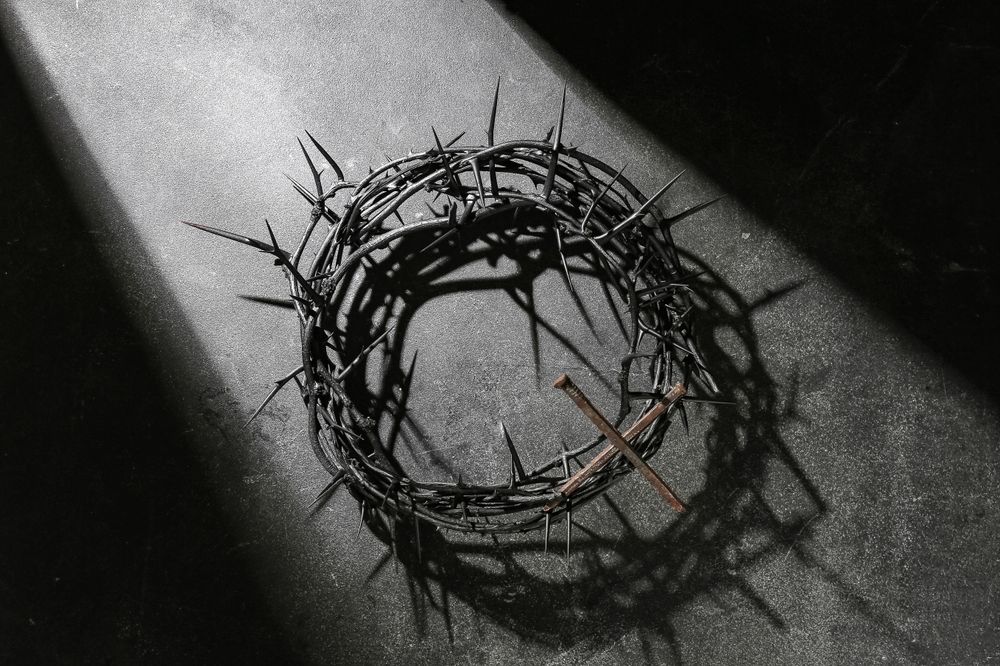
On the Friday before Easter, Christians commemorate the arrest, torture, and death of Jesus Christ. When you think about it, calling this day "Good Friday" is a little strange.
There are somber church services. People fast. In some countries, there are processions through the streets that carry a decorated coffin. By almost any measure, it sounds like the opposite of a good day.
So what's so “good” about it?
Turns out the answer depends on whether you're asking a language scholar or a believer – and both have a compelling case to make.
The Language Answer
The most widely accepted explanation, backed by the Oxford English Dictionary and most language scholars, is that the word "good" here doesn't mean what modern English speakers assume.
In Old and Middle English, "good" carried a sense closer to "holy" or "sacred." The same way that "goodbye" is a shortened form of "God be with ye," the "good" in Good Friday likely evolved from a similar root: something set apart, belonging to God.
That would explain why almost every other language takes a more direct approach to the holiday's name. In Spanish and Italian, it's called Holy Friday. The Eastern Orthodox church calls it Great and Holy Friday. In German, it's Karfreitag – "Sorrowful Friday."
English and Dutch are essentially the only languages that landed on "good," and scholars say that likely that happened through centuries of gradual language change rather than any deliberate choice.
The Faith Answer
However, many Christians don't see the name as an accident of language at all. For them, there's a clear spiritual answer: Good Friday is good because of what it led to.
The death of Christ, in Christian belief, is the act that made forgiveness and salvation possible. Easter Sunday – and the Resurrection – is only three days away. The crucifixion is a hinge point for Christianity, and it should be recognized as such.
“It’s a very weird day to call ‘good’ when you have your savior and Messiah die,” says Rev. Dr. Brent Strawn, a professor at Duke Divinity School. “Why would you call that a good day?”
Strawn continues: “For those people who have Christian faith, it is a good thing that Christ died for us. It gave us peace with God and made us at one with God.”
This interpretation includes genuine grief over the suffering of Jesus, and genuine gratitude for what that suffering accomplished. Safe to say it’s emotionally complicated.
Neither reading of Good Friday makes the name less strange. But both explain why "good" (whether it meant "holy" or simply "meaningful beyond measure") has stuck around for centuries.
A Holiday Full of Layers
There's something fitting about the fact that one of Christianity's most solemn observances carries a name nobody can quite agree on.
The same is true of Easter, which has its own surprising pagan origins. Or Christmas, whose status as a religious holiday has been debated for generations.
Major religious observances have a way of gathering layers of history, culture, and interpretation until the original meaning becomes genuinely hard to pin down.
Good Friday may be the clearest example of that. The name is either a relic of old English, a statement of faith, or both – and depending on who you ask, you'll get a very different answer.
What are your thoughts?
29 comments
-
 Jannetje Eleanore Van Went
The Beauty of human status is we change our perspective to be inline with the position we view things from. Like the Ray of a Sun's Beam we have a different perspective of the earth and cover only a small area of its surface, we need each other with the respect for personal perspective and positions to put this together, I am sure it lights up the views of the whole world in perspective...lol We need to see with each others eyes too...if its meant for good, it will be clear. My Perspective Good Friday; Its the day the idea that the Son is born and raised only by a mother (with no father) dies or the Death Card of the Matriarch once the numerology turned to 1000, it is known to be the male number to be in power, it was good for them and they designed the patriarchal society from that point on, there for their perspective is A Good Friday for them, they have freedom from mother's law, (where as a mother loosing a son to the masses is sad for a mother - she can no longer protect him, from himself)...Patriarchal (Mercury) leaderships are first before the Sun and Matriarch (Venus) are second behind Mercury to the Sun, So the 2s have it and women are now in power. Things must be questioned and potentially changed to accept all perspectives today, a mother has no bias when it comes to raising a child, no gender, no culture and no condition prevents a mother from raising her child - Which ever the male she procreates with, the child is loved, no matter the difference - matriarchal acceptance is global...there for spiritual aspects will be too. It was Good Friday, with what women learned it will be Great Friday I am sure, for every mother sees a man as her son first then second redesigns him into a true son. He is always in safe hands. With his Mother.
-
 Frances Tebora Watson
My hinge is Romans 14:5. When you strip away human nomenclature, every day is not just good but very good (Genesis 1:31). I choose God's opinion. May mercy peace and love be multiplied to you (Jude 1:2).
-
 Richard Stofer
Your article is partially right and partially incorrect. If you back far enough, when English was still pretty much Anglo-Saxon, god meant good. You can verify this by the Norwegian and Swedish greetings of "God Jul" (Good Yuletide). I found this out rather late in life, since as a child, Jesus dying on a cross didn't seem good to me.
Minister Richard
-
 William
Jesus was crucified on Wednesday prior to the annual High Sabbath on Thursday, therefore in the tomb 3 days and 3 nights , the sign he told the Pharisees that he was the Messiah.
-
 Fred Duane Bazhenow
Thank you! This article validates my perception of what I believed to be the answer...that it led to the Resurrection. It seems there's many places in the Bible that refer to things that must occur to satisfy the Lord's path.
-
 ronald
while one is a eglish lesson and one a scripture I believe they both mean the same thing,but just differant interpatations of the wording.but they both mean the death and rising of Jesus and a basis for all of us being saved and reborn after death
-
 Angela Laughingheart
What a wonderful discussion. Being raised Catholic I was not encourage to question anything that was scripted by the Bible and Baltimore Catechism. A lifetime later, I see I was deceived and that the Canonical texts were heavily redacted. Also, I pledged allegiance to the church without ever being given a choice, or exposed to other belief systems. Blind Faith only.
-
Frances Tebora Watson
Wow, thank you for reminding me that free will is a gift and has purpose. It is good that you are aware now. Exposure to other beliefs is critical to understanding and critical to making sound decisions. While growing up we were not taught to think critically, but only to obey church rules anything else was sin. So glad I'm finally free! Thank you for your comment.
-
-
 Steven Ferrell
In Ireland it is called Aoine an Chéasta which means Crucifixion Friday or Friday of the Passion.
Whatever it is called, it is the day Christ took the sins of the world upon himself, that through his shed blood, we might be saved.
-
 Randy Michael Mellinger
Good Friday is inaccurate, Jesus said that the sign He would give was as Jonah was 3 days and 3 nights in the big fish. We'll, if you account for days as the Jews did back then Friday at 6:00 PM is actually Saturday. There is no way you can get 3 days and nights out Jesus being crucified on a Friday. It is a tradition of man and the apostle Paul warns us of traditions of man.
-
 Angela M. Parisi
Bravo for disclosing the pagan origins of Easter (goddess of fertility bunnies eggs SUNrise service) and Christmas (Saturnalia and winter solstice etc) that the church has adopted and changed and their discretion the appointed seasons and days of GOD. There is a book being launched beginning of May called THE CONNECTIO:Why Mankind Needs Saving which is a personal journey using a Scriptural timeline and verse as well as history to explain and answer that question. Many will be challenged and disturbed realizing the fallacy of what they were taught and believe. In HIS set time the minds and hearts of HIS chosen flock will be opened to HIS truth. Amen.
-
 Raymond Harry Anderson
Humanity‘s sin was a debt owed to God that only a sin-less divine God-person could, by his own blood, repay God. Jesus willingly gave his life as a substitutional atonement for humanity‘s sin. God’s grace has forgiven and redeemed humanity through Christ‘s sacrifice and resurrection so that humanity could have eternal life. The event on Friday, hence, was „Good“ for all humanity both believers and non-believers, and their own salvation is achieved by having faith in God‘s promises, its unconditional God‘s grace.
-
 Kenosi Modisane
Kenny Modisane Johannesburg South Africa
There's millions of languages across the globe. There's also millions among them who follow, in one or another, the teachings of the Bible. Are we ever going to get the exact original words now after thousands of years and myriads of translations. My main concern is about the people of my country, Blacks in particular and Africans in general who cannot read or write. What matter's for them? Do I just ride roughshod and ignore that aspect of their "knowledgeability?
-
Kenosi Modisane
Kenny Modisane Johannesburg South Africa
There's millions of languages across the globe. There's also millions among them who follow, in one or another, the teachings of the Bible. Are we ever going to get the exact original words now after thousands of years and myriads of translations. My main concern is about the people of my country, Blacks in particular and Africans in general who cannot read or write. What matter's for them? Do I just ride roughshod and ignore that aspect of their "knowledgeability?
-
 Elizabeth Jane Erbe Wilcox
Why does anyone care? In today’s climate there is little to nothing “good” about any day of the week. Of course we have the inhabitants in the house of whiteness to “thank” for that.
-
 Rev. Kameelah Stewart
I don't know where YOUR FAITH is, but mine is in any day that God opens my eyes and provides his grace and love is a "Good Day". My God does not care about the folly of men and what they do. He doesn't cause confusion; he takes care of it. Man makes plans and God laughs, you speak as if you are not counting on God's grace. The fact that Jesus sacrificed his blood to forever cleanse the world of sin is "Good" God is the waymaker, the provider and protector. He is the final say on all he sees and everything we don't. God does not change with the "Climate" he is not swayed by the events of man. I am the daughter of a King of man and I will never forget who my Father is and What he can do, and what he does do. And because of that "You" should care.
-
-
 Joseph B. Barnett
Jesus wasn't crucified on a Friday to begin with as it doesn't add up with the three days and three nights that He stated would be like Noah in the fish's belly.
-
 Morten Fordsmand
In Denmark the term is Langfredag, which translates to the long friday - which seems to put a more sad meaning to the name.
-
 Douglas Robert Spindler
Modern scholars consider Good Friday racist and non-inclusive. Black Friday or Runup Friday are now the accepted terms.
-
 Rev. Miche'al Yosef Dixon
As this article touched on and left ambiguous; I learned in Seminary that "Good Friday" derived from "God Sabbath" changed over time to "Good Friday". "Got" in German and "God" in Latin in the English became "Good". And Friday which at sunset becomes "Sabbath" -"seventh day" however Yeshua was arrested on Passover night which in 28 AD was a Wednesday on the Roman Julian Calendar. Changed to ("Frija's day" Norse not Roman) when the Council of Niece changed Sabbath to the first day of the week Worshipping the Sun on "Sun's Day" and began at sunrise not sun set on "Saturn's day". The new Gregorian Calendar we us today goes more by Norse calendar than Roman. Nonetheless, "Good Friday" is a made-up holy day to celebrate Yeshua's Illegal Arrest, Kangaroo Trial, and Murder.
-
 Rev Ned
Has anything “holy” ever happened in the “Holy Land”? It seems to me that constant killing is going on in the area, over history, by 3 factions that all worship the same God, but in different ways. 🤔 I wonder which one She/He’s rooting for.
-
 Father Frederick
Rev Ned, I've always heard that it's not so much a matter of being same God, or who one roots for; but it's the fact that humans have this strange ability to worship a deity and their laws, but somehow mutate the laws into what "they" believe is best for their religion.
Those who are at the top of the food chain of earthly representation of the religion can justify the killing and crimes in the name of their God, as well as use their claims and God's name as leverage upon those who don't believe Got is that cruel. It's the "them vs us" in the power struggle of who is best.
As you say, constant killing in the "name" of God/Lord and those who have a hand in the killing are rewarded by being told they did the will of God.
Same situation applies to politics as well as sporting fans. :) If they are not of our mind set, do them harm as they deserve it in the eyes of my God.
-
-
 Bishop William Dusenberry, DD
Emile Durkheim (a prominent sociologist) categorized three types of suicide — one of which is altruistic suicide, for those who comment suicide with the expectation that their death will help “others” (suicide-bombers are today’s most common exemplars). The Jesus of Hebrew/Christian mythology is the best-known example of altruistic suicide — even though suicide is a sin for Christians — but was Jesus a Christian, or a Jew when he allowed himself to be tortured to death by the Romans? This is the major question which should dominate the conversation regarding Good Friday — especially by those of us, who’ve received DD certificates from the ULC.
-
 Colleen McAllister
I have always wondered why it was called Good Friday but figured it was just the custom. And it was good that the day happened as without it there would be no need for a Resurrection.
-
 Daniel Todd Kamm
Friday is always Shabbos ... others are greeted with wishes for a "Good Shabbos." Lots of things both "good" and "bad" can happen on that or any day.
But I'll stray away from that and toward the interpretation that it was Sabbath; there may or may not have been a "Passover Seder" versus a regular Friday night event.
At a Jewish Passover Seder or regular Friday night Shabbos event, no one, including a person devout to the rules, expectations and routines of Judaism, would have EVER offered the wine as his OWN blood, or the bread as his own body.
Despite medieval christian myths, like the Blood Libel, blood of any sort at Shabbos or indeed Pesach would have been a huge no-no.
If one goes back to the days of the Temple(s) (pick one) when farm-stock etc were offered and slaughtered at the temple to simultaneously appease g-d, who apparently liked the smell of a good cookout; absolve sins; and feed a tribe of fat priests... blood was still a no-no... so everything was burned (or at least cooked well-done) like broiling chicken livers before it makes its debut as "pate."
I really struggle with the ultra right wingers in Israel who want to return to the practice of sacrificing animals on the Temple Mount. They try every year... some other sects like the Samaritans still do, but not at the Temple Mount.
A thing I have always wondered ... if the man did have the audacity to offer up wine and bread as his own body and blood... that would have triggered a problem among his friends and followers.
And that could lead to a messy situation.
As we approach Pesach tomorrow eve and "Easter Sunday" next week I wish you a very blessed and positive whatever you have.
-
 Reverend Paula Copp
Holy Friday, I think, is a more accurate description than Good Friday.
-
 Elvin St. James
Awww. It just alittle Spiriual Oxymoron! (smile)
-
 Calvin Walker
Belief in our Lord Jesus Christ goes beyond definitions and myth. Believe is his spirit everyday, no matter what has been added over time, or contemplation. So..., whether it's Good Friday, Easter, Christmas or any other day that has created unfounded theories, just believe in his word and thank him everyday for his glory. I love the Lord! God Bless everyone!!!
-

The Jesus of Christian mythology allowed himself to be tortured to death (ergo, he committed altruistic suicide) which, if he were to “come again (as he already has, according to LDS Christian-types) would be a mortal sin — if he allowed himself to be tortured to death today.