

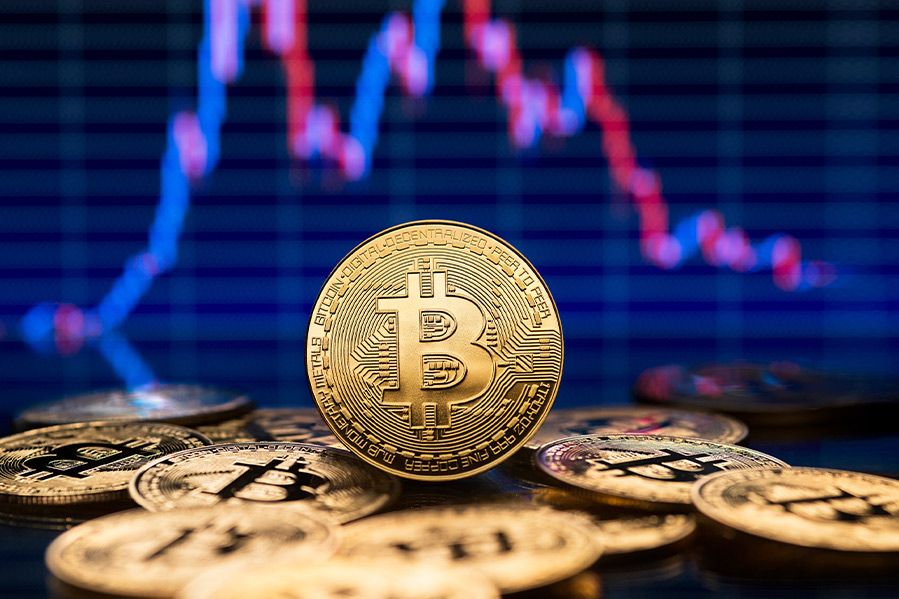
Does God love cryptocurrency?
Digital currency, once met with skepticism by many faith communities, is receiving ever-widening acceptence in religious circles.
Faith-based financial forecasters – many of them pastors themselves – are selling their followers dreams of financial freedom through crypto, even amidst recent market dips. And in just a few years, the leading figures at this growing intersection of faith and finance have staked a claim as some of the most influential voices in both worlds.
But what are they really selling?
Why Crypto?
Before we get too deep into the “who's who” of religious crypto influencers, it’s important to look at why Christians are increasingly drawn to virtual currencies. The believers immersed in the crypto subculture have wide-ranging reasons for their interest, ranging from mundane to apocalyptic.
Many people putting money into crypto see it much the same as anyone else – a means to build wealth, leaving more time for family, leisure activities, and worship.
But some reiligous investors see a greater divine reason to go all-in: the view crypto as a sign that the end is nigh, interpreting the rise of a global digital currency as a step towards the one-world system prophesied in the book of Revelation. Think of it as an investment to usher in the end-times.
For others, investment in cryptocurrency is a way to avoid being "de-banked," a concern among conservative Evangelicals who fear banks terminating their accounts over their political or religious beliefs (though it’s worth noting that last year, President Trump issued an executive order penalizing financial institutions for closing accounts on ideological grounds).
Others say crypto is God’s favorite currency. On the website of nonprofit Thank God for Bitcoin, which is dedicated to teaching Christians financial literacy, crypto investment is framed as nothing less than divine. “Fiat money is an immoral, unsustainable, and hubristic overreach of power,” it reads. In contrast, “Bitcoin is sound, decentralized money that submits itself to and embraces the thermodynamic realities that God designed to govern the universe,” offering “a divine corrective and protection against immoral and oppressive love of money and idolatrous pursuit of power.”
Whatever the reasoning, a growing number of Christians are showing interest in investing in cryptocurrency. And though there are many offering sound crypto advice, it’s also a market ripe for abuse.
New Prosperity Gospel Just Dropped?
One of the most popular ways Christians come to crypto is through financial workshops hosted by charismatic figures who are often, but not always, pastors themselves. One such figure is Michelle Renee, an entrepreneur who tours the country hosting crypto workshops, incorporating biblical messaging into her financial advice. “My destiny is to lead God’s people to wealth,” she says.
Many of these faith-based investment workshops teach similar principles: Crypto is on a high? That’s providence. Your investment is in a dip? That just means it’s a good time to buy more.
As the industry continues to grow, scholars warn that some Christian crypto influencers prey on the faithful by exploiting their shared belief and the inherent trust that comes with religious authority.
“Religious communities are often vulnerable to fraud because they are bound together by these networks of trust,” argues University of Chicago Divinity School professor William Schultz. “I think our defenses are often lowered when there is someone who speaks our language, who in some cases dresses the same way we do, professes the same beliefs.”
"Divine" Coins Prompt Concerns
Just last year, self-stylized “Crypto Pastor” Eli Regalado and his wife were indicted on 40 counts of racketeering, theft, and securities fraud. They are accused of leaning on their religious connections to recruit – then allegedly defraud – investors, pocketing $1.3 million on a cryptocurrency Regalado once sold to investors as divinely inspired but now acknowledges was a “scam”.
Other prominent faith figures have even launched their own coins, including Pastor Lorenzo Sewell, who spoke at President Trump’s second inauguration last year. Hours after delivering his remarks on the national stage, Pastor Sewell encouraged followers to purchase his coin $Lorenzo to "help us do what we need to do in the ministry."
"I need you to do me a favor to go and get that coin for us to accomplish the vision that God has called us to do on earth," he said.
Some critics said the coin’s inherent volatility and well-timed release made this appear to be a quick cash grab on Sewell’s part.
Others were more blunt in their assessments:
Follow the Money
Even amidst all the memecoins, dips, and swindles, the intersection of Christianity and crypto is only growing – and clearly someone is making money.
But is that the flock, depositing their funds into the virtual collection plate, or those promoting crypto investment from the pulpit – who are often hoping to cash in themselves?
What do you think? Is crypto a heavenly gift or a worldly grift?
36 comments
-
 Jannetje Eleanore Van Went
This is the same old tactic they have used for years (since it was created) - Crypto is the most easily traceable currency in the world, there is no chance someone can do something with crypto with our leaving a trail of information behind - what is really happening is large industries are making it dirty (this is an attempt to find loop holes, transfers and errors - but are not successful - they will spend endlessly converting their cash to crypto - it is a leveling event, better for people with no incomes to start out, than expensive transferring of large sums of money for the rich) - it is mostly used by underground and human, weapon and drug trafficking - because it is a reliable way to trace money sent, because it is safer and the test on the world of ill-repute has successfully ensured the police can track multiple organizations of thieves who use it, including terrorists, so if Religion cleans it up, in essence, they show us the way to make it stronger with trust....Crypto is money soup - no one ever goes without.
-
 Consulate Clive Orlando Hessing (The Rod)
This is a great investment go for bitcoin
-
 Ronald A Sherwood
Beware of wolves in sheep's clothing.... As with "Ai", love it or not, crypto is here to stay in one form or another. It's not a tool to fear or ignore, neither is it a tool to jump into blindly. Do your due diligence then test it on a small scale to see what happens. 😊
And if you want to invest, email me at - - - (just kidding) ❣️
-
 Religion as a Weapon is Wrong
Did y'all miss the scene from this 70 year old movie? https://youtu.be/VQRjp_62uj0?si=ksP2iziqzGghT1Vk If you like gold, you'll love this.
-
 William
Bitcoin is a prelude to the mark of the beast, mentioned in Revelation.
-
 Alexander Clarke
Money and religion go hand in hand. Religion has but one purpose and that is to control what you think, say, do and to separate you from your money. Religion is big business.
-
 Jessica Forbes
Why are we trying to talk about money and religion in the same..even this article sets up approving except able to speak as both the same. And there is laws protecting groups from preying in religious as a bias for money. There is a law I don't remember witch one. But the victims one in court from being targeted based on that. It was a deliberate disruption of there beliefs and worship. Which is something the United States says it protects its people free to choose their own kind of beliefs. God is not worried about money. He will save your soul even if your broke and eating food out of your mom's kitchen. Or if you landed the next big contract that you earned if you didn't screw somebody out off. He's worried about how you treat people. Beware of anything that uses the topic of God to talk about money.
-
Jessica Forbes
*which -witch doctor Why is the devil trying so hard to bring separation in our homes of mixing what's good and bad. I can see it all over. They are just moving from one low to the next to keep surviving and feeding off of other people. The reality tv show survivers. Believe me when I tell you these things. If you didn't want it find out from loss later.
-
-
 H. Edward Newman
God's Word informs us to be aware of the signs of the time. Since Crypto is digital currency, does it not lead us to conclude that it will make it much easier to enforce the mark of the beast if currency is digital? It's time for the human race to look to the Eastern Sky and look for the return of our, Lord and Savior, Jesus Christ! Crypto currency is indeed a sign to reflect the Word of God in our, society, in our churches, and in our hearts! Communicate with God so that he can communicate with us.
-
 Steven Ferrell
This whole crypto thing is a joke. Just stay with cash and it will not get taken as easy.
-
 ServantOfJudgement
Assuming you work, you money is seamlessly taken from you with every single paycheck. It couldn't be any easier to take us dollars than it is right now.
-
 Patricia Ann Gross
SOJ,
Like someone else mentioned above, it can be compared to a volatile stock transaction. If you get in early and before any "crash," you can make a ton of money (exchanged for "real" currency rather than electronic impulses). I was once heavily invested in tech stocks in the early 2000s, and had amassed close to a half-million dollars (on paper) before the stock crashed. It was hard to diversify, because the capital gains taxes negated a lot of the gains you made for a stock that was not performing as well at the time. Bitcoin is no different. Their value has no value until you sell, and then you are at the mercy of the buyer. God help you if you did the equivalent of a "margin loan" on your crypto, because when it crashes you lose everything with no cushion, and have a broker with a nervous breakdown when all their customers are losing their shirts.
-
-
-
 Roy S. Thorpe
I love to watch people interpret the Bible to match their moronic ways of dealing with reality! If you read carefully black can be white! The old testament is a collection of old Hebrew stories, sayings, and laws! So twist away! The new testament is about the life of Christ and His teachings which are a lot harder to warp!
-
Patricia Ann Gross
How can anyone consider bitcoin or any crypto as currency. They are an electronic form of a pyramid scheme that will one day collapse taking all of its investors (except those "lucky enough" to get out early) with it.
-
 Joseph Grieco
Bitcoin is a scam. It only has value when people are buying. If you try to sell, good luck getting anywhere near what its value is.
-
ServantOfJudgement
My son exchanged some of his crypto at exact market value into us dollars to completely remodel his home. It took moments for the exchange. That's why it's called currency.
-
 Michael Hunt
Lucky him! I'd assume he bought early which is why it was worth so much when he sold it. Currently, the price of Bitcoin is down 40% over the past 6 months. It's barely different from a highly volatile stock.
Currency is used to purchase things; Bitcoin has value that is exchanged for a currency that people can spend. I don't think your son paid for the remodel with crypto, did he? Currently there aren't enough people accepting Bitcoin as currency for it to be usable as currency in our economy. It's just people speculating about the value Bitcoin might have in future.
-
-
-
 Rev. Miche'al Yosef Dixon
"The Love of Money is the Root of All Evil" not money itself as Yeshua said, "Give unto Caesar what is Caesar's and Give unto God what is God's." An 18th century preacher named Pink said, "It perplexes my mind why men will kill men over a rock." Referring to Gold, Silver and diamonds which technically from a scientific point of view are "rocks". These "Bitcoins" are even less they are nothing but electric impulses. One electrical sergeant and your money is wiped from existing. That's from a lowly man who just happens to have a simple associate degree in Computer science and computer engineering from the us Navy and a college.
-
 Barbara Harris
The fool and his money are soon parted.
-
 Nicholas J Page
Crypto money is not big here in England. People use cash or card these days If you got mugged they will not get any cash and if they took your cards provide them with false details.I don't recognise Crypto currency.
-
 Rev Ned
Our AntiChrist POTUS loves Bitcoin!
-
ServantOfJudgement
It's exciting to hear that President Trump is attending the birthright citizenship supreme Court case. Let's pray that all the scammers and milkers reap what they've sown.
As of late, tons of nasty illegal aliens have been cutting the udder off to get the milk.
Go Trump!
-
Michael Hunt
As of late, Trump and his family has been using his position as president to enrich themselves at the expense of taxpayers. Immigrants do not come close to the Trump family when it comes to being scammers and milkers.
Getting rid of birthright citizenship would clearly contradict the Constitution and settled legal precedent. The President attending the case, the first time ever a president has done so, is a clear intimidation tactic to try and force the court to do his bidding. It's dictator type behavior.
-
ServantOfJudgement
I've noticed that when I pull uninvited weeds from my garden the job isn't done yet. Once the weed seed matures, they'll be back to smothering my vegetables again. The weeds have no right to live in my garden even if their parents dropped them there before I pulled them. If I ignore them or even water them, I know it won't be very long at all until the entire vegetable garden will be overflowing with all sorts of choking weeds. They'll all do very well in my peaceful and prepared garden. My family however will not do very well at all.
This is the way of things.
Let the gardener do his job and allow the intended, permitted vegetables grow and fruit in abundance.
-
Patricia Ann Gross
SOJ,
I totally agree with Michael, but would also add that if birthright citizenship is retroactive, his children, all born before their mothers were citizens (with the possible exception of Baron), would then lose their citizenship. Just like everything else, anything he puts into place as a law, would not apply to him or his, most likely. Of course, one could argue the "weed" element being applied to all of them.
-
Michael Hunt
Human beings are not weeds. Immigrants do not smother and choke US citizens, preventing them from existing. They make significant positive contributions to our society and are loved members of communities. The insinuation you are making towards immigrants is gross and shameful.
-
-
-
-
-
 Colleen McAllister
Truth is if it revolves around money then it is against the things of God. Period.
-
 Donald G Magel
Unless of course it is a "special" collection at your church or on your TV.. Then it has god's approval.
-
-
 Daniel Todd Kamm
Grift and greed....
Some people do well enough exploiting "bit" and other formats (like the dollar, the pound, the kroner, the yen, etc).
But I hesitate since our illustrious "president" and his family are up to their necks in bit coins recklessness, and these are not the best or the brightest that g-d has allowed to grace our daily lives. And I steer very clear of these risks and forms of exploitation.
Oh! for common currency: which, traditionally , has always featured aspirational, inspirational images of heroes past like Native Peoples, Harriett Tubman, Kennedy, Eisenhower, Roosevelt, Lincoln, Franklin, Washington and a few "Liberties" along the way...
And now some idiot want to put Donald Trump on a coin simply because its the nations 250th? HELL NAW! Let him die first like everyone else if he wants a coin or a stamp... for g-d's sake... if the mint goes ahead with this, I propose the make a coin with a "Pig for Attention" on the reverse...because that man's personality problem is way out of control.
Bet ya a dollar!
Peace Out... tk
-
 Robert Gagnon
So everyone will Trump coin after he over prints the dollar out of existence and declares U.S. bankruptcy.
-
Steven Ferrell
Please keep your politics out of this. This is about crypto coins, not a place to trash the President because you are unhappy your person lost.
-
Donald G Magel
Trump is a convicted felon and a seller of his bitcoin. This is what this discussion is about; scammers.
-
ServantOfJudgement
Naw it's not about Trump Derangement Syndrome. It's about crypto currency and Christians. It says that at the top of the article. Trump did protect your dollars from being seized because of ideology. This article is about crypto.
-
Patricia Ann Gross
How did Trump "protect your dollars from being seized because of ideology?" Asking for a friend.
-
-
-
-
-
 Reverend Paula Copp
Grifters gonna grift!

I can't go into a mom & pop store and buy something with gold or crypto, I'll stick with cash or credit.