

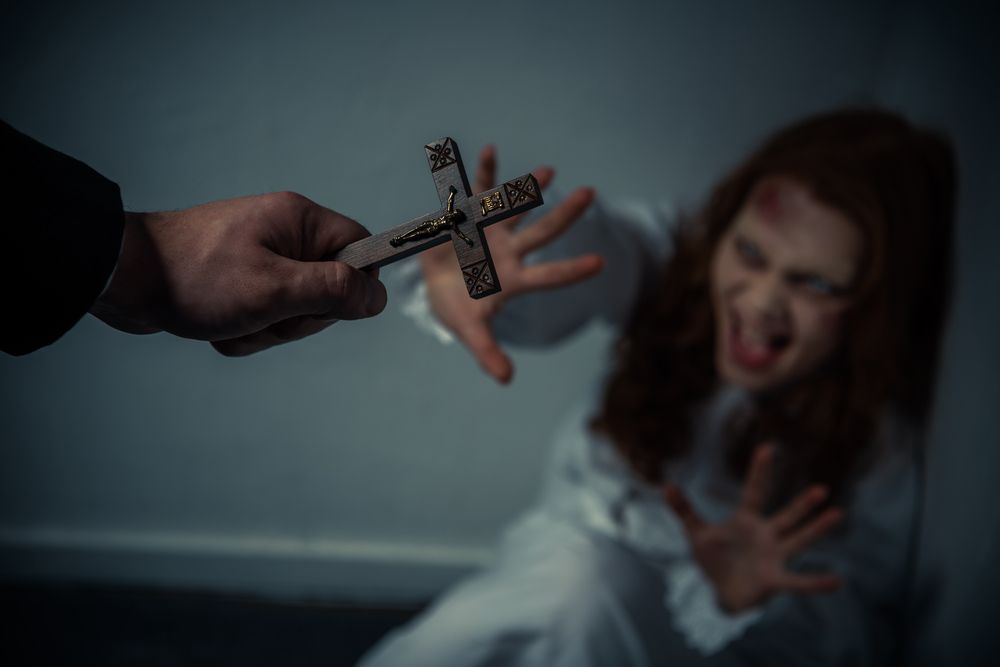
Pope Leo XIV held a private meeting this month with the leadership of the International Association of Exorcists (AIE), a Rome-based Catholic organization that counts more than a thousand members across 58 countries. The group came with a warning and a request: the Church is facing a growing crisis of occult activity, and it needs more trained exorcists to respond.
The exorcists presented the Pope with a detailed report on what they described as a significant rise in cases linked to occult practice and its spiritual consequences.
Their primary goal? That every Catholic diocese worldwide be staffed with at least one properly trained exorcist priest.
"The spread of occultism in its various forms, and of Satanism, unfortunately opens doors and windows to the extraordinary action of the devil," Father Francesco Bamonte told a Catholic news outlet. Without properly trained clergy at the diocesan level, he warned, the faithful who suffer are left without adequate support – and may turn to practitioners who make things worse.
Exorcists Get Papal Approval
The meeting is the latest in a series of signals from the Vatican that it takes this ministry seriously. Just last September, more than 300 exorcists gathered in Rome for a formal conference.
Pope Leo XIV, though not present in person, sent a written message framing the exorcist's role as one of "liberation and consolation."
The International Association of Exorcists was founded in 1994 by Father Gabriele Amorth, an Italian priest who for decades served as one of the most recognized exorcists in the Church. Pope Leo told the March delegation he had personally known and admired Amorth – whose ministry inspired the 2023 Russell Crowe film The Pope's Exorcist.
The association now holds formal Vatican recognition and recently published Guidelines for the Ministry of Exorcism, a document reviewed by several Vatican offices. A copy was reportedly presented to the Pope at the meeting, along with a metal image of Saint Michael the Archangel. Leo sent the visitors off with a rosary.
How Common Is Exorcism?
If every diocese needs a trained exorcist, the logical follow up question is: how common is this ritual, actually?
The answers are murky. No official exorcism figures are published by the Church, and most estimates come directly from priests who perform them.
One fact does seem undisputed, though: exorcism requests are on the rise.
Father Vincent Lampert, the designated exorcist for the Archdiocese of Indianapolis, says he receives around 2,000 requests a year – and he is one of more than 100 approved Catholic exorcists in the U.S. alone (up from just 12 when he was appointed to the role in 2005).
Father Amorth, the AIE founder, claimed to have performed at least 60,000 exorcisms over the course of his ministry before his death in 2016.
Note: in its mission to represent all faiths and faith perspectives, the ULC offers a wide range of books in its literature catalog. Among those titles is An Exorcist Explains the Demonic, by Father Amorth.
What are the Dangers of Exorcism?
The Church insists that suspected cases of possession be carefully examined alongside medical professionals – including psychiatrists and psychologists – before an exorcism can be considered.
There's good reason for this. Critics of exorcism have long argued that the practice pathologizes mental illness, attributing symptoms of known medical conditions like schizophrenia or epilepsy to demonic influence, rather than referring people to qualified care.
In the most serious cases, misdiagnosis has turned fatal: an 8-year-old autistic boy was killed during a church exorcism in 2003, and a 14-year-old in England died in a similar incident in 2010. Such cases have fueled lasting skepticism about whether the rite can ever be performed without risk to vulnerable people.
What Comes Next?
Only time will tell the impact more exorcists may have on the Catholic church and its members.
For skeptics, the entire premise raises questions about whether the Church is addressing a genuine spiritual crisis or conflating mental illness and spiritual curiosity with something more sinister. For believers, the Vatican's response is long overdue.
What is your reaction?
85 comments
-
 pastor master blaster
Yo, I'll exorcise anyone and anything, hit me up, I'll do it cheap too.
-
 PKBW
PKBW
Exactly. They are lucky we haven't been invaded or bombed from other countries. They might not like Trump but guess what, if the democratic party was leading we'd be dead or under a different probably a communist law. Let it soak in. Next we need to take care of Russia and China. One bomb for China One bomb for Russia. DONE.
-
 Annmarie Buckley
Comment removed by user.
-
-
 Kevin Venteicher
there are alot of matters at play around the world definetly need attention would agree the only question i have are there enough trained or educated qualified in our work place i know im not to be honest
-
 William M Buzanoski
A.S.A.P. AMEN!
-
 Tom Herman
An interesting topic I would love to see more about. If you believe in the concept of good and evil then being able to get rid of one or the other exists. How that is done is all over the place. Any one of us has the ability. I am not persuaded that Catholics have a monopoly on exorcism. What is faith? The question must be answered by each individual. If one trusts the manipulation of energy to be real, then you are well on your way to a greater understanding. I look forward to seeing more on this topic.
-
 Steven Ferrell
We have been seeing the increase of evil and that is indeed demonic influence. It does not just happen in the Catholic community, but worldwide.
But satan is crafty and he uses means that seem innocent enough to impart his demons into people.
Need more people of prayer to be praying against those demons.
-
 Rev. Kev
No supernatural demons exist. Not even necessary. We have plenty of regular humans of all political and religious stripes (many of them passing themselves off as pious Christians, among others) on the planet to cause misery and strife for all.
The causes are all quite explicable. Poor education. Greed. Selfishness. Ego. Superstition.
America is a nation that worships money, power, and violence (Not everyone, of course. But a majority do seem to do so). Those not worshipping at the altar of such base gods can see what such adoration is getting us. And it isn't positive.
Religions need demons and other intangible enemies to keep believers frightened and engaged. Essentially a false disease passed off as true in order to sell an equally false cure that only they can provide. Which makes it super easy for the folks with the money and power to keep everyone else in line.
-
 Kenosi Modisane
If we believe in the freedom of belief and practice as long as it is right and not offensive to others, why be concerned about exorcists belonging to the establishment (Catholic church) in this instance.
Kenny Modisane Johannesburg South Africa
-
 Blanca Rosa Houston
The theologian N.T.Wright suggests that we are under the influence of a mammon cult here in America. If it is happening in America, it may be present in the world. In his book, The Vision of the Ephesians, the task of the Church and the Glory of God,he compares our present society with the Ephesians stressing the unity of the people and the church standing firm against evil. Today, it is the mammon cult lead by a demon spreading sexuality, money is the god, and getting even at all costs is what the demon asks. Notice what trump said. He gets even. It makes him happy and he feels good. And he is going to get away with all the crimes he committed against the young. So, yes. The nation needs an exorcism. Unscrupulous evangelical preachers are involved in supporting this cult. There is an abundance of evidence.
-
 Roy S. Thorpe
The Catholic Church is still resorting to mumbo jumbo for the masses! To believe in possession is baloney! Another scare tactic to keep the masses in line! The old joke about if you don't pay your exorcist you get repossessed! 😆 Evil spirits don't have to possess anyone because bad people allow them in willingly!
-
 Steven Louis Clark
I wasn’t a believer until I was able to see those who passed on and a so called shadow figure came after me when I was a child. I thought I was a bit off in the head lol until I saw one and my roommate at the time tried to chase it after seeing it too thus validating my seeing them. I was once at a friends house and saw his grandmother after she passed it scared him but I knew it was her because I knew her in life. I believe it is not what most think and deserves further investigation!
-
 Carrie Jane Daken
Yes. We shall do what Jesus did, including "cast out demons" Mark 16:17, Matthew 7:22, Matthew 12:27, Luke 10:17, Acts 19:13
Yes, it's needed now more than ever. Wickedness has increased and continues to do so.... Matthew 12:24.
Jesus sets us free and includes deliverance from the darkness. The Gospel describes Jesus healing those oppressed by demons and unclean spirits. Such as the boy the would shake violently, often into fire or water. Jesus cast out the demon and the shaking left. Luke 9:37.
God I pray for the Church to most certainly appoint those to pray for people who need this kind of freedom. God I pray you would set us all free of anything unclean in our hearts or bodies today. As we approach Good Friday and the Resurrection Day, let us see once again ALL the BENEFITS YOUR DEATH provides for us. Amen.
-
 Marie Grace Maroney
Yes, there are Demons among us.. they’re in the White House, the large majority of corporations and the folks running the countries around the world.
-
 Dr. Ronald J. Tuman
Yes, demons are among us; they were in the Whitehouse 1-20-2021 1-20-2025. I am hopeful this current Whitehouse will turn around many of the ungodly things that were forced on many, especially young people in America.
-
 Rodolfo Perez Jr
Truly good people do not justify the evil in others. Disgusting.
-
-
-
 Mark
Mark
In recent times the church has been in a constant battle with evil. Islamic forces are probably behind this. I lived in an islamic country for nearly 10 years where young people were taught how to talk to the dead. Is it possible that this could have envoked demonic forces.
-
 Lori Mongillo
Back in the dark ages my son would have been considered possessed. He has what is called Charge Syndrome. He can't speak, among other things, and he has self-injurious-behavior. For some reason Christians back then, and apparently still do, put a possession label on afflictions they do not understand. Rather than accept the various afflictions for what they are, they'd prefer to make stuff up that fits with own Personal Spiritual Delusion. Delusional possession belongs to the sick believers, not the medically afflicted, who need much love and people that understand what is really happening. I am appalled by the number of individuals that cling to such archaic beliefs. They're still living in a cave somewhere in the past, believing the God of lightning is going to strike them down if they don't sacrifice someone to appease him. Exorcism is way beyond ignorance. It's time to grow up!
-
 Rev. Carol M Anaski-Figurski
Very interesting article. I'd say Pope Leo is prepared. ULC offers the book by Fr Amorth chief exorcist of the Vatican "An Exorcist explains the Demonic." is how a catholic priest would do the exorcism. We need more books out there on multicultural demons like Kali & the 8 to 12 other demons in hindu & how to conquer them. The popes exorcist is a good movie. & for movie buffs the new exorcist movie comes out March 12.2027. m. Flanagan's version. My question is could you come back in reincarnation as a demon??
-
 Sir Lionheart
It’s a very interesting picture that has been portrayed here for this topic. Rumor has it that all forms of mental illness affect 50% of the population. The other 50% are men. 😂
Thank you for letting me bring some humor to this conversation. 🤗
🦁❤️
-
 Mary P
Humor? I'd classify it more as toxic misogyny, which seems to be running rampant among Christian Nationalists.
-
Sir Lionheart
Nooooo! Please don’t tell me you are part of that 50%. 🤭
As a secular humanist, I wouldn’t know what you meant by Christian Nationalists. Perhaps I’m a Secular Nationalist loving my country, flying my flag 🇺🇸, supporting our President making America great once again.
I’m so glad he is making the world safer again by ensuring an Islamic fundamentalist regime country doesn’t have access to making a nuclear weapon; and additionally, men not taking part in women’s sports; children not being allowed to have gender transforming surgery; and removing people that have entered this country illegally being found and returned to where they came from. We are all going to be safer and better for these wonderful policies.
Let me know if you would like the White House app that’s been developed. I can send you the link so that you can get daily truthful updates from President Trump, which saves you having to rely upon left leaning propaganda news that can easily affect those 50 percenters.
Thank you for your comment.
🦁❤️
-
 Michael Hunt
For a secular humanist, you support Christian Nationalist policies quite often. These policies are not making our country safer, they are making it weaker and more divided than ever.
If you think you're getting truthful statements from President Trump, you're a bigger fool than I thought. It amazes me so many people fervently believe everything a convicted fraudster says even as he protects the pedophiles in Epstein's orbit and funnels billions of dollars into his own pockets. Don't forget that all of your data is being provided to the White House if you have that app on your device. For someone who's constantly accusing Democrats of being nefarious agents trying to ruin the country, you'd think you wouldn't want to be providing all of your personal information to the government.
Your original comment posits that all women have mental illness, which is blatantly misogynistic and sexist. Being that you actively support a misogynistic, sexist person like Trump, I'm not surprised that you're also a sexist and misogynist.
-
Sir Lionheart
Humor is clearly lost on most of those that are left leaning, but that’s okay. Do you remember those wonderful days when people could laugh at jokes about all of us and our idiosyncrasies and not get upset? Hopefully those days will come back as America becomes great once again. Allah willing? 🤪
🦁❤️
-
-
 Patricia Ann Gross
Sir LH,
I've read some very nasty things about that WH app, such as embedded code that tracks your location, spies on other apps you have installed and reports you for posting anything negative about what the WH is doing, so if you're all into government overreach, go ahead and have your field day! I'll pass on the app, thank you very much. Just be careful what you post anywhere, because one day you're considered the star of the show, the next day you're looking for a new job. Just ask Pam Bondi, and at least a hundred others. By the time this adminstration is finished, at least half his cabinet will have been replaced and all for not licking his boots to the shiniest shine.
-
Sir Lionheart
It’s wonderful isn’t it when those that don’t make the mark in Government are replaced? It’s a pity that Biden, or the Auto Pen people, didn’t do that with the severely underperforming Border Tzar, Kamala Harris, or the pathetic Mayorkas. But now that I think about it, I guess the unelected Presidential hopeful, Harris, or the Auto Pen people, pushed Biden to one side at the last minute after his disastrous Presidential debate with Trump. So, as you can see, it even happened under Biden’s organization, but in that case he was the one unceremoniously replaced.
🦁❤️
-
Patricia Ann Gross
I don't know if you've been here long enough to remember, but Richard Nixon started "cleaning house" when anyone said anything he didn't like, and if you don't remember, or didn't learn that when you came "across the pond," read up on what happened to him. Once he fired the AG it was all downhill from there.
-
Sir Lionheart
No I wasn’t here then, different President though with different ideas.
It equally went downhill for the Democrat Party when Biden was unceremoniously booted out of running for President again. They cleaned house by replacing him (without a vote) with someone that quite obviously was not up for the job, ultimately decided by the electorate. I personally believe we dodged a HUGE bullet there.
🦁❤️
-
Patricia Ann Gross
I had a long retort ready to post until I realized this has gotten so far off the topic at hand that there's no point. I won't waste other people's time scrolling past. The only thing I will suggest is that you go back and research the demise of Nixon and see if you catch the similarities I do.
-
Sir Lionheart
Nope! Sorry, I don’t see any similarities. Donald Trump is going to go down as one of the greatest Presidents we have ever had. Thanks to him, we are now much safer from having a crazy fundamentalist Islamist country having a nuclear bomb. Who knows how many American lives have been saved removing unvetted illegal aliens out of the country that should never have been allowed in. Not to mention no tax on tips, overtime, or Social Security, (which I just did 🤭), and we are only 15 months into his Presidency.
I don’t see that type of connection with Nixon.
🦁❤️
-
-
-
-
-
-
-
 Reverend Paula Copp
Can we exorcise the United States federal government? The devil is strong with its members!
-
 Daniel Todd Kamm
Lori, I love that comment, and I will put forth a response based in my own background in mental health (from which I am soon retiring after almost 40 years, and thank goodness!) and my interest in the antiquities of Freud and Jung.
You hit one of my favorite ideas!
There seems to be something to us (meaning human beings, people, etc) that is aware ... not only of ourselves, but aware of at least 2 others: something that on one side wants to be naughty, and on the other side wants to lord it over us ... one is trying to get by with what it can, to the point of absolute freedom, and the other admonishes, and restricts, to the point of absolute condemnation.
Is this intrinsic to human beings, or is it a learned, socially and culturally necessary expression of how/ why we consider ourselves "above" and "different" from other species, or how or why we as people need to get along to survive...?
No clear answers.
I agree that "good" and "evil" are products of the mind... an of collective minds , which eventually leads to societies and cultures, and structures around the fundamentals of ... what they do.
Social structures dictate the "good" and the "evil" what is approved or disapproved, and we are all raised in it, regardless. It's the glue that keeps us all together on some level.
I won't go on (and on) but back to a little history: the Ego and the Id? One wants one thing the other wants something else. Freedom? Conformity? Or, as human beings, something in between?
And it doesn't require exorcism to know or address the problems of a confused, divided and conflicted mind or even a confused, divided or conflicted society.
One of my favorites: "The ... inside as the outside and the outside as the inside... and the two will be as one," (apocryphal , attributed to JC when asked when his kingdom would come.
Now there's an internal conflict to resolve...!
Happy whatever holiday you have!!!
tk
Peace Out... tk
-
Lori Mongillo
I agree. We are extremely complex beings with many layers of conditioning. We grope for illusions to color our lives, though it really isn't necessary. I devoted many years to looking at my our illusions and one by one I escaped them. Being raised in Christianity required losing the guilt and judgement issues. Freedom from fundamental concepts is a wonderful thing. I have found living a more realistic life releases so much confusion and conflict from the mind. I've found it's more important to see life for what it is, instead of what I want it to be. We start making stuff up when we try to escape the real world. Peace to you too.
-
-
Lori Mongillo
Why is it that people refuse to grow beyond the archaic mentality of the dark ages. They cling to illusions of devils and demons like they need that kind of thing in their lives. It's difficult to understand the logic and the quest to maintain psychological fears such as these. We resist attaining emotional and perceptive intelligence. Never seeing the whole picture. Evil entities are products of the mind. As long as we keep them psychologically alive, they will continue to haunt the receptive minds that cannot free themselves. Belief's are something ignorant humans embrace as reality. They think they hold the answers, and they pass the illusions on from generation to generation.
-
 ServantOfJudgement
I presume you believe nothing then Lori? I hope you don't believe we evolved from trippy goo struck by cosmic lightning in a universe that created itself from nothing via physics that don't exist.
Perhaps you might turn to Hollywood and the music industry for your answers. Those two industries perpetuate the demonic in ways a million +1 churches and street preachers never could or will.
Actors and artists openly say they've made contracts with satanic forces. They incorporate it in their films, music and videos. The market is flooded with demonic content that finds its way in not every eye and ear on the planet.
I had demon with horns and face tattoos in a McDonald's pick-up window take my money and pass me a bag of choke-n-puke. After I paid but before I left the parking lot I just threw the bag of food away. In 2026, it's ok to look like a demon I guess.
With Dominic forces and demons not existing, we sure do see a lot of them don't we.
-
Lori Mongillo
No. Actually I don't see a lot of demons. I do see some people that have mental illness or drug issues. I guess you could use the term demons as a metaphor. I do believe in something. I really don't know what that is, and neither does anyone else, even though they think they do. That's also where the mental illness come in. I love science an The newer findings and theories that are evolving. There are so many things we don't know and perhaps never will. But I don't believe books written by men explain anything, and there are so many interpretations! No two people believe the same thing, which also tells me religion/spirituality is simply language we use to reach out to the Great Spirit/Mystery. Reality is not something most people embrace, especially here in the bible belt. But if they truly embrace LOVE, I don't really care what they believe. That is the foundation of existence. Just look at the naturally created world, and how beautiful and balanced it is, right us until we humans started with our illusions.
-
-
-
 Rev Ned
The White House in DC could use a thorough exorcism.
-
 John P Maher
YES 100 % YES, THROW HOLY WATER on tRUMP HE SHOULD DISINTERGRATE, HELL FIRE
-
Rodolfo Perez Jr
Alleluia, brother. Ministers must take a stand against evil. And trump is an evil, delusional and petty man.
-
 Pamela Marie Gutierrez
As a minister, I can't believe someone would say this about anyone specially here on Christian website I will pray for you
-
Lori Mongillo
Pamela.... What don't you understand about Universal Life? That means all beliefs, or should I say: delusions. I'm really sorry you are so in the dark.
-
ServantOfJudgement
Naw, pamela isn't in the dark at all.
She's using the most perfectly written document known to mankind as a reference for life. Modern science and psychology are just starting to catch up with what it stated thousands of years ago. That said, the field of psychology has gone off the path and won't learn what the bible knows. To ignore it is the same as hiding from the sun in the very back of a cave.
Universal Church of Life hacked the word Church from translations of the New Testament which means Belonging To The Lord. Pamela simply trusted UCL to be honest with their name and expected to see Christians as the name implies.
Did you know the Bible knows what a woman is? I do too and I bet Pamela does too. I wonder why science is having such a tough time with it suddenly. I think our scientific community is getting stupider as they pave their way to the new universal word-Stoopit.
-
Michael Hunt
By what standard is the Bible, "the most perfectly written document known to mankind," SoJ?
Modern science and psychology have long surpassed the Bible regarding our understanding of the universe. Many parts of the Bible that are posited as facts have been categorically disproved by science.
Science isn't having a tough time knowing what a woman is, you're having a tough time accepting that the science disagrees with your beliefs. Ignoring the science is the same as hiding from the sun in the very back of a cave, not ignoring the Bible.
The scientific community is not becoming more stupid, it's the laymen who reject scientific consensus that are becoming more and more stupid. It's the people who fall into cults of personality and reject evidence presented to them when it contradicts their beliefs that is causing our society to become so stupid. I could list tons of examples of conservatives continuously denying studies that repeatedly contradict their stances but that's more time than I'm interested in spending on this topic.
-
Rev. Kev
"She's using the most perfectly written document known to mankind as a reference for life."
I wasn't aware any document has been recognized as the "most perfectly written" by all mankind.
Certain groups assert their document of choice is perfect. But that's an entirely subjective view based on accepted faith statements or positions. Such as Muslims claiming the Qur'an is perfect and, in fact, could not be written by mere mortals. Such a claim is meaningless and affords no automatic authority to those outside of each, respective group.
-
ServantOfJudgement
Rev Kev
Unbiased literary experts throughout time recognize the Bible as a masterfully written document that ties itself together over thousands of years. It even defined itself. You don't need to agree, I wouldn't think you would unless you've studied it. It's far easier to simply type your disappointment and punch the enter key.
The Quran however is not given such praise. Sure, sure, guys with swords will tell us it's a perfect document but experts say otherwise. I'll agree, anything worth reading from that document was plagiarized from the Bible.
-
Rev. Kev
SOJ:
Your reply is all claims and no substance. How about some verifiable facts to support those claims? Citations, please?
The fact that I disagree with your claims is zero indication I never studied it. Quite the contrary. I have listened to and read both leading apologists and Biblical scholars who have peer reviewed work to their credits.
Once again, you lace your words with a smug sense of superiority. I am honestly getting the odor of Dunning Kruger in the air. It's not doing you any favors at all.
-
-
-
-
ServantOfJudgement
Pamela Marie, this is not a Christian website. There are all forms of religion and beliefs here. We've even got Satanists who don't worship Satan(Don't let them know they really do please)-No joke.
Be prepared to get your nose rubbed in the Bible by people who don't believe it but sure think they know it.
Welcome!!!!
-
Rev. Kev
SOJ:
When were you gifted with psychic abilities to know what total strangers know, think and believe?
-
ServantOfJudgement
It's not psychic Rev Kev. It's reading and experience. I read Everyone's posts. If you pay attention, you'll see the average atheist or pagan quote the Bible by far and large beyond all the Christians.
That said, I have been gifted amazing powers of observation.
-
Rev. Kev
In other words, you have drawn your own conclusions about people based on your own biases and limited, subjective impressions. Then made statements about them as if you are certain such statements are true. Even to the point of declaring as fact what they "really" think, even if they say differently about themselves.
You are definitely gifted with something. Meekness and humility don't appear to be in there, anywhere.
None of which is putting you or the religion for which you hopelessly attempt to offer a witness in a positive light.
P.S. People who are not Christians will usually cite the Bible in a discussion with Christians because of the fact that Christians are supposed to believe in and follow its contents to one degree or another.
Just as a non-Muslim will cite the Qur'an or Hadiths (if applicable) to a Muslim because those are their standards.
Many atheists in the West are former Christians. They ended up atheists because, in part, they studied the Bible from cover to cover and learned about how the Bible came to exist and what it says or does not say.
Many a non-Christian knows the Bible far better than the average Christian. The Pew Forum on Religion and Public Life released a survey on religious knowledge. Atheists and Agnostics scored higher on it than anyone else, closely followed by Jews and Mormons.
-
-
-
-
-
-
PKBW
Find on this post my reply to you.
-
-
 Colleen McAllister
I'm not convinced that so many exorcists are needed. I do know that possessions do occur and that extreme mental illness can often be mistaken for such possessions. The real issue Is who should decide which is which. A wrong diagnosis can cause untold problems. .
-
Sir Lionheart
It’s very simple Colleen, there is no such thing as Satanic possessions, it’s all different types of mental illnesses that people are afflicted with, much like religion.
🦁❤️
-
-
 Bishop William Dusenberry, DD
Placebos work — it’s simply mind over matter— ergo exorcisms are just religious hocus-pocus akin to eating Holy Communion. Until the Pope gets his God to legalize the use of birth control, the Catholic Church is the most enemy of humanity there is — and now the Southern Baptists (and, the GOP) have joined with the Pope to force poor females to live lives of despair.
-
 Rev. Miche'al Yosef Dixon
Before I got ordained by this Church I was already Ordained Clergy through a Christian College. Major in Christian ministry and minor in Christian Archeology. One of the classes we took was Psychology. And Catholics don't have the corner market on "Exorcism" as Yeshua the Messiah gave everyone clear instructions and authority if you truly believe in Him in His Name. However, he did warn some require "Fasting and Prayer" but generally two words, "Get Out" no long 28 tries over 45 days required if you truly have Faith. These Catholic Priests are like the Jewish Priests the demon beat up and chased out naked. And yes, I would advise a trained psychologist first and/or with the Clergy you get for the evaluation. My psychiatrist thinks I'm crazy because I see and speak with Angels (and fallen angels aka Demons). If you don't believe in the supernatural entities than that's your choice, if you truly believe in a god/God then you have to believe in the other beings as well. "Satan's greatest victory is to make people believe he doesn't exist. For if he doesn't exist then that means God doesn't exist also." -Martin Luther
-
Daniel Todd Kamm
An "Inconvenient Reality" or a "Convenient Lack of Reality."
Exorcism has long been used inappropriately; it was a common ritual to force the submission of wives and children to husbands and parents before the old world laws yielded to legal institutionalization for reasons of insanity. So Cyndi has a point.
It's a very fine line.
Which is why the church correctly protects potential recipients of such rituals by ensuring that all medical solutions are explored and treatments expedited. A lot can go wrong with one's body and it has less to do with "evil" and/ or "possession," than say, a tumour.
An even finer line: "Hostage to the Devil: The Possession and Exorcism of Five Living Americans" (1976), by Fthr Malachi Martin.
The man believed in his work; I am not sure that he had an understanding of all of the crazy things that can happen to people medically way back when... but I feel his work was distorted on the heels of 1960's-70's horror flicks, such as "Rosemary's Baby," "The Exorcist" etc. etc. etc.
Still an okay read if you can find it... just keep the lights on when you go to bed...!
I'm sending a letter to the Pope asking him to send exorcists to address the Lord of Chaos and his MAGA-TES.
If ever a people need the "Ghost Busters," it's now!
I'm Jewish, and there are certain things I don't believe in or endorse: possession and exorcism are two of them.
The idea of possession assumes that one is not accountable for what one does, because "the devil made me do it." (Thank you Flip Wilson!)
But what about the victims of the person who is exorcised and no longer accountable for any evils they imposed on others?
If Hitler had been exorcised, would the things he and his government did suddenly amount to being freed from a possession as well as the liability?
I think not.
Regardless... crazy topic....
Peace, Out, and as next week is Pesach (Passover) feel free to free yourself from whatever brings you down and tell your own story ... I rather liked the topic at hand because it's much like the idea of not having any control over one's life... so someone comes in to ritually give you back control....
And then there is Easter, eh?
I admit, I intend to enjoy a marshmallow egg. a few jelly beans, and a peep or two...not my holiday... but hey... Hallmark makes it all good!
Peace Out Reb tk
-
Patricia Ann Gross
DTK,
I don't think that "demon posession" results in lack of accountablity, only an explanation of how it came to such an evil end. Mountig a defense by "passing the buck" whether it's twinkies or demons seldom yeilds results that the defendant wants (or perhaps needs). I agree that evil is evil and the ones who perpetrate it need to account for it regardless of the charge, otherwise there is no justice.
-
-
 Elizabeth Jane Erbe Wilcox
Seems like a great set up for more groomers and pedophiles to join the Catholic priesthood. Yes they are priests and generally “elderly” so wow!
As for the practice of exorcism that seems very unnecessary and I view it as harmful as “conversion therapy.”
-
 Michael Burton
I only wish is that an exorcist could exorcise Project 2025 which haunts the White House.
-
Sir Lionheart
Noooo! Project 2025 is very much needed to prevent our country from the socialist woke mess it was headed by the last administration. We have now been unburdened by what could have been. 🤭
I’m thinking of doing a black magic séance to keep it alive, but don’t tell the Pope. 😂
🦁❤️
-
Lori Mongillo
And you, Lionheart, are very much part of the larger delusion, whether it be woke or sleeping. If you think the Whitehouse has your well-being at heart, you are as misguided as the Dem's.
-
Sir Lionheart
Don’t worry Lori, it’s all part of a very cunning plan. All will soon be revealed. 😜
🦁❤️
-
Michael Hunt
I've been waiting on this plan to reveal itself since Trump's first term. You'd think if there was some "very cunning plan" they'd be able to outline what that plan is and enact it instead of saying over and over, "all will be revealed soon."
Project 2025 outlines plans to remove the guardrails preventing a president from abusing the powers of the executive branch, expand the government's surveillance of citizens, allow for the targeting of journalists and protestors by the government, making voting more difficult and restrictive, censor academic discussions on race, gender, and oppression, remove legal protections for the LGBTQ+ community, the mass deportation of immigrants, removal of birthright citizenship, and ending the asylum program. Project 2025 doesn't address socialism at all, it only expands the government and executive branch's powers over the country. It is a road map to an authoritarian, theocratic dictatorship.
-
Sir Lionheart
Oh my! You really don’t have to believe everything you read, but if you must, that then becomes your choice. The mass deportation of “illegal” immigrants will continue, just like it did under Obama, and Clinton, if that’s what you meant to say. Anyway, hang in there, all will be revealed. 🤭
🦁❤️
-
-
-
-
-
-
 Nicholas J Page
I have never believed in Exorcism and at 67 years old im not starting to believe now it's all a load of rubbish people are not possessed by the devil or other demons it's called mental health issues and I suffer from Borderline Personally Disorder which is one mental health issue
-
 Father Frederick
Not surprising, given events and the actions of people throughout the world.
But the issue I have is concerns training. I've known 2 exorcists, very well respected and achieved. 1 is now deceased at age 74. the other in his early 80s. Like normal trades, the need for the job shadows the number in practice. It's not like you can come out of school and jump into the practice. It takes a very special set of skills.
I don't know how they can reasonably staff each diocese with at least one properly trained exorcist priest. Where I used to live, there was nobody within 187 miles, and where I live now, there is nobody, period.
However, the need is genuine and based on what many of us see, necessary. At 72 years old, I don't think I'm up to the work.
The one thing many don't realize is that it's not a easy job. Sometimes it can require multiple sessions, and I've heard of as many as 28 over a period of 45 days. The demands upon the Priest can be hard, long hours, travel, not to mention dangers in the exorcism to the priest and those assisting.
Good for those bringing this to the attention of Pope.
If anyone is interested in a good read on the subject, find a used copy of "Hostage to the Devil: The Possession and Exorcism of Five Living Americans" (1976), by Fthr Malachi Martin. Good read for those who do not understand possession or the exorcism.
FWIW: Father Martin has a lot of problems with the Popes he worked with, as the subject is touchy and often avoided by the higher-ups in the Vatican. It's what you call an Inconvenient Reality.
-
 Dr. Zerpersande, NSC
Nonsense.
-
-
Sir Lionheart
What on earth is a trained exorcist? This, right there, is the complete insanity of religion, and people actually believe this stuff. Amazingly, if Jesus had been stoned to death, I’m sure all priests would have to do would be to show a stone to someone that was mentally disturbed, and they would possibly have the same reaction as if they were being shown a cross today. Goodness knows what reaction some very naughty religious people would have had if they had to lie down, or walk along, on a stony beach. 🤭
Some of you might find my comment on this topic to be crazy, and even disrespectful, but if you do, it’s very possible you are one of those that have been completely indoctrinated into all this crazy religious BS.
🦁❤️
-
Patricia Ann Gross
Sir LH,
Crazy, no. Disrespectful and uninformed, yes. You are willing to believe in mental illness and physical ailments, some of which cannot be explained given the number of incurable diseases and disorders, but are totally unwilling to acknowledge that there is a force or power outside what can be seen, heard or felt that helps to power the cosmos. That some of us believe in a "higher power" by any name makes us no more dilusional than your belief that no such power exists. Calling every believer in any religion "indoctrinated" and "crazy [religious]" is as disrespectful as me calling you a crazy athiest/agnostic who has been indoctrinated by other non-believers, so I will refrain from calling you anything like that. And to answer your next question, I have no proof that such a power exists. You have no proof that it doesn't either.
-
Sir Lionheart
You are quite right in that I cannot prove a “higher power”, or whatever you want to call it, doesn’t exist, just like you and I cannot prove fairies don’t exist, or the Loch Ness Monster, but where does one stop with this type of theoretical nonsense?
🦁❤️
-
Patricia Ann Gross
Sir LH,
The best place to START is by respecting other people's views and STOP disparaging them for believing differently than you do. Start with respectful inquiry rather than disrespectful name-calling. For example, something "theoretical" means that there is some evidence that it may have at least some truth to it, and therefore should never be called nonsence.
-
Sir Lionheart
I think I know what you mean, however, don’t you think that people’s beliefs of a god that would kill children, drown most everyone on earth, stop the earth from turning for one day (an impossibility because we would all die) at someone’s request is theoretical nonsense? Can I respect those peoples beliefs? I’m sorry, but absolutely not.
They are of course also entitled to not respect my beliefs based on logic, reason, and critical thought. Many of them are Democrats wanting gender transforming surgery for children, and allowing men into girls bathrooms. 🤭
🦁❤️
-
Patricia Ann Gross
Sir LH,
One can still believe in a power that generated the universe and set the course that would inhabit the earth without taking everything in the Bible literally. Much of it is poetry, some is allegory, and a lot of it was written based on an oral tradition. The "great flood" could be related to the meteorite that struck the earth (allegedly) and wiped out the dinosaurs. The notion that Moses lived 900+ years gives us the understanding that Moses was not likely a single person, but a multi-generation family, much like others in Old Testament lore. I have studied at the Master's and Doctorate level on the scientific excavation of historical documents and sites that are included in the Biblical stories. One thing I truly believe about it all, is that you don't have the whole story unless you take into account the original language the document was created in, including the literary type (genre), the customs at the time, who the historical author was, and why it was written. All of the "original" copies of canonized scripture have multiple hand-scribed copies, some of which are significantly different than others. These include the Gospel of the New Testament, the Epistles (letters) written by early church leaders, and the Dead Sea Scrolls excavated from the caves at Qumron.
This all takes critical thought, reason and logic. It is not nonsence, it is science. Your twisting everything into some Democratic scheme to change every child's gender is getting tiresome. I say we make ALL bathrooms unisex, without urinals, and be done with the whole controversy about what is in the pants of the person in the adjoining stall. It wouldn't bother me a bit.
-
-
-
Rodolfo Perez Jr
“The greatest enemy of knowledge is not ignorance, it is the illusion of knowledge."
-
Sir Lionheart
Yes you are so right, but let’s not get talking about Democrats too much here, they get very easily upset, and don’t seem to have a sense of humour at all. 🤭
🦁❤️
-
-
-
-
-
 Cyndi McReynolds
I have questions.
First, If the Church is giving these "exorcists" the authority to perform this rite, why do they not keep records of when, where and upon whom these actions are being performed?
Second, are these people trained mental health professionals? Are they able to discern who is "possessed" and who is experiencing a psychotic break?
Is there a licensed mental health professional part of the team of "exorcists" before, during and after the rite takes place?
I am not a doctor, but even I know that subjecting someone who is in the middle of a mental health crisis to something as arduous both physically and emotionally as an exorcism could be quite harmful to their psyche.
I imagine being out of touch with reality in the first place and to then be told that there is a demon inside me that must come out, how would I know what's really happening to me? How would I respond? I can guess that it wouldn't be pretty.
I'm quite alarmed that this practice still continues.
Next, I wonder where these people are getting their statistics. I don't recall being asked by the census takers whether or not I was an occultist, or if I was affiliated with any Satanists. Will the witch trials be starting soon? Should I be concerned for certain members of my flock?
Does believing in magic make one an occultist?
So many questions.
-
ServantOfJudgement
Cindi, I'm sure they keep records, we're just not privy to them.
Licenced mental health professional carry just as much luggage as their patients. Sometimes they're even more off the rails than the patient. I've got family members who've had their lives destroyed by one such hack.
Science is in opposition to the existence of a soul, demonic forces and God. It doesn't know where to look or what to look with. An exorcism requires what science can not provide, belief in God.
Have you noticed how many people lately are identifying as They or Them for a singular person? I believe that those people are telling the truth. They just don't know they're possessed, which is usually the case. Some people know they're possessed and invite the demons in. The singer Beyonce is one example but there are many to choose from.
-
Patricia Ann Gross
SOJ,
First, if they keep records, they are protected from disclosing them by clergy privilge, which is tighter in the Catholic Church than any other because of the sacramental quality of the confessional.
Second, science is not in opposition to God or demonic forces. Philosophy, which is the rock on which many religions, including Judaism and Christianity, are built, is considered a science. St. Thomas Aquinas has outlined in Summa Theologicae how the science of philosophy supports divine revelation.
Third, I agee that there are "hacks" that pass themselves off as mental health professionals, much like any other profession, so having one available for an exorcism may not be of any value, unless they understand fully what is to be evaluated.
Fourth, I'm not sure what identifying as a non-binary individual has to do with being posessed by a demon or why you are slamming Beonce.
Trained exorcists (if you read the article, it explains it clearly) will not perform an exorcism unless they are cleared first by mental and physical health professionals to rule out things like schizophrenia and epilepsy. It is considered to be done only as a last resort.
I suspect that the rise in the number of requests is due to the fact that being gay or trans is no longer considered a mental health issue to be cured by "conversion therapy" and therefore getting the "gay" or "trans" demon is the only "cure" left. The only "sick" one is the one who insists that this is a curable illness and never to be considered normal.
-
ServantOfJudgement
Patricia, I agree that true science is in agreement with creation. The bible gave scientific facts 3000 years before science even knew of the subject. Main stream science is not in agreement however. Main stream science can not support a spirit or a creator at least until it knows where to look and what to look with. It may never, I don't know. In defiance, man has created a scientific belief system of its own(defying the principal of science) to escape creation.
Beyonce has invited someone she calls Sasha Fierce to control her body to physically perform better on stage. It works. She's not the only one. Tons of successful bands attribute their fame to the occult. This slow, steady increase in demonic language and appearance is now seeping into the average person on the street. The outlandish demonic costumes Kiss and the like once wore on stage can be found commonly on the street of big cities.
-
Patricia Ann Gross
Actually, science and the Bible only disagree on whether the fishes or the birds came first and the number of days it took to create the world. There are those that think of science as their religion, I get that, but one can believe in science and a creator God in their own contexts. It's just that "the force" that kicked off the creation has not been found yet.
Do you find anyone who takes inspiration from anyone, seen or unseen, is delusional and possessed by a demon? Many people have always looked at inspirational characters for motivation and inspiration, especially those who have vocations within the artictic professions. My grandmother dies in 1999 and I am continually inspired by her. My step-father died in 1989 and I often "hear his voice" in my head when trying to make a decision I would have asked his advice on. Again, this is why the Catholic Church's protocol for and exorcism is to first have the person cleared of mental and physical health (i.e., scientific) explanations for their behavior before performing one.
-
-
-
Dr. Zerpersande, NSC
So gay people are possessed? Are militant atheists possessed? Basically anybody that doesn’t accept the storyline of your 2000+ year old book?
You want possessed? Dancing in the spirit, speaking in/interpreting tongues, laying-on of hands. There’s your examples of possession. Possession by ignorance.
-
ServantOfJudgement
Whoa there Z! I never said gay people are possessed. I said if someone says his pronouns are They/Them, then they're possessed because they say they are. The English language affords referring to a singular person as they. It's a must for clean communications. However if that person wants me to change 'You" for "They" then that person is telling me they've got more than one entity living in their head. Time to back away slowly.
I'll agree with the tongues junk. If I feel like cringing I'll either watch a hack speak in tongues or watch Biden get close to a kid. Both are just as good for that creepy feeling. I can't bear to watch spirit dancing.... no sir.
Atheists are just trying to figure out the same thing I'm trying to figure out with the tools they have. Nothing at all wrong with that. The only obstacle to truth is the assumption you already possess it. Right?
-
Dr. Zerpersande, NSC
‘Atheists are just trying to figure out the same thing I'm trying to figure out with the tools they have.’
‘The only obstacle to truth is the assumption you already possess it, right?’
Two statements.
As for the first… it’s not so much figuring out the truth for me. It reminds me of the passage by an 11th century poet philosopher, (that AA appropriated and turned into a plea to God), “At the head of all understanding is the realizing of what is and what cannot be, and the consoling of that which is not in our power to change.”
For me,’what is’ are the things which have been true proven to be true by experimentation, reproduceability, and peer review. Science, or at least the fact that science has detailed. For the theist, there is only the singular tool, blind faith.
As of the second, that’s really funny, because theists believe that they truly possess and absolutely the truth in the form of a collection of ancient scripts originating with Bronze Age, nomadic, desert, goat herders. And there are some researchers believe these homonids had not even reached the full level of human consciousness at the time of the first writings.
-
Patricia Ann Gross
So, people with southern accents are possessed? They often use a contraction of "you all" (Y'all) as both singular and plural. Since when were Mirriam and Webster certified as Medical Doctors? Many different dialects exist within this country and not all of them are reflected in the dictionary. APA, MLA, and Chicago style guides for scholarly literature now recognize the plural (they/them) as a substitute pronoun when the gender is unknown (or fluid), as he/she can be offensive to both the transgender and straight communities (due to the ways 20th-century transgenders were treated and labeled).
-
-
-
-
-
Dr. Zerpersande, NSC
Because the Pope is the Head Delulu.

Yes, This I agree with, we can't have withstood wars, crime and murder with out noticing the temptation to get things with ease of crime over the power of skilled hard labor - We expect this is a probability [narcissism, EGO and Psychopaths are too often found in high authorities positions that crave control and power over others - these are the equivalent to evil, in that they are created by following the 7 deadly sins]. Anyone ever wonder why we don't learn as much about the many good graces, good deeds and heavenly lessons as we have the 7 deadly sins pounded in to us all the time (the structure of government and industry run them all). In the moon ceremonies there are a lot of shadows, that hold secrets to say, we must protect ourselves today.