

Pope Leo XIV has been trading blows with the White House over the war in Iran. Leo insists the war is unjust. In response, President Trump has called him “weak.”
It feels like a historic moment. But this kind of standoff is hardly new, and is older than you might think.
In fact, popes and political leaders have been clashing for over a thousand years. Sometimes the pope won. Sometimes the political leader did. Each instance provides an interesting lesson about religious vs. political authority.
Here are five times a pope drew a line – and refused to move it.
1. Pope Gregory VII vs. Holy Roman Emperor Henry IV (1076)
This one sets the bar for dramatic papal confrontations, and you could argue it has never really been cleared.
When Holy Roman Emperor Henry IV tried to appoint his own bishops against the pope's wishes, Gregory VII promptly excommunicated him. That meant Henry's subjects across Germany and Italy were released from their oaths of loyalty to him – effectively dissolving his political authority overnight.
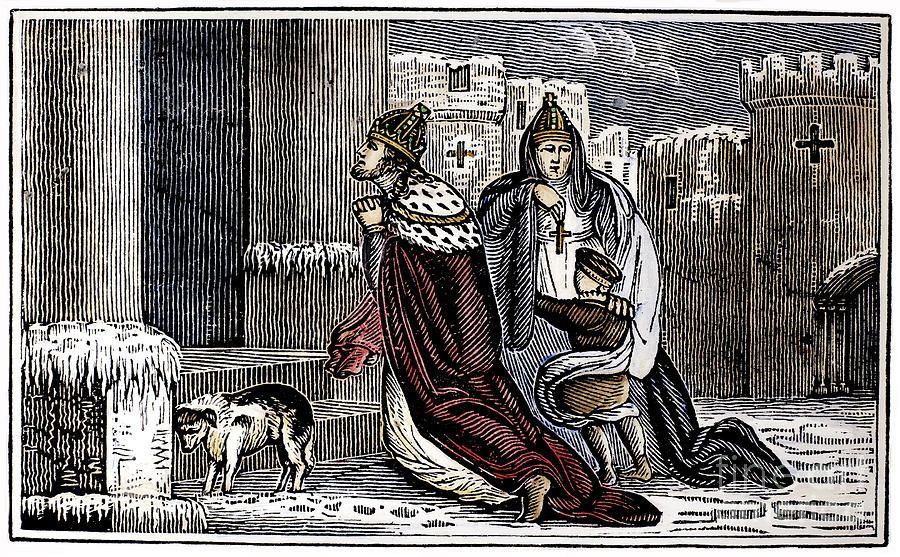
Henry had one year to get the ban lifted or lose his throne permanently. So he did something no one expected: he crossed the Alps in the middle of winter, walked barefoot through the snow to the castle at Canossa in northern Italy, and stood outside the gates for three days until Gregory agreed to see him. The most powerful ruler in Europe was on his knees, in a blizzard, waiting for the pope to open the door (or so a dramatic reading of the story goes).
Gregory lifted the excommunication. Henry went home and immediately went back to fighting with Rome. But the image stuck, and became a defining example of what spiritual authority could do to earthly power.
2. Pope Pius VII vs. Napoleon Bonaparte (1809)
Napoleon conquered most of Europe, but he was less successful with the pope.
When the French emperor annexed the Papal States and demanded that Pius VII submit to French authority, the pope responded by excommunicating him. Napoleon's answer was to have Pius arrested and hauled into captivity in France, where he remained for nearly five years.
Napoleon pressured Pius into signing a new concordat. Pius signed it – then withdrew his signature. The pope, imprisoned by the most powerful military figure of the age, still refused to fully capitulate.
Napoleon finally stumbled and lost power 1814. Pius returned to Rome and was cheered for refusing to submit. One takeaway? Moral authority can outlast military might.
3. Pope John Paul II vs. the Soviet Bloc (1979)
When Pope John Paul II – the first Polish pope in history – returned to his homeland in June 1979, the Soviet-backed government was deeply nervous. They couldn't stop the visit. They couldn't control what happened next, either.
Millions of Poles poured into the streets to greet him. John Paul II's message was deceptively simple: "Do not be afraid." For people living under strict communist rule, it was one of the most charged phrases anyone had ever spoken publicly. He gave an entire country permission to hope – and its leaders reason to worry.
His papacy went on to become one of the most significant moral forces behind the Solidarity movement and, eventually, the collapse of communist Eastern Europe. John Paul II didn't topple anything with force, but his words fortified the push for freedom that would come.
4. Pope Paul VI vs. President Lyndon Johnson on Vietnam (1965)
This one is a fairly close parallel to what's playing out today – an American president, a war, and a pope speaking for peace.
In 1965, Paul VI became the first pope to address the United Nations, where he delivered one of the most quoted lines in the history of the papacy: "No more war, war never again!" Two years later, he pressed President Johnson directly to pursue peace negotiations in Vietnam. Johnson acknowledged the pope's concerns publicly and called the meeting warm.
The war, however, continued for another decade.
On the surface, Paul VI's intervention failed. But it also established an important precedent: that a pope had both the standing and the obligation to speak directly to an American president about the morality of war.
5. Pope Francis vs. Donald Trump on Immigration (2016)
Some of you will remember this one.
When Pope Francis visited the U.S.-Mexico border in 2016, a reporter asked him about then-candidate Trump's proposal to build a wall. Francis didn't dodge the question. "A person who thinks only about building walls – wherever they may be – and not building bridges, is not Christian," he said.
Trump called the comments "disgraceful." He then described Francis as "a wonderful guy."
The exchange was relatively brief, and the two later smoothed things over. But a pope calling a presidential candidate's signature policy un-Christian was a window into future conflict.
Nearly a decade later, a new pope and the same president are at it again, over a war this time, and with considerably less smoothing over.
An Age Old Tradition
The pattern here is not hard to recognize: a pope speaks out, a political leader pushes back, and conflict erupts. The real “winner” is not always immediately clear.
The pope may not have an arsenal of conventional weapons at his disposal, but if history is any judge, the spiritual and moral authority wielded by the head of the Catholic Church lends a different type of power that should not be easily discounted.
What do you think? Should religious leaders draw lines in the political sand, or is getting involved in geopolitics beyond the scope of the job?
32 comments
-
 Jannetje Eleanore Van Went
The Government is an elected world leadership position by the people, (truly they are to serve and protect the people) a Pope is a world leader by holly, secular and spiritual guided principals of faith in a God (millennials of history here) He is chosen by an ancient voting practice - conclave.
The Pope is not voted in by status he is voted in by his ability to do the job, the position is taken very seriously, it isn't just his job for a term, it isn't something he does part of his day, he built every day towards learning just this to become a person chosen for the position.
Trump is an elected government, he must win the peoples votes, by telling them he will be a good leader, by gaining their respect or attention as someone they can see being a good leader for a term - he gets a chance to be leader.
If we look at the issue of who should have been respected - the Pope has the higher position with the people and as a world leader...
Trump governs one Country
The Pope keeps the hopes of all his people around the world that one day their practice of religion will bring peace and prosperity - the Pope has a larger community of support, most people would have noticed this and had respect for his position. Naturally
-
 Christian
Pope Leo XIV can visit Tehran and give Mass for all those who wish to attend and Hear a Full Gospel Message of Christ Jesus. Here in this current conflict is the very reason Jesus came to Save Souls and Change Lives. In Iran Christ can Save Lives and many people seeking God's Love and Forgiveness can and shall be SAVED. PRAISE JESUS CHRIST ! Pope Leo XIV can literally be the Good Samaritan and Visit Tehran to Give Mass for all of Iran.
-
 JT Sunrise
POWER, AUTHORITY, AND WHAT PEOPLE ARE MISSING
By Rev. JTSUNRISE
The article lays out a simple idea: throughout history, popes have confronted political power. Kings, emperors, presidents—none of this is new.
That part is accurate.
A pope excommunicates a ruler.
A ruler imprisons a pope.
A priest stands in front of a government and says, “Do not be afraid.”These moments have been happening for over a thousand years. (Universal Life Church Monastery)
But the reaction to the article misses the point.
Some responses treat it like a contest of strength.
Some reduce it to security, force, or physical protection.
Some dismiss the entire idea, as if power only exists in weapons, armies, or enforcement.That misunderstanding runs deep.
There are two different kinds of power being described, and they are not the same.
Political power controls bodies.
It uses force, law, surveillance, and systems of enforcement.Moral authority moves minds.
It operates through belief, meaning, and shared understanding.The article is not saying popes “win” in a physical sense. In fact, many of them lose in the short term. Some are imprisoned. Some are ignored. Some are overruled.
But something else happens over time.
A ruler can command obedience.
A ruler cannot command belief.That is where the tension lives.
When a pope excommunicated an emperor, it didn’t remove soldiers or armies. It removed legitimacy. It told people: you no longer owe this man your loyalty. That is why a ruler as powerful as Henry IV ended up standing in the snow waiting to be forgiven. (Universal Life Church Monastery)
That is not about force.
That is about perception.The same pattern shows up again and again.
Napoleon had armies across Europe, yet still imprisoned a pope who refused to submit—and that refusal outlasted him. (Universal Life Church Monastery)
John Paul II did not overthrow a government with weapons. He changed what people believed was possible. (Universal Life Church Monastery)
That is a different kind of leverage.
The comments that reduce this to “who has more protection” or “who would win in a confrontation” are operating inside a very narrow model of power.
That model only sees force.
It does not see legitimacy.
It does not see meaning.
It does not see the role of belief in holding a system together.Every government depends on that layer.
When belief shifts, systems move.
That is why these moments matter historically. Not because a pope physically defeated a ruler, but because the line between authority and obedience became visible.
The real issue is not whether a pope can “take on” a leader.
The real issue is this:
Who defines what is right?
Governments claim that authority.
Religious figures claim that authority.
Individuals negotiate between the two.That tension never resolves. It just takes new forms.
Right now, people are reacting to this like it is a spectacle—like a scoreboard.
It is not a scoreboard.
It is a reminder that power is not one thing.
Force can compel action.
Authority can shape belief.When those two collide, history pays attention.
That is what the article is actually showing.
Everything else is noise.
-
 Dr Dennis Chevalier PhD, DDvin
Plagiarist abit?
-
-
 Leslie A. Hulberg Née Tomasura
As an American, I definitely believe in separation of church and state. When one looks back over history, you can see how detrimental one religion over another brings nothing but destruction and destructive behavior.
-
Dr Dennis Chevalier PhD, DDvin
and the opposiant is true as well...bringing change. Sometimes for the better.
-
-
 Br. Joshua
The pope, like all little yarmulke wearers, rapes children.
-
 Patricia Ann Gross
How anti-semitic of you. Since when does the Pope wear a yarmulke?
-
 Michael Hunt
All Jews are pedophile rapists? Seems like I'm constantly hearing about Christian church leaders being convicted for possessing child sexual materials and pedophilia, not Jews. Surely you have evidence of your claims, though, if you're going to make them. If not, your claims are solely anti-Semitic and hold as much weight as someone's claim that you are a pedophile rapist. I don't believe you are since I don't know you besides your anti-Semitic posts here, but it is curious how frequently the people most vocal about pedophiles and rapists end up being one.
-
 Rev. BH
Br. Joshua, your antisemitism is obnoxious.
-
-
 Tom Herman
"Should religious leaders draw lines in the political sand, or is getting involved in geopolitics beyond the scope of the job?
As Evelyn has pointed out, this is a great question. First, the Vatican is a sovereign state and it's leader has every right to make statements on behalf of their nation.
Second, it's well known the Vatican does not have the military might most other nations have but it does have 1.422 Billion people or 17.7% of the world's population. Add all Christianity and you're talking about 2.4 Billion people and 31% of the world's population.
Third, it would be unwise for any political leader let alone a religious leader to not make full use of the resources at their command to effect adherence to or change in policy. While many Christian Protestants may not recognize the Pope as the leader of all Christianity, I know of none who at least do not acknowledge the Pope was the very first leader of the Christian faith before the reformation caused a divide. That fact is simply established history.
Finally, while Trump may be a liar, racist, rapist, grifter, bully, cheat, hypocrite, Russian asset, twice impeached, convicted felon, narcissistic megalomaniac, self proclaimed dictator wannabe, I don't think he or at least his puppet masters are totally stupid. He has earned the contempt of every leader in the free world. He has drawn the ire of many countries with his ethnic cleansing deportation policies and use of ICE. He has split Americans in half with his Maga political ideology bigotry and use of the military against US citizens. It is unwise to reinforce that contempt by alienating all the world's religions as well. Of course, no one said Trump or those who really control him was smart.
In closing, Pope Leo XIV is the first United States Pope. Educated with his BS at Villanova University and his MDiv, JCL & JCD elsewhere. He of all former Pope's understands the American mind. His education and position puts him in the best position to understand the geopolitical situation we currently find ourselves and the US position on the world stage. While some may not agree with him, I know of few who do not have great respect for the position and the influential power of the Papacy. For Leo not to use the resources at his disposal to help the world will only serve to cause the world to fall further into the abyss. I applaud his taking on Trump and pray Leo uses all his resources wisely.
-
 James Trenton Smith
5 Times a Pope Took On Powerful World Leaders ... lol ... as if. They just popped that mouth off a little.
How about that time the English King Henry (yes...the horrible one...) dared Rome to come and take their money... all of you "Roman Imperators" let's see if you can handle England alone... Have these battle-hardened Priests challenged an actual Kingdom in-between their interludes of buggering up boys, impregnating nuns, and visiting their orphanages...? When has a Pope done this in the past 1000 years ... since Innocent III actually fought in the 1st. Crusades?
-
 Alexander Clarke
There was a saying "back in the day" that if you screwed up badly enough someone would say "that would piss off the Pope" well if anyone can it is Trump.
-
 Evylyn Rose
"Should religious leaders draw lines in the political sand, or is getting involved in geopolitics beyond the scope of the job?"
I love this question. Even outside of the specifics of this article, the question posed here speaks to something we often forget when we're talking about the role of religious leaders (and spiritual leaders, more broadly): Addressing our spiritual health is a major component in the overall wellbeing of all humanity, regardless of one's religious affiliation or lack thereof.
I know many people who don't put much weight behind anything coming from the Pope, let alone the Vatican, for very logical and sane reasons. I can say the same about many other religious leaders with varying levels of influence. Yet, speaking on the topic of politics, the only people I've ever heard say anything along the lines of "they should stay in their lane" are those who disagree on hypocritical or self-serving bases.
(For those who need this clarification: I'm not saying that religious leaders are infallible and everyone should agree with them. To the contrary, all religious leaders can--and sometimes certainly do--"get it wrong" when they engage in geopolitics.)
The role of spiritual and religious leaders are to help guide us in matters of faith and spirituality. Like our physical, mental, and emotional health, spiritual health is interwoven and connects with all other areas of our lives and wellbeing. To tell a religious leader they shouldn't engage in any political discourse, commentary, or reflection would be synonymous with telling your doctor or therapist to "back off" when they point out that doom-scrolling social media for hours every night might have something to do with your sleep problems you reported. In other words, we should absolutely expect religious leaders to at least touch upon and comment on politics (read: policy) that governs all our everyday lives. Because all of it is interconnected.
Any responsible religious leader should be aware, understand the complexity, and stand ready to speak on political matters within the framework of their religious or spiritual affiliations, just as they would any other topics for the spiritual health and wellbeing of those they serve.
-
Patricia Ann Gross
Exactly, the spiritual and the political are intertwined, and speaking out for those that get caught in the crossfire (if you forgive the reference) of political actions that end up dehumanizing, demoralizing, or worse the very people most religions are there to help (in Christian terms: the poor, the sick, the visitor, the stranger, etc.).
-
-
 Steven Ferrell
You neglected Pope Urban ll who went against the move by islam to take over the world and started the crusades.
That was a great Pope.
-
 JaZe
JaZe
It s the Pope s job to advocate for peace, dialogue and reconciliation, he is not preaching only to americans, there are tyrants everywhere 😪
-
 Rev. Carol M Anaski-Figurski
Interesting article. Pres. Trump has the hardest job in the America protecting us in America. The pope is wrong about god. Lets remember what God did in genesis 18 19 the" 2 cities destroyed by God with fire & brimstone due to extreme wickedness, sexual immorality, in hospitality & pride. God rescued Lot & his family. His wife turned to a pillar of salt when she turned to look back."
-
 Jonathan Ross
Naah...this sounds like idolatry mixed with jingoism.
-
-
 Bishop William Dusenberry, DD
The popes (the Christian God’s representative on Earth — at least the one’s who’re Catholics) proclaim that they are anti-war, ergo are pro-peace) yet by continuing to continuing to categorize family planning as a mortal sin, are forcing poor destitute women, who’re pregnant and/or with little kiddies, to migrate to where they think there’s food, shelter, and maybe access to family planning. Anyone who aggressively opposes the use of birth control is a danger to the future of humanity — and as long as the pope, is the most aggressive influential opponent of birth control, he should be categorized as such accordingly.
-
Br. Joshua
Agreed. The proper demographics seek birth control.
-
Patricia Ann Gross
Bishop,
You are back in the 19th Century. Vatican II relaxed the edict against birth control, as they were seeing that, at the time, the world was becoming overpopulated, and larger families were not as necessary after the Industrial Revolution(s). The only "birth controls" they are actively opposed to are those that eliminate fertilized eggs (abortion, Plan B, IUD). They are even actively debating IVF because they generate more fertilized eggs than are implanted, and those sometimes are destroyed if not used.
-
-
 ServantOfJudgement
Lol, the pope isn't staring down anyone.
He's not at risk in any way shape or form. He's quite safe while the president is in office. He's very safe behind his gates and fences. The
Vatican armed guards will keep all of them safe. They're not afraid to kill people to protect the pope. He won't mind that either. He knows he'd rather have an intruder killed than himself.
He's no fool, he's got dudes with guns trained to kill sinners.
-
Patricia Ann Gross
And, how exactly, is that different than what Trump has? He has a whole DOJ branch called the Secret Service that scouts every location before he gets there and everyone is trained to take a bullet for him. Not one of them would hesitate to take down a threat. Not that I object, because the POTUS, whatever his [or her] name or party affilliation is a valuable asset that needs and deserves such protections. Popes have also been subject to assasination attempts, and are also regarded as valuable assets and also deserve no less.
-
ServantOfJudgement
No different at all Patricia.
That's my point. One man knows lethal force must ultimately be used to protect innocence and the other denies and decries it even though he uses it.
You can't have a gun but I can. You can't have a wall but I can. You can't kill attackers but I can. Etc, etc, etc.
Jesus calls that hypocrisy. The Pope is doing what Jesus said is hypocrisy.
-
Patricia Ann Gross
So, you're advocating for open season on all Popes and the Vatican?
Why not do away with the Secret Service while you're at it, and put the president back in an car with an open parade seat rather than an armoured SUV. While you're at it, remove all metal detectors at the White House. Protection of valuable assets sometimes require lethal force.
-
-
-
-
 Douglas Robert Spindler
What about the times the Pope sided with World Leaders? Hitler is one. After Hitler and the Nazis took power the the pope immediately made a treaty and partnered with the Nazis
If you read Mein Kampf in the very first Chapter, Hitler states he will be doing God's work and executing God's work to destroy the Jewish People with the support of the Pope and the Vatican.
The pope swore allegiance to Hitler and the Nazi party.
The Catholic Church celebrated the birthday of the Fuhrer until the end of WWII.
-
 Rev. Miche'al Yosef Dixon
Yes and the last Pope apologize to the world for personally authorizing Hitler's actions. Leader's in history that do anything without the Pope's approval have a habit of ending up dead.
-
Br. Joshua
you spelled Michael wrong. Who is Al? Al Alohim?
-
Michael Hunt
Well they're not spelling Michael, they're spelling Miche'al. Your ignorance of other cultures and their naming conventions is making you look foolish.
-
-
-
-
 Colleen McAllister
The Pope has every right to speak out against Trump, as does anyone else. Ultimately it is God who will win the argument.

I truly believe at times the voices of the religious community needs and will always be heard. By the continence bestowed from God men will act in accord with the spirit of truth. Ignoring these ever pressing matters of world conflict will only arise more. When the voice of the spirit is heard all is well.