

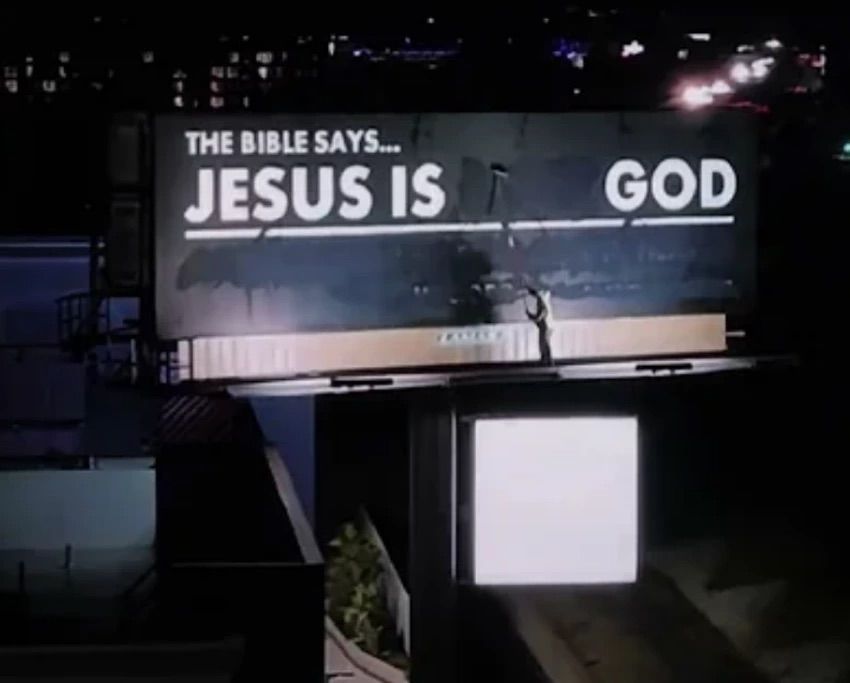
Is vandalism acceptable if it’s in the name of evangelism?
A video going viral shows an unidentified man atop a Los Angeles billboard, paint can in hand, carefully covering the word "not" on a sign that reads "Jesus is not God."
With the skyline of LA behind him, the man transforms the controversial message into a proclamation of traditional Christian faith:
The original billboard is part of a campaign by World's Last Chance, a religious group that describes itself as non-denominational volunteers preparing for the return of Christ. Their billboards, which have appeared in California, Georgia, and other states, challenge mainstream Christian teachings on several fronts, including the deity of Jesus and the doctrine of the Trinity.
When Does Conviction Cross the Line?
The video has garnered thousands of shares and comments from Christians praising the painter's bold action. But it also raises the question: is destroying or defacing property ever justified in defense of religious belief?
On one hand, many believers feel a visceral reaction when encountering messages that contradict their deeply-held convictions about Jesus. The impulse to "correct" what they see as dangerous heresy is understandable – after all, from their perspective, souls are at stake.
On the other hand, the billboard was legally purchased and displayed. World's Last Chance paid for the advertising space to share their interpretation of Scripture, just as any church or religious organization might. The property belongs to the billboard company, and painting over it is, legally speaking, vandalism – regardless of how righteous the motivation might feel.
Why Do Most Christians Believe Jesus Is God?
To understand why this billboard strikes such a nerve, we need to rewind nearly 2,000 years to one of Christianity's most fundamental – and contentious – questions.
The belief in Jesus's divinity wasn't universally settled from the beginning. In the early 4th century, a presbyter named Arius from Alexandria, Egypt, taught that Jesus was God's first and greatest creation, but not eternal or equal to God the Father.
This teaching spread rapidly and divided the young Christian church. Emperor Constantine, concerned about a rift in the early Christian church, convened the Council of Nicaea in 325 CE to address the controversy.
Over 300 bishops gathered in what is now İznik, Turkey, for what became the first ecumenical council of the Christian church. This important meeting resulted in the Nicene Creed, an agreement that affirmed that Jesus is "of one substance" with the Father – meaning truly and fully God, not a created being.
Fun fact: the exact location of this famous council was a mystery for centuries. That is, until last year, when archaeologists finally zeroed in on the ruins of the basilica where it was held:
What Happened After the Council of Nicaea?
Interestingly, Arius refused to sign the creed. He was exiled, but the beliefs known as Arianism continued to influence parts of the empire for decades afterward.
For mainstream Christians today – whether Catholic, Orthodox, or most Protestant denominations – the divinity of Jesus is non-negotiable. It's considered essential to Christian salvation: if Jesus were merely a created being, his death couldn't atone for humanity's sins. The belief that God himself took on human flesh, suffered, died, and rose again is the heart of traditional Christian theology.
Yet not all who identify as Christian accept the Nicene formulation. World's Last Chance is part of a small but persistent tradition of non-Trinitarian Christianity.
Modern denominations sometimes associated with Arian-influenced teachings include Jehovah's Witnesses and certain branches of the Messianic Jewish movement (though many understandably avoid the term "Arian" because of its… historically negative connotations).
Vandalism vs. Evangelism
When you understand this history, it’s easier to see why the billboard video went viral. But does that make the vandal’s actions right? It's one thing to feel that someone's religious message is wrong or even harmful – it's another to silence it.
There's also the matter of precedent. If it's acceptable to vandalize a billboard you disagree with, where does that end? Could atheists paint over Christian billboards? Could Muslims deface signs promoting other faiths?
Where do you stand? Does religious conviction justify defacing property that promotes what many Christians consider “false teaching”? Or is it important to defend the right of all groups – even those we vehemently disagree with – to share their interpretations of faith?
76 comments
-
 Bishop William Dusenberry, DD
In the SHP denomination of my (an ordained ULC minister) ULC, we accept the fact that Nature and God are the same thing (as Thomas Jefferson, Albert Einstein, Spinoza, George Washington, and ULC minister William Dusenberry have also pontificated) Jesus is clearly a meme, which billions accept — which is demonstrable by those who bless people who sneeze, even though they were never authorized to do so. Hopefully the ULC will issue a certificate authorizing every ULC ordained minister, to bless those who sneeze— whether they want to be blessed, or not.
-
 Brother Peter
You may know that our friends the Bahai feel that Christ already came, toward the end of the 19th century. I personally think that immortality (like that of Jesus) is just how long someone is remembered. Jesus is immortal because his name is spoken every day by millions. He isn't "coming" because he never really left. He may have even known this. Look at the last sentence in Matthew's Gospel.
-
 Johan H Akkerman
I like what everyone has said, yes he is not God, he is the son of God. And I believe that the days are coming to an end where he shall return, as it says a light well come from the east and go to the west, and that has already happened, I believe that he is already here because it says I will walk among you as one of you. You will not know me until I speak to you, and as the world shows before his return, they’ll be famine, earthquakes, hurricanes people are living in the streets and look around. It is happening. The only way can be like one of us is to be reborn as a human and know the teachings that are going on today., and all defaults prophecies that are happening and where nobody believes anymore, but wake up the end is near. Amen
-
 Rev. Kev
I'm guessing you realize that the whole "The End is Nigh" thing has been going on for a couple thousand years. There's always a bunch of people saying, "This is definitely it." The big ones were at the end of the first century, The Great Disappointment 1 and 2 (same guy failed twice and people believed him both times), Y2K, and the recent TikTok prediction a few months ago that crashed and burned. Each time people prepared themselves for the end. They cried and said goodbye to their loved ones, then waited patiently while nothing happened and the so-called "prophet" those folks believed in began making excuses for why it didn't happen. All it did was create a spectacle and a source of jokes for everyone else.
Groups like the Jehovah's Witnesses keep setting dates, then resetting the dates when The End doesn't happen. In between are the endless believers who say this or that time or generation who come and go.
My personal view on the matter is to take care of life today and not bother with some supposed event at some unspecified time that may or may not happen. A person who keeps their house in order today has no worries if guests drop by tomorrow.
-
-
 Harley Oden Miller
1 Corinthians 6:19-20 “Do you not know that your bodies are temples of the Holy Spirit, who is in you, whom you have received from God? You are not your own; you were bought at a price. Therefore honor God with your bodies.” – 1 Corinthians 6:19-20
Proverbs 17:22 “A cheerful heart is good medicine, but a crushed spirit dries up the bones.” – Proverbs 17:22
James 5:14 “Is anyone among you sick? Let them call the elders of the church to pray over them and anoint them with oil in the name of the Lord.” – James 5:14
Exodus 15:26 “He said, ‘If you listen carefully to the Lord your God and do what is right in his eyes, if you pay attention to his commands and keep all his decrees, I will not bring on you any of the diseases I brought on the Egyptians, for I am the Lord, who heals you.'” – Exodus 15:26
smoke pot its not a drug it came from god cannabis is good for us makes us happy and healthy man made drugs like meth makes our bones dry read this it makes sense in biblical terms. the anointed of Jesus is cannabis oil don't let the churches lie to you. aka the burning bush reference.
-
Rev. Kev
Interesting how your words about weed aren't anywhere in the verses you cited. That verse in 1 Corinthians might even go the other way since treating your body like a temple would seem to leave out activities like taking a mind altering drug that has negative effects if taken regularly over long periods. If smoking is involved, then we can add on lung damage. Smoke of any kind is not friendly to lung health.
According to a NIH study "marijuana joints have been shown to deliver at least four times as much tar to the lungs as tobacco cigarettes of equivalent weight." Not surprisingly, clinical studies suggest that people who smoke marijuana are more likely to develop respiratory illnesses than are nonsmokers. Many of the same carcinogenic, or cancer-causing, compounds present in tobacco smoke are also found in burning marijuana. In particular, unfiltered smoke from joints contains higher concentrations of a class of chemicals called polycyclic aromatic hydrocarbons (PAHs) than does smoke from tobacco cigarettes. An especially convincing study evaluated changes in blood cells taken from pregnant women who were exclusive smokers of marijuana and also from their babies after they were born. In a class of white blood cells called lymphocytes, the researchers found significantly more DNA aberrations of a type linked to cancer development as compared with lymphocytes from nonsmoking women and their newborns.
Smoking aside, several biological studies suggest that cannabinoids can depress the immune system's response to infection. In some experiments, white blood cells in experimental animals exposed to THC and other cannabinoids exhibited a reduced capacity to proliferate following infection; some animals also produced fewer than normal antibodies or showed signs of impaired “killer cell” activity. Marijuana smoking was also found to reduce the ability of alveolar macrophages to destroy disease-causing fungus and bacteria as well as tumor cells. Moreover, marijuana smoking appears to depress macrophages' ability to produce cytokines—hormonelike chemicals that help coordinate the immune response.
All of this not including the psychological effects from sustained, long-term use. But that would make this comment way too long to detail. I think what I wrote here suffices for my point.
On a personal note, I'm happy and healthy without the need to self-medicate.
-
-
Harley Oden Miller
my people this is god chosen one i must add however you reach Jesus, Jesus is KING doesn't matter if its amulets or a statue doesn't matter however you practice a way to Jesus is still praying to Jesus and anything can be your religion like walking breathing enjoying nature going to church as long as its Jesus because remember god created the earth and everything in it and remember this too those who dwell in the house of the lord shall be saved the godly save the godly while the righteous and wicked shall parish and money is the root to all evil and the world is becoming so dark the darkness is winning and we the light workers need to shine the light and love all around the world with love light happiness and remember this is up bucked 86 from TikTok sup sup
-
 James Riggle-Johnson
It comes down to this: Are you so insecure in your beliefs that you feel the need to silence anyone or anything that questions them? Or, if your faith is that strong—then why worry at all if someone says different? Don’t vandalize something you didn’t pay for.
-
 Anita Rogers
If Jesus was God why would he pray to himself? Why would he talk about himself in the 3rd person?
Make make sense.
-
 Timothy Sean Hamilton
Yes, simply yes. Now let’s all move on. Thank you for sharing your thoughts as well. No disrespect intended.
-
 Daniel Todd Kamm
I hate billboards, period. I blame the people who own the plots of land and the companies that rent them out.
One billboard asks us to neuter cats, the next one to protect human contraception, or infants from abortion; the next one wants you adopt cats or maybe children, I forget which?
The rest of them? You name it.
I have never understood why the public tolerates this roadside garbage? Not a lot of litigation out there opposing the visual mess these things create.
In college I discovered that a spray can or bucket of paint could do wonders to correct certain social ills. Still I was never a fan of the art form itself. I preferred stickers... and t shirts....
Suddenly , I'm feeling inspired.....
-
 Br. Jon
I rarely post comments because the vitriolic responses are not worth my time. However, this topic is one of particular frustration.
One's beliefs do not negate the law, or anothers constitutionally protected free speech.
-
 Maria
Maria
First of all the bible does not say Jesus is God......so that statement is wrong! And who knows if the bible is true or not. I doubt that God would create a book that causes so much controversy and hate and war in this world. People need to focus more on not what the bible and religion tells you, but what your conscience and free will tells you about what is right and wrong, and good and evil. And we all know difference! If we all chose to live by doing what's best for everyone and loving and caring for your fellow man we would be living in a beautiful world - no matter what religion we believe in. Personally, I don't like religion as all it does is divide us and cause deaths and wars! However, I do believe in a supreme being and an after life. And since I do have a conscience and free will, I live a life that God would be proud of.
-
 Cameron Lewis
So we silence the truth? Jesus is not god, he is the SON of god in the great book of christian myth, sorry and gossip. Yes some but not all faiths assume he is God in the holy trinity.
-
 Ari Joseph Bertine
Vandalism is illegal no matter who does it for what reason. And as we have recently learned, all illegal activities are equal, which is why it's okay for ICE to murder undocumented immigrants over a misdemeanor.
-
 Thomas W Fiechtl Jr
This question sounds simple, but it only stays simple if terms are left undefined. Once you slow it down, the honest answer is not a one-word “true” or “false,” but “it depends what you mean and which parts of the Bible you’re reading.”
-
 velkyn
destruction is stealing. As is unfortuantely typical, many christians ignore their god when they find it convenient.
-
Rev. Kev
The problem with this sort of thing is that while one group is breaking the law by vandalizing a sign another group paid money to display, their preferred message is equally wrong in the eyes of other people. Including some other Christian groups. It's damaging one party out of a sense of special privilege. Doing nothing constructive in the process. Simply being a "I'm right and you're wrong because I say so" grade school level irritant. They also make themselves look worse in the process.
Bottom line is that we live in a nation of diverse cultures and beliefs. We need to accept that other people have other views. Some of which a person may even allow themselves to feel offended over. But as long as such views are expressed peacefully and within the bounds of the law, people just need to learn to live with it. Let it roll off their collective backs and move on.
-
 Rev. Dr. Robert Allan Roush
I cannot see any reason to put up a billboard that says Jesus isn't God. It seems that it would just be to irritate people, not to reach anyone or share some universal truth. While saying Jesus isn't God is fine to hold as a belief, putting it on a billboard in order to ram your beliefs down someone's throat is offensive; just as offensive as what many Christians do with their beliefs.
What was done to the sign was not vandalism. Vandalism intentionally destroys property. It's all black, but what was done was graffiti - in order to change a message or send message of it's own, which is the purpose of graffiti. Whatever laws govern that in the area are what should be enforced for their act.
It may be illegal, but I liked the graffiti artist's solution and message.
That said, I don't tend to believe Jesus is God any more than any person is - which I think was Jesus's message. Be good, because you're God too.
And THAT said, try putting something on a billboard like "God Loves You!" We need more messages of hope and less of division.
-
velkyn
vandalism is destroying property and painting to cover up a message is vandalism. It is also theft since it cost money to put the sign up and to replace it. Which means that the christians who did this are ignoring this "15 You shall not steal."
-
 Geoffrey C. Olive
God loves you??? If you believe it exists then it also created religion, diseases, famines, wars, crime and criminals, greed, floods, earthquakes, volcanoes, poverty, oppression, republicans🤣, etc! And probably a lot more! Is that something done in the name of love? I think not!👎
-
-
 Stephen R Smith
Getting to the heart of the matter....To this day understanding of the trinity is not a simple thing to wrap one's head around. The many councils that cannonized the bible disagreed and it continues to this day.
Are you a diest, a thiest? Just for an example the two differ greatly on the understanding of the trinity
Bible scholars see it according to conservative or liberal interpretations and variables abound.
Is He God, God in man. Can a man contain the fullness of God.??? The Nag Hamadi library offers some insight for those willing to accept it.
Religion and philosophy are evolving and you can't stop it.
-
 Rev. Miche'al Yosef Dixon
As a minister of the Messiah Yeshua John 10:33-37 (KJV) The Jews answered him, saying, For a good work we stone thee not; but for blasphemy; and because that thou, being a man, makest thyself God. Jesus answered them, Is it not written in your law, I said, Ye are gods? If he called them gods, unto whom the word of God came, and the scripture cannot be broken; Say ye of him, whom the Father hath sanctified, and sent into the world, Thou blasphemest; because I said, I am the Son of God? If I do not the works of my Father, believe me not. He expressly said he was not God. That said, as a Veteran who killed and was shot protecting the 1st Amendment of the Constitution a citizen paid for that billboard and their right to advertise what they want is protected with veteran blood. If they wanted to print "Jesus is a Bastard" that is their right and as rude as it sounds is technically True. Mary got pregnant and gave birth out of legal wedlock to the child's father. Who could not be himself. In 1960s a group of radical Christians burned down businesses because "they promote the Devil". Television stores were their primary targets. Today those same people use those televisions to become billionaires. They were arrested for breaking the laws. These vandals should also be arrested for domestic terrorism. If a Muslim did it they would be arrested for terrorism.
-
 Joseph Grieco
I'm going to completely ignore theology here. Vandalism is wrong. It's wrong to vandalize a public Nativity display. It's wrong to vandalize a public menorah. It's wrong to vandalize an atheist display. It's wrong to vandalize a wiccan/pagan display. It's wrong to vandalize a Native American site. It's wrong to vandalize a public building. It's wrong to vandalize a religious building. It's wrong to vandalize a private residence. Going back to the 1st Amendment, the Establishment Clause allows public demonstrations of belief or non-belief. It prevents the government from telling us what faith is proper and what is not.
-
 Keith D
It'd be great if people would answer the question instead of climbing up on Soapbox 213.
Harming another person, their life their wealth or their work is a violent act, justified only in genuine defense of self and only to the extent necessary to terminate the threat.
This is gradeskool 101 for agnostic and atheist libertarians (if they believe their doctrine, which they often don't), and just about anyone pre-8 YO. ...and then, trained firearms defense people get this--officially.
The doctrine? Let them spew! The 'harm' is a test of the wits and discernment of the reader. If you feel compelled to erase it, paint over it, or destroy it, that speaks of the weakness of your belief and its credibility as even you see its credibility. It also may suggest envy (their easier way) or straight up narcissistic personality disorder or even borderline personality disorder.
Is your heart in tune? Let that shining light 'magnetize' people--the ones you're intent to influence--be drawn to you. But it's not pure, if you feel compelled to get down in the dirt wresting their will. That's just black magic without the sparkle.
-
 Reverend Paula Copp
Vandalism is against the law. Render unto Caesar that which is Caesar’s; render unto god that which is god’s…
-
 ServantOfJudgement
So is entering the country illegally, interfering with immigration officers and inciting riots.
If your opposed to the lesser crime of vandalism I should see you red faced on the news protesting the protesters protesting immigration operations.
You should quote some bible verses about hypocrisy next. There's some really good thought provocative ones....
-
 Patricia Ann Gross
So is LEOs (ICE officers, in particular) racially profiling based on skin color and accent and arresting people without a judicial warrant or due process (illegal, that is).
If you're opposed to the lesser of civil disobedience (not illegal), then i should see you red-faced on the news protesting ICE agents murdering peaceful protesters who are American Citizens standing up for other people's rights.
Hypocrisy goes both ways.
-
Ari Joseph Bertine
Entering the country illegally is a misdemeanor.
-
James Riggle-Johnson
I knew this would devolve into something political sooner or later.
-
-
Geoffrey C. Olive
What exactly in the 21st century is god’s? I have nothing to give to your god!
-
-
Bishop William Dusenberry, DD
After all is said and done; there’s only one provable God that’s the maker of all things — both visible and invisible (as per quantum mechanics) and that provable God is Nature — the more one studies Nature, the greater the respect one has for Nature— and Nature doesn’t have a beginning nor and end — but just as “Old man river keeps rolling along,” so does Nature. Nature use the process of evolution to provide humans with brains — then humans used their brains to explain where everything came from — and prior to eventually developing science, humans used religious mythology to explain what was otherwise unexplainable — once the totality of humankind accepts Nature as the one and only God — “Imagine” what a wonderful world it might be. “Just Imagine.”
-
ServantOfJudgement
Who made nature?
-
Bishop William Dusenberry, DD
Nature, because Nature always was, and always will be, didn’t require a maker, because Nature always was, and always will be. Hopefully this answers your inquiry, which you shouldn’t have to even ask, if you listened to my personal astrophysicist, NDT, SOJ.
-
 Sir Lionheart
No one knows.
🦁❤️
-
-
Geoffrey C. Olive
Nature is not a god! Why can’t you accept that evolution on this planet and everything else in the universe was not created by a supernatural being called by you “god” that happened to look like an elderly bearded white man? If humans don’t know the answer, then why make one up that doesn’t even make common sense?
-
ServantOfJudgement
Geoffrey,
Can you show me how life created itself please? I'm really interested in believing that even if it sounds super silly. I'd even settle for a little demo the boys down in the lab rigged up to demonstrate the belief. I'd love to watch a clump of mud in a pitri dish suddenly spring to life. Does it take long to happen? What kind of energy does the mud use to make itself living? Cosmic Horizon Beams or Jacked up Red Lightning? Oooooo, Dark Energy!?! That's a popular one nobody can find.
Since you know life created itself you should be generous and share your knowledge. Please post the YouTube link when you find it. I'm super excited!
-
 Gerard Anthony Ritchie
If you are genuinely interested (I presume that is why you have asked) then I would recommend that you read Richard Dawkins book, The Selfish Gene. He explains how self-replicating molecules in the 'primordial soup' that characterised the first stage of global evolution were the precursors to what we now call genes. And that following the laws of thermodynamics, which favour stability over instability, those molecules that formed the most stable configurations and developed the ability to replicate, became the dominant molecular forms. The proliferation of these dominant molecular forms created competition for resources (smaller molecular and atoms) that were needed to 'feed' their replication. In turn, and as a consequence of random changes that conferred some competitive advantage, following multiple replication cycles, this enabled certain molecular configurations to form additional structures to protect themselves from competing molecules. These additional structures became replication machines which over the millennia became more and more sophisticated and now represent what we call cells, tissues, organs and bodies of living creatures. His theory is in line with accepted laws of physics and classical evolutionary theory. If we reject accepted scientific principles then we reject the modern world that we live in. You can't have your cake and eat it! If we enjoy the benefits of science, physics and engineering that make our lives easier and more comfortable, then it is perverse and contrary to say that we reject scientific explanations for how the world works. But read Dawkins book and make up your own mind.
-
Geoffrey C. Olive
It seems that SoJ doesn’t have the mindset to understand science and prefers religious mumbo jumbo! It’s a waste of time being rational with such points of view!
-
ServantOfJudgement
Gerald,
I appreciate your response. I was being somewhat facetious.
Thermodynamics (things tend to become disorganized rather than organized) is a testament against a self creating universe from an explosion and self creating organized life from lifelessness.
I understand the given process you stated. I also thoroughly enjoy scientific research. I'm also a former atheist/evolutionist. The trouble is this: once we wash away all the fluff of creation AND evolution, the two are equally impossible and philosophically identical. Both require belief in something we will never prove.
I don't believe in creation to be on the safe side of things. I believe it because it appears to be the most logical of the two beliefs.
Thank you again for your thoughtful response.
-
 Michael Hunt
Creation and evolution are not philosophically identical as we have evidence of evolutionary change in fossils, we've shown that life could be created under the atmospheric conditions of Earth as study and research has determined to likely have existed at that time, and thermodynamics can be both disorganized or organized depending on high or low entropy.
On the contrary, creation has zero scientific evidence to suggest its validity. We might not be able to know for a fact that the Big Bang occurred or if God exists, but we have lots of data and research that supports the Big Bang theory and evolution.
-
-
-
Geoffrey C. Olive
Your comment really is super silly and just shows how ignorant you are about human knowledge! I suggest you look it up for yourself using geology and biology as the main headings and origin of life as sub headings. There’s far too much science on these topics for me to give specific references. If you don’t believe the science and prefer religious answers, then next time you need surgery, medicine or doctors help just try praying instead and see if that fixes a broken leg, cures appendicitis or whatever!
-
ServantOfJudgement
Well Geoffrey, then show me. You don't need to insult me, you can just show me and prove yourself right. Show the magic clay.
I'm thrilled with science. I love it. My paycheck depends on understanding physics and several programming languages. I have patents for new innovative processes. God gave us science back in Genesis.
I'm terribly sorry to say that even you, no, not anyone on this board has the education or intellect to understand the science and math of a self created universe and furthermore self creating life.
No Human On Earth Has The Level Of Education To Comprehend What You Believe Geoffrey Olive. Not One, Not Ever.
Friend, you have no choice but to believe what you do not comprehend and can not prove. The science supporting your beliefs will literally look like mumbo jumbo to you regardless of your education or intellect.
You must believe and I'll bet hope.
Fear not friend, your not alone. I'm right there with you. I wonder how God turned clay into Adam, sounds impossible.
-
Geoffrey C. Olive
No further comments from me on this topic as I seem to be conversing with a nonhuman bot!
-
Michael Hunt
Understanding physics and programming does not make you an expert on biology, geology, environmental science, or astronomy.
There are plenty of scientists who are educated enough to comprehend the theories around the creation of our universe. Here's some articles about said scientists.
https://news.uchicago.edu/explainer/origin-life-earth-explained
https://carnegiescience.edu/chemical-evidence-ancient-life-detected-33-billion-year-old-rocks
-
-
-
-
-
-
 Rev. Carol M Anaski-Figurski
Interesting article. I love it. the bold christian would make the billboard christian. It does not appear a chrisitian billboard perhaps its jewish. to the Jews Jesus was just a messiah an ordinary man. It could be a satanic board. perhaps its antichrist. or perhaps another religious faith which are allowed to exist are testing the faith system. Blest be & so mote it be Amen.
-
ServantOfJudgement
It's pretty darned clear that the Bible says Jesus is one with God, the Son of God and Good like God.
Ya don't have to believe it but ya sure can't say the bible doesn't say it.
Still, the brother should not have corrected the author of the billboard. Oh well, at least the readers will see truth until they make it wrong again.
-
Rev. Miche'al Yosef Dixon
Actually wrong, Jesus expressly said he was not God. John 10:33-37 (KJV) The Jews answered him, saying, For a good work we stone thee not; but for blasphemy; and because that thou, being a man, makest thyself God. Jesus answered them, Is it not written in your law, I said, Ye are gods? If he called them gods, unto whom the word of God came, and the scripture cannot be broken; Say ye of him, whom the Father hath sanctified, and sent into the world, Thou blasphemest; because I said, I am the Son of God? If I do not the works of my Father, believe me not.
-
-
Patricia Ann Gross
Posting an opinion is not illegal, so long is it does not cause libel or incitement of violence, and that is for a court to decide. Vandalizing someone else's opinion, however is illegal.
-
Patricia Ann Gross
Nowhere in the Bible does it say Jesus was anything but the son of God, and even that could have been a metaphor rather than literal. There is no question that Jesus was an influential prophet, whose ministry made a significant impact on history, but his divinity goes only as far as you believe in the indwelling of God (i.e., divinity) in anyone else.
-
 Donna May Evans
I grew up Lutheran. I do not currently participate in organized religious form. I've always had a strong connection to the Spiritual Realm which is not one 'Religion'. We are all Sisters & Brothers.
I remember vividly when a beloved Lutheran Pastor looked at me and remarked. Jesus was Human. He followed strict Jewish Law. He most definitely would have had a Wife and Family.
A lightbulb went off in my head. Of course he would. And of course it would have been extremely extremely important to keep that family a secret from everyone. For their protection and that of future generations.
Back then Females were in charge of the Home and Spiritual Life. I believe under Jewish Law the Children followed the Mother's Belief System.
I do believe the Divine was part of Jesus the Teacher the Rabi. Just as I believe there is a part of the Divine in each and every Human.
The Great Spirit, the Divine, the Gods and Goddesses call on every Human to Live the Very Best Physical Life.
Jesus was not God. Jesus was Part of the Divine as many others like Mohammed, The Buddha etc etc etc.
Just My Thoughts Water is God
-
 Rev Ned
I was raised Missouri (Holy MO) Syndod Lutheran. In the 1950s, I was in grade school,my mom told me that Leonard Bernstein was Jewish. As a big fan of his, I said, “You mean he’s gonna go to Hell because he doesn’t believe in Jesus??!?” She replied, “Well, I guess so.” That was the beginning of my path to agnosticism.
-
 Barbara Harris
Buddha has never been considered a god or god like. The majority of Buddhist do not believe in any gods. I have been studying Buddhism for several years now. Now that is not saying that a person who comes to Buddhism may not bring with them their belief in a god. Here is a place to read up on Buddhism and a god; https://www.buddhanet.net/ans73/
-
 Ben
Ben
The Buddha himself never claimed that there weren't any gods but that they weren't necessary for one to achieve enlightenment. He said one's salvation was solely up to the person.
-
-
-
Geoffrey C. Olive
It would be good if the comments had a negative or thumbs down option. How about it Universal Life Church Ministries?
-
Geoffrey C. Olive
It’s all mumbo jumbo!🤣
-
 Richard DellaValle
It is a settled FACT that the doctrine of the Holy Trinity was fabricated by man and not inspired by the Bible. If God wanted us to believe he is Father, Son, and Holy Ghost, He would have stated so in the Hebrew Bible. The doctrine of the Holy Trinity exists not because it is explicitly stated in the Bible (it isn't!) but because early Christian leaders developed it to reconcile conflicts within their own scriptures and religious practices. In other words, a con job! Believers in a Trinity are not right with Yahweh. The word “Trinity” does not appear in the Bible. No biblical passage clearly states that God is one being in three coequal, co-eternal persons. Many passages emphasize strict monotheism (e.g., God is one alone. Most Christians today accept the Trinity because a: It became official orthodoxy enforced by church authority. B: Alternative views were declared heretical and suppressed, and c: It was later taught as “biblical truth,” even though it relies on interpretation rather than explicit scripture.
Since God never directed this doctrine to Moses, I totally reject it because even in the New Testament, Jesus never said he was God, and he never said he was as smart or as good as God. He plainly said, “Only God is good.” I believe Jesus was divinely appointed, but to equate him to Yahweh is blasphemy of the highest order since God said there was no other like him, many, many times. Jesus never said he came to die for our sins; otherwise, he wouldn’t have cried out that he was forsaken. God already had a system of atonement in place, as laid out in Deut. 30:11-14-11. The more you really study and truly understand the Bible, and not just repeat going over the “nice” stuff that makes you feel good and inspirational, the more you will realize God is not a trinity. Jesus was chosen by God to warn of the soon-to-come kingdom of God. THAT’S IT! Jesus never said he would die for our sins. He died because he claimed to be the Son of Man, the heir to the kingship of Israel. God bless.
-
Ben
Likewise he never claimed to be the Messiah mentioned in the book of Isaiah. He just claimed to be a teacher expressing that the kingdom of God was at hand.
-
ServantOfJudgement
Richard,
How do you know what God would do or when he might do it?
Didn't you really mean to say that if YOU were God YOU would do this or that?
You can deny Jesus is one with God but you can't deny Jesus said it. Jesus directly said as much in enough ways you can't miss it unless you're covering your eyes and plugging your ears.
-
-
 Dr. Zerpersande, NSC
The likelihood of the existence religiously popular Jewish guy is greater than that of a sky-dwelling, finger snapping, 6-day workweek, Mr. Magic.
-
 Colleen McAllister
Vandalism is never right. No matter if you disagree with the message they have the right to post it.
-
Ben
And people that can't see that have a problem.
-
-
 Nicholas J Page
We all know Jesus Christ is God's son. No one should be defacing public or private property
-
Dr. Zerpersande, NSC
We do, do we? That’s your opinion? Even if you meant to limit the ‘we’ to those reading your comment you still mistaken.
-
ServantOfJudgement
Of course you do Z.
Even though you think the Bible is fake(regardless of archeology and science saying otherwise)you still know it says Jesus is the son of God.
Sure you may not believe it but you still know the bible says it.
-
Dr. Zerpersande, NSC
Page didn’t say that we all know the bible says Jesus is the son of Mr. Magic. The ‘the bible says’ part was left out.
I didn’t say the bible was fake. It’s a collection of a mix between known facts (Egypt exists/existed, crazy goat herders started the practice of genital mutilation) and sheer nonsense (Jesus stayed dead for a 3-day weekend so god could forgive the humans he created).
-
Michael Hunt
What science or archeology has proved the Bible to be fact, out of curiosity?
-
-
-
Sir Lionheart
Your demonstrable evidence for that claim is where, Nicholas? Is it just another “faith” claim, like Mormons, Hindu’s, and Islamists etc, have? Are you attempting to include them in the “We all know…” statement?
🦁❤️
-
ServantOfJudgement
It's super easy lionheart.
You know Luke Skywalker is the son of Darth Vader just as you know Jesus is the son of God. Belief isn't required.
-
Sir Lionheart
Oh yes, I read that in a book somewhere. I think it was the equivalent of CNN back in the day. 🤭
🦁❤️
-
Michael Hunt
If we're viewing both Star Wars and The Bible as works of fiction, your analogy holds water. If you're saying we know Jesus was literally the son of God just as we know Luke to be the son of Vader, you're comparing knowing whether something actually happened in our reality against knowing a plot point of a sci-fi film.
We know that stories written in The Bible state that Jesus is the son of God but we have no other corroborating evidence to support the Biblical claim.
-
-
-
Geoffrey C. Olive
Nicholas J. Page No we don’t!
-
 Douglas Robert Spindler
Sounds like you are a God or dictator to proclaim this.
It's not something I knew.
-
ServantOfJudgement
As much as you quote the bible Douglas, you know precisely who the Bible says the father of Jesus is.
Ever single anti christ, anti creation, anti bible anti Christian person in this blog knows to absolute certainty who the bible says Jesus is the son of.
Sorry bubbas, y'all ain't fooling me, I been reading too much too many times for too long how y'all say God raped Mary.
Lol, don't know who Jesus' Father is, lol, OK boomer
-
Patricia Ann Gross
SOJ,
While this is true, that is not what the vandalizer is making the billboard say, He is changing it to say "The Bible says ... Jesus is God (not the son of God). Not even all Christian denominations subscribe to the Trinity doctrine that Jesus is Divine. There is no scripture that supports this. Son of God, yes. God, no. This doctrine was perceived by the Council of Nicaea in the 4th Century CE as part of a complete rejection of anything remotely Gnostic.
-
-
-

Jesus is God. Jesus is NOT god. Take your pick. It's an irrelevant billboard defaced. Big deal. Just don't deface traffic signs. That could be a real problem.