

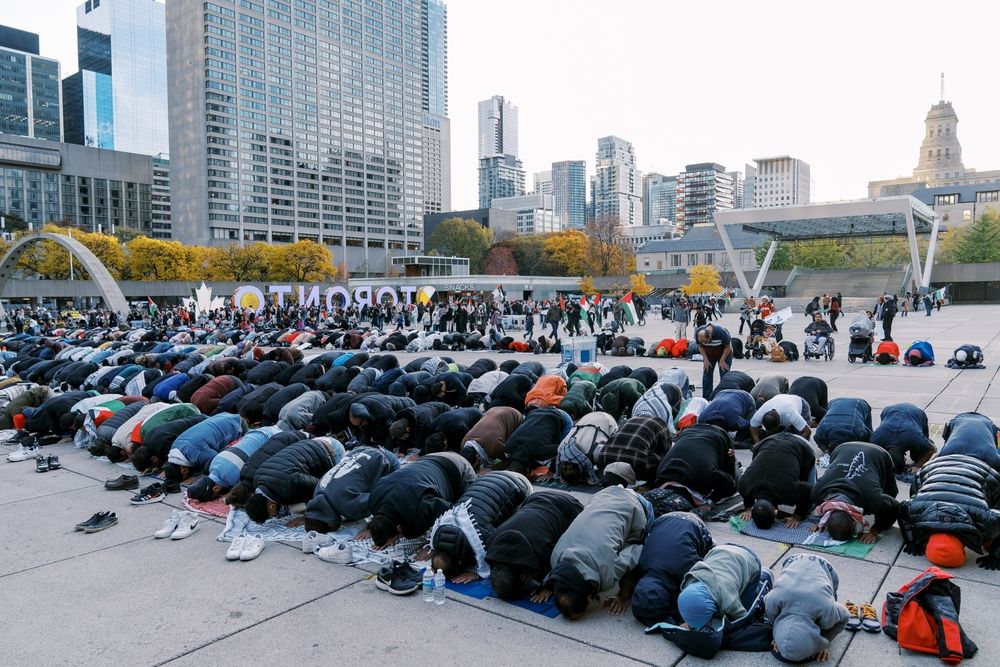
Every faith tradition has its own relationship with public worship. Christians carol in town squares at Christmas. Jewish communities hold public Passover seders. Sikhs stage outdoor Nagar Kirtan processions through city streets.
And during Ramadan, Muslims around the world often gather in open public spaces to break the fast and pray together – including, recently, in the heart of London.
The thing is, some people weren't too happy about that last one.
Prayer Sparks Backlash
During this year's Ramadan, an open iftar (the communal meal that breaks the daily fast) was held in London's iconic Trafalgar Square, with London's mayor in attendance. For many, it was a welcome celebration of a diverse, multicultural city. For others, it was something far more charged.
One member of Parliament set off a firestorm when he posted a blunt take on X:
"Too many are too polite to say this. But mass ritual prayer in public places is an act of domination," argued MP Nick Timothy. "Perform these rituals in mosques if you wish. But they are not welcome in our public places and shared institutions."
Many people were quick to condemn this view, framing it as inherently Islamophobic. The defenders included some Christian leaders.
"Nothing Sinister" – An Anglican Bishop Responds
Arun Arora, the Anglican Bishop of Kirkstall in the Diocese of Leeds, wrote an op-ed dismissing such reactions to the gathering and calling the Islamic prayers "nothing sinister."
Arora drew a direct comparison to Remembrance Day, held annually near the same square, where the Bishop of London leads a public Christian act of prayer in the open air – attended by leaders from Jewish, Hindu, Sikh, and Muslim communities alike.
Arora pointed out that public religious expression, whether Christian or Muslim, has long been part of British life. A church bell on Sunday morning rarely draws accusations of "domination."
The question is why the same logic applied to the call to prayer leads somewhere so different.
"This Is About Civilization"
Not all Anglican voices sided with Arora, though. Traditionalist Bishop Ceirion H. Dewar recently posted an open letter to King Charles III, warning that Britain's Christian heritage is being "deliberately eroded" by Islam and other faiths.
"Remove Christianity from the story of Britain," Dewar wrote, "and you do not create a neutral society – you create a moral vacuum. And history teaches us that moral vacuums are never left empty for long." The letter drew thousands of signatures.
The controversy comes while the Church of England is already facing question over its own future; earlier this month, former Archbishop of Canterbury Rowan Williams publicly expressed doubts about whether the Anglican Communion will survive its current internal fractures over sexuality and gender issues.
A Debate Far Beyond Trafalgar Square
The tension between Islamic practice and Western public life has surfaced repeatedly in recent years – from debates over Muslim prayers being broadcast in American cities, to controversies over Muslim groups in schools, to ongoing questions about Islamophobia that have only grown louder in recent years.
One question underlying these tensions: in a pluralistic society, whose religious traditions get to occupy public space – and on what terms?
Evangelical Christians hold open-air revival meetings. Jewish communities set up menorahs in public parks. Pagans and Wiccans gather for seasonal celebrations. And Muslims hold public prayers during Ramadan.
The idea that any one of these constitutes "domination" depends almost entirely on the perspective of the person making it, argue defenders of religious expression.
What is your reaction? Is there a meaningful difference between a Remembrance Day prayer service and a Ramadan iftar at the same location? Does the content of a prayer matter when evaluating whether it belongs in a public space – or should all public religious expression be treated equally?
88 comments
-
 Ronald A Sherwood
I believe most people who pray are praying for good, not for evil, and the Christian Bible points out how powerful the spoken word is.
So, if anyone is praying for good, whether in private or public - no matter what their language or beliefs may be - the world becomes just a little bit better for everyone.
-
 Rev. Lindsay
This is self inflicted pain letting droves of Muslims enter their country. The question is whether false religions should be allowed to advertise in public like obviously shouldn't be allowed. The issue should be raised that when a religion does not have Christ at the center it isn't a religion at all. It's much like people that used to pray to pieces of wood or stone in the old testament. These fact needs to be discussed publicly to make people see these displays of false faith should never be allowed of spiritual fakery. These people put faith in fiction.
-
 Rev. Kev
"The issue should be raised that when a religion does not have Christ at the center it isn't a religion at all."
Except religion isn't defined in terms of your preferred one. Religions existed long before Christianity came along. Many exist today with no Christ involved.
What's a "false faith" to you isn't to others. What you see as a "true faith" is false to others. Outside of unsupported faith, there are no solid parameters to determine if ANY of them have any basis in reality when it comes to claims of gods or spirits or other supernatural claims.
The irony I am seeing in many posts on this page is people bashing Islam (or other faiths) for certain things while desiring to do pretty much the same things, themselves, in the name of their god and religion.
I guess it's OK if it's done for the "true religion". Except anyone who adheres to some religion or believes in some god(s) inevitably believes their faith is the true one.
-
Rev. Lindsay
I think you have no idea what you're talking about. I guess you support Islam which is ant- Christ so you are anti-Christ as well which makes you against Jesus Christ and ant-God which means the Rev. in your title no longer is valid. Fake minister Ken. Too many people like you get convicted and respond mostly of their ignorance. You better reassess who you think you are now Fake minister Ken.
-
Rev. Kev
Gerald:
You wrote: "I think you have no idea what you're talking about."
OK. You are entitled to that opinion. Any chance you can support that opinion with anything other than what appear to be attempts at personal insults? Maybe fact-based refutations of the actual content?
You also wrote: "Too many people like you get convicted and respond mostly of their ignorance."
Like when you make blind assertions regarding a person you don't know without first bothering to ask questions to confirm or falsify your opinions? You know. In the spirit of being honest.
Telling falsehood about someone when you have the opportunity to ask and find out are lies. Is that a sin in your version of following Christ? Because it doesn't seem like it.
TBH I'm not seeing you having a single, tiny patch of ground to stand on when it comes to judging or berating me in any way.
-
Rev. Kev
P.S. Mr. Observant: It's "Kev"...not "Ken".
Couldn't even manage to get that one right. Good job! 👍🏼👍🏼
-
-
-
-
-
 Ari Joseph Bertine
What's good for the goose is good for the gander. If any religion is allowed to conduct public events, all must be. My high school graduation took place in the gym of a public school and was filled with Christian prayers at every segment of the event--not even a religious event, just people adding them to the program because they could. Freedom of religion applies equally to all religions.
-
 Mark P. Bender
All humans search for a single common theme, but can't seem to get there equally. Sad.
-
Rev. Kev
I'm genuinely curious. What single, common theme do you think all humans search for?
-
-
 Gary
Gary
https://www.msn.com/en-us/news/us/conquered-nyc-firefighters-angry-after-bosses-muslim-firefighters-make-startling-change-to-9-11-memorial-area-for-ramadan/ar-AA1YqQxm
-
 Michael Hunt
This is MSN showing an article from the Western Journal, another far-right outlet that is also a questionable source for factual information.
https://mediabiasfactcheck.com/western-journalism/
-
Gary
I find it amazing how everything that you do not agree with is a questionable source. I guess the Muslim terror attacks all over the world, including US soil did not happen in your world view.
-
Michael Hunt
I find it amazing that you appear to get all of your information from verifiably questionable sources.
Your strawman fallacy isn't gonna fly here. I never said there haven't been terrorist attacks carried out by Muslims. All I have been saying is that the stories you are sharing are being written by outlets who have a well-documented history of bending the truth and straight up lying to create the narrative they want to sell. You would be wise to find more reliable, honest sources of information.
-
-
-
-
 Cam Kirmser
If they are not interfering with the public's use of public spaces, who cares? Let'em pray.
But, they must be prevented from blocking any public space from use by even one person. If this presents a difficulty to the Islamists - well, too bad. One's religious practices do not supersede the right of others to access the public spaces.
This would apply to any religion - or, indeed, to any gathering of people for whatever purpose; religion, politics, sports celebrations, anything. The public spaces must not be blocked from use by others.
-
Rev. Kev
Religious freedom means (to me, at least) that all religions get equal treatment under the law. Religions are made of people, and I have yet to see a group of people who are perfect, so no religion will be perfect or free from troublemakers. Which is why we give blanket freedoms under law but still reserve the right to use the legal system to address the lawbreakers when they surface.
No religion is better than another or deserves different or preferential treatment under the law. No god is better than any other under the law. If one religion gets to erect a monument on public grounds, receive public funding, or have public services then all religions are automatically afforded the same rights.
I am in favor of such religious freedom. It is the most sensible way to build a civil, peaceful, multicultural nation of people with a wide diversity of beliefs and practises. At least until such time as humans grow beyond the desire for those things.
Christians should note that such freedom even protects them from being persecuted by a more dominant denomination of Christianity. Christians have as much of a history of torturing and killing each other off for silly things like heresy as religions, in general, do in attacking each other and other faiths. When you have different groups all claiming to have the one and only correct god(s) and the one and only correct beliefs, and the one and only correct practises with eternally lasting consequences, then conflict is inevitable. Freedoms enshrined in law and practised equitably are the best ways to mitigate more hazardous forms of conflict.
-
 Geoffrey C. Olive
I like your comments that start with, “No religion… or “No god…” as that sums up what would make humanity less divided and with fewer wars based on fictitious beliefs! Imagine how advanced humanity would have become without religion being so anti science which questioned the obvious nonsense of superhuman sky daddys! All religions can’t be right so it’s better to think that none are!👍
-
-
 Steven Ferrell
If people did a study of islam, they would realize they are trying to dominate the world.
The Crusades started because islam was trying to dominate the global and a Pope said enough and fought back.
If people do not wake up, they will find islam and their garbage sharia law being forced on them and it will be to late to fight it.
-
 Deborah Jane Vogel
Re: Nick Timothy, MP’s comment that public praying by Muslims “is an act of domination” -
I suggest that public praying by Muslim faithful is just that - prayer.
Labeling the public act of praying as an “act of domination” says more about Mr. Timothy’s fears, bias, and narrow vision of God and purposefully militarizes a simple act of worship.
-
Geoffrey C. Olive
All religious prayers and practices should be ignored as they don’t make common sense!
-
 Joseph Grieco
Looking at the comments from some of the Conservative Anglican Bishops, they seem to be still living in the fantasy historical realm when the British Government considered themselves a benevolent dictatorship over the rest of the world, and their way was the only way. They ignore that Britain has become a pluralistic society, thanks to the old Commonwealth policy where a Commonwealth passport holder had free access to the rest of the Commonwealth. Reality is that Islam has spread all over the world. Britain has granted Freedom of Religion to all. If they are afraid of Islam then they need to open their doors and have a dialogue with Imams to see the similarities and understand the differences between the two.
-
 David Buck
As someone with a deep British heritage and who has spent considerable time there, I am apalled by what is happening in my ancestral home. I do not object to people praying in public. However, the very idea that it is acceptable for Muslims to pray in their thousands in Trafalgar Square, and yet individual Christians are arrested for praying SILENTLY on the street, is something straight out of dystopian fiction. The degradation of free speech, and two-tier policing is disgusting. The Labour Party has allowed rampant, unchecked immigration, both by legal and illegal means, to continue to the point where the UK is almost unrecognisable. Starmer is the very worst so-called 'leader' in the very long history of Britain and must go. HM The King would seem to have failed in his sworn duty as Defender of the Faith. I never thought I would see the UK fall so far.
-
 Rev. Carol M Anaski-Figurski
Great article, I think its the coolest thing to see people of any faith have the respect & freedom to express their religion with out heckling or discrimination. Islam is the largest growing faith today & many have made their holy Pilgrimage to mecca which draws a million people. To have a holy place in America to gather & prayer with respect is divine in the culture of Islam. One day all who pray of any denomination shall be able to prayer alongside like Christians united to Islam faiths. It may prevent wars here & overseas. lets think about the miraculous work of pope Francis in the gulf where 3 faiths can gather a Christian church, a mosque & a synagogue. We are the world & world faiths need to be proud to pray anywhere. Blest Be amen. Happy Easter & happy Ramadan
-
 Rev Ned
Christians, Jews and Muslims (anlphebeticlal order) all worship the same God. So, when they start slaughtering each other, which faction do you suppose He/She roots for?!?
-
 Rev. Miche'al Yosef Dixon
First remember where this happened; in London, Great Britain and they don't have the same "freedoms" the United States of America Constitution grant. In fact few European countries ("Western") do. So, Americans need to be aware it's not the same Great Britain government is harder on Islamic faithful than American government and Spanish government has Been trying to get every single Islamic out for over a millennium. As to here in America; not long ago in Baton Rouge, LA in the Public Square down town, call "Concert In The Park". Franklin Graham gave a public sermon. Venders sold food and others sold Christian stuff (shirts, CDs, DVDs, ect). No one complained about that and you could hear it for miles around over same loud speakers the jazz band used night before and country band before them. Same as politicians use during campaigns. During Gay Pride the LGBT+ use it to promote their messages. So, if the Islamics want a public prayer more power to them. If they are praying to the "One True God" and not sociopaths they are the friendly Islamics not Muslims. Big difference. Like comparing Catholic with Protestant. Catholic will burn you at the stake alive and Protestant will put you in stocks and let the public torture you. "When you pray go into your closet and pray in secret so your Father in Heaven will reward you in public." -Yeshua The Messiah to his disciples.
-
 Patricia Ann Gross
Rev. Miche'al,
The Human Rights Act of 1998 established the UK to have freedom to worship and practice of one's religion of choice. There has been a separation of church and state in most EU countries since the Reformation in the 1700s, since it generated so many different Christian denominations that it wasn't practical to establish any one of them as the "state religion" since.
-
Geoffrey C. Olive
Rev. Dixon, I think we are several hundred years beyond your Catholic and Protestant comparison!🤣
-
-
 Man of God
Islam is a faith based on the teachings by their one and only Prophet Muhammad. As their God Allah, taught him while he slept to teach their believers
.Without going into details, Islam teaches there can be no other believes except Islam. No language except Islam, no written text except Islam. Islam teaches that non-believers are infidels and must be converted to Islam. A TRUE believer has the right to do anything they want to an infidel. Including a true believer can lie to, enslave and mistreat all infidels anyway they want. But there is a special teaching for Jews and Christians. All Jews and Christians must be decapitated in public. There heads must be removed from their bodies, so that their spirits will be lost forever. The true believer, has the right to destroy all believers who questions the teachings of their God Allah, by the one and only prophet Muhammed. There is no compromise. The only group of true believers that has followed the teaching of Muhammed, in my life time is call ISIS. The two separate branches of Islam are working towards the same end, to honor their God. One is with the gloved hand and the other with the sword. Their goal is the conversion of the whole World to the teaching of the God Allah... Know for a fact. No other religions are able to exist in a true Islamic country. When they come to another country they will use that country's law to grow in number and then when strong, subvert that country's beliefs by any means necessary.
-
Joseph Grieco
Maybe you should study the history of Spain under the Moors, North Africa under the Berbers, or Mugal India. Centers of learning where all People of the Book were welcome to learn, study and practice their religion.
-
 ServantOfJudgement
Naw, we can just read this mornings headlines and see how many Christians Islam chopped up. We don't need to put blinders on and defend our executioners.
-
-
-
 John Alex Paxson
The adhan - which declares there is no god but Allah and Muhammad is his messenger - is, when called in a public place, a declaration of domination. Can someone explain what this means? If it is true then I believe all religious beliefs should be private and kept to yourself, because we all know, nobody knows whose religion or what belief is the real true one.
-
Geoffrey C. Olive
The simplest answer is none of them are the real truth! Why not accept that?
-
Patricia Ann Gross
John,
Same question about "Our Father, who art in heaven, hallowed be thy name. Thy kingdom come, thy will be done, on Earth as it is in heaven" from the Christian Lord's prayer. The rhetoric is exactly the same.
-
Joseph Grieco
Considering Timothy is a Tory politician with a history of Islamophobia, Anti-Catholicism, and Anti-Hindu statements and writings, you can consider the source. He's a favorite of the Rupert Murdoch owned media in the UK, and can be regularly counted on to come up with statements like this designed to incite people who barely passed their high schools complaining that the guy whose parents came from Pakistan is now a chief of surgery instead of them being so.
-
ServantOfJudgement
Islam is very bold when it claims new territory. We see this live in the UK and other high trust society in Europe. It places a mosque where former religions once had their temple. It will send militants into for example a Christmas market for the purpose of establishing dominance by disrupting the events. Another example is the Great Library of Alexandria. Not an apparent religion but one where people somewhat worshipped knowledge. That was destroyed, the ancient knowledge in it was destroyed. Now the Nabi Daniel Mosque sets there.
Stone Henge, the super cool pagan place, that will one day be destroyed and replaced with a mosque. Trust it.
England has fallen.
-
ServantOfJudgement
One more thing John, Europe is having lots and lots of fires that burn old historical buildings and churches down. That's an Islam move. Islam MUST remove whatever culture was there before them. And it does.
-
 Pix Edward
Sounds like an arsonist move, and, to my knowledge, they're quite fond of fire, but don't adhere to a specific faith.
-
ServantOfJudgement
Pix, of course it's arson. Islam burns down things. You can't burn down churches that are illegal to burn down unless you commit arson.
Please bring a more horsepower to the debate next time.
-
-
-
-
 Douglas Robert Spindler
Are those the Muslim terrorists we all hear about? Looks peaceful. Can't say that about Christians when they try to do something similar.
-
ServantOfJudgement
Lies.
You and I both know there are no Christian armies killing everyone who doesn't become Christian and we both know there's not enough words permitted on this blog to list all the Muslim and Islamic murders perpetrated against Christians and gays globally.
Be nice and tell the truth.
-
-
 Destiny Marie Morgan
First of all I am a Muslim minister in USA and I have replied on some of these emails I get about Islam that the monestary is posting . I would like to remind everyone God created us all equal no matter the race or skin color or religion etc . So we are all ordained correct and no one has any right to judge anyone except God correct ? As well as no one has any superiority over any other correct ? So instead of asking questions do certain groups belong or don’t or show they or not causing speculation and more separation why is the monestary and all religious people not bringing these simple few words to the front . No one has the right to judge anyone except God . No one is superior over anyone else and it doesn’t matter the race or skin color or religion or status because God loves everyone . We are commanded in any faith to love everyone including those that are enemies . We are commanded to come in peace correct and love and have mercy and forgiveness correct . So the way I see this is that those who oppose do not have belief in God at all and that is the problem . That is where we are taught do not take non believers as friends and such correct because they lead you away from God. This is where so many listen to anyone just to agree which is wrong . Everyone is allowed to pray to God no matter where in the world they are . Everyone just prays different and that is where others get upset when they should be rejoicing that so may live God in their unique ways God created for them to serve . No two people have the same finger prints just like no two religions have the same ways to worship or the same life purposes but together as a whole world we are meant to co-exist and bring unity in unique ways not problems and destruction and drama and chaos. Those emotions and actions are not from people that have a God spirit it’s people possessed by demonic entities so please humble selves and be reminded of the oneness of Gods creation is meant for everyone to be different and never the same .
-
ServantOfJudgement
Destiny,
There are two main divisions of the Muslim faith. The Muslim and the Islamist. If a Muslim drops the Hadith, that Muslim is as you describe yourself for the most part. Peaceful and pleasant. They don't blow people up, they don't harass people in public, they don't take over Christmas markets or shoot up gay bars and they don't kill Christians. I've had dinner with a Muslim family in their home. Nice folks and great food.
This story is not discussing that Muslim. The Muslims of Europe are of Islam. Islam MUST replace all people and cultures and we're watching Europe fall on live television.
The quite Muslim you describe remains quite while his islamist neighbor harasses and kills Christians. They'll force their will upon all, even the gay people that protect them whom they must kill.
-
-
 Reverend Paula Copp
Can pagans worship in public? Can Wiccans? Christians? Buddhists? What’s good for the goose is good for the gander. As long as each group has the same rights, what’s the problem?
-
Gary
Passover seders are not, rep[eat not, held in public.
I also call your attention to these Muslim events in NYC:
https://gellerreport.com/2026/03/fdny-hq-defiled-muslim-prayer-rugs-spread-over-names-of-343-9-11-heroes-slain-by-islamic-terror.html/
https://gellerreport.com/2026/03/islamic-battle-cry-blasted-from-loudspeakers-in-nyc.html/
https://gellerreport.com/2026/03/mrs-mamdani-is-a-terrorist.html/
https://gellerreport.com/2026/03/after-wave-of-islamic-terror-attacks-mayor-mamdani-decries-crisis-of-islamophobia.html/
https://gellerreport.com/2026/03/nyc-muslim-demo-features-chants-for-terror-groups-and-blood-libel-smears-against-jews.html/
https://gellerreport.com/2026/03/mamdani-gracie-terror.html/
https://gellerreport.com/2026/03/nyc-muslim-shrapnel-bombers-launched-slew-of-chilling-islamic-exhortations-and-threats-after-their-arrest.html/
https://gellerreport.com/2026/03/jihad-mamdanis-shrapnel-bomb-narrative-blames-islamophobes-but-ignores-allahu-akbar-screaming-muslim-bomb-throwers.html/
https://gellerreport.com/2026/03/muslim-terrorists-shrapnel-bomb.html/
https://gellerreport.com/2026/03/mamdani-promotes-islam-his-photo-of-himself-praying-with-sanitation-workers-was-not-benign.html/
https://gellerreport.com/2026/02/new-york-city-muslim-crowd-calls-for-new-stronger-october-7-jihad-massacre.html/
https://gellerreport.com/2026/02/zohrans-nyc-thousand-of-muslims-praying-flood-times-square.html/
https://gellerreport.com/2026/02/mamdani-terror-cair.html/
https://gellerreport.com/2026/02/new-york-city-in-2026-waking-up-to-islamic-calls-to-prayer.html/
https://gellerreport.com/2026/02/nyc-mayor-jihad-mamdani-forces-israeli-company-out-of-new-york-city.html/
-
Michael Hunt
Every single source you're providing is from the same place, which happens to be a known far-right website with highly questionable reporting. The Geller Report is merely a blog from anti-Muslim writer Pamela Geller, not a legitimate news source.
https://mediabiasfactcheck.com/geller-report/
-
Gary
Judging by your comment, I am assuming that you believe none of the above happened and it is all right-wing propaganda. That my friend makes you a very good dhimmi.
-
Michael Hunt
Respectfully, I'm not friends with people who are Islamaphobic, xenophobic, racist, sexist, or generally bigoted in any way, so you don't need to address me a such.
Based on the history of The Gellar Report and their numerous failed fact checks where they've pushed clear disinformation, I do strongly question whether these things are actually happening. If these things actually happened the way The Geller Report claims things are happening, you should be able to provide more sources that verify that their reports are accurate.
Calling out right-wing propaganda for what it is doesn't make me a good dhimmi. If Islam was actually taking over America and turning the country into a theocracy, I'd be the first in the streets to fight against them doing so. Yes, there is an extreme wing of Muslims who want to destroy Western civilizations, but there are also extreme wings of Christians who want to destroy Eastern civilizations. Neither of these groups are a majority of the faith. Painting all practitioners of a faith with a broad stroke based on the most extreme in the faith just creates hate.
-
 Neil Patrick Hines
Very reasoned response. This is what we need: discussions. We do not need name-calling or hate speech.
-
Gary
https://thereligionofpeace.com/attacks/american-attacks.aspx
-
Michael Hunt
The Religion of Peace website is a questionable source for information.
https://mediabiasfactcheck.com/the-religion-of-peace/
-
-
Gary
https://nathanaelg.substack.com/p/new-yorkers-wake-to-the-islamic-call
-
Michael Hunt
This seems to be a Substack for a former website, Def-Con News, which is a far-right, questionable source.
https://mediabiasfactcheck.com/def-con-news-bias/
-
-
Gary
https://www.frontpagemag.com/mamdani-and-the-muslim-invasion-of-new-york/
-
Michael Hunt
Frontpage Magazine is an extreme, far-right website and it too is a questionable source for factual information.
https://mediabiasfactcheck.com/frontpage-magazine/
-
-
-
Gary
https://www.youtube.com/watch?v=0FkYzeDD6B0
-
Michael Hunt
In the video publisher's own words, "Reasoned provides a mix of entertaining and informative content to help viewers reach their own informed opinions on a range of political and current affairs topics." That's not a news organization, that's an entertainment organization.
They're backed by far-right organizations and think tanks in the UK and I would be highly suspicious of any content they produce being honest and factual.
https://zelo-street.blogspot.com/2020/05/reasoned-uk-who-funds-you.html
-
-
Gary
https://nathanaelg.substack.com/p/first-responders-accuse-moslems-of
-
ServantOfJudgement
The left Media will NEVER cover the gore of Islam. That why leftists think they're going to go on a picnic with their executioners.
A horse will literally break its own neck before you make it drink water.
It's lost Gary, let them put their head under the falling hammer.
-
Gary
I do not care that Michael Hunt and his fellow travelers want to commit suicide. That is their personal problem.
I do care greatly that have chosen to commit suicide by Muslim terrorism, as that means that a whole lot of innocents (myself possibly included) are going to be killed with them in their suicide attempt.
-
-
-
-
-
-
-
 Colleen McAllister
People are getting too touchy. Maybe if we were more accepting of others' beliefs we would have less tension.
-
ServantOfJudgement
Islam kills Christians ever single day because they're Christians.
-
Joseph Grieco
Islam? No. Muslims? Some. Why does this happen? Because none of the countries where this occurs have anything of value to "Western" nations. So they consider it an internal problem.
-
ServantOfJudgement
Joseph, I'm terribly sorry that you're protecting those who repeatedly, reliably and frequently kill Christians.
No offense and I really mean that but you're lying through your teeth.
Again, I'm terribly sorry that you've put me in the position to call you out. What you've said is an absolute and total lie.
-
-
Pix Edward
A woman called many houses of worship as a social experiment, asking for baby formula. Not a single mosque denied her request. There are extremists of all faiths.
-
ServantOfJudgement
You mean a liar called churches for help she didn't need?
Dearest Pix, let's not confuse suicide bombers, chopped up villagers and kidnapped child brides for milk formula a chick didn't need for a baby she didn't have.
-
Michael Hunt
Lets not confuse the extremist sect of a religion to be the entirety of a religion.
Also, how would she be confusing extreme Islamic beliefs for a woman asking for baby formula? One is an ideology while the other is a person.
She may have been lying about needing help, but that doesn't change how no mosque turned her away while Christian churches regularly did. I don't agree with what she did, but you can't pretend that the results of her actions don't exist.
-
-
-
Ari Joseph Bertine
Christianity kills gay and trans people all the time just because they're gay and trans. It used to kill pagans every day just because they were pagan. Let he whose religion is without murders cast the first stone.
-
ServantOfJudgement
No. No Christian organization anywhere kills people today. Once upon a time when pagans were converted into Christianity, it took a while to get those pagans to stop their old ways.
Now Christianity builds hospitals and invents antibiotics.
I'll cast my stone right now. Islam kills today and you can trust they'll kill tomorrow.
Stockholm syndrome is real. Don't defend your executioner, it's silly.
-
-
-
 Stefano Di Stefano
Anche i Muslim dovrebbero essere piu aperti ma non mi sembra
-
Rev. Lindsay
That might be true if Islam was actually a religion, which Islam isn't. It's anti-Christ. I John 4;3 - And every spirit that confesses not that Jesus Christ is come in the flesh is not of God: and this is that spirit of antichrist, whereof ye have heard that it should come; and even now already is it in the world.
-
-
Geoffrey C. Olive
No different to any other religious gatherings in public! Don’t go if you don’t believe! How many non Christians protest about Xmas or Easter? They’re probably glad of a couple of days off work!👍 All religions are false beliefs, but why protest against something you don’t believe in? Are they causing you any trouble?
-
ServantOfJudgement
Xmas is a form of protest. Christmas is something protesters can't say.
You personally protest against all religions as often as possible except this one religion. You probably know better. I heard in the UK a fella can go to jail from a Facebook post about You Know Who. Shhhhhh, don't even think about it...
-
Joseph Grieco
XMas is a correct form. X, in this case, is actually the Greek letter Chi, the first letter in the Greek word for Messiah, aka "The Anointed" (χριστός ). This was used for centuries as a substitute for Yeheshua's name. Paul was a Koine speaker and would have used Koine terms to describe Yeheshua instead of the Aramaic spoken by Him and His followers. This also comes from use of the Chi-Rho (☧) to symbolize His Divinity, and has been in common use since Emperor Constantine utilized it. This is formed by superimposing the Greek Letter Rho (P) over the Chi (X), again as a short form of χριστός
-
Ari Joseph Bertine
Thank you for posting this explanation. Too many people unwittingly dishonor Christ by claiming his name is wrong simoly because it is spelled in a way of which they don't know the origin. Because Paul one of the Apostles, Christian scholars standardized the X in medieval times to be the most common way to spell "Christ". Ignorance of history is little excuse for overwillingness to accept unnecessary drama as truth, but removing the ignorance is always the best way to shed light.
-
-
Geoffrey C. Olive
I don’t understand your reply! I’m anti ALL religions and am just being sarcastic for enjoying their days off when I used to go to work! BTW as I’m retired, every day is a day off!
-
ServantOfJudgement
Happy retirement Geoffrey!!!
-
 DeElla J Kirkpatrick
If you're anti-all religions, why are you on this blog? Just to antagonize believers? For someone anti-all religions you sure spend a lot a time on a religious blog. "Me thinks you protest to much.."
-
-
Pix Edward
I see a beautiful example of people celebrating their faith in a time when so many mourn theirs.
-
-
-
 Nicholas J Page
I'm an English man living in England and we all have places of worship so why should the Islamic people be allowed to have the right to worship out in the open 🙏
-
 Gwendolyn Lord
Why not? Other groups have prayed in public. Don't be narrow minded.
-
Geoffrey C. Olive
You could also do the same in England if the weather is good enough!🤣
-
Patricia Ann Gross
Feel free to grab all your buddies, go down to the street corner and say the Lord's Prayer. I doubt anyone will complain or consider you evil for doing so. Even have a communal meal afterwards. I don't think the UK has any laws against any of those. Oh, and how is the "thy kingdom come, thy will be done, on earth as it is in heaven," any different than the prayers that Nick Timothy complained about?
-
Geoffrey C. Olive
All religious prayers and practices are mumbo jumbo that should be ignored by anyone with common sense!
-
ServantOfJudgement
Patricia, I'm sorry to say if a Christian tries a stunt like that in one of the countless all islam neighborhoods, they'll not fare so well. I was going to walk through such a neighborhood when I was in England and 6 locals pitched in for a taxi because they said id not make it through. Too white.
I wish Jesus wasn't right about us Christians being so naive, he is though...
-
Patricia Ann Gross
That was not what I was suggesting at all. I said for him to do so in his own neighborhood. If you were a dark-skinned Muslim dropping a prayer rug on a street corner in a lily white Christian neighborhood, you probably wouldn't fare well either whether in the UK or the US. Being a guest in a country, from my own experience, requires we take caution and determine if and whether where we go will put us in danger, so having a local keep you from making a big mistake was very kind. Not all neighborhoods are safe for a WASP to venture into. There are parts of the city where I live that I would not walk down the street alone, but the Muslim neighborhood is not one of them. It is a very peaceful community, and gets along well with the neighboring Christian neighborhoods. They participate regularly in inter-faith events and are a vital part of our community.
We expect Muslims to respect our high holy days, listen to our Christmas Carols, Watch our Easter parades, and yet we get all up tight when they want to worship in public. What does that make us?
Where/when did Jesus ever call Christians naive? He didn't because they didn't exist during his lifetime.
-
ServantOfJudgement
Matthew 10:16 Patricia. Here he tells us to be wise because he knows we aren't. He tells us to keep our cool when we're called all the names we're called.
What a contrast to the god of Islam. As different as God and Satan are is Islam and Christianity different.
-
Rev. Kev
To borrow from Google:
The Qur'an strongly emphasizes peace, urging Muslims to remain peaceful, seek reconciliation, and avoid aggression, even during conflict. It permits fighting only as a last resort for self-defense against persecution, while demanding justice, mercy, and the acceptance of peace treaties if the enemy inclines toward peace.
Key Qur'anic teachings on peace in conflict include:
Prohibition of Aggression: Muslims are forbidden from starting hostilities and must fight only those who fight them, stating "God loves not the aggressors" (2:190).
Preference for Peace: If an enemy sues for peace, Muslims are commanded to accept it and trust in God (8:61). Justice and Restraint: Even when faced with hostility, Muslims must maintain justice and cannot allow hatred to prevent them from acting fairly (5:8).
Rules of Engagement: The Qur'an and Islamic tradition restrict conflict to combatants, protecting civilians, forbidding the destruction of nature, and encouraging the release of prisoners.
Individual Conduct: When confronted by ignorant or aggressive behavior, believers are advised to respond with peace (25:63)
Many Muslims are peaceful people just trying to make a living and have a family. We can't make the mistake of bunching all Muslims into a generic stereotype any more than a Christian wants to be placed in some stereotype that does not reflect their beliefs. I've worked and socialized with Muslims. They are not violent, hateful people. Muslim leaders in some cities even work with Christian pastors in joint projects to help the hungry and homeless.
I take them as individuals. Not titles. Just as I don't see all Christians to be anything like our current Secretary of Defense praying for God to help our military take out the Muslims in Iran and elsewhere. Asking God to guide each bullet to hit its target. Seriously, invoking Christianity in a conflict is the best way to turn Christians into the enemy, and not just the government.
By the same token, while painting a horrible picture of Muslims in one location our (self-identified Christian) leaders happily take favors and money (a LOT of money) from Muslims in other countries. I guess they have no problems with all Muslims.
-
Patricia Ann Gross
SOJ,
He is saying when he sends them [the disciples] out, like sheep among the wolves to be wise as serpents and innocent as doves. He is saying this because Mission is hard, and when you strike against the empire, the empire strikes back (New Interpreter's Study Bible, NRSV). He was saying this to the disciples as part of a "pep talk" before sending them on a mission. He didn't call all Christians naive. He didn't even call his disciples naive. He told them to be wise, because he knew they were or could be. Again, context is everything.
-
-
-
-
-

But people will go to Muslim countries for travel and the same thing is happening, you may even participate in this, yet someone who is not part of this tradition questions this sacred moment as any different than their own sacred moments - Do they believe they cannot pray at dinner as their faith custom because they are in another country with a different faith? Do they not go to other countries and preform Christian weddings, social gathering with Christians as families or even church, choirs, spiritual or sporting events (these are all western culture practices, that Muslims permit in their countries - without humiliating the people who practice other faiths, religions or society events - in another city, country or community) I guess they could learn a lot from people of other cultures that don't judge so harshly, don't hold their Gods as power over others and don't use their Gods to create separation over stipulations that are not conditions of God, but more like Conditions of people creating Hate.