

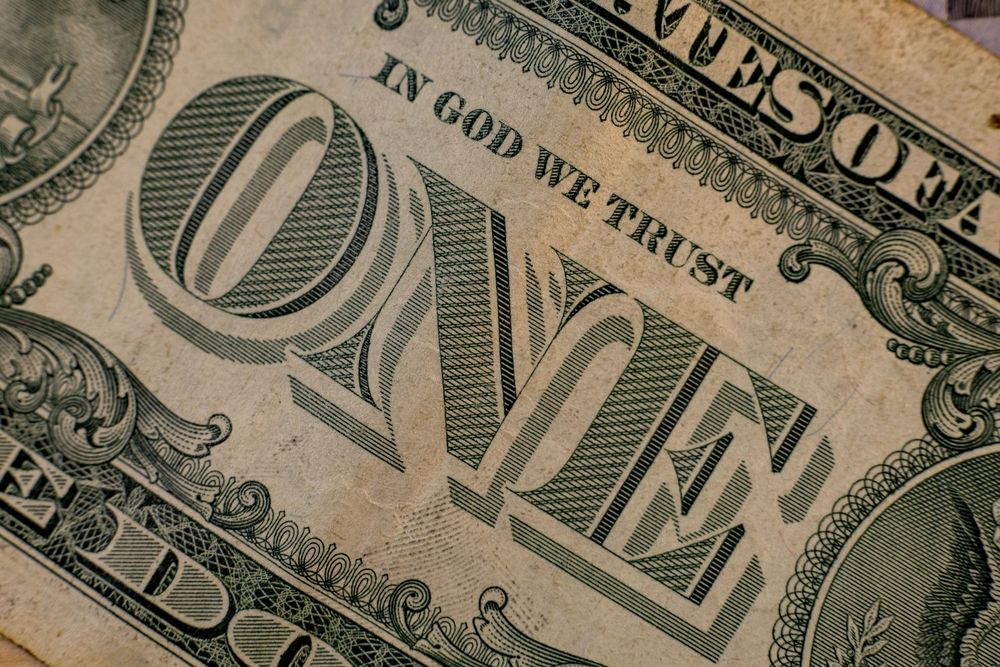
America's motto is already printed on every dollar bill and coin in circulation. Now, a bill introduced in Congress would require those same four words – "In God We Trust" – to be inscribed or prominently displayed in every federal building in the country. The debate over what exactly that means, and for whom, is heating up again.
The legislation, introduced by Rep. Mary Miller of Illinois, would direct the General Services Administration to carry out the mandate.
And the timing may be deliberate, as the bill arrives days before a large prayer gathering on the National Mall billed as a "rededication of our country as One Nation to God."
It also fits within a broader recent pattern of politicians pushing for more Christian representation in public spaces.
Those Who Support the Bill
Supporters frame this as a matter of history and patriotism. "In God We Trust" first appeared on U.S. currency in 1864, adopted during the Civil War as a declaration of national purpose. It was later made the official motto by unanimous congressional resolution in 1956.
Courts have consistently upheld it as constitutional, reasoning that the word "God" is broad enough not to endorse any specific religion. For advocates, displaying the motto in federal buildings is simply a recognition of what America has publicly declared about itself for nearly 70 years.
Those Who Aren't So Sure
Critics raise concerns about the true motives of this intiative, though.
For example, the bill's most prominent champions have been clear about what they believe "God" means in this context.
One Senate co-sponsor has said publicly that America "was founded on the Gospel of Jesus Christ" and warned of a national "spiritual crisis" caused by the country's drift from its Christian roots.
Courts have upheld the motto precisely because "God" is too ambiguous to constitute a religious endorsement – but when the legislators promoting the bill define it in specifically Christian terms, that argument starts to fall apart, critics say.
For millions of Americans who practice other faiths (or no faith at all) making "In God We Trust" a federal mandate is an aggressive intrusion of Christian beliefs into the public sphere – and a worrying sign of a government advancing one religion over others.
A Familiar Debate in a New Setting
This bill is the latest in a pattern of efforts to bring religious expression further into civic life. State laws have already mandated "In God We Trust" displays in public school classrooms across the country, and recent federal policy has opened the door to greater religious expression in government workplaces.
The broader question – how much faith belongs in shared public institutions – is one that remains a source of deep disagreement.
Courts have generally held that the motto crosses no constitutional line. But legal permissibility and cultural meaning are different things.
What do you think? Does requiring "In God We Trust" in every federal building feel like an act of patriotism, or something closer to a declaration of Christian identity? And if the bill's own sponsors frame it as a Christian statement, should the legal case for its religious neutrality still hold?
180 comments
-
 Geoffrey C. Olive
Employ a builder who is a very poor speller and get him to ‘accidentally on purpose’ put “In Dog WeTrust” on the building!
-
 Dr Dennis Chevalier PhD, DDvin
LOL!!
-
-
 Raven Raye
I don't believe those words should be on ANY federal building, should be taken off our currency, and taken out of the pledge as it was only added as an afterthought. Religion isn't supposed to have a place in government.
-
 Cisco
Cisco
I understand the intention but don't believe it is 100% for religious reasons at all. People are not supposed to force others to follow their beliefs let alone taunt it in other people's face, trying to force one religious ideology over another. Let's say it passes, now what's going to happen to those who refuse? This has to be a choice, not a forced religious ideology. To pass this bill would a blatant slap in the face who fought for this country's independence and the belief of freedom this country holds do dear. This is why it is written in our constitution and is the First amendment to start this historic document. Our leaders need to be reminded from time to time why it exists.
-
 Kristine Johnson
By mandating that It violates the Amendment me t rights of the constitution America was founded on freedom not oppression. This is not an Islamic country of one religion. Not a Christian oppression
-
Kristine Johnson
By mandating that It violates the Amendment me t rights of the constitution America was founded on freedom not oppression. This is not an Islamic country of one religion. Not a Christian oppression
-
Kristine Johnson
By mandating that It violates the Amendment me t rights of the constitution America was founded on freedom not oppression. This is not an Islamic country of one religion. Not a Christian oppression
-
Kristine Johnson
By mandating that It violates the Amendment me t rights of the constitution America was founded on freedom not oppression. This is not an Islamic country of one religion. Not a Christian oppression
-
-
 Daniel Smolenski
i am a veteran.its one nation under god.i guess thats how i see it.all of us are children of god.im proud!
-
Dr Dennis Chevalier PhD, DDvin
good on you Daniel!
-
-
 Bishop William Dusenberry, DD
The only group actually able to prove the existence of God, are Pantheists, because their God is Nature, and everyone who’s alive (with a functioning brain) knows that Nature actually exists — ergo, everyone knows that Nature (AKA, God) exists; but the same thing’s not true for any other God — ergo, anyone who doesn’t accept that Nature’s God is an atheist.
-
Dr Dennis Chevalier PhD, DDvin
Your Eminence may I ask, what/where/faith you are a Bishop of? Respectfully requested...
Fr. Denny
-
Bishop William Dusenberry, DD
Bishop? I’ve been a ULC bishop, since 1972 (I’ll email you a copy of my ULC bishop’s credentials, upon receipt of your pre-paid, pre- addressed envelope, and or the monasteries agreement to post it on this website.)
-
Bishop William Dusenberry, DD
Bishop? I’ve been a ULC bishop, since 1972 (I’ll email you a copy of my ULC bishop’s credentials, upon receipt of your pre-paid, pre- addressed envelope, and or the monasteries agreement to post it on this website.)
-
Dr Dennis Chevalier PhD, DDvin
according to ULC, there are NO bishops in ULC and ULC started in 1977, i have no idea about which you speak. See email from ULC today that I received...
"Subject: Can I become a Bishop in Arlington, TX.
Created May 27, 2026 2:20 AM · Updated 3 hours ago Is it possible to attain the rank of Bishop in Texas enforcing the rules of a sect of several ministers /home churches in Texas that I work with? We do the religious side, not just weddings, funerals, baptisms, etc.? It is modeled after catholic traditions but do not do the forgiveness of sins (reconciliation) or the Eucharist instead we perform the "in remembrance" service and not Holy communion. Other than that, we echo Catholicism and are known in Texas for this. We do what is right and are fully accountable. Please advise. Dr. Dennis Chevalier MDiv, PhD, DDVin, DD and an Honorable ULC DD 817-xxx-4344 Conversation Thread
Support Team · May 27, 2026 4:01 PM (3 hours ago) Hello Dennis,
The ULC does not have any hierarchy within the Church so there wouldn't be any specific way to achieve the rank of bishop. That said, I'm not aware of the process of being a Bishop in Texas so there might be steps you can take with the state, if you're looking for something like that.
Always here to help,
Tom Lyle ULC Support Team"
so yes, please give me your address and I’ll send the pre-stamped envelopes you demand for you to prove YOUR ULC was in existence in 1972 instead of 1977 and proof of rank to which ULC SAYS IT HAS NO BISHOPS.
Respectfully Rev. Denny
-
-
-
 Patricia Ann Gross
Bishop Dusenberry,
To a point, I agree with you, but as a Christian, I have a theology that supports pantheism, which is also consistent with Jesuit theology, that "God is in all things" (aka omnipresence). One cannot separate God from God's creation, as God dwells within everything.
-
-
 Religion as a Weapon is Wrong
I pledge allegiance to the flag of the former United States of America, and to the Republic for which it once stood, One Nation, Under Many Gods or No God for that is our right, indivisible, with liberty and justice for ALL.
-
Bishop William Dusenberry, DD
If everyone on this Earth, were a Secular Humanist Pantheist (God and Nature are the same thing) “What a wonderful world it would be.” This is what my denomination in the Universal Life Church understands— and is what I preach, whenever I get the opportunity. And, I’m the titular head of the ULC in Oklahoma.
-
Religion as a Weapon is Wrong
Hello Bishop. I am an Omniest and believe something similar. All religions have common good points and I respect them, but I believe math/science/nature are the key to a peaceful and healthy world.
-
Geoffrey C. Olive
And common bad points!
-
-
-
 Honey Healer
It should not be allowed... Everyone knows what it is it means to them, no matter what they say
-
 Ronald A Sherwood
If those four words are important to someone's faith, I believe they should live their life in such a way that their faith is self-evident and the words are unnecessary.
-
 Shawn Peter Flanagan
This country was founded on freedom of religion, that means that the people are aloud to worship as they want to. " In God we trust" was put on the money to state that we are alone Christian founded country. It dose not make it only a Christian country, by no means do I belittle any faith for that was the primary reason that those who where put on the Mayflower came to the new world was to be able to practice thier faith thier way. Our founding fathers also put a separation between church and state and that is what we should be standing on is that the church and state should remain separate but God gave us the law and all of our laws are founded on the 10 commandments. Many different religions pray to GOD, and many believe in GOD. Who are we to say that GOD IS THIS OR THAT. God is a turm a general description not HIS Name so as everyone has sead I put my faith in and on him . I don't need to have a sign on my back that says I'm a believer, for I walk in faith and trust in Him. Aman
-
 Alexander Clarke
Who's God? The Catholic God, Jewish God, Muslim God? I suspect that Rep. Mary Miller means the Christian Nationalist God who sits at the right hand of Donald Trump.
-
 Patricia Sydney Solis
They are mistaken. In GODDESS we trust!
-
Geoffrey C. Olive
What about GODIT? Get it?🤣
-
-
 Sally Jeanne Altobello
One's faith is personal; it is not for our country to dictate one's beliefs in their spiritual journeys. To debate that "God" (with a capital G) is wide-ranging is a total fallacy; using a small g (god) would be more inclusive. This MAGA cult is using religion to a worthless level. They are not acting in a Christian manner. I feel America is in an onslaught of exclusivity and this plan to put this motto on all public buildings can only exacerbate the issue...or it will make the motto meaningless.
-
 Rev. Kev
The article asks: "Should 'In God We Trust' Go on Every Federal Building?"
My answer: No.
Constitutional issues aside, it's a totally superficial act. Someone in the Bible is recorded saying that we will know believers by their fruits. Not loud, public proclamations. And given the amount of self-dealing, antisocial and just inhumane acts both perpetrated and approved by members of our current government, such a move also sounds laughably hypocritical.
"Don't pay attention to all the harm being inflicted on Americans by our actions, or lack of actions. Don't pay attention to the fact that we have money aplenty and eat well while we took food programs away from families and children. Don't pay attention to the fact that we have great healthcare while we tossed citizens off Medicaid or raised insurance premiums so you can't afford it any more. Don't pay attention to the fact that we claimed the nation can't afford to fund social safety nets and consumer protections and environmental protections while we spend trillions needlessly. Just pay attention to yet another stupid way to spend your tax dollars in an effort to pander to the voters to make it look like we're really decent people."
Gimme a break.
-
 William Moses
Maybe we need overwhelming support for a new motto. Something that we can all get behind no matter what we believe. How about the old standard, “Love Thy Neighbor“? What do you say? Want to make it a little less biblical? Just change it to Love Your Neighbor.
-
 Lillian Sanchez
Insanity has overtaken the United States of America. We were founded as a secular nation with the bonus freedom of (and from) religion. So what if "In God We Trust" is on the dollar bill. If you think that saying should be everywhere as well then I think you're deluded. It hasn't stopped a Trump from stealing money, has it? Nope, not a single Trump.
-
 Amber Fry
Yes, it is and it's also very unconstitutional. No government building is supposed to be able to accomodate a religion or prohibit anyone from practicing their religion, or not if they so choose, as long as they are not imposing on the general public. That means a big fat no. It shouldn't have been added to the US Dollar in the 1940 to begin with.
-
 Wayne L Christensen
This is wrong, and Jesus Christ did not want this kind of public display. He wanted it in the hearts of people truly trying to find their way back to God. According to one Christian faith Satan wanted to force God's children to follow only one path, and learn or have choice, and according to them their was a war in Heaven and Satan was cast out. People were given choice for a reason. Now, I am not saying they are wrong or right in their beliefs but they are not shared by everyone. Beliefs in God and the way worship is not about slogans or monuments, pretend religious views, or dressing pretty on Sundays (Christian faith) and pretend that you believe in God when you fail to live the teachings of God, or human decency. Declarations of faith do not make you followers of faith much like those who built monuments and raised their voices, and did sacrifices, as a spectacle for others. Your connection with God is too be personal and not for public fodder.
-
 Patricia Law
what happened to freedom of religion??that is what the country was founded on and freedom from religion
-
 Warren Calvin Wall
"In God We Trust" is an oxymoron. Historically, gods are notoriously untrustworthy. Doesn't matter which god or which religion you are discussing. Untrustworthy! All gods, historically, act on mere whims for simple amusement. Torture believers and non-believers equally. They all tend to be decadent rapists. They all treat people as slaves and/or toys. They all tend to be immature and flighty with their decision making processes. Why, in this world or, any other world, would you Trust ANY of these entities?
-
 Miriam Gates
It states “IN GOD WE TRUST” not “IN CHRISTIAN WE TRUST”
NOT ONE OF YOU OPPOSE USING DOLLARS BECAUSE IT IS ON THERE! You accept money in every way. You won’t not enter a federal building because it’s on there!
-
 Rev. BH
Miriam, we are talking about America's Christian god, not any other. "In Allah We Trust"? On buildings? No, won't happen. The money notation is "grandfathered in". Removing it now would be prohibitively expensive. The building thing is new, we can still try to stop it. Or do you want your heavenly spirit visible to all? Why?
-
Religion as a Weapon is Wrong
Really, who uses cash anymore. The places I visit are card only. I rarely have cash in my wallet. I don't care who is on it.
-
-
 Rev. Matthew Mastrogiovanni
Here's a thought. You dedicate the country to god. If the country fails, that shows that your god is weak.
-
Dr Dennis Chevalier PhD, DDvin
No it doesn't. It means you are!
-
Rev. Matthew Mastrogiovanni
No. If your government has god as it's patron, then that patron must've been weak for the nation to fail.
-
Dr Dennis Chevalier PhD, DDvin
WOW the Hubris you exhibit is amazing....
-
-
-
-
 Amy Varela
To anyone saying the United States in a Christian nation, I say: Prove it. If you're making that claim, you have the burden of proof. Show me where in the Constitution - which IS the founding document of the USA - it says that we're a Christian nation. How many times is the Christian god, Jesus, the Bible or Christianity mentioned?
Believe what you want to believe, but please keep your mythology and fairy tales to yourselves.
-
Dr Dennis Chevalier PhD, DDvin
you claim otherwise, the burden of proof is on you
-
-
Rev. Matthew Mastrogiovanni
It's white, Christian privilege. This country does not and can not have a state religion.
-
Dr Dennis Chevalier PhD, DDvin
How racist of you
-
Rev. Matthew Mastrogiovanni
How is that racist!? White Christians feel that their beliefs should control this country and freak out (like you did) when anyone calls them out on their BS.
-
-
-
 Merlin
Humanity created God for an answer to the unknown. Before humanity was Nature.
-
Dr Dennis Chevalier PhD, DDvin
The Gospels record 37 miracles performed by Jesus, and scholars usually divide them into healing miracles, nature miracles, and raising the dead. I’ll list them in a clear, detailed way so you can see each one. I’ll rely on the accounts from Matthew, Mark, Luke, and John.
- Healing Miracles (24) Healing a leper – cleansed a man with leprosy (Matthew 8:2–3; Mark 1:40–42; Luke 5:12–13) Healing a centurion’s servant – healed from a distance (Matthew 8:5–13; Luke 7:1–10) Healing Peter’s mother-in-law – from a fever (Matthew 8:14–15; Mark 1:29–31; Luke 4:38–39) Healing a paralytic – lowered through the roof (Matthew 9:2–8; Mark 2:1–12; Luke 5:17–26) Healing a man with a withered hand – on the Sabbath (Matthew 12:9–14; Mark 3:1–6; Luke 6:6–11) Healing a woman with a bleeding issue – touched His cloak (Matthew 9:20–22; Mark 5:25–34; Luke 8:43–48) Healing two blind men – near Galilee (Matthew 9:27–31) Healing a mute demon-possessed man – could speak afterward (Matthew 9:32–34) Healing a man born blind – in Jerusalem (John 9:1–12) Healing a deaf and mute man – in Decapolis (Mark 7:31–37) Healing a blind man at Bethsaida – gradually regained sight (Mark 8:22–26) Healing a woman bent over for 18 years – synagogue (Luke 13:10–17) Healing a man with dropsy – on the Sabbath (Luke 14:1–6) Healing ten lepers – only one returned to thank Him (Luke 17:11–19) Healing a blind man named Bartimaeus – near Jericho (Mark 10:46–52; Luke 18:35–43) Healing a servant’s ear – during His arrest (Luke 22:50–51) Healing many sick in Capernaum – at sunset (Matthew 8:16–17; Mark 1:32–34; Luke 4:40–41) Healing Peter’s mother-in-law – fever (already listed, but sometimes counted again) Healing many possessed and sick – wherever He went (Matthew 4:23–24; Luke 4:40–41) Healing an official’s son – in Capernaum (John 4:46–54) Healing a paralytic at Bethesda – by the pool (John 5:1–15) Healing a crippled woman – Luke 13:11–13 (might be same as #12) Healing Simon’s mother-in-law – already counted, but Gospel repeats it Healing others in crowded towns – Matthew 8:16–17 (collective healings)
(Some counts vary; scholars often combine repeated accounts.)
Nature Miracles (7) Turning water into wine – at Cana (John 2:1–11) Calming the storm – on the Sea of Galilee (Matthew 8:23–27; Mark 4:35–41; Luke 8:22–25) Feeding 5,000 – with 5 loaves and 2 fish (Matthew 14:13–21; Mark 6:30–44; Luke 9:10–17; John 6:1–14) Feeding 4,000 – with 7 loaves and a few fish (Matthew 15:32–39; Mark 8:1–10) Walking on water – Sea of Galilee (Matthew 14:22–33; Mark 6:45–52; John 6:16–21) Cursing the fig tree – it withered (Matthew 21:18–22; Mark 11:12–14, 20–25) Coin in the fish’s mouth – to pay temple tax (Matthew 17:24–27)
Raising the Dead (3) Raising Jairus’ daughter – age 12 (Matthew 9:18–26; Mark 5:21–43; Luke 8:40–56) Raising the widow’s son at Nain – (Luke 7:11–17) Raising Lazarus – after 4 days (John 11:1–44)
Exorcisms (3–6) Casting out an unclean spirit – Capernaum synagogue (Mark 1:23–27; Luke 4:33–36) Casting out Legion demons – into pigs (Matthew 8:28–34; Mark 5:1–20; Luke 8:26–39) Casting out a mute demon – Matthew 9:32–34
✅ That gives us 37 miracles. Some lists differ slightly depending on whether repeated healings or collective healings are counted individually
-
Dr Dennis Chevalier PhD, DDvin
If thats true, please explain how this happened...
The Gospels record 37 miracles performed by Jesus, and scholars usually divide them into healing miracles, nature miracles, and raising the dead. I’ll list them in a clear, detailed way so you can see each one. I’ll rely on the accounts from Matthew, Mark, Luke, and John.
- Healing Miracles (24) Healing a leper – cleansed a man with leprosy (Matthew 8:2–3; Mark 1:40–42; Luke 5:12–13) Healing a centurion’s servant – healed from a distance (Matthew 8:5–13; Luke 7:1–10) Healing Peter’s mother-in-law – from a fever (Matthew 8:14–15; Mark 1:29–31; Luke 4:38–39) Healing a paralytic – lowered through the roof (Matthew 9:2–8; Mark 2:1–12; Luke 5:17–26) Healing a man with a withered hand – on the Sabbath (Matthew 12:9–14; Mark 3:1–6; Luke 6:6–11) Healing a woman with a bleeding issue – touched His cloak (Matthew 9:20–22; Mark 5:25–34; Luke 8:43–48) Healing two blind men – near Galilee (Matthew 9:27–31) Healing a mute demon-possessed man – could speak afterward (Matthew 9:32–34) Healing a man born blind – in Jerusalem (John 9:1–12) Healing a deaf and mute man – in Decapolis (Mark 7:31–37) Healing a blind man at Bethsaida – gradually regained sight (Mark 8:22–26) Healing a woman bent over for 18 years – synagogue (Luke 13:10–17) Healing a man with dropsy – on the Sabbath (Luke 14:1–6) Healing ten lepers – only one returned to thank Him (Luke 17:11–19) Healing a blind man named Bartimaeus – near Jericho (Mark 10:46–52; Luke 18:35–43) Healing a servant’s ear – during His arrest (Luke 22:50–51) Healing many sick in Capernaum – at sunset (Matthew 8:16–17; Mark 1:32–34; Luke 4:40–41) Healing Peter’s mother-in-law – fever (already listed, but sometimes counted again) Healing many possessed and sick – wherever He went (Matthew 4:23–24; Luke 4:40–41) Healing an official’s son – in Capernaum (John 4:46–54) Healing a paralytic at Bethesda – by the pool (John 5:1–15) Healing a crippled woman – Luke 13:11–13 (might be same as #12) Healing Simon’s mother-in-law – already counted, but Gospel repeats it Healing others in crowded towns – Matthew 8:16–17 (collective healings)
(Some counts vary; scholars often combine repeated accounts.)
- Nature Miracles (7) Turning water into wine – at Cana (John 2:1–11) Calming the storm – on the Sea of Galilee (Matthew 8:23–27; Mark 4:35–41; Luke 8:22–25) Feeding 5,000 – with 5 loaves and 2 fish (Matthew 14:13–21; Mark 6:30–44; Luke 9:10–17; John 6:1–14) Feeding 4,000 – with 7 loaves and a few fish (Matthew 15:32–39; Mark 8:1–10) Walking on water – Sea of Galilee (Matthew 14:22–33; Mark 6:45–52; John 6:16–21) Cursing the fig tree – it withered (Matthew 21:18–22; Mark 11:12–14, 20–25) Coin in the fish’s mouth – to pay temple tax (Matthew 17:24–27)
- Raising the Dead (3) Raising Jairus’ daughter – age 12 (Matthew 9:18–26; Mark 5:21–43; Luke 8:40–56) Raising the widow’s son at Nain – (Luke 7:11–17) Raising Lazarus – after 4 days (John 11:1–44)
- Exorcisms (3–6) Casting out an unclean spirit – Capernaum synagogue (Mark 1:23–27; Luke 4:33–36) Casting out Legion demons – into pigs (Matthew 8:28–34; Mark 5:1–20; Luke 8:26–39) Casting out a mute demon – Matthew 9:32–34
✅ That gives us 37 miracles. Some lists differ slightly depending on whether repeated healings or collective healings are counted individually
-
-
 Joseph Grieco
Some of our members of Congress seem to believe that phrase has been on our money since Day 1! Well, it hasn't. It was adopted during the Red Scare of the 1950, when everyone was afraid of "Godless Communism". Just like "Under God" was added to the Pledge of Allegiance, by request of the Knights of Columbus. The irony is this is exactly what Barry Goldwater warned was going to happen to the Republican Party. The Christofascists have taken over the leadership of the GOP under the banner of MAGA. The people in Congress now rank among the most purposely ignorant in the history of their government. It's not that they don't understand how government and our country is supposed to work, they refuse to do so and insist on running it like some Evangelical Christian Fantasy.
-
Dr Dennis Chevalier PhD, DDvin
Here’s a comprehensive overview of major countries and whether their currency references God or a deity. I’ve organized it by continent for clarity.
Countries With “God” or Religious References on Currency North America United States – “In God We Trust” (on all coins and bills) Belize – Some coins carry Christian references Europe Malta – Euro coins with religious imagery (Christian heritage) Vatican City – Euro coins with Pope images (implicitly Christian) Middle East / North Africa Egypt – Coins may carry Islamic phrases (“Allah”) Iran – Rial notes include religious inscriptions Saudi Arabia – Riyal coins feature Islamic inscriptions United Arab Emirates – Dirham coins sometimes reference Islam Africa Some Islamic countries (e.g., Sudan, Libya, Morocco) include religious inscriptions on coins or bills Countries Without References to God on Currency (Secular / Neutral) Europe Eurozone – Euro coins and notes: architecture, bridges, cultural symbols, no deity United Kingdom – Coins: monarch, floral symbols; no God reference Sweden, Norway, Denmark – Coins: monarchs, animals, cultural motifs North America Canada – Coins and bills: monarch, wildlife, national symbols Mexico – Peso: historical figures, Aztec motifs Asia Japan – Yen: cultural and natural symbols, no deity China – Renminbi: historical leaders, national symbols South Korea – Won: historical figures, landmarks India – Rupee: no deity references (though coins sometimes have cultural or historical symbols) Oceania Australia, New Zealand – Coins and banknotes feature wildlife, historical figures, national symbols South America Brazil, Argentina, Chile, Colombia – Currency features leaders, cultural or natural symbols, no deity references
Key Observations are.... 1. Religious references on money are the exception, not the rule. Most secular or pluralistic countries keep currency neutral. 2. Countries with strong religious heritage—especially U.S., some Middle Eastern nations, and Vatican City—are the main ones including deity references. 3. Europe’s eurozone is a good example of deliberate neutrality: multiple nations, multiple religions, zero references to God.
So now you have a solid reference for te God and money issue but the buildings are a totally differant matter.
-
Geoffrey C. Olive
Dr. Dennis, you have lots of religious qualifications after your name which reflects a great amount of indoctrination! Please explain what are the needs for unproven religious explanations in this modern age of science and technology! Apart from the obvious charity provided by religious organizations, why do many humans need this unproven fallback on made up god(s) and superhuman beings such as saints and angels, particularly in view of all the misery, wars, etc caused by the opposing beliefs around the world throughout history?
-
Dr Dennis Chevalier PhD, DDvin
Mr. Olive,
You statement makes too many assumptions to address in any answer under 5000 words.
Please explain what the "...needs for unproven religious explanations are…"
Define “…needs to…”
Define “…UNPROVEN religious …”
“…in this modern age of science and technology” you mean CURRENT “age” right?
“Why do many humans need this “unproven” fallback on made up god(s) and superhuman beings…”
Define “unproven…” what is YOR STANDARD of proof?
Any explanation or evidence to your contrary position has already been met with contempt by you through the very nature of your questions.
You are not asking for information to understand. You are attempting to imply that anyone that has or offers a different way of thinking contrary to yours is automatically in error or false.
This is of course a shortened answer so that I don't have to write a 5000-word religious tome of which that would just simply be thrown away by a person such as yourself in your current state of mind.
If in the future, you are actually; earnestly seeking knowledge to understand something you wish to acquire, I am at your disposal.
Take care and go forth and sin no more.
-Rev. Dr. Denny
-
Geoffrey C. Olive
Dr Dennis, thank you for your failure to understand the most basic meaning of atheism for someone whose life is controlled by religion! For your enlightenment, atheism is the absence of belief in a supernatural god or gods, angels devils and demons or anything outside of the basic common sense of current science! Atheists like myself are perfectly willing to accept what you claim as god provided you can show evidence that that is scientifically sound and can be repeated ad infinitum! Until then made up stories about heaven and hell with a god and a devil are just that - made up! If they exist, as you claim, then why is there no scientific evidence to prove it?
-
-
-
-
-
 Mrknowitall
We are a Christian nation...you don't like it...Leave, GTFO
-
 Brien
Brien
I served my country so you can take your bigoted zealot attitude and you get out. Why do you insist on forcing your fictional beliefs on me? I truly believe that you have the right to believe as YOU wish to, but you DO NOT have the right to force your fictional beliefs on me. I bend knee to no person nor fictional being. I hope that is clear enough for your limited understanding.
-
Dr Dennis Chevalier PhD, DDvin
Well the timing of my post placed it in the wrong place however, I am a Penitent Man thus I bend a knee to my Lord and I have served my country, my community, my state and neighbors.
-
Brien
And I have nothing against your personal beliefs and fully support your rights to them.
-
-
-
Rev. Matthew Mastrogiovanni
@Mrknowitall "We are a Christian nation...you don't like it...Leave, GTFO" Is this your idea of being a Christian Witness? Is this loving your neighbor like yourself? Is this how Jesus would speak?
You sir, are proof of the hypocrisy of Christianity.
-
Patricia Ann Gross
Rev. Matthew,
@Mrknowitall did not show proof of the hypocrisy of Christianity, he showed the hypocrisy of @Mrknowitall. Other than that you are spot on with your questions.
-
-
Dr Dennis Chevalier PhD, DDvin
Amen!
-
-
 Rev Ned
Mary Miller needs to have someone read and explain The Constiution to her.
-
Mrknowitall
Someone should explain it to you cause after 250 years of unshakeable doctrine under God you fail to recognize what it true and factual...President Trump sends hugs and kisses.
-
Patricia Ann Gross
mrknowitall,
"Under God" wasn't added to the money or the pledge of allegiance until the 20th Century. Does that explain it well enough?
-
 Michael Hunt
Where is "God" used or referenced to in The US Constitution?
-
Dr Dennis Chevalier PhD, DDvin
The U.S. Constitution itself does not explicitly mention “God” anywhere. Unlike some state constitutions or national mottos (like “In God We Trust” on U.S. currency), the federal Constitution is secular in language.
Here’s a clear breakdown:
- Preamble “We the People of the United States, in Order to form a more perfect Union…” No mention of God or deity.
- Articles and Amendments The Constitution primarily lays out the structure of government, powers, and rights. Terms like “religion” appear only in clauses protecting religious freedom, but not as a reference to God: First Amendment: “Congress shall make no law respecting an establishment of religion, or prohibiting the free exercise thereof…” This guarantees freedom of religion and forbids a state religion, but does not mention God.
- Secular Language The Constitution carefully separates government authority from religious mandates. Unlike the U.S. motto on coins (“In God We Trust”) or references in oaths of office (“so help me God”), the text of the Constitution itself does not invoke or reference God.
in Summary:
God is not mentioned anywhere in the U.S. Constitution; however, Religious references appear only indirectly, in the form of protections for freedom of religion (First Amendment). Later traditions (like “In God We Trust” on currency) are outside the Constitution.
-
Geoffrey C. Olive
These are just words! Either you believe in god(s) or you don’t! No religion should be forced on anyone irrespective of the nation’s beliefs whether it’s Xtianity, Judaism, Islam or any other! We don't live in the Middle Ages anymore although some places seem to have never left them!👎 People who say they are not religious but still believe in god(s) are just hypocrites!👎
-
-
-
-
 ServantOfJudgement
The United States Government brings in tens of millions of illegal aliens, some who've killed, raped and robbed it's citizens and commit fraud to steal our wealth and drink our wine. It's presidents are alcoholics, adulterers, liars and coke heads who shower with children. It's secret agencies wage war and meddle with foreign nations which drag our innocent men and women into war. We cut babies from our wombs by the millions. With belligerence it takes land from citizens only to give to soulless corporations for profit. It taxes citizens without representation only to give the dollars from the poor to imported freeloaders and home grown parasites. It's politicians openly encourage mob violence in the memory of violent career criminal addicts. Leaders who enter in poverty and depart as millionaires fight to put men in places reserved for women. Our nation cuts the udder from the citizens for their milk, unwilling to let them have their own. Corporations wield more rights than human beings. We drag God's covenant through human feces with pride for our perversion.
God should be on no building or dollar. Doing so is an insult to his perfect rightousness and begs for judgement.
-
Religion as a Weapon is Wrong
Yikes. Change the channel.
-
-
Rev Ned
Which God?!? In the U S Army Security Agency, our unofficial motto was, “In God we trust, all others, we monitor.”
-
Dr Dennis Chevalier PhD, DDvin
Hooah!!!
-
 Rev. Miche'al Yosef Dixon
United States Marine corps motto: "Kill 'em All, Let God Sort 'em out".
-
Dr Dennis Chevalier PhD, DDvin
Hoorah is the Corp.
Hooah is the US. Army (formerly me)
-
-
-
-
Geoffrey C. Olive
It seems that religious people particularly xtians think there is something wrong with those who don’t believe in their god and its son! Their point of view is that belief in some sort of sky daddy is perfectly acceptable and normal! Which seems more logically probable in this day and age? Three guesses!🤣
-
ServantOfJudgement
Sticky swamp goo struck by funky space lightning hit by a meteorite all jacked up on horizon beams suddenly springs to life and turns into a walking fish in the Susquehanna river sounds way way more reasonable.
-
Michael Hunt
It actually does when you consider that it happened over millions of years and wasn't as simple as you're trying to portray it, nor was "a meteorite all jacked up on horizon beams" involved or "space lightning," just normal lightning.
-
-
-
Patricia Ann Gross
This only shows the disconnect between the legislature and its constituents. Don't they have better things to do? Come on people. The economy is a mess. There is an out-of-control executive branch. There is a war going on for heaven's sakes that we have no business starting let alone joining with Israel to fight. The need to get their priorities straight, or every person bringing such c--- to the Senate or House floor needs to be voted out of the next election, and term limits imposed.
-
Joseph Grieco
Oh, they have better things they should be doing, but when you consider she, and her entire party, have embraced someone as their Personal Leader who shows all the attributes of the Antichrist that their preachers have warned us of, well... Governing is hard. Balancing budgets is hard. Holding the Executive Branch accountable for their actions is TOO hard. But standing up and claiming we are a "Christian Nation" and "The Shining City on the Hill" is easy and gets better air time.
-
Patricia Ann Gross
Exactly. And unfortunately, the entire Cabinet has been filled with djt loyalists who couldn't run a hose to water the lawn, let alone a federal agency with a multi-billion dollar budget.
-
-
 Sir Lionheart
With regards the current war in Iran, our President only did what Hillary said needed doing. Would you be saying the same thing if she had done the same thing?
https://www.instagram.com/reel/DW7R6OritgJ/?igsh=NTc4MTIwNjQ2YQ==
🦁❤️
-
Patricia Ann Gross
If she had done the same thing without consulting congress and by defying every court ruling against her, of course I would have. Whatever gave you the idea I was a fan of Hilary Clinton. I was not a fan of her husband either, but the economy was better than we have now under Bill Clinton, and he did not lead us into a useless war like his successors (Father and son, one each).
-
Sir Lionheart
It’s totally okay for you to see it as a useless war. Many have the same opinion as yourself, mostly driven by their hatred for our President.
Congressional approval isn’t always needed for military actions, just like Obama didn’t need to seek any approval when he dropped bombs on Syria, Iraq, Afghanistan, Libya, Yemen, Somalia and Pakistan.
https://turnto10.com/news/nation-world/presidents-dont-always-need-congressional-approval-for-military-actions-just-ask-obama-united-states-america-donald-trump-iran-israel-middle-east-nuclear-sites-airstrikes-bombings-war-powers-resolution
🦁❤️
-
 Jerry D. Miller II
Take a breath. Trump being a poor excuse for a human being does not immediately make his every decision wrong. What has been repeatedly demonstrated over the past 10 years is he cares only for his own enrichment and lies continously. Unfortunately, when people know this the first filter applied to his every action is "What was in it for him". His administration seems to have done a few things to improve the public good. Very few. In those very occasional situations where his good and the good of the American people overlap we might get a good outcome. Otherwise what we have is a double dealing scam artist.
-
Sir Lionheart
It’s only been just over 18 months, Jerry, for those “few things” that meet with your approval. Let’s see how the next two and a half years go to see if there are any more things you might be happy with from our duly elected President by the majority of the electorate.
Over his term of office his $400,000 annual salary has been distributed to a variety of government branches, which have included:
White House Historical Association: Used to fund building renovations and state properties.
National Park Service: Used for deferred maintenance on historic battlefields and national parks.
Department of Veterans Affairs: Used for health care and outreach initiatives for former military members.
Other Federal Entities: Including the Department of Education, the Small Business Administration, the Surgeon General's office, and the Department of Agriculture.
These donated contributions from him are not bad for someone that you like to call a “scam artist” and who “cares only for his own enrichment”.
If I didn’t know better, one would think you don’t like him. 🤭
🦁❤️
-
-
Patricia Ann Gross
Obama didn't start that war, Bush 43 did. Biden ended it. That war spanned four presidents and 20 years and a few months, longer than any other in history. It is highly likely it will take another Democratic president to get us out of this one. Hopefully it doesn't take 20 years to do so.
-
Sir Lionheart
I’m confident it won’t last long. In essence the “military” war is over….for now. Let’s see how diplomatic discussions go. I’m doubtful there will be sensible negotiations with an Islamist regime, but let’s hope they do go well.
Hopefully it won’t need a Democratic president to end it, we don’t want anyone left behind like Biden did with the last one. 🤭
🦁❤️
-
Patricia Ann Gross
How many times does djt have to say, "it's all under control now, we are close to agreement," and the next news segment shows another ship blown up or another drone attack for you to get it? Iran has no interest in letting this go to a negotiating table, because Trump doesn't negotiate. It's his way or the highway, and we'll blow up another bridge or school. To him, even minor concessions are a sign of weakness, and contrary to the narcissistic thought process.
-
Sir Lionheart
Yes, it’s a very cunning brilliant plan isn’t it? 🤗
Let’s all hope that when it’s over we don’t do a Biden and leave anyone behind. 🤭
🦁❤️
-
-
-
Michael Hunt
The bombings done by the Obama administration is one of my main criticisms of his presidency. I disagree strongly with those decisions and the lack of congressional approval the administration had. Two wrongs don't make a right.
-
Sir Lionheart
It wasn’t just Obama that didn’t get congressional approval during his term in office:
President Biden did not seek or receive formal congressional approval for the U.S. military to engage in the war in Gaza. His administration frequently bypassed standard legislative reviews. On two separate occasions in December 2023, Secretary of State Antony Blinken approved the sale of tank ammunition and artillery fuses to Israel without the standard congressional review period.
President Clinton did not receive formal congressional approval for his major military engagements. Instead, he ordered military operations—such as the 1999 bombing campaign in Yugoslavia and the deployments in Bosnia and Haiti—under his constitutional authority as Commander in Chief and through after-the-fact funding. He maintained that explicit congressional approval was not strictly required for these actions. The lack of a formal war declaration created ongoing tension with Congress. In Bosnia’s and Haiti in the 1990’s he deployed U.S. troops to both nations. In these instances, he bypassed formal declarations of war, opting to consult with lawmakers and secure funding “after” troops were already deployed.
Could this be now four wrongs don’t make a right, Michael, or could it just be that Presidents of the United States use their legal authority as Commander-in-Chief during these times of conflict, but the left only want to home in on President Trump just because they don’t like him?
🦁❤️
-
Patricia Ann Gross
So, Mr. LH,
Which defense contractor are you CEO of, and which no-bid contract did you get? Was it the Reflecting Pool or war-ready drones? That's the only thing that makes your unbridled loyalty make sense. Either that or you have billions in the bank and donated millions to his campaign, all funneled through various organizations so as to not raise any red flags.
-
Sir Lionheart
Wrong on all counts. It was the Ballroom. 💃🕺
🦁❤️
-
Patricia Ann Gross
And beyond that, what makes you think that any of us were "okay" with any warfare attacks by Democratic presidents. Republicans loved it because it lined their pockets with defense contractor PAC money and investments, and therefore there wasn't as much push-back until a Democrat came into office. djt has just gone too far, and now even the Repubs are pushing back. November is going to be interesting unless the Repubs gerrymander themselves into a mid-term stalemate, much like we have now. Nothing happens now, because the Democrats do not have enough votes, and the Repubs refuse to cross the aisle. What the SCOTUS just did is a pure abomination, and is setting civil rights back 100 years or more.
-
Sir Lionheart
That’s an interesting point of view. Thank you for your opinion.
When this very short war is over, and the dust clears, I’m confident you will see the bigger picture of how it will benefit everyone, and not just us in the USA. But that’s just my opinion. 🤗
🦁❤️
-
Patricia Ann Gross
This very short war, is going to turn into us abandoning the Middle East and focusing again on the Carribean, Cuba, in particular since we can't get Iran to negotiate any better than any other president the past 47 years. The mess in the Middle East is going to be left for the next president to clean up, just like it has been since the 1970s with presidents from both parties.
-
Sir Lionheart
I disagree, but again, thank you for your opinion.
You need to have faith. 😇
🦁❤️
-
Patricia Ann Gross
Disagree all you want. Opinions are just that. Having one doesn't make you right and me wrong, or vice versa. I have plenty of faith. Faith that the American public will finally wake up. Faith that we will overcome what has happend over the past 18 months, and faith that whatever the outcome, we will perservere unitl the next regime takes over.
Thank you for your concern.
-
Sir Lionheart
You are quite right that our opinions are just what they are.
Fortunately, people did wake up at the last election. They saw exactly how we were going downhill with the previous administration, no one really knew who was in charge, inflation was through the roof, and BIG changes were needed. I realise they are not the changes you favor, but I’m confident the next 2 1/2 years will finally put the woke nail in the coffin for the liberal left, but the proof of the pudding will be at the next election in 2028. Hopefully by then, a gallon of gas will be lower than half a pint of beer (8 fl oz). 🤭
🦁❤️
-
Patricia Ann Gross
We may only have until November 2026. Then there will be enough votes to return to the balance of power that is woefully needed. Unless, of course, the gerrymandering scheme the Repubs have going works. If they thought they had enough votes to win in November they wouldn't be scurrying so bad right now.
-
Sir Lionheart
Sadly, it’s politics isn’t it? It seems that both parties are scurrying. If the balance of power doesn’t go your way it could be the end of the Democrat party as we know it. It’s in such a disarray right now and is nothing like it used to be since the Progressive movement (AKA Regressive movement 🤭) came into play.
Dems are hurting so bad right now that they are talking about the need to pack the Supreme Court, when they can do it, in an attempt to try and level the playing field being as their redistricting plans are hitting road blocks.
The mid-terms are for sure going to be very interesting, but that’s how democracy works.
🦁❤️
-
Patricia Ann Gross
The dems are fighting back by matching the gerrymander (and no, two wrongs do NOT make it right, as it skews the district representation). The only reason the Repubs fought all the way to SCOTUS for the redistricting that is clearly against the Civil Rights Act was because they are the ones running scared right now because they see how poorly djt is doing in the polls everywhere and on every issue.
-
Sir Lionheart
It’s interesting how we see things differently, isn’t it?
I am not seeing where President Trump is doing badly in the polls everywhere, and on every issue, but I guess it depends on where you get your data from.
🦁❤️
-
Michael Hunt
It is amazing how you see things differently from reality. Why is his approval rate so low?
https://thehill.com/homenews/administration/5901371-trump-job-approval-record-low/
-
Sir Lionheart
Again, I’m not seeing that our President is doing badly in polls “everywhere, and on every issue” as was being suggested.
It’s totally okay for you to be amazed, Michael, that people see things differently to yourself such as myself. Let’s see if those in the polls, that just don’t like him as a person, feel the same way in over 2 years time. We are not even half way through his Presidency yet. There are at least two more wonderful years to go. It’s very exciting isn’t it?
🦁❤️
-
Patricia Ann Gross
Here's a whole list, from his personal habits to the latino vote, evangelical vote, whether or not he has to follow a court order, you name it. He is doing badly in every given category.
-
Patricia Ann Gross
https://www.pewresearch.org/search/president+trump+approval+ratings
-
Michael Hunt
It's hard to see what you aren't looking for, LH.
-
-
-
-
-
-
-
 Dylan Tuatha Le Danaan
The Constitution states that there is a separation between church and state. it's bad enough that the radical belief that putting that phrase on our money would stop the rise of communism. To have a religious minority continue to push their anti-constitutional Creed all the rest of the United States is a detriment to our future progress.
-
 Rev. B.D. Rees
NO.... NADA..... NEVER!! What kind of IDIOT thought this PROJECT 2025 idea up??
FACT: We are CERTAINLY NOT a Christian Nation.... We are a SECULAR NATION made in the image of our FOUNDING FATHERS and OUR CONSTITUTION!!
FACT: It wasn't until 1947 that "IN GOD WE TRUST" was even thought of on our money!!
We are a REPUBLIC Democratically set with a Congress and Senate, what the hell do these Evangelicals think they are doing? We are NOT governed by any ONE RELIGION but indeed NO RELIGIONS AT ALL!! So... those who would believe in Project 2025, or MAGA or any other FAR RIGHT fringe BULL TWADDLE who are trying their best to take over our Country.... You have a fight on your hands for sure!!
-
Sir Lionheart
It sounds as though you might be upset, but not to worry, only two and half years are left before the next election. Just be prepared for another possible loss though just in case the majority of the electorate are still not happy with the liberal pink, blue, purple and green haired, face pierced, regressives, and men wanting to dress up pretending they are women. But thats totally okay if thats what they want to do, I’m all for it, thats the beauty of democracy isn’t it, it’s their body. I’m all for democracy, aren’t you? It what helps to make America be great. 🇺🇸
🦁❤️
-
 Elizabeth Jane Erbe Wilcox
Your hatred towards transgender human beings is ugly and uncalled for. Sounds like your innards have rotted from being infected by tRumpism. Doubtful there is any cure for that. Have the day you wish upon others.
-
Sir Lionheart
Thank you Elizabeth. I’ve never had a hatred for transvestites, we are all human beings. I actually have great sympathy for them, I have known and have interacted with many, but thank you for your comment.
I’m sure at heart you mean well. Without a doubt I plan on having a wonderful day that I wish upon others. May the ground you walk upon always be firm. 🤗
🦁❤️
-
Rev. BH
Lion, your key word: "sympathy". Not love, not respect, not even neutrality or indifference. " I have known and have interacted with many..." and offered them your sympathy?
-
Sir Lionheart
I’m sorry if the noun I used didn’t meet your expectations.
🦁❤️
-
Rev. BH
Oh It, did Lion. It did.
-
-
-
-
-
-
Rev. Miche'al Yosef Dixon
Actual that's the last line of last verse of "The Star Spangled Banner" our national anthem. "Let our motto be In God We Trust" . It's in the fourth verse and they only sing the first verse in ball games so, it's understandable very few actually know it. At the Church of Jesus Christ of Latter-Day Saints most wards when singing "The Star Spangled Banner" we sing the entire song takes ten to twelve minutes. Not just the first verse.also "In God We Trust" Is in "The Declaration of Independence"
-
Michael Hunt
"In God We Trust" is nowhere to be found in The Declaration of Independence. Additionally, "The Star Spangled Banner" wasn't adopted as our national anthem until 1931 so we shouldn't be looking towards it for the perspectives of the founding fathers.
-
Rev. B.D. Rees
Rev Dixon:
Michael is correct, the Declaration of Independence doesn't have the phrase in it in it's entirety. The Star Spangled Banner was written in 1814 and was not adopted as a National Anthem until 1931 the poem was however altered in 1929 to include the phrase "In God we Trust"..... One must have their facts straight when making a rebuttle in a debate.
-
Rev. Miche'al Yosef Dixon
Okay fact from the History text book I was taught from in junior High: George Washington stated after being forced into being President which he opposed saying it's replacing one king for another. "I will rule this Nation as my God commands me not as many commands. Any man who objects speak not or be subject to Gods Rule as long as I am in this office." The Bible was his guide plain and simple. He recognized the next man in office may not use that guide did not speak outright against it, fact there was two atheist and two Jews running the show but all excepted it was same God worshiped different or not at all. But today every that's supposed to be "woke" gets up set at others believing different. I was simply making the point the word "God" has been part of this Nation before it was created. 1692 a famous little Religious party called "Salem Witch Trials" in which 20 innocent people murdered accused of being witches, and hundreds accused and imprisoned and tortured. Yet the one woman that actually was a witch found "not guilty" later formed "The Salem Witch Academy" which survives today and sued J.K. Rawlins for using their name without permission. Officially The last person legally murdered for being a Witch in the USA was in New York in 1909 witchcraft still on books as illegal and execution only sentence. Based on Scripture command, "Thou shalt not suffer a witch to live". And people want too say the nation is not built on Bible laws.
-
Rev. B.D. Rees
Rev. Dixon
I won't argue Theology with you because no amount of common sense or history will ever change your tunnelvision on God Bless America..... The Facts are overwhelming that the "UNITED STATES" was envisioned by our FOUNDING FATHERS as a SECULAR Nation Separate from "THE CHURCH"!! Hence the saying how we must keep the State SEPARATE from the Church!! Our Founding Fathers most of them anyway were not even Christian, they were instead Deists, believing in a Universal God and that the Universe takes care of everything along with Nature, and Natural Law.
So, you can theorize all you want to, but that doesn't make it so....
-
-
-
-
Mrknowitall
Learn your history, and ALL CAPS never makes you right....The founders were Christians who relied and prayed for wisdom and knowledge from God while forming our Govt. and country
-
Rev. Matthew Mastrogiovanni
Knowing history means separating personal belief from documented fact. Some founders were Christians, some were deists, and some were openly skeptical of organized religion. What matters is not what they personally believed, but what they chose to build. They created a government that does not establish or enforce religion. That choice speaks louder than any private prayer. The Constitution is the authority here, and it deliberately leaves religion out of the structure of government. Appealing to what individuals may have felt or believed does not override what they formally agreed upon. If their intention had been to create a Christian nation, they had every opportunity to say so plainly. They did not. Confidence and volume do not make an argument true. Evidence does.
-
Rev. B.D. Rees
Like I said, trying to make you see the actual truth of the subject is quite impossible. You're mind set is MAGA-like and you're cherry picking the Bible is very insulting to most intelligent Christians. If you want to put a sign on you're own home that reads "In God We Trust"..... You be my guest, and I will fight for you're right to do it!! However, put a sign like that on a Federal Building and I will fight you tooth and toenail because you DO NOT have the right to do that!! Trump or no Trump!!
-
-
-
Elizabeth Jane Erbe Wilcox
Which “god?” Whose “god?” What “god?” Why “god?”
No.
-
 L*Mo
L*Mo
In God we trust, all others pay cash, is the motto I think America is looking for. No, it should not be on every federal building.
-
Patricia Ann Gross
I've heard that before. I think adding "all others pay cash" to the money makes more sense than putting it on a federal building.
-
-
Dr Dennis Chevalier PhD, DDvin
“I believe ‘In God We Trust’ should appear on federal buildings, but only as a truthful acknowledgment. The phrase reflects a recognition of God’s guidance, as Scripture reminds us: ‘Unless the Lord builds the house, the builders labor in vain’ (Psalm 127:1). From our nation’s founding, leaders like George Washington and Abraham Lincoln publicly acknowledged God’s hand in guiding our country, seeing faith as central to civic life. Displaying this motto is not just a nod to history—it’s a reminder that God has always been part of the moral and spiritual foundation upon which America was built.”
-Rev. Denny (c) 2026
-
Joseph Grieco
The G_d George Washington, a deist, and Lincoln, an irregular at best church attendee, acknowledged and celebrated is not the same G_d Miller endorses. Washington saw the deity as inspiration to do better. Lincoln saw the deity as someone who could teach healing. Miller wants the deity to be a yoke on the shoulders of everyone to force conformity into HER narrow view of what her pastor thinks G_d should be.
-
Amy Varela
Scripture also says that the moon is a light (it's not) and that bats are birds (they're not).
Is it possible that the bible was written by ignorant men in the iron age who were intimidated by the imagery of the powerful female deities of all of the other religions of the time? Perhaps a small group of these men got together and made up their own god. One male god who gave them authority over everyone else.
In God We Trust might be true for believers, but it's not universally true. Maybe we trust in Thor, Inana or Osiris. Maybe we trust in ourselves or our closest friends. The claim can't be made if it's not backed by evidence.
And if there is an all-powerful being who wants everyone to believe in it, it's doing a really horrible job at letting people know.
-
Rev. Matthew Mastrogiovanni
Why god? Why not Odin or Buddha?
-
-
 John Alex Paxson
God means many things to many people, many faiths and beliefs, not just Christianity. Everyone believes in one type of God. God is not a religion.
-
Joseph Grieco
In the case of folks like Miller, the only "G_d" their minds can allow is a very strict definition based on the Old Testament and the Epistles of Paul. While they claim to be "Christians" and claim to have accepted "Jesus" as their personal savior, their words and actions belie that. They reject Yeheshua's teachings as WOKE. They reject his Commandments (he only had two) as weak. They deny the legitimacy of any image of G_d other than the one that their own narrow minds can encompass. They have no room for Jews (although they admit there are "good" Jews - Wow, does that sound like Germany in the 1930s or what?), Muslims, Hindus, Buddhists, etc. They give lip service to Episcopalians, Lutherans, Presbyterians, and Methodists. They completely exclude 99% of Roman Catholics and Eastern Orthodoxy. The thing of most concern, is not only do they NOT accept their image, they want to impose their own on everyone else!!!
-
Amy Varela
Sorry, but not everyone believes in a god. To me, the gods, all of them, are characters in stories people made up when they didn't understand nature and how things worked. Well, not the bible god. That one, as far as I am concerned, was made up by some men who didn't like the female deities of the other religions, so they made up a genocidal, misogynistic one.
-
Rev Ned
Everyone?!?
-
-
 Ipsissima: Leonora
No. In my opinion, unless the building is some kind of church or other religious space, it shouldn't be on any building. Certainly not on a federal building. Strength Heart and Wisdom to you..
-
 Douglas Robert Spindler
Sure why not. Appears Rep Mary Miller has nothing better to do than waste federal law makers time and tax payer money over something so stupid.
-
 Dr. Zerpersande, NSC
Reminds me of a meme…
You’re allowed to believe in a god. You’re allowed to believe in unicorns for all I care. But the day you start telling me how to wear my shoes so I don’t upset the unicorns, I have a problem with you. The day you start involving unicorns in making decisions for this country, I have BIG problem with you.
That’s why I’m a militant atheist. In the US, it’s the Christians pushing their religion on everybody else. Putting ’In god we trust’ on money. Putting ‘…under god’ in the pledge. Swearing in witnesses with ‘…so help me god.’ As of several years ago there were laws in some areas that prevent atheists from holding certain jobs or holding office.
-
Dr. Zerpersande, NSC
No, and it shouldn’t be on currency or in the pledge.
-
Religion as a Weapon is Wrong
I pledge allegiance to the flag of the former United States of America, and to the Republic for which it once stood, One Nation, Under Many Gods and No God for that is our right, with liberty and justice for ALL.
-
-
 Robert James Ruhnke
No. Not just no. But hell no.
-
 Colleen McAllister
Mixed feeling here. I see both points. I have no problem with God mentioned on Federal buildings but don't think it should be legally mandated. But it is on all our money so think it would be appropriate on some buildings. Every building is pushing it.
-
Patricia Ann Gross
But why spend time in Congress debating the topic and the taxpayer's money for a mere "decoration" on a building that has nothing to do with all of the other things Congress should be worrying about right now? I think their priorities are all screwed up.
-
Rev. Matthew Mastrogiovanni
I don't want any religion involved with anything federal.
-
-
Geoffrey C. Olive
No! Never ever! But I wouldn’t mind seeing his name at a crematorium or on a gravestone!
-
 Reverend Paula Copp
I’m surprised they didn’t vote on putting in trump we trust… oh, that’s right. They’re actually discussing that possibility. Of all the narcissistic, evil and vile “people” on the earth, the orange bloviating cockroach is the worst! May his karma be swift and sure!
-
Mrknowitall
Another Hateful fake 'Love" Homosexual spews hate...Way to go
-
Robert James Ruhnke
The only hateful person here is you Mr. know-nothing.
-
-
-
 Maximillian Martin
HELL NO!!!! Take it off all currency too!!!! This is not and will NEVER be a christian nation!!!!!
-
 James Richard Munro
America was founded as a Christian nation. There always someone who tries to screw it up. Some of you are responsible for taking religion out of public schools. Look what is happening to them? May God Bless you and keep you safe.
-
Rev. Matthew Mastrogiovanni
America was not founded as a Christian nation in any legal or constitutional sense. The Constitution deliberately avoids establishing any religion, and the First Amendment makes that boundary explicit. That wasn’t an oversight—it was a safeguard against exactly the kind of religious control many early settlers fled. Removing organized religion from public schools didn’t “ruin” them; it upheld the principle that the government doesn’t get to decide what children should believe. Students still learn values like responsibility, respect, and critical thinking without being required to follow a specific faith. Blaming social or educational problems on the absence of school-sponsored religion ignores more serious, measurable causes like underfunding, inequality, and lack of support systems. It’s a convenient explanation, but not a credible one. People are free to practice their religion fully—just not to impose it through public institutions. That balance protects everyone, including Christians.
-
Maximillian Martin
Wrong as usual. This country is NOT a theocracy and was never created on those ideas!! Even the constitution was not in any way based on any abrahamic religion!!! It was based on the Gayanashegowah, the great law of peace from the Iroquois Confederacy. I don't need your jew god to be safe or at peace!!!! Take it back to the Middle East where it belongs!!!
-
James Richard Munro
If you Google, what was Christofer Columbis`s religion, it says, A devote Catholic. DNA testing of his bones shows he had some Jewish ancestoriy in him. Rev Jim
-
Rev. Matthew Mastrogiovanni
Impossible. The location of his remains, are famously contentious and shrouded in historical dispute. There isn't one universally accepted location; instead, there are two primary sites, each with strong claims and a fascinating story.
The two main locations vying for the honor are:
Seville Cathedral, Spain Columbus Lighthouse (Faro a Colón), Santo Domingo, Dominican Republic.
-
-
-
-
Rev. Miche'al Yosef Dixon
"Courts have consistently upheld it as constitutional, reasoning that the word "God" is broad enough not to endorse any specific religion. For advocates, displaying the motto in federal buildings is simply a recognition of what America has publicly declared about itself for nearly 70 years." The same argument has been used about the term "Religion" the writers were clear it meant any religion that worshipped the "God" of Abraham, Isaak, and Yakov. The "God" who is the Father of Yeshua Ha'Messiah. Other so-called "Religions" were Satanic by any other name. James 1:26 If any human among you seem to be religious {G2356}, and does not keep his mouth shut, but deceives his own beliefs, this human's religion {G2356} is in vain.
James 1:27 Pure religion {G2356} and undefiled before God {G2316} and the Father {G3962} is this, To visit the fatherless and widows in their affliction, and to keep himself unspotted from the world.
{G2316} "theos" [Pronunciation: theh'-os] Definition: "a supreme deity male or female of a culture." {G2356} "thrēskos" [Pronunciation: thrace'-kos] Definition: "ceremonious in worship". I once heard a Jimmy Swaggert sermon in 1985 he condemned the printing of "In God We Trust" printed on money. He sited that the term even capitalized is still only a description not Our Father's name. That Mammon is acknowledged by Yeshua (Jesus) as a god spelled with a small "g". Mammon is the god of money/wealth. By putting the phrase on government places, items a anthems Mammon could just as easily if not more so be the "God" we are trusting and we don't need that motto to remind us whom we trust. This is the definition of "Religion" the 1st amendment writer was talking about and the "God" referring to.
-
Patricia Ann Gross
As several of the founding fathers and authors of the Constitution were theists, not specificially Christian or one of the other "Abrahamic" faiths, the freedom of religion in the first amendment was all-inclusive, even to include no religion.
-
Dr Dennis Chevalier PhD, DDvin
Excellent description and defense!
-
-
 Daniel Todd Kamm
NO
-
Rev. BH
No.
-
Sir Lionheart
As a secular humanist I’m not going to get bent out of shape if people still want to insist that deities are real and need them to be mentioned on money, buildings etc. If it helps them to be better people by believing in a deity I’m okay with that. It’s sad that many need that belief system to enable them to live their lives as honorably and as lovingly as possible, but we are what we are.
🦁❤️
-
Robert James Ruhnke
These are your people though, kitten butt. Just own it. For railing against religion, you certainly make a lot of excuses for the worst of the bunch. You always turn a blind eye to the most absurd things right wing christians do in this country.
-
Sir Lionheart
I’m just trying to be as understanding as best I can Mr Ruhnke. Some people need religion to help them through life’s journey, much like you possibly need Liberalism and your negative thoughts of being disrespectful to those you disagree with. It’s what us conservatives have come to expect, but the difference is we can deal with it in a sensible and respectful way.
Anyway, thank you for your comment. I’m sure these are very difficult times for you.
🦁❤️
-
-
Elizabeth Jane Erbe Wilcox
Agreed. Except that currently the christian nationalists have highjacked what “honorable and loving” mean.
-
Sir Lionheart
I understand what you mean, but judging from many comments from left leaning Christian’s here in this blog I think you will see your reference to it being highjacked is equally applicable here in this blog, and elsewhere, not just from conservative Christian’s.
🦁❤️
-
-
Patricia Ann Gross
Sir LH,
Interesting. But I have a question. For a secularist, why do you always give a pass to the right-wing Christian minority that is trying to take over this country, and are quick to disparage any other religion or any type of Christian that preaches peace, love, compassion, and being decent human beings?
-
Sir Lionheart
I guess I’m not aware Patricia what “a pass” really means. Right-wing or left-wing, in my eyes they are all misguided in their religious belief structure. It’s wonderful we are all diverse people isn’t it, as long as we still have our freedom to express our differences peacefully.
Thanks for your question.
🦁❤️
-
Patricia Ann Gross
Sir LH,
You stated. "If it helps them to be better people by believing in a deity I’m okay with that," and your political rhetoric on this board echoes the same thing the right-wingnuts spew, only minus the fact that they think this is a "Christian Nation." Trump (your hero) is now planning a religious service to "reaffirm" this, which I believe to be a political atrocity. Religious Nationalism (i.e. Theocracy) never works well, as both end up fully corrupt. This led to the Protestant Reformation, and the changes (for the better, I might add) to the Catholic Church with the two Vatican Councils. They still have a way to go, but two millenia of tradition cannot fully transform overnight.
-
Sir Lionheart
I am not a proponent of religious nationalism. One could look at The Church of England as possibly being a national church, though I don’t see it as being a theocracy. Interesting thoughts though.
🦁❤️
-
Patricia Ann Gross
I believe the UK quit being a theocracy when Thomas Cranmer helped Henry VIII split with the Pope and formed the Church of England in 1533. The King has always been the "Pope/head" of the COE since, but more as a figurehead and not as a theologian. The Archbishop of Canterbury has that distinction as head theologian. It is the predominant religion more than the "national religion" as others are allowed to believe and worship (or not) however they choose.
-
-
-
-
-
Robert James Ruhnke
These are your people though, kitten butt. Just own it. For railing against religion, you certainly make a lot of excuses for the worst of the bunch. You always turn a blind eye to the most absurd things right wing christians do in this country.
-
Sir Lionheart
“Weird things” is of course very subjective isn’t it Mr Ruhnke? I bet we all do things that are considered weird by others….right?
🦁❤️
-
-
 Ari Joseph Bertine
It's pretty blatantly not helping the people sponsoring the bill to be better people. These are the same people persecuting minorities and turning a blind eye to needy Americans when it costs money to help them.
-
Rev. BH
Lion, how about rainbow flags hung on buildings? Or Satanist symbols? Or Trump posters? Or is it only religious propaganda you laugh off?
-
Sir Lionheart
They are just flags. It’s always weird to me that the gay pride flag has “straight” lines. 😜
🦁❤️
-
Rev. BH
L, More "wit" and childish emojis.
-
Sir Lionheart
I insist on remaining a child at heart. 😇
Thank you for your comment. 🤗
🦁❤️
-
-
-
-
-
 Echo
Echo
This seems to be a declaration of Christian overreach. I understand the statement originally came from the masonic community, however the meaning has been only used by Christian communities to enforce a Christian right to rule and build laws that empower only Christian law making abilities. Federally putting this on the buildings translates to religious right ruling over the country, not the Masonic interpretation that "in a higher grand architect that built the foundations for life to form as expressed in science, we should trust."
-
 John P Maher
NO ! 100% NO !

Can we use "In Krishna we trust" or "In Allah we trust?" If not, why not?
No, for the same reason we cannot put "In God we trust" on all buildings.
Tim, because of Xtian bigotry and believing that they are the only ones right! All others are evil pagans! As I have previously mentioned, all religions cannot be right so the best conclusion is that they are all wrong! No god, gods or supernatural beings, just the universe and physics that human are still working on to understand! If you don’t know, don’t make up or believe in nonsensical entities! There is nothing wrong with being an atheist except in the eyes of the religiously afflicted! Are there fairies at the bottom of the garden? Just as likely as a god in heaven which is zero! Well at least we can go to the bottom of the garden to see if there are any! We won’t know if there is a heaven until we are completely dead and no one has ever come back from that! Forget Lazarus as that’s a fictional story from 2000+ years ago! To those who believe what religion preaches, show me some scientifically proven evidence and I’ll accept your beliefs, otherwise keep it to yourself!