

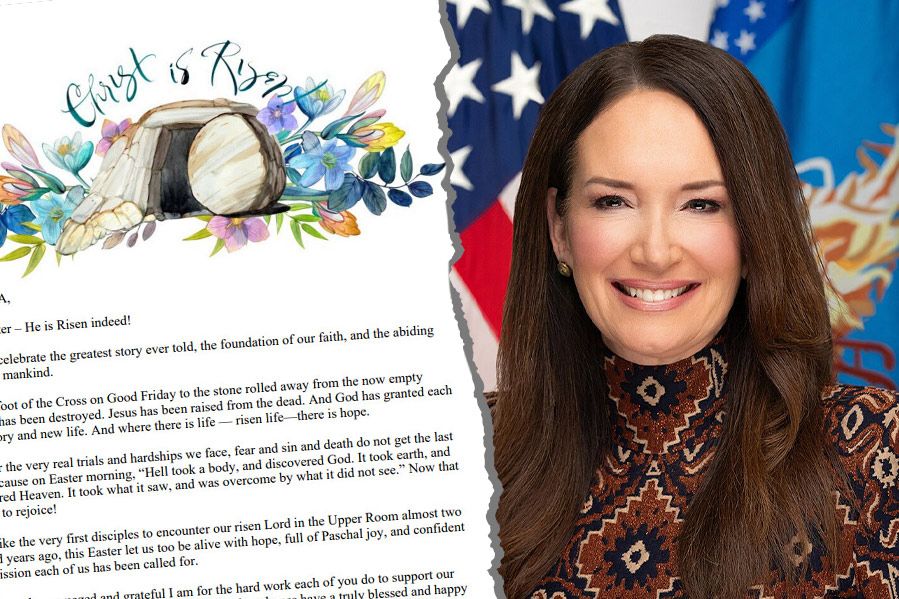
Employees at the U.S. Department of Agriculture (USDA) recently filed a lawsuit against Agriculture Secretary Brooke Rollins, alleging she was using her role as department head to inappropriately proselytize to federal employees.
Rollins “has adopted a practice of sending increasingly proselytizing communications to the entire USDA workforce, promoting her own preferred brand of Christian beliefs and theology to the captive audience of employees that report to her” according to the lawsuit, which was filed last week.
"It is exactly the sort of government-sponsored religious coercion, religious sermonizing, and denominational preference that the Establishment Clause prohibits,” the lawsuit reads.
Is it, as the lawsuit alleges, “government-sponsored religious coercion”?
Invocation in the Inbox
The lawsuit features a laundry list of explicitly Christian emails sent to roughly 90,000 USDA employees throughout the last year. “May God continue to protect the United States of America and may His favor shine over all her land” read a Fourth of July email. A Thanksgiving message gave "gratitude towards a loving God.” At Christmas, Rollins praised Jesus and said that “God gave us the greatest gift possible, the gift of his Son and our Savior Jesus Christ."
But the straw which broke the camel’s back was a recent Easter email sent by Rollins. “Today we celebrate the greatest story ever told, the foundation of our faith, and the abiding hope of all mankind,” reads the Easter message. “From the foot of the Cross on Good Friday to the stone rolled away from the now empty tomb, sin has been destroyed. Jesus has been raised from the dead. And God has granted each of us victory and new life. And where there is life — risen life—there is hope.”
You can view the full message here:
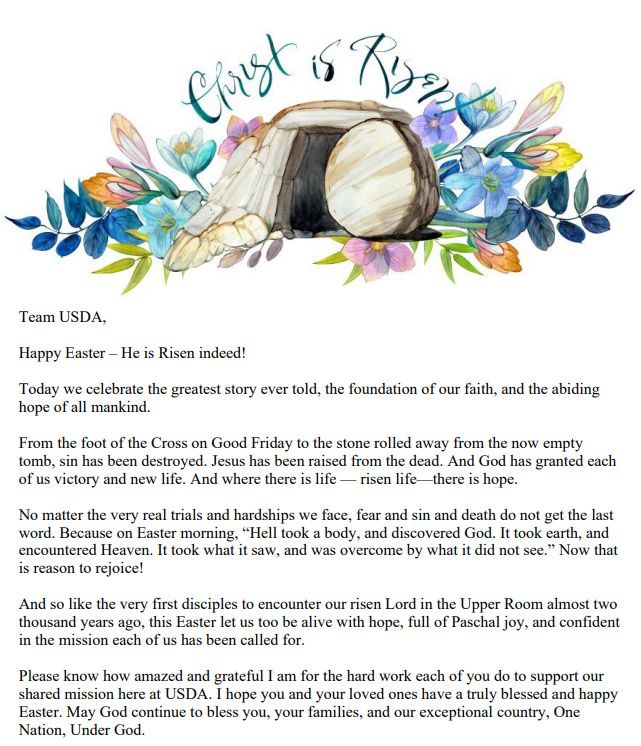
“The Secretary’s practice reached a crescendo,” with the Easter message, the lawsuit reads. Shortly thereafter, a group of seven USDA workers, consisting of Jewish, Buddhist, pagan, and nonreligious employees, backed by a number of secular activist groups and the National Federation of Federal Employees, filed the lawsuit alleging religious coercion in the workplace.
Is This Religious Coercion?
The lawsuit states that the secretary never commented on non-Christian faiths or religious holidays, using her platform to proselytize to a captive audience. And some employees say the messages make them feel not only unwelcome, but that advancement in their careers now depends on if they share their boss’ faith.
One employee says they were told it would “create trouble” for them if they asked to be removed from the email list. Another says the messages make him feel like he’s “going to hell” for not being a Christian.
“There is a preferred religious ‘in-group’ at USDA,” the lawsuit states - and the messages convey “the expectation that USDA employees share in the Secretary's religious beliefs, even when doing so would betray an employee's own beliefs.”
When asked about the lawsuit, a USDA spokesperson stated that the department doesn’t comment on pending litigation, but confirmed that they will “keep the plaintiffs in our prayers during this process."
It seems clear from the response that the USDA sees nothing wrong with the head of the department regularly sending out explicitly Christian missives to 90,000 federal employees. But the employees who filed the lawsuit say that the emails paint a very clear picture: They don’t have a prayer of advancing in their career unless they… well, unless they pray to the same God as their boss.
What do you think? Should federal department heads really be proselytizing to their employees? Where is the line when it comes to faith, management, and the workplace?
75 comments
-
 Ivan Burrows
Faith is an individual thing, what the boss wants is not the way to go here. No matter what faith the boss is it sould not be pushed onto the employee with force.
-
 DAG of Hamburg
This individual should be relieved of her job immediately. What a totally biased and inappropriate way to communicate with 90,000+ employees. An absolutely asinine and biased person who should be removed from her job immediately.
-
 Patricia Ann Gross
DAG,
Sounds a bit harsh, but I would be happy with a sternly worded "Cease and Desist Order" with a consequence of not complying as leading to termination of employment. Same goes for Hegseth and his prayer gatherings/Bible readings.
-
-
 Phillip R. Harris
There's more than one facet to this: One is the religious facet, and another is the business facet. I think we can, in this case, place our focus on the latter. Religion should be kept out of the workplace. If I were paying the salaries to these employees, and in this case, I am, I would be concerned about the amount of time wasted writing these greetings and sending them to other employees who waste time reading them, even though they do not appreciate the content. Then how much time is spent in hallways, restrooms, break rooms, etc., discussing this matter with other employees? At the end of the day, how much is this costing the taxpayers?
-
 Scott B. Bolduc
I agree 100% for all of the same reasons, practice what you believe on your dollar and your time not mine.
-
-
Phillip R. Harris
There's more than one facet to this: One is the religious facet, and another is the business facet. I think we can, in this case, place our focus on the latter. Religion should be kept out of the workplace. If I were paying the salaries to these employees, and in this case, I am, I would be concerned about the amount of time wasted writing these greetings and sending them to other employees who waste time reading them, even though they do not appreciate the content. Then how much time is spent in hallways, restrooms, break rooms, etc., discussing this matter with other employees? At the end of the day, how much is this costing the taxpayers?
-
 Rev. Dr. Travis McMillan
This is why I don't talk about my religion at work.
Not anyone's concern, nor is it their business.
That being said it does not stop our clientele from attempting to push theirs on me because they see me as a captive audience.
I still won't talk about it with them.
Again, not their concern, not their business.
This is an email I'd have deleted and kept it pushing.
-
 John Fox
When you work in a government facility it is always wise to keep your views of religion to yourself and not force them on someone else. There are consequences when you do.
-
 ServantOfJudgement
Who cares about the emails!!? 90,000 FDA employees!!? That's the real concern. Immediately terminate 85,000 of them. Like yesterday.
Come on President Trump! Why the heck isn't he doing something about all that waste! Get them gone Quick and Now!
-
 Michael Hunt
Do you not want people ensuring the food and drugs you take are safe? Cutting the FDA down to 5000 employees would cripple the agency's ability to do any type of oversight.
-
ServantOfJudgement
The food we eat and drugs we take aren't safe Michael.
Money buys them "safe" like Titanium Dioxide.
If I could trust 90k employees to do the right thing that'd be another story. That many people and we still cranked out a vaccine that doesn't vaccinate without the mandatory 10 year study. 90k employees and two presidents tried to force me to take the poison.
Chop them all just to prove a point.
-
Patricia Ann Gross
When you are dealing with a pandemic that is killing millions of people today, you don't have ten years to do a study. I was part of the study, and have gotten the shot everry time it was recommended. I also got COVID five days after my last shot last October, and it was the sickest I have been in 20 years. Since I am immunocompromised, if it weren't for the shot and Paxlovid, I may not be here today. By the way, my husband and I both caught the virus from a sick health care worker at a clinic where he was getting his cardiac exams required for a kidney transplant. Like the flu, the shot does not prevent the disease, but lowers the effects of the disease. I was told that without the shot and the Paxlovid, I would have spent a long time in the hospital rather than at home helping care for my sick husband who also had it, while also dealing with dialysis.
-
-
-
 Rev. Kev
SOJ:
It's hard to think someone is at all connected to reality when they say nothing about trillions of wasted taxpayer dollars lost due to self-dealing, scams, fraud, and incredibly bad decisions all being done by the current administration in broad daylight while asserting that individuals working for a living (and supporting families and the economy) in agencies designed to protect the public is where the waste is.
The FDA is tasked with protecting the American public from harm across the entire nation. That includes inspections at ports of entry, manufacturing hubs, farms, meat packers, processing plants, medical supply sites, shipping and delivery facilities, and all the restaurants in operation. Add on to that being a part of testing and development of new foods, dyes, additives, etc. and new medical products. The FDA has already been significantly damaged by DOGE cuts. As such, inspections that used to occur have stopped, or happen less frequently. As a result, the food you buy is not necessarily as safe as it used to be. The restaurant you visit may not be as diligent in things like rotating inventory or holding foods at food safe temperatures. Are you even aware of the number of food borne illnesses you can get from poorly stored, kept or prepared foods? Or from (for example) a CPAP machine with bacteria from improper production, cleansing, or packaging? When regulations are cut or not enforced the greedy execs have no problem hurting anyone in pursuit of higher profits. It's why waterways that provide drinking water to towns are now unsafe from untreated waste being dumped in them. Greed and stupidity kills.
No bid contracts or contracts pushed through to family members loaded with fraud and waste and pocketed cash are just fine, but the health and welfare of other people is just too much? What god do you worship to be so heartless?? Abbathor? Plutus?
-
ServantOfJudgement
Rev Kev.
Every single president has taken us deeper and deeper into debt. Each political side blames the other for the same things they do. I'm disappointed our promised cuts haven't come. Doge has not even come close to what the trump voter expected.
To the left, no government agency is bloated on paper or practice. To the right, no government agency is bloated when the time comes to cut spending, instead they increase it.
We're all eating Roundup. Polymers leech from plastic food containers into our food. We give synthetic hormones to livestock so they'll produce more of whatever they're producing. Your chewing gum is a synthetic polymer.
That agency and most others are all beyond repair and no longer do what was intended, if it ever did. Imagine paying farmers to not farm! You gotta be kidding me!
-
 Donna Jean Kain
It doesn't take much research effort to see that the problems with current US debt can be definitively placed on Republicans' doorsteps. Some of the worst economic debacles of the last 30 years were the result of DEregulation, not regulation. I ask quite often what it is that causes people to work against their own self-interests. The answers are beyond me.
-
Rev. Kev
SOJ:
No administration has put us in debt even as close as the current one. We're talking trillions added in just the first year and a half. For the first time in our history the debt now exceeds the GDP.
The "promised cuts" were never going to come because they were all lies. Like every other promise made to gullible voters. The amount of corruption in this administration beats any previous administration by a long shot. If ANY other president of either party did the tiniest fraction of the things this one is doing, the entirety of Congress would already be holding impeachment hearings. And I would be in total support of the action. Just the pay-to-play activity and insider trading with market manipulation would be enough. Literally billions of dollars have been spent without a single vote by Congress, all of which included money pocketed by the prez, his kids, and wealthy donors. Even the stupid reflecting pool (which has soared in cost as it goes forward on an uncontrolled no bid contract) and the luxury bunker and drone platform (which has also kept getting more and more expensive and involved no bid contracts with zero oversight on the expenditures) which started out as a ballroom no one needs are all about pay-to-play and graft. The rich donors who paid in a few million dollars have so far received 50 billion dollars on extended and new contracts. Again, without Congressional approval or oversight. Add on more wasted money on fountains, an ugly arch that even veteran's groups are protesting, and a promenade at the Lincoln Memorial that will no doubt bear the prez's name. You want to talk about fraud and waste? Look no further than the White House.
I'm going to bet you have no clue what the various government agencies do. Especially what they do for the American citizens.
Could there be some updating and streamlining to make them more efficient? Sure. But that is a process determined by experts in finance and systems after taking a detailed look at the specific offices and determining a long-term and detailed plan that makes those changes in an orderly fashion. At least that's how adults would do it.
What happened, instead, was an uncontrolled, unplanned, and destructive slashing of agencies with the simple purpose of freeing up taxpayer money to get it in the hands of the wealthy. Which is why a couple of times they did an "Uh oh" and had to do an emergency rehire of some personnel after the fact. Like most Americans, Musk had no frikken clue what he was doing or what the various agencies do. And why that has put us all in harm's way.
As a result of all the things this administration has done, we are less safe, less secure, and heading right for a cliff over which we will jump right into the waiting crevasse. We have lost trading partners. We have lost needed allies. We have made ourselves weaker. Other economies are tired of the illegal and senseless tariffs. The senseless sanctions and restrictions. As such they are now in the process of decoupling from the dollar. Several nations, including Japan (the largest holder of U.S. debt) are dumping their bonds. China and Russia have both moved away from holding debt or dollars in their central banks and have been accruing gold. China's international payment system has been cleared for several central banks, including the EU central bank. Where nations can deal directly with China in trade without the current system of converting to USD for trade. Which is making the dollar lose value. Which we will never be able to get back. All of which (including issues with fuel, the housing and stock market bubbles, fertilizer, production, and food supplies) will take us to a massive recession....if not a complete depression. Dust bowl level.
None of which this prez gives a single care about. He's having a great time raking in the money. And he doesn't have to stick around if it all goes down the toilet.
BTW, I am aware the U.S. food supply sucks. It's why many countries won't import our products. Pointing that out simply shows we have room to improve and find a way to get all the big money from wealthy donors out of politics. In other words, we find a way to fix it. Not say "It's all bad now so what's the use in trying?"
America is not great. It's getting less so every week that passes. We are a declining empire. We are the international joke and cautionary tale for everyone else to see. It's sad how people here simply cannot see it when it is right out in the open.
Since we stopped operating by the Constitution in 2025 and consolidated all power to a single person, we can't even truthfully celebrate a 250th birthday for the Republic. I see no reason to celebrate.
-
-
-
DAG of Hamburg
Huh?
-
-
 James Bullard
In this context, it is a violation of the Constitution which forbids government 'establishment' of religion. It also is a mistaken concept of the role of religion which is self-control, not control over others. If you meet the Buddha on the road, kill him. Jesus said it more subtly, the kingdom is within you. We are meant to live in such a way that we set an example to others, and not to correcvt others while ignoring our own failings.
-
 James Riggle-Johnson
A government employee who is in charge of 90,000 employees is the government. Sending these emails to her employees makes them feel as if they don’t share those beliefs, they will be treated differently.
It’s unacceptable. The Establishment Clause prevents the Government from establishing a state religion. The Secretary of the USDA is the Government. She appears to be establishing a favored religion in her department.
I hope these employees win the lawsuit. It will prevent the rest of the religious zealots in Government from continuing this. Public office is not a ministry.
-
 Kevin Joseph Kervick
Multiculturalism is a silly concept that cannot and will not work. The USA should morph to several shared culture nations.
-
Patricia Ann Gross
How do you propose we be divided up? People respecting each other is a much more practical choice, not to mention, much cheaper as well.
-
-
 Dr Dennis Chevalier PhD, DDvin
i wish people weren't so petty...
-
 Kerry L Gausemel
I agree it is inappropriate in the government workplace, but it is far from being a crime.
The only reason a lawsuit might succeed is if all other avenues to complain about this behavior have been ignored; Otherwise, I don't see much coming of this lawsuit.
I'm sure a majority of the employees don't really care about her language except to gossip about it (like we are doing here) around the proverbial water cooler known as the internet. It isn't like she is personally coming to your office/workstation/desk to pray over you regularly.
My question is: What harm has been done to the employees? Serious question. Who is losing their minds over stupid emails? Did someone go blind?
-
Patricia Ann Gross
Kerry,
According to the lawsuit/complaint:
"It is exactly the sort of government-sponsored religious coercion, religious sermonizing, and denominational preference that the Establishment Clause prohibits,” the lawsuit says.
You ask who is harmed? Suppose that the supervisor is Catholic, and suggests that everyone, including the athiests and Muslims spend time each day saying a Rosary, or she was Muslim, and insisted everyone drop and pray at the appointed times of the day. If you were not her brand of Christianity, or a Muslim, would you feel ofended. Even though it would go against the way you pray or your particular beliefs, and would potentially affect your shot of what the afterlife offers, and felt compelled to follow her lead or lose your job, there is harm done, as this is against the "establishment clause" in the constitution that states the FEDERAL GOVERNMENT (which she is in a management position) cannot dictate a particular religion. There were 90,000 of these emails with this type of content that went out in the past year. It wasn't a simple "Have a blessed day," or a signature line with the word, "Blessings," it was a fullblown devotional/sermonette, written in her perticular dialect of Christianity.
-
-
 Timothy Drake
God is everywhere. This country is God's.
It founded in God we trust.
Christianity is not religion but truth. When Christ walked the earth, He taught love and repentance from evil. It doesn't matter where you are home or work. These are God's commandments. She speaks truth not religion. Giving God praise and Thanksgiving is what we all should do. The days where misconduct is fine but praising God is wrong are the days that brought about the great flood.
Jesus is God, please take head.
God bless you!
-
 Donald J Rothschild Jr
Hate to burst your bubble but this nation was not founded on the Christian faith. The governing documents that our founding fathers wrote explicitly did not mention god or any religion. They saw in Europe what happens when government and religion mixes, unending wars. They built a secular government where freedom of and freedom from religion can flourish. A large number of founders where in fact Deists. Read the Treaty of Tripoli article 11 which states “The United States of America was not founded on the Christian religion”. Unanimously approved by the US Senate and signed by James Madison.
And as a side note “In God We Trust” became a motto in the early 1950’s to distinguish us from the “godless” communists.
-
James Riggle-Johnson
Our country was founded in 1776. In God We Trust was added on July 30, 1956. We were NOT founded on Christianity.
-
Rev. Kev
Timothy,
The Founding Fathers were, for the most part, influenced by the Enlightenment. Which can be seen in creating a government that was governed by the people instead of an aristocracy or theological hierarchy. The government was supposed to be comprised of fellow citizens who were elected by their fellow citizens to represent the will of the constituents. The entire system was entirely secular. Which allows for individuals to adhere to their religion of choice with no fear from the government (since other nations often punished those who were not members of the State religion). And that freedom applies equally to all people for any religion. Or none at all.
In short, the country belongs to the people. Not any specific faith or god(s). You are free to praise your god as much as you want. Free to adhere to any special services or holy days. But also called to respect that other citizens do not share your faith. Nor should they be required to do so. In the spirit of 'doing unto others' it's part of the social contract to not impose your beliefs on others as you would probably not like anyone else imposing their beliefs on you. A proper time and place for everything.
As an aside, I am sure you see your preferred version of Christianity as "the truth". But it is a religion by definition.
-
-
 Ruth P Doughty
I believe that work is one of the few places that your boss has final say on what you do and do not post or share. If you’re on your time, in the grocery store, driving around town, at a doctors appointment whatever, talk about your religion all you like. But when you are at work, you are there to do a job and nothing else. Your religious beliefs are irrelevant. You absolutely have the right to follow them, but you have absolutely no right to tell anyone else that they need to, and even sharing your personal information is too much in my humble opinion. I believe that pushing your religious beliefs on others, while in the workplace should be a fireable offense. I’m a minister, ordained through this program, and I still don’t wanna hear about other people’s religious stuff at work. Just because I’m a chaplain, doesn’t give anyone the right to puke, their religious beliefs onto me. I am more than open to discuss their beliefs off the clock, should they seek my advice or a suggestion of some kind on how to handle a particular situation but while I’m at work, just no! absolutely not. Ruth
-
Rev. Kev
Using a government email system to send blanket religious messages to all employees is totally inappropriate. I can see where it might make some feel uncomfortable or that they may be expected to adhere (or appear to adhere) to certain religious standards to be accepted or even move up the ladder in that organization.
-
Patricia Ann Gross
In all my time in working for secular companies, there was NEVER an executive that would send out emails like this, and furthermore even when I worked in churches, they were rare, except for those who went out to a subscription list for devotionals or the prayer chain. That said, there are two things an employee can do, read them, or hit the delete button, but unfortunately in a case like this, the trail of the email is probably monitored. It is inforunate that this is in a federal agency, because it is entirely inappropriate.
-
 Travis A. Lee
From what I've read, people are citing the Constitution as reference for their "defense" in the comments Against what that person is doing by sending out a offensive email. Had I been working for the Department and NOT Christian, it would have been highly offensive to me, especially since she did not acknowledge ANY of the other Religious Holidays observed by those Religions.
I would bring to mind that we actually have a Administration that has repeatedly IGNORED the Constitution. We have a SCOTUS that IGNORES the Constitution, the VERY ONES who interprets and is allegedly uphold the Laws of the Land, which is the Constitution. We have seen it time and time and yet time again with how the Constitution mean very little to those in power. ALL OF THEM, not just the Maga Republicans, the Republicans. ALSO the Democrats.
-
 Oversure Overture
I’d actually be more worried about her cognitive capacity. Looks like a complete nut job.
-
 Leslie A. Hulberg Née Tomasura
As well they should. This is one of the biggest reasons for separation of church and state. There are many different religions and some without a belief in a higher power and they need to be recognized as well. You can’t have freedom for some without having freedom for all.
-
Leslie A. Hulberg Née Tomasura
As well they should. This is one of the biggest reasons for separation of church and state. There are many different religions and some without a belief in a higher power and they need to be recognized as well. You can’t have freedom for some without having freedom for all.
-
 Ari Joseph Bertine
I have yet to hear about anyone repeatedly sending company emails about the joys of being bisexual and implying that anyone who asked not to get those would be in big trouble, but I agree that that would be just as bad. Emails promoting any lifestyle should not be sent to employees. That has nothing to do with work.
-
 Robert Berry
Agreed. An employer may choose to honor a group of people/customers that an employee disagrees about. The employee should be required to do the assigned legal function whether they like it or not though. Just do the job if it's legal. Your personally adopted views are not of any worthy matter. Or you can quit the job. To stay and whine or sue is paltry and spoiled nonsense.
-
-
Ari Joseph Bertine
Absolutely inappropriate in a federal office. If it was a private company she owned, she could get away with that, but it isn't. There are very clear rules about how much religion can be paired with government functions, and it is not a non-zero number.
-
 Joe R Day
This is an obvious attempt by a department head to spread her faith to her subordinates. I shall watch this lawsuit with interest. A little background is warranted. "Since Eisenhower, every sitting U.S. president has attended the breakfast at least once during his term. The presidential address is only part of the breakfast, a multi-day event. While most presidents have used the address to speak about their personal religious beliefs, at the 2020 breakfast, Donald Trump waved “Trump Acquitted” newspaper headlines and used the opportunity to launch an attack on the religious commitments of his political opponents." In my opinion, religion belongs in the home and the church, not in politics. Of 342 million people in the US, there are over 370 distinct religious bodies and denominations officially tracked in the United States, with hundreds of additional independent and non-denominational groups. For our political leaders to try and shoehorn 'all US citizens' into their chosen religion is reminiscent of the Religious Cleansing from the past. "The Spanish Inquisition & Expulsions (1492–1502): Following the Alhambra Decree, the Catholic Monarchs in Spain forced hundreds of thousands of Jews and later Muslims to convert to Catholicism, leave the Iberian Peninsula, or face execution." "The Crusades (1095–1291): Initiated by the Catholic Church, a series of religious wars sought to reclaim the Holy Land from Muslim control, but frequently resulted in the massacre of Jewish and Muslim populations across Europe and the Levant." And we can't forget "The Yugoslav Wars (1990s): During the collapse of Yugoslavia, "ethnic cleansing" campaigns were heavily driven by religious divisions." "Those who cannot remember the past are condemned to repeat it." George Santayana...
-
 Jeff A
Most employers have strict rules/policies about this. Bringing religious beliefs into the workplace can cause a hostile workplace, as we all have different beliefs. Bottom line is this, if your workplace has rules against sharing religious beliefs, you agreed, when you signed their employment contract, that you would perform certain work, during certain hours, and you would abide by their rules. Are you ready for this? You signed away your right to proselytize and you did it in trade for cash. You are being paid to do things their way, not yours. End of the silly court case.
-
 Daniel Genson The Third
Christianity goes a bit too far with this kind of thing. They don't respect that a person wants nothing to do with it. There needs to be a boundary.
-
 Brutus
Christianity: The popular belief that an invisible sky daddy sent a celestial Jewish baby who is also his own father, born from a virgin mother, died for three days so that he could ascend to heaven on a cloud and then make you live forever only if you symbolically eat his flesh, drink his blood, and telepathically tell him you accept him as your lord and master so he can remove an evil force from your spiritual being that is present in all humanity because an immoral woman made from a man's rib was hoodwinked by a talking reptile possessed by a malicious angel to secretly eat forbidden fruit from a magical tree. Sounds perfectly plausible..."
-
 Bonnie R. Tucker
These are my feelings exactly. Thank you.
-
James Riggle-Johnson
This is the funniest description of Christianity I have ever heard. Thank you. It made me laugh out loud. Lol
-
ServantOfJudgement
That's the exact description an ape would give if it could speak human. That's not intended as an insult so please don't take it as one. I don't think the average ape would understand things beyond their immediate environment, that is the physical world. Certainly not things they can't see and touch such as light itself, the photon. I did watch a video of a chimpanzee gazing at its hand in a stream of moving water once in apparent thought. I wonder what it was thinking.
I've read somewhere that evolutionists came from snails and scallops. Walking fish too. That might explain why some humans are so slow in motion and thought. It explains why some people love to wear hats too. They just can't shake the need to have a shell of some sort I suppose.
Thank God we were designed to be superior over all life on the planet we're stewards of. When God gave us science to subdue the earth back in Genesis, he did it so we'd not live and behave like the animals the godless think they came from though some still choose to.
Did you know God doesn't actually live in the sky? He's on the other side of the edge on the universe. Go ahead and toss that around for a while. I'll bet you'll look just like that chip with his hand in the water did.
-
-
 J Orville Adams
Don't have the other background, but this letter is highly inappropriate. Just because it is inappropriate does not mean it is illegal. It is, in essence, the same as sending a Christmas card.
What would make it illegal is if she then followed up with tying advancement or even hiring to being a Christian. If shed did that, then it would be government entanglement in religion. One poster said this is not a first amendment violation, this is not true! It is a clear establishment violation. The establishment clause covers the following:
This clause prohibits the government from establishing or favoring one religion over another. It aims to maintain a separation between church and state — not hostility toward religion, but a boundary that prevents government endorsement or promotion of any faith
Key principles:
No official state religion — the government cannot sponsor or control religious institutions.
No favoritism — laws cannot give preferential treatment to one religion over others.
No excessive entanglement — government should not create overly close ties with religious bodies.
So, she if she is showing favoritism or entanglement, then it would be a clear first amendment violation and would be compensable. She, as administrator, should know this. Although we have a very left swinging court, I think the court would clearly uphold the foundations of the separation of church and state and would find the USDA liable for damages.
-
 Steven Ferrell
Perhaps this should not have been sent, but also emails promoting alphabet lifestyle should not be sent to employees.
-
Rev. Kev
Steven,
I am sincerely curious where such emails "promoting alphabet lifestyle" have been documented or been made public? How does one even "promote" such a thing?
I've heard of things like introducing EEO rules to not discriminate against others for their gender and such. But never saw a group email advertising something like "Friday is try being gay day!"
-
Patricia Ann Gross
Rev. Kev,
I laughed out loud. I'll add to that: I never heard of a "Friday is switch bathrooms day," or "Friday is everyone dress like a DRAG queen day," although I have heard that "Friday is wear casual clothes (or jeans) day" in offices where "Business Attire" is the usual dress code.
-
-
 Jenni B
The difference being that following a religion (or not) is a choice, while being LGBTQAI+ is not.
-
 James Richard Munro
Clavelin Clinic, John Hopkins, and Mt Sinai hospitals would disagree with your statement. They have stated that it is a choice. You are not born with the mental disease of LGBTQ. It's a choice you make. Pastor Jim
-
-
-
 Elaine Evelyn Levi
I believe there is practice/discipline that demonstrates kindness above all without proselytizing one’s beliefs. It is the Golden Rule.
-
 Lynnea Urania Kaylor
In my opinion, this isn't a First Amendment church/state issue since it doesn't involve a decision by Congress to establish a religion. But it is a highly presumptuous act on the part of Secretary Rollins whose department consists of a lot more than just her version of "Christian" and many who would not consider themselves Christian at all. She has acted in a way that many parents do, imposing upon their children, saying, "In this family we believe this," dictating the parents' religion, allowing no real autonomy and no chance of questioning that can lead to a deeper learning of faith. But these aren't children and Secretary Rollins is not their parent. Will those not of her faith venture to question? That's a preposterous expectation. It's one thing to recognize a religious observance for those who observe it to honor the day. It's another entirely to collectively claim it as a religious doctrine to be embraced by all department employees. This is highly disrespectful, and a form of disrespect too commonly accepted as a norm surrounding Christmas in which all who object to similar impositions are subjected to various forms of verbal abuse and sometimes even physical violence.
-
 Susan Christine Giganti
Highly inappropriate to send a letter like this .
-
 Leslie Cox
I believe that sharing a message about your religion in the workplace is like taking a dish to a potluck. Some might be interested, others not. Do not take offense with those not interested, if that is not the path that works for them. Wish them a good day and both of you go about your lives.
-
 Louis Edward Zitnik II
Works for me, except your comparison overlooks the employer-employee power dynamic. Being on the receiving end of a religious message from your employer at work is more like listening to your instructor at a cooking class describe her favorite recipe and then having you prepare it for a grade. You want it to taste good! But what if you want to change one of the ingredients? Will that change your grade?
-
Patricia Ann Gross
Louis,
Your comments about the power dynamic is spot on, but the potluck example is more like if the boss (or instructor) made an inedible dish (or recipe) because it had too much salt added and insisted everyone take a large portion and eat every bite with no regard for dietary needs or preferences.
-
-
-
 Nicholas J Page
I have said before keep your religion to yourselves and not force it onto anyone.
-
 Bishop William Dusenberry, DD
“Your religion?” No one has their own religion— except, those, such as we ULC ministers (etc.) who’ve started their own unique religion, and try to convince others to convert due to their being in agreement. Whenever one says that “they believe” they usually mean that they merely believe in the same religion that their parents believe — follow the leader, and “might makes right”, determines one’s religion — and all religions are man made (or, mythology). We ULC ministers, who know (not merely believe) that God and Nature are the same thing, are the only ones who can prove that God’s real — and should be recognized for their uniqueness accordingly.
-
Dr Dennis Chevalier PhD, DDvin
Sir, According to ULC, there are NO bishops in ULC 1960 and ULCM started in 1977, I have no idea about which you speak but both say you are NOT and never have been A BISHOP of ULC like you claimed to me at the blog …https://www.themonastery.org/blog/should-in-god-we-trust-go-on-every-federal-building ! See email copy from ULC today that I received.
"Subject: Can I become a Bishop in Arlington, TX.
Created May 27, 2026 2:20 AM · Updated 3 hours ago Is it possible for attain the rank of Bishop in Texas enforcing the rules of a sect of several ministers /home churches in Texas that I work with? We do the religious side, not just weddings, funerals, baptisms, etc.? It is modeled after catholic traditions but do not do the forgiveness of sins (reconciliation) or the Eucharist instead we perform the "in remembrance" service and not Holy communion. Other than that, we echo Catholicism and are known in Texas for this. We do what is right and are fully accountable. Please advise. Dr. Dennis Chevalier MDiv, PhD, DDVin, DD and an Honorable ULC DD 817-xxx-x344 Conversation Thread
Support Team · May 27, 2026 4:01 PM (3 hours ago) Hello Dennis,
The ULC does not have any hierarchy within the Church so there wouldn't be any specific way to achieve the rank of bishop. That said, I'm not aware of the process of being a Bishop in Texas so there might be steps you can take with the state, if you're looking for something like that.
Always here to help, Tom Lyle ULC Support Team"
…so yes, please give me your address and I’ll send the Existential pre-stamped envelopes you demand for you to prove YOUR ULC was in existence in 1972 or of 1977 and proof of rank to which ULC SAYS IT HAS NO BISHOPS and that you never have.
Respectfully Rev. Denny
-
-
-
Nicholas J Page
Why has this taken so.long to come out I have said before that people should keep their religion out of the public domain and keep it to themselves
-
 Douglas Robert Spindler
People have NO Freedom from religion in some parts of the US. Just try to be a non-Jew in Lakewood, New Jersey where you will be a goyim. The Jews are in control of the Government and public schools. Goyims have been complaining and nothing is done.
Same with the Mormons in Utah.
-
 Reverend Paula Copp
Isn’t separation of church and state a major tenant of the Constitution? Oh, that’s that’s right… the Constitution is now whatever the current vile and evil regime and the orange one at the head of it, at least when he’s awake…
-
 Ronaldo
No, the separation of church and state is neither stated nor implied in the Constitution. If you truly want a separation, the People could either attend church, or vote, but not both.
-
Ari Joseph Bertine
The Constitution says the government cannot promote any religion whatsoever. That is what is interpreted as separation, not separation in citizens but in government institutions. That includes government jobs.
-
 Rev. BH
Ronaldo, I'm free to do both, or neither.
And Ari is correct.
-
Robert Berry
Whaaaat? The people can do as they want. It's the government that can't adopt a particular religion. In God we trust. That mostly excludes atheists. I'm not sure we can trust the God of the Bible or Quran and I'm spiritual in nature.
-
-
-
 Colleen McAllister
Let's get real here. This woman is interfering in other people's lives; crossing into their personal space. This should be considered harassment if nothing else.
-
 Rev. Miche'al Yosef Dixon
As a minister for Yeshua Ha'Messiah and ad a Veteran who was shot believing he was fighting to defend the Constitution, She did not violate the Constitution which states "Congress shall not make any law" she exercise her right to free speech, tactlessly grant you. Now if the Employer USDA has a policy in place forbidden it that's a policy issue. Many comments are correct the work place is no place to evangelize no more than sexual harassment. As for the employees chases to advance unless the employer directly illegally ask what their religion is that should even be an issue. I worked in planets as a pipefiter for 11 years beside a guy that I didn't learn until later he was a Muslim. And to answer Echo's question we started down Orsen Wells and Adouis Huxley path around 1812 first recorded red flag, James Madison that wrote the First ten Amendments had to go before Congress about the Bill to make Polygamy illegal, "There is not a shadow of right for the government to dictate religious beliefs upon the people of the United States of America." -James Madison. George Washington stated, "I do not foresee this new nation lasting beyond 200 years if you simply replace one king for another." We coming on 250 years and how many of these blogs revolves around a president called a king? Hell, 1861 the nation was fighting itself and a new unCivil war is ready for a match to light the fuse.
-
Rev. BH
shred/crumble them up, mail them back to her.
-
 Lillian Sanchez
Echoing the first comment. Freedom of and from religion - does anyone remember that small phrase?
Ms Rollins can practice her Christianity in her home, at her church, heck, grab a couple of JWs for a good conversation even, but what she can't do is push her faith onto the people who work under her. That is a big no-no and an HR nightmare.
-
Robert Berry
Agreed and she can remain a Christian at work via her personal conduct without seeking or forcing an audience for her beliefs. I don't recall takes of Jesus forcing his tenets on anybody.
-
 Stephanie A Willey
Comment removed by user.
-
-
 Echo
Echo
Asking for legal separation of church and state is correct and I hope the plaintiffs win this. The fact that its a question is indeed a slippery slope has been traveled into Orsen Wells world become reality. Sad day indeed.
-
Robert Berry
Agreed!
-

How many times do we have to visit this complaint? This seems to keep happening. Apparently, her supervisor needs to step in, or in this instance, should have already done something about this. I would think that it's time to take it to the next level. At this point, I would definitely consider this to be a form of harassment. I was a Union Stewart for 9.5 years.