

For centuries, humans have gathered in Canterbury Cathedral to pay homage to the Madonna. On August 15th, they gathered again... this time, for Madonna herself.
Hundreds of people packed the nave of the historic cathedral to spend the summer Saturday night dancing to 1980s pop music.
There was a bar, and in addition to Madonna the DJs spun Prince, Kylie Minogue and other chart-toppers. The medieval cathedral was washed in colored light as dancers wearing glowing LED headphones switched among three different music channels. The second session ran until midnight.
Some Christians were horrified.
“The church no longer believes in the attracting power of the gospel, and resorts to secular music instead,” wrote Tim Dieppe of the conservative Christian publication Christian Concern. Another commentator called the event “the desecration of a sacred space.”
It's easy enough to understand the reaction. Canterbury is not an abandoned church somebody turned into an entertainment venue. It remains the mother church of the worldwide Anglican Communion (ever heard of the Archbishop of Canterbury?), with services still taking place daily.
But take away the Madonna songs and glowing headphones, and some of the offending imagery starts to look surprisingly familiar.
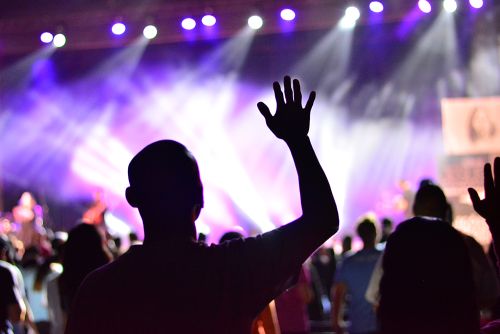
Colored lights. Giant screens. A darkened room. Music pounding through an expensive sound system. Performers on a stage. Hundreds or thousands of people standing together, singing, swaying and raising their hands.
In many American churches today, that's just Sunday morning.
Does This Look Like Church?
Consider Lakewood Church in Houston, one of America's best-known megachurches, led by one of America's best-known pastors: Joel Osteen.
Its sanctuary seats roughly 16,000 people inside what was once the arena where the Houston Rockets played basketball. Instead of stained glass and a pipe organ, worshippers encounter enormous video screens, professional theatrical lighting and a sophisticated concert-quality sound system.
Lakewood is hardly alone. Contemporary evangelical churches across the United States employ production departments responsible for lighting design, cameras, video walls, livestreams, moving lights and even theatrical haze.
Haze, incidentally, is not some rare extravagance reserved for unusually flashy churches. Church Production Magazine recently described it as a “weekly necessity” for many congregations. Church production consultants openly discuss how to use moving lights, color and haze to create atmosphere during worship. One 2026 industry guide advises churches to coordinate lighting with the “emotional arc” that worship leaders hope to create.
How Churches Learned All the Right Moves
 This didn't happen accidentally.
Religious historians Kate Bowler and Wen Reagan have traced much of today's worship style to the rise of American prosperity megachurches and televangelism. Beginning in the 1990s, they argue, large churches increasingly modeled their music on arena rock, aided by enormous sanctuaries and increasingly sophisticated audiovisual systems.
The result was what Bowler and Reagan call a “liturgy of timing, lighting, volume and performance.”
Hillsong, the Australian Pentecostal church network whose Hillsong Worship and Hillsong United music ministries are now international forces in contemporary Christian music, helped export that model around the world. Worship songs have begun to sound like contemporary pop and arena rock, sanctuaries have begun resembling concert halls, and worship leaders have become recording artists, touring performers and celebrities in their own right.
Religious-studies scholar Katja Rakow spent time studying worship at Lakewood Church and found that the technology there does far more than make the service look impressive.
Lighting, video, music and sound deliberately change as worship progresses.
The goal, Rakow argues, is to make a 16,000-seat arena feel simultaneously enormous and intimate, creating conditions in which an individual worshipper can experience personal closeness to God.
In that interpretation, the spectacle isn't competing with worship... it's producing it.
Holy Spirit or Production Cue?
That idea makes some Christians deeply uncomfortable.
Kelsey Kramer McGinnis, who has worked as a worship leader, described in Christianity Today what happened when she performed at a large Christian conference. Through her earpiece, a production manager told her: “Bigger!”
She was instructed to raise her arms higher, move more and encourage the audience more energetically. Hymns had even been assigned numerical energy levels to help construct the emotional progression of the event.
The difficult religious question is what happens when the person experiencing that crescendo attributes the resulting tears, goosebumps or euphoria to God.
Did the Holy Spirit move them? Or was it the well-timed beat drop? Can it be both?
Some Christians working in church production reject the idea that using technology to shape an experience makes that experience counterfeit. At a recent Churchfront conference, Nathan Finochio defended elaborate production in explicitly theological terms: “Production matters because worship matters.”
Is the Club Also a Little Bit Like Church?
And as it turns out, this road could be traveling both ways. Scholars have spent decades studying the strange spiritual vocabulary that appears in nightclub and rave culture.
One Harvard Divinity School examination of rave spirituality notes that clubs have repeatedly been called “churches” by the people who inhabit them. House music pioneer Frankie Knuckles is often credited with calling Chicago's legendary Warehouse nightclub “church for people who have fallen from grace.”
Church Has Always Been a Sensory Experience
Modern megachurches did not invent church production, they only electrified it.
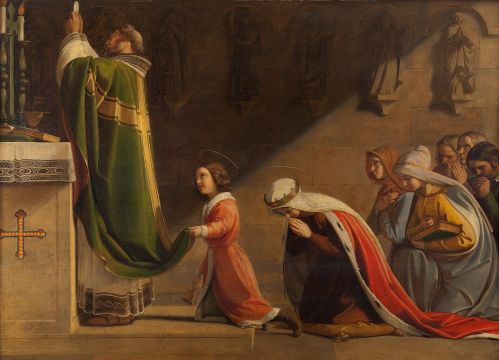
Consider the high point of the late medieval Mass: the Elevation of the Host, when the priest raised the consecrated bread for the congregation to see and adore. Churches developed an entire sensory apparatus around those few seconds. A bell announced that the moment was coming. Candles helped illuminate the white Host inside the dimmed church. An altar server might help lift the priest's heavy vestments so he could raise it higher. Some churches even utilized a dark backdrop behind the altar to make the Host even easier to see.
The bell could be heard outside the building, alerting people nearby that the moment had arrived. The spectacle became so important to lay worship that records describe medieval Christians hurrying into churches just to catch the Elevation, and even moving between simultaneous Masses to see it more than once. Medieval historian Miri Rubin puts it succinctly: at the Elevation, “all senses were called into play.” Bells sounded, incense burned, candles glowed and worshippers knelt before the object they believed had become the body of Christ.
In a world before rock stars, that bread was a big deal.
In modern language, this all sounds an awful lot like production. There were bell ringers, choristers, acolytes, vestments, incense, processions, lighting and carefully timed visual reveals, all employed to focus attention and help turn Christian belief into something worshippers could see, hear, smell and physically experience.
Canterbury itself offers an especially vivid example. Medieval pilgrims approaching the shrine of Thomas Becket climbed worn stone steps, sometimes on their knees. At the top they encountered an enormous shrine containing Becket's remains in a golden, jewel-encrusted chest. Shrine keepers were employed to highlight the jewels and tell the shrine's story. Stained-glass windows depicted people supposedly healed through Becket's intercession. Pilgrims could even leave with merch, departing with badges or tiny containers of “St. Thomas' water,” associated with the murdered saint's blood.
And Christianity's history of physical religious experience goes well beyond cathedral pageantry.
In Dancing in the Streets: A History of Collective Joy, Barbara Ehrenreich traces a much older history of people pursuing religious ecstasy through dancing, feasting, rhythm and collective movement. Religious communities had been cultivating versions of it for centuries, even as church authorities periodically tried to restrain forms of celebration they considered disorderly or excessive.
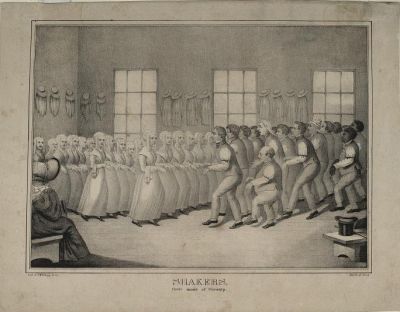
American religious history supplies some wonderful examples. The "Quakers" literally got their nickname from the trembling and “quaking” that could accompany their early worship services. A more ecstatic Quaker offshoot went further: They sang, trembled and danced so energetically during worship that outsiders called them the “Shaking Quakers,” eventually shortened to Shakers. In early Shaker communities, spontaneous dancing was part of Sunday worship; it later developed into choreographed communal movement.
That makes the line from medieval cathedral to modern megachurch considerably less neat. Christians have worshipped through near-silence. They have also worshipped through bells, incense, spectacle, trembling, dancing, chanting, stained glass, organs, electric guitars and enough theatrical haze to make a fire marshal nervous.
The equipment may have changed, but there has always been a level of "showbiz" involved.
A Rave in the Nave
The cathedral has defended the silent discos as “missional.” Dean David Monteith argues that events like these bring people into Canterbury who might otherwise never enter a house of worship. He also points out that cathedral naves historically were not reserved exclusively for formal religious services.
There is real history behind that defense. Medieval church naves occupied a much less tidy boundary between sacred and secular life than many modern worshippers might expect. Historians have documented dancing, commercial trading and even judicial proceedings taking place in churches alongside singing, prayer and preaching. Other church records mention beer, games, bartering, courting and gossip all being enjoyed inside chapels. For centuries and across the faith spectrum, the community's house of worship could also be a space for just about every other aspect of life.
Even the Church of England's own rules leave some room for interpretation. Canon law prohibits secular uses “inconsistent with the sanctity of the place.” But official legal guidance on church wedding receptions specifically says that dancing and accompanying music are not necessarily impermissible inside a church.
American Catholics recently drew the line somewhere else. In 2023, Sabrina Carpenter filmed part of her “Feather” music video inside Annunciation of the Blessed Virgin Mary Church in Brooklyn, dancing around the church in a short black dress and veil while pastel-colored coffins stood propped near the altar. In the aftermath, the Diocese of Brooklyn said it was “appalled,” and even held a Mass of Reparation to restore the church's sanctity. The pastor who approved the filming was later stripped of his administrative duties.
Carpenter, ever the wordsmith, offered a rather efficient theological rebuttal: “Jesus was a carpenter.”
A medieval pilgrim staring at a glittering shrine, a superfan screaming Taylor Swift lyrics in an arena, a Shaker moving rhythmically with fellow believers, a worshipper crying beneath Lakewood's stage lights, and a clubgoer disappearing into a dance floor can all experience some combination of awe, release, belonging and the feeling of becoming part of something larger than themselves.
Churches have spent centuries learning how sound, light, movement and crowds can help people reach beyond themselves. Nightclubs learned many of the same lessons.
If carefully orchestrated light and music cues elicit similar emotions on the dance floor and during Sunday worship, does that make the religious experience less sacred? Or does it tell us something about how human beings have always reached for transcendence?
19 comments
-
 Patricia Ann Gross
I have very mixed feelings on the spectical that these churches put on, but at the same time, when I was a child, there was a notion that women cover their heads with a veil or hat (in the Catholic Church it was a requirement) and wear their "Sunday best." Now I am comfortable in church wearing jeans and a t-shirt, and would feel out of place with the "dress-code" compliance of my chilhood. The biggest issue I have with these is that the Gospel that is preached is often the "prosperity Gospel" which is unsustaining, and the "clergy" involved are becoming rich from it, many of which are eventually taken down by submitting to the addiction of the power it brings them. A Gospel that allows a person to seek God and justice when they are down-and-out as well as well-to-do is a more sustaining message. It allows for those who "have" to reach out and help those who "have not" rather than enriching church leadership. Don't get me wrong, I believe that church leadership should be paid equitably for what they do, but if they are there just to get rich, they are in the wrong profession.
-
 Ellie Will
Ecstatic dance has been part of various worship practices for millennia. It was documented by Greeks and Romans. Bacchanalia anyone? In the Bible, it was recorded in the story about the Tower of Babel. There is nothing new under the sun when it comes to this topic.
-
 Roy S. Thorpe
MAKE A JOYFUL NOISE UNTO THE LORD,! Good for you and your soul!!!!!
-
 Susan Christine Giganti
This type of event isn’t going to gain converts or lovers of history. I’m not a fan of mega-churches because I think they are impersonal. I do like some genres of modern Christian music.
-
 William M Buzanoski
There are plenty of musical works, which respectfully played, which are spiritually and religiously inspiring..Provided the Lyrics are of a morally and religiously correct to the respective Religious Denomination! Such application to the Religious Ceremony taking place is one of a Celebrants most effective tools in many elements attending ! I have observed this effectiveness applied at Certain religious celebrations in the 70s in San Bernardino, California! Careful choice of the music and message must proceed the religious occasion.....I.e. Do not just play..preplan/preview before the ceremony!
-
 Lori Mongillo
We all use different keys to unlock a connection to the Great Mystery. It's a language. It doesn't matter what the language is, as long as it carries us into the realm of Spirit. Through music, lighting, etc., the churches are leading the minds of the congregation to a pliable state, to where they give more. More money. More time. More devotion to the cause. They are hypnotized by the theatrics and pulled into the narrow passageway that leads to fundamentalism. It is a desire to be consumed so one does not have to confront critical thought. It's an escape,...or perhaps, an opening to Dante's inferno.
-
 Walter Abington
Churches want to be an entertainment venue, tax them like one.
-
 obere mchugh
are people fine with the festivals and weekend fundraising events churches have all across america, that have food carnival type events with food and alcohol to entice adults to come and spend their money ? ive seen so many of these pop up festivals and such as they are all geared towards adults as they know adults will come to a weekend event even if its for a church if they sell alcohol and food. so whats the big deal music there just trying to line there pockets and get more in there seats as that is how they view things. i dont agree with it personally as atleast within my tradition we are only ever capped at 13 members anyway and if we do anything public its at a event being held within the wider context of either our faith community at large or the wider one as in the end atleast within the craft of the wise we dont want converts and we dont just want anybody within our circles we want those who can amplify and work well with not just every person were not interested in nor do we want just anybody. everyone must be on the same page and work well with each other thats why we keep things small and intimate.
-
 Jimmy Moon
It's just the lost leading the lost to Hell.
-
 Dr Dennis Chevalier PhD, DDvin
yup!
Dr.D.
-
-
 Douglas Robert Spindler
Completely understandable. Churches are having a hard time financially and attracting new members. With all of the lawsuits against the churches and clergy over molesting children and rapping women people are not wanting to be part of religion anymore. This is all about getting the money churches need to pay off there victims.
-
 ServantOfJudgement
I'll bite on that one Douglas. It's a bottom line move. Money. That's all but that's not new.
Any church that's been proven to protect molesters should be closed and sold. Give the money to the victims. Hang the molesters and imprison his/her/their protectors.....when found guilty.
-
 Rev. Mike Eggleston
Chirstianity is dying out in the UK. In the 2001 UK Census, 72% of the population self-identified as christian. By 2011 that had fallen to 59% and by 2021 to just 46%. Churches are going out of business all over the place. A Methodist chapel in a nearby village closed in 2021 and the CoE church there is just about unusable. Individual churches are having to repurpose to try to bring some money in.
-
-
 Father Frederick
I'm reminded of many statements over the decades, "Just because you can, doesn't mean you should".
I understand that some people see it as a good thing, but like many things in culture and life there are limits and protocols which should be observed. "Off the leash" is a term I've heard for some that just go beyond comfortable bounds.
And old priest at our church described it as doing something which offends other. Just because it's OK to our moral values, does that mean we have the right to interrupt, or subjugate the lives of others? It's sort of like thinking it's OK to have a loud party in your backyard at 1AM, and telling the other neighbors to accept it, or "just get over it".
Perhaps the better choice would have been another location, or smaller church whose member give permission.
I'm reminded of two churches in Toledo, Ohio, not far from each other. One a Presbyterian calm service, and the other was a Black Baptist church with "house musicians" who had a beautiful Hammond B2, Leslie speakers, Fender bass amp, lead guitar, drums, and occasionally a brass section. The minister of the Presbyterian church commented to the minister of the Baptist church, "Why do you celebrate in this way?" The Baptist minister said, "That's the way we worship. But if you notice, our church times are between your 1st and 2nd services, so not to disturb your congregation. We don't worship the same, but we can respect the other's method."
-
 Cyndi McReynolds
For Pete's sake. People need to get over themselves. I'm 70, and I have not forgotten attending various youth nights with friends from many different denominations. Some of my fondest memories are of dancing to the popular music of the era; Simon and Garfunkle, James Taylor, Sonny and Cher. It was great fun and showed me and my friends that at the end of the day, we were all just kids with the same questions about life, regardless of what faith we Followed. I particularly remember one of the chaperones walking around the dance floor reminding us to dance far enough apart to make room for Jesus between us. The music may have changed, and the disco ball has been replaced by strobe lights, but objecting to giving young people a safe, supervised way to blow off steam and use up some of their excess energy on the dance floor is doing them a great disservice and confirming their suspicions that adults don't trust them to conduct themselves appropriately. Let's not undermine our relationships with our young people by condemning them for their youthful exuberance. Let's not confuse innocent fun with sin. Let them "Make a joyful noise" and show them the respect they deserve.
-
 Monique D. Thompson
Ditto❣️
-
-
 Colleen McAllister
As a Worship leader myself I know how important it is to keep our thoughts focused on Christ. We are not performing for an audience but for the Lord of the Universe. We are simply witnessing to the audience of how God has changed our lives and freed us from slavery to sin. If we don't feel that when we sing then we might as well be silent. The music does not need special effects, it simply needs to be sung or played sincerely.
-
 Dr. Zerpersande, NSC
You mean a bunch of cognitively challenged individuals waving their arms around, exhibiting incoherent/drunken speech and appearing to be having some sort of seizure?
“ The combination of speaking in tongues (glossolalia) and dancing in the Spirit (holy dance) as a core church practice dates back to the Azusa Street Revival (1906–1909). While individual instances of ecstatic tongues occurred earlier in 1901, Azusa Street in Los Angeles, led by African American preacher William J. Seymour, is the first recorded birthplace of a sustained Pentecostal church culture where spontaneous, unchoreographed dancing and speaking in tongues occurred.”
So about 125 years?

Just more proof that organized religion is a fraud.