

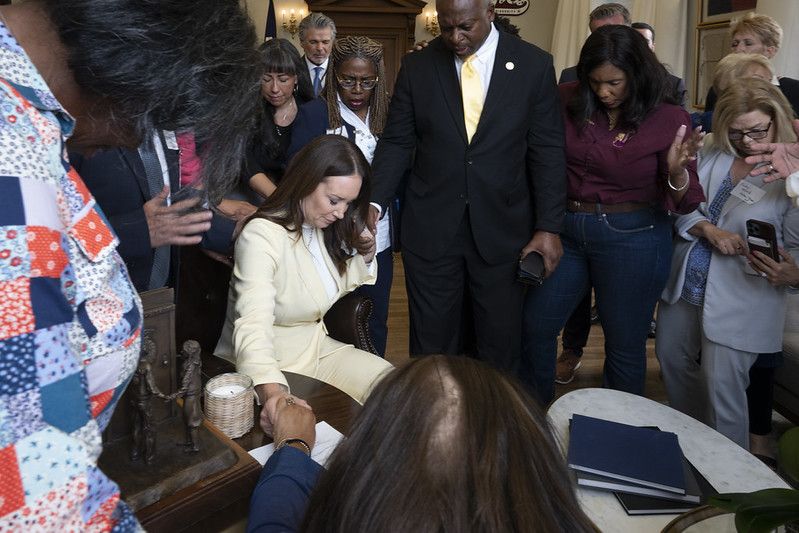
An Easter greeting went out to the U.S. Department of Agriculture's entire workforce earlier this year with a curious assumption inserted into the text: the resurrection of Jesus Christ, Agriculture Secretary Brooke Rollins wrote, was "the foundation of our faith."
"Our" is a tricky word when you're talking to roughly 100,000 federal workers, some of whom are Jewish, Buddhist, Pagan, atheist, or simply not interested in receiving religious instruction from the boss.
One of them, longtime USDA employee Lanette Dietrich, says she asked to be taken off the department-wide email list. According to her court declaration, she was told it was "not possible," and that pushing the matter could "create trouble." Rollins also used that email account for important announcements about department reorganizations and government shutdowns, so employees couldn't simply ignore her messages. Another plaintiff, Ethan Roberts, said he simply wanted to do his job and make his country better. "I shouldn't have to suffer through sermons," he explained.
On November 19, U.S. District Judge Trina Thompson found that Rollins' religious emails likely violated the First Amendment and ordered her to stop using her official authority to pressure employees. Rollins, who has declared that she'll "never stop talking about Jesus," told Fox News on November 24 that she would fight the ruling "all the way to the Supreme Court."
The judge didn't forbid Rollins from practicing Christianity, discussing faith with interested coworkers, or extending polite religious invitations. She did limit Rollins' ability, as the department head, to send religious messages to an audience that cannot easily say no. We've covered the USDA employees' original complaint, but the dilemma reaches well beyond Washington. Overtly religious messaging from the boss has become an increasingly prevalent, and expensive, problem on Main Street, too.
After all, it's much harder to decline an invitation to prayer when it comes from the person who approves your paycheck.
Mandatory Morning Devotions
At Aurora Pro Services, a North Carolina home repair company, the workday reportedly began with a prayer circle. The owner read Bible passages, employees shared prayer requests, and attendance was monitored. According to a federal discrimination lawsuit, the meetings sometimes stretched to 45 minutes.
John McGaha, a construction manager who is an atheist, objected. His boss allegedly offered a form of religious freedom with a rather significant catch: "If you do not participate, that is okay, you don't have to work here."
McGaha and another employee, agnostic customer service representative Mackenzie Saunders, were subsequently fired. The Equal Employment Opportunity Commission accused the company of making religious participation a condition of employment and retaliating against dissenters. In 2023, the business agreed to pay $50,000 to settle the case, without a court ruling that the allegations were proved.
If the boss is taking attendance, a prayer meeting starts looking an awful lot like a staff meeting... and that can make declining it a career decision.

The Office Has an Onionhead Problem
The employees at a New York company had a different sort of spiritual instruction to contend with. It came with cartoon onions, incense, and, according to testimony, the possibility of demons entering through the fluorescent lights.
Meet Onionhead.
Originally devised to help children understand their emotions, Onionhead was developed by spiritual teacher Denali Jordan. Her nephew, Robert Hodes, ran United Health Programs of America and its parent company, Cost Containment Group. Under a related program called Harnessing Happiness, Jordan's teachings became a fixture of office life. The company paid Jordan nearly $1 million over five years for her consulting work.
Employees were expected to wear Onionhead pins, display pictures of the winged onion character and spiritual cards, and attend workshops about feelings, divine guidance, and the energy of their surroundings. Candles and incense appeared. Overhead lighting gave way to lamps because, witnesses said, Jordan believed the fixtures could let demons through. An office utility closet became a meditation sanctuary.
Workers testified about being encouraged to hug and kiss one another, tell colleagues they loved them, and supply photographs of their children. One recalled being required to join a hand-holding prayer chain stretching across the office. Another said the incense worsened her headaches.
For employee Faith Pabon, the trouble reached its peak during a company-sponsored weekend advertised as a spa trip. Pabon refused to attend one of Jordan's sessions. She testified that Jordan called her "an evil person filled with demons" and fired her. A human resources letter later described the dismissal as insubordination for refusing a supervisor's instruction.
The company described Onionhead as a conflict-resolution program, but employees argued that its spiritual teachings and mandatory practices amounted to religion. A federal judge agreed in 2016, ruling that Onionhead and Harnessing Happiness qualified as a religion under employment discrimination law.
Two years later, a jury found that the companies had subjected workers to a religiously hostile workplace and wrongfully fired Pabon. Jurors awarded $5.1 million in damages, later reduced under statutory limits.
Please Address the Ashtray
Onionhead wasn't the only unusual set of spiritual practices to find its way into an American workplace. At Dynamic Medical Services, a Miami-area chiropractic business, employees allegedly spent at least half their workdays taking Scientology-based training courses.
The exercises included reading texts written by L. Ron Hubbard, staring at another person for eight hours without moving, and shouting instructions at ashtrays.
Yes, ashtrays.
The ashtray exercise is intended to train someone to deliver commands with complete conviction and control. The EEOC also alleged that one employee was required to undergo an E-meter audit and purification treatment at a Church of Scientology facility.
One worker who objected was reportedly told, "You have to because Nobbe requires it," referring to company owner Dennis Nobbe. A Jehovah's Witness employee was among those the EEOC said faced discrimination after objecting to the practices.
Dynamic Medical Services denied wrongdoing but agreed to a $170,000 settlement in 2013.
Batman Versus the Pride Flag
In Los Angeles, a man named Batman has a problem with a rainbow.
Eric Batman, a longtime civil engineer with the L.A. County Department of Public Works, claimed he could not in good conscience walk past the Progress Pride flag that flies outside his office each June. In a religious accommodation request, he wrote that being forced to look at it on his way to work violated his Christian beliefs.
Batman asked to work from home throughout Pride Month, rather than coming into the office on his usual in-person days. According to his March 2026 lawsuit, the county rejected the request and suggested he use a rear entrance to avoid the flag. He also alleges that other employees had been allowed to work remotely for religious reasons, including during Ramadan.
A supervisor cited the county's commitment to an inclusive workplace for LGBTQ+ employees. Batman's lawyers argue that letting him work remotely would have respected his religious convictions without interfering with anyone else's.
We covered Batman's lawsuit in June.
A Chaplain on the Payroll
Tyson Foods, one of the country's largest employers, once employed more than 100 chaplains. Its latest corporate report puts the number at nearly 85, spread across 23 states. They're on call around the clock, and some even make home and hospital visits.
At a Wisconsin smoked-meat plant, chaplain Carrie Kreps Wegenast described walking a manufacturing line "turning pork and beef into a stuffed sausage." During one shift, she prayed with a worker whose mother had fallen, took down the number of a young father seeking child care, and referred another employee with car trouble to a nonprofit.
Although most of Tyson's chaplains have historically come from Christian denominations, the company has also employed Muslim chaplains and says the service is open to employees of any religion or none.
Wegenast also helped arrange conference-room break spaces for Muslim workers observing Ramadan, allowing them to spend their lunch breaks away from coworkers who were eating.
Tyson says its chaplains don't initiate religious conversations unless employees bring up the subject themselves.
What Does the Law Actually Say?

Under Title VII of the Civil Rights Act of 1964, employers with 15 or more employees generally cannot discriminate against workers because of their religion, or lack thereof. They must also reasonably accommodate employees' religious practices unless doing so would impose an undue hardship, meaning substantial costs in the context of the business.
A religious boss is perfectly free to talk about God, invite coworkers to pray, or keep a Bible on their desk. But requiring employees to attend prayer meetings, punishing them for declining, or subjecting them to religious harassment can violate federal law. The Equal Employment Opportunity Commission explicitly states that employers cannot require workers to participate in religious activities as a condition of employment.
Here's how different the rules can be from state to state:
Imagine a small landscaping company with eight employees. The owner requires everyone to participate in morning Christian prayers. An atheist employee refuses, so the owner fires him.
In California, that firing would be illegal religious discrimination. State law protects employees at businesses with five or more workers, and even smaller workplaces are prohibited from engaging in religious harassment.
In Alabama, the same boss could potentially get away with it. Federal religious discrimination protections only kick in at businesses with 15 or more employees, and Alabama has no comparable statewide law protecting private-sector workers. Unless another law applies, the atheist employee could lose his job for refusing to pray.
Georgia and Mississippi have similar gaps in their statewide protections. At the opposite end of the spectrum, New Jersey prohibits religious discrimination even at businesses with just one employee.
There are special exceptions for religious organizations, including certain hiring decisions and ministerial positions. But running an ordinary business doesn't entitle an owner to those exceptions just because they're religious.
What If Your Boss Is Pressuring You?
The EEOC recommends telling your employer that the pressure to engage in religious activity is unwelcome, if you feel comfortable doing so. Employees can also report the issue to human resources or another appropriate company official. Keep copies of religious emails, instructions to attend prayer meetings, and any threats or disciplinary actions connected to your refusal.
Employees can also file a religious discrimination charge with the EEOC, generally within 180 days, or 300 days where qualifying state or local laws apply. Retaliation for reporting discrimination is itself unlawful under federal law.
When reporters asked the USDA about the lawsuit, a spokesperson said the department couldn't comment on pending litigation. The spokesperson added: "We will keep the plaintiffs in our prayers during this process."
If your boss asked everyone to pray together at work, would you feel comfortable saying no?
4 comments
-
 Najah P Tamargo
Najah Tamargo-USA
The work place is where you go to WORK. You work to make money to feed you and your family. Your religious beliefs need to stay at HOME! They should not be forced upon you at work, at school or anywhere else. That's what church is for.
-
 Dr. Zerpersande, NSC
Christians be whack.

"If your boss asked everyone to pray together at work, would you feel comfortable saying no?" Yes, I would feel very comfortable saying no, even if we shared the same faith, because I'm there to do a job. And in all the years I worked the situation NEVER EVER came up and I find it very troubling that this looks to be a thing! If a coworker was in the hospital a get well card would get passed around for us to sign, or a congratulations card at the birth of a baby, something along those lines. We might even have chipped in for a gift. I'll be honest, a bunch of insecure people trying to shove their beliefs down everyone's throats is absolutely insane.
A local auto dealer has morning prayer, which was required, but over time a few people have opted out. The contention was not the prayer as much as it was a). the requirement as part of employment, and b). some objected to "their" version and traditions of that particular religion. I always found it humorous since the dealership was not the most honest, and tended to use that the religion as a selling point.