


You can bet on pretty much anything online these days: from sporting events, to elections, to natural disasters.
But how about an even more consequential event? Apparently, you can also wager on the return of Christianity’s savior, Jesus Christ.
Online betting website Polymarket is allowing users to place bets on the return of Jesus Christ by the start of 2027. What are the current odds? The market has His return in the range of a 2-5% chance.
Should Jesus return, those who bet correctly will hit a big jackpot – though one wonders how, exactly, they’ll collect their winnings in the midst of global rapture.
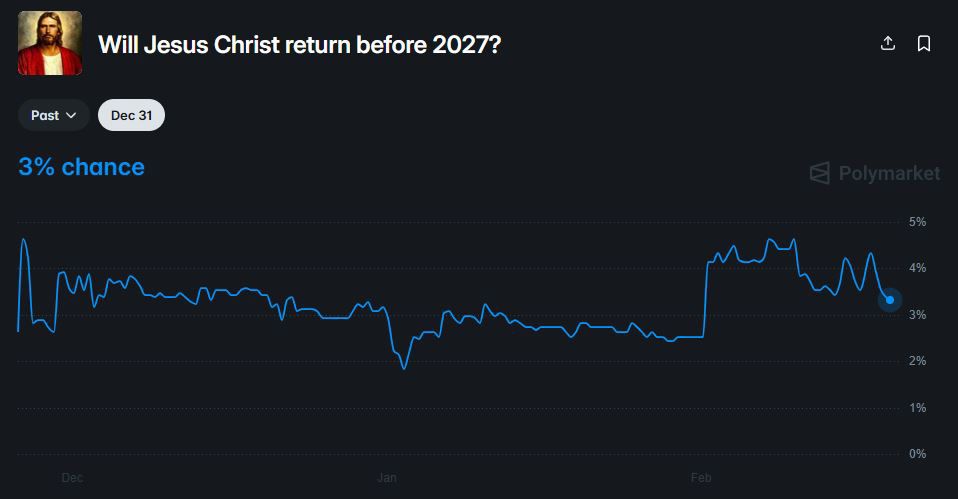
Potential Jesus jackpots aside, that got us thinking. What do the world’s major faiths say about gambling?
Christianity
The Bible never explicitly mentions casinos, lotteries, or sports betting. But it has plenty to say about money, greed, and stewardship. Many Christian critics of gambling point to verses like 1 Timothy 6:10: “For the love of money is the root of all kinds of evil.” Hebrews 13:5 adds, “Keep your lives free from the love of money and be content with what you have.”
Some Christians argue that gambling fosters covetousness, and can undermine trust in God’s provision. Proverbs 13:11 warns, “Wealth gained hastily will dwindle, but whoever gathers little by little will increase it.”
That said, Christian views vary widely. The Catholic Church does not consider gambling inherently sinful, stating in the Catechism (§2413) that games of chance are morally acceptable unless they deprive someone of what is necessary for themselves or others. However, many Protestant denominations discourage or oppose gambling outright, especially when it becomes addictive or exploitative.
Judaism
The Torah does not directly ban gambling, but rabbinic tradition wrestles with its ethics. The Talmud (Sanhedrin 24b) disqualifies professional gamblers from serving as witnesses, labeling them as dice players who do not contribute productively to society.
Biblical principles often cited include Exodus 20:17: “You shall not covet… anything that belongs to your neighbor.” Some rabbis argue that gambling resembles a form of theft if one party wins money based on unrealistic expectations rather than informed consent.
At the same time, casual or recreational gambling is often treated more leniently in modern Jewish communities, particularly when it does not harm others or become exploitative.
Islam
Islam is among the clearest and most uncompromising on gambling. It is explicitly forbidden.
The Qur’an states in Surah Al-Ma’idah 5:90: “O you who have believed, indeed, intoxicants, gambling, sacrificing on stone alters [to other than Allah], and divining arrows are but defilement from the work of Satan, so avoid it that you may be successful.” The next verse (5:91) warns that gambling and alcohol sow “enmity and hatred” and distract from the remembrance of God and prayer.
Because gambling involves uncertainty and unearned gains at another’s expense, it is considered haram (forbidden). In Islamic jurisprudence, even small-stakes betting falls under this prohibition.
Hinduism
Hindu texts offer a cautionary tale rather than a blanket ban on gambling. The Mahabharata famously centers on a disastrous dice game in which Yudhishthira gambles away his kingdom, his brothers, and even his wife Draupadi, triggering a devastating war.
The Rig Veda (10.34) includes the “Gambler’s Lament,” a vivid warning against wagering on games of chance. The hymn portrays gambling as addictive and ruinous, describing dice as “deceptive, hot and burning,” arguing that “they give and take again.”
While Hinduism does not universally prohibit gambling, many traditions warn against it as a vice when it leads to moral decline or neglect of duty.
Buddhism
Buddhism approaches gambling through the lens of suffering and attachment. The Sigalovada Sutta (Digha Nikaya 31) lists gambling among activities that lead to the “loss of wealth” and social decline. It warns of six drawbacks to habitual gambling, including the loss of friendships, loss of credibility, and – of course – loss of money.
Because Buddhism teaches non-attachment and mindfulness, gambling, which often feeds craving (tanha), is widely discouraged. While not always framed as a strict prohibition, it is seen as unwise and spiritually counterproductive.
Is Gambling a Sin?
Across traditions, a pattern emerges. Few faiths frame gambling as harmless fun. Most warn against greed, addiction, exploitation, and the social fallout that can follow in its wake. Islam forbids it outright. Christianity and Judaism debate its moral limits. Hindu and Buddhist texts caution against its destructive potential.
Across time, culture, and faith, the moral concern over habitual gambling is quite consistent. And while few faiths explicitly prohibit gambling, all warn of its destructive potential: what begins as a game of chance can quickly become a test of character… so it’s best to be careful.
Does that mean placing a wager on Jesus's return is a bad idea? You'll have to be the judge.
40 comments
-
 Dr Raymond Furr
Yes gambling is a sin for the Christian people. It is same way as loving money more then God.
-
 Rev. Matthew Mastrogiovanni
It's real simple, does what you want to do distract you from god for even a single moment?
If no, then you're okay, if the answer is yes, then it's a sin. Double down, if whatever it is might be fun.
-
-
 Wayne L Christensen
In my mind, although I will reread the crucification of Jesus "soldiers gambled at the foot of his cross for his robe, and this troubles me. Still many gamble for many things, like making it to work on time, Bingo and most are innocent enough because they are not gambling their lives away or the lives of their families. It is the addiction that does harm, the hopes by gambling their lives will better without working for a better life.
-
 Lynnea Urania Kaylor
I gamble every day.
All I have to do is get out of bed and bet that I won't fall on my face. All I have to do is cook a meal and bet that I won't get sick from something that will be recalled the next day. All I have to do is go outside the door of my house and bet that I won't be mauled by the neighbor's dog or shot by a local hooligan. All I have to do is drive and bet that I won't get T-boned. All I have to do is work and bet that I won't get harassed from someone I meet in a public space. All I have to do is join my aviator friend and bet that her plane won't crash. All I have to do is post on this blogsite and bet that nobody is going to put me down but that everyone is actually interested in civil discourse.
And when I go back to bed, I look back on all the bets I made throughout the day and realize that it really was a miracle that I came through it after all. And with a prayer of thanks, I bet that there will be another day to gamble the same way all over again.
-
 Patricia Ann Gross
I really like your perspective on this. I find it refreshing.
-
-
 Jessica Forbes
I would say don't gamble more then you pay for your bills to keep it in perspective. And don't bet against the harm of somebody.
-
 Kevin Patrick Dabbs
If you follow mainstream religion, everything is a sin, in my spiritual beliefs, gambling is wrong, but we don't say you are going to hell for gambling, as far as Jesus returning, I have been hearing this for 60 yrs, it is NOT going to happen, it is just another scare tactic for mainstream religions to use to keep people lassoed,
-
 Tom Herman
Many churches sponsor gambling. They hold raffles, sponsor bingo nights, etc. I see no harm in any of that. However, to bet on the return of Jesus seems a bit ridiculous. That return will be judgement day. All the winner will get is prehaps the satisfaction that their guess was right.
-
 Steven Ferrell
Worked to hard for my money to gamble it away.
-
 Ronaldo
I'm an avid gamer. Not online games, but board or card games. I play to socialize, and I don't get angry when I lose. It's just a game. Some of my friends like to play with money on the table, so I'll place bets I can afford to lose. Making money gambling is not my goal when playing. Socializing is. I've gone to a couple of casinos with friends, and have never won or lost any substantial amount of money while there. My goal was the experience, not the money. The goal is the key here. Scripture does not say "money is the root of all evil", though some misquote the passage often. The key word in the real phrase is "love". When "the love of money is the root of all sorts of evils" is considered, it's easy to see that love, and not money, is the subject of the sentence. I like money, because it's a tool that allows me to accomplish good things in my life. I do not love it more than Jesus, or my bride, or even my dogs. I have true love for them, but money is just a tool, so I don't "love" it any more than I do my hammer, or my multimeter.
-
 John Casillo
IT SEEMS THAT EVERY DAY GOD GAMBLES ON US......SO DON'T LET HIM DOWN!
-
 Sir Lionheart
Did you have a particular god in mind? Just asking for a Krishna friend of mine.
🦁❤️
-
Rev. Matthew Mastrogiovanni
The god of Abraham is allegedly: Omniscient, omnipotent, and omnipresent. So, "He" gambles on nothing.
-
-
 Tami Tabone
I don't believe in "sin" as discussed in most holy books. So therefore, my perspective on gambling is that it is not a bad thing as long as no one is being harmed, including the gambler. As I always live life in moderation, I never gamble more than I am ok in "losing" and most of the time, it is so little that I see it as cost of playing the game. However, this is not about a monetary gamble. This is something divine. More of a competition for the correct answer. Who will be right? And will we recognize it, if it happens, when we see it? I don't personally believe it is going to happen the way we think it will. But gambling on it seems to take away from the whole divinity of it. Let's be surprised. What an adventure life can be.
-
 Donald V. Dunham
There are a lot of opinions here but not much actual study being referenced. Any serious discussion of theology requires historical context, manuscript comparison, and more than one English translation. Cherry-picking verses or relying on a single translation does not produce defensible conclusions. If we’re going to comment publicly on religious ethics, the standard has to be real scholarship, not personal interpretation.
The King James Version is a 17th-century English translation based on limited manuscripts available at that time. Serious study compares Hebrew, Greek, and multiple manuscript traditions. No credible scholar relies on a single translation for doctrinal conclusions.
There is no direct recorded statement from Jesus specifically addressing gambling. Scriptural warnings focus on greed, exploitation, dishonesty, and neglect of responsibility. Any honest discussion has to deal with those broader principles rather than inserting modern assumptions into the text.
Everyone is entitled to an opinion, but public theological claims should be grounded in actual study. Without context, language history, and full-text analysis, conclusions are speculation.
-
 Gregory Allan McLeod
The author of this piece totally misrepresented the Jewish faith and what they believe. Got himself calls the Jews "children of the devil" and l"iars and deceivers".
-
Gregory Allan McLeod
Roughly 60 million Christians kills by Jewish lead Bolsheviks and Jesus didn't return then?
-
 Patrick M Persinger
Ignorance is unbecoming.
-
-
 Joseph Grieco
I'm kind of disappointed. No one posted the old joke about the "Chip Monks of Las Vegas".
According to the Gospels, the "Roman" soldiers (likely Syrian Auxiliaries) cast lots (i.e. had a dice game) for Yeheshua's clothing. They made one mediocre movie and one really crappy sequel to it based on that one verse. And they probably had more impact on the people of the US than the actual Gospel did.
A simple reading of the New Testament anticipated Yeheshua's return during their lifetimes, not at some future date. What no one expected was that Christianity would eventually be co-opted by the Empire, once they found it was too big to suppress anymore. All the teachings about the Rapture and the Second Coming stem from "apocalyptic revivalism" of the early to mid 19th Century.
-
 Dr. Zerpersande, NSC
Death and taxes? You can switch out prison for taxes if you wish.
-
 Rev Ned
Most religions would be against gambling for business reasons. The less money parishioners have, the less they have to PTL, pass the loot. The Catholic Church has turned gambling into a lucrative side hustle, bingo etc.. The Lutherans used to consider life insurance gambling that you were gonna die before the policy was paid off.
-
Patricia Ann Gross
I am assuming that the Life Insurance point was that the insurance companies were making that gamble, which is standard in the industry. Auto insurance companies gamble you won't total your car. Home insurance companies gamble it won't burn down. Health insurance that you won't get sick, etc. They employ statistitians called "underwriters" to determine the odds, and thus your policy rates.
-
Rev. Matthew Mastrogiovanni
Only Abrahamic faiths.
-
-
 Barbara Harris
I have worked in the casino industry for 28 years. In that time I have seen quite a few of the religious leaders of various churches in the area gambling. And I'm not talking the little grandmother who comes up once a month and spends a few bucks. These guys show up in the middle of the night and drop thousands in a few hours. And then when folks start showing up they are gone. One even would park his car in a remote area of the town he lives in and have a private limo pick him up. So the "do as I say and not as I do" still seems to be a common thread here.
-
Joseph Grieco
That reminds me of the old joke, Protestants don't recognize the Pope, Catholics don't recognize the Archbishop of Canterbury, and Baptists don't recognize each other in the liquor stores or casinos.
-
 Pastor George Day
Joseph Grieco
The Protestant pope isn't the Archbishop of Canterbury but the king of England, by tradition.
-
-
-
 Colleen McAllister
I rarely gamble, and then only on a vacation to Vegas or Laughlin. I play only those slots that a gaming component. I rarely win and what little I do provides money for souvenirs. Mostly what I do is sightsee.
Is gambling a sin? Depends on whose money it is. If it's God's, then, yes it is a sin.
-
 Brother Peter
Just about everything in life has a probability associated with it (except death and taxes), so can be considered a gamble.
-
 Reverend Paula Copp
Anything in excess is frowned upon by most religions. The focus, for religions, is worship- and anything which changes that focus is strictly forbidden. Addiction- to anything- is devastating to the addicted and to society.
-
 Douglas Robert Spindler
Christian leaders want you to bet all your money that there is a Christian God so you will give them all of your money.
-
 Nicholas J Page
Gambling is the work of the devil
-
Sir Lionheart
If you are using the human construct word “devil” as a meaning for “unhealthy”, yes you are right. It can lead to terrible addiction, that can cause a break-up of marriages, and financial ruin.
🦁❤️
-
-
Sir Lionheart
Ironically, all faiths use Pascal’s wager just in case they are wrong with their belief structure. That in itself is a form of gambling. Pascals wager allows them to hedge their bets. 🤭
🦁❤️
-
Dr. Zerpersande, NSC
For me, the problem with that is that you’re supposed to express a belief in something. And to me having that belief is very different from simply attending church and putting some money on the plate every once in a while. You can’t fake belief. And if you’re dealing with something that supposedly has all the powers of these various deities then they’re gonna know. They’re gonna know you don’t believe. So you wasted your time.
I think it’s kind of like the AA thing, fake it until you make it. The AA **** didn’t work for me either. I stopped drinking, but it wasn’t because I accepted their higher power concept.
-
Pastor George Day
Dr. Zerpersande, NSC
AA has no Higher Power concept. You just choose your own. So, why blame AA?
-
Dr. Zerpersande, NSC
AA most certainly does have a higher power concept. because it’s in the second step. “Came to believe that A POWER GREATER THAN OURSELVES could restore us to sanity.” And it’s much easy to say HIGHER POWER than what is in the second step.
Now, you are correct that you can choose your own. I’ve even heard it said you can choose a door knob. However, there is a push toward Christianity and you can see it in the third step.. “Made a decision to turn our will and our lives over to the care of God as we understood Him.” now not only turns that higher power into the first person-singular-masculine form but CAPITALIZES it. Well, H-E-L L-O-O-O Abrahamic god!
I go up to meetings in June of various years. I went to almost every weekly meeting for the first year. Then I skipped a year. I have since skipped up to 3 years between meetings. Currently, I’m on a three -year hiatus which follows a two year hiatus. I just can’t take the religious nonsense.
I go for two reasons. One is because I consider one of the guys to be my friend. I took him as a sponsor for a while. He fired me because I told him that the big book made me nauseous and I didn’t read it. But we’re still friends. Another reason I go is because I’ve heard that people that have as many years piled up as myself give him inspiration to others. Problem is that 90% of my long years involve not going to meetings. Because I don’t count one meeting in a year as ‘going to meetings’. I have to be careful though. What works for me? May not work for others. AA has a very low success rate as it is. Some studies have shown you have about as much chance of quitting with AA as you do just quitting by yourself. Which is what I did. But last time I went one guy wanted to contact me about a business I run and so I gave him my contact information. But when he contacted me, he asked me what I thought about him not going to meetings. I didn’t encourage him either way. I did tell him about a book called. “Rational Recovery”. That’s how I stopped drinking. But I would never have found out about that book without having gone to AA. But I found out about the book through some guy that, like I now do, showed up to the occasional meeting.
But I digress. In summary, AA most certainly does have a higher power concept. The concept is that you need/must have one. It’s not true but it’s there. And the first person-singular-masculine pronoun is a push toward the Abrahamic god as that higher power. I’ll argue here on this morning. But I’m not going to go into a group of people that are trying to stop drinking and do anything that might reduce their chances of succeeding in the effort.
-
-
-
 ether_ore
But that is still playing long odds. To really hedge your bets you need to bet on more, many more, than just one!
-
Pastor George Day
Sir Lionheart
Where did you hear that?
-
Sir Lionheart
Well, knowing that no one can “prove” their religion, and this is why all they have is faith, headed by the deity they want to believe in insisting is real, there are obviously two schools of thought/beliefs regarding religion.
Either they are:
1) Totally delusional, having convinced themselves that their particular religion, and deity, is the real one. In which case it’s a form of mental illness. Much like me convincing you that fairies really do exist to the point that you would be prepared to die for your faith and belief in fairies, and some people would even kill us if we didn’t believe in their fairies. You might be thinking that is a weird delusional comparison, but in reality, it isn’t. It’s no more delusional than other human beings believing in their gods and not yours.
Or:
2) They are not delusional, but like to think there could be a god but don’t really know which one to believe in, so will say they are god fearing, just in case there really is a god and Hell exists, and if there is, they could win the lottery and get a pass from going to Hell. If there isn’t anything after this life they haven’t lost anything. They might get lucky and find that there is no God, but fairies really are real. 🤭
Thanks for your question. 🤗
🦁❤️
-
-

"lots are deceptive, hot and burning, they give and take again. O you who have believed, indeed, intoxicants, gambling, sacrificing on the ground as an alters to other than YHWH, and divining your children's meat in defilement from the work of Satan, so avoid it that you may be successful.” Book of Nathaniel Jesus quoted out of. It's where the hard core anti gambling Christians get there believe. I learned it in Christian College studies on Christian Archeology. ("Lots" is ancient "Dice" been around since at least 1500BC)