

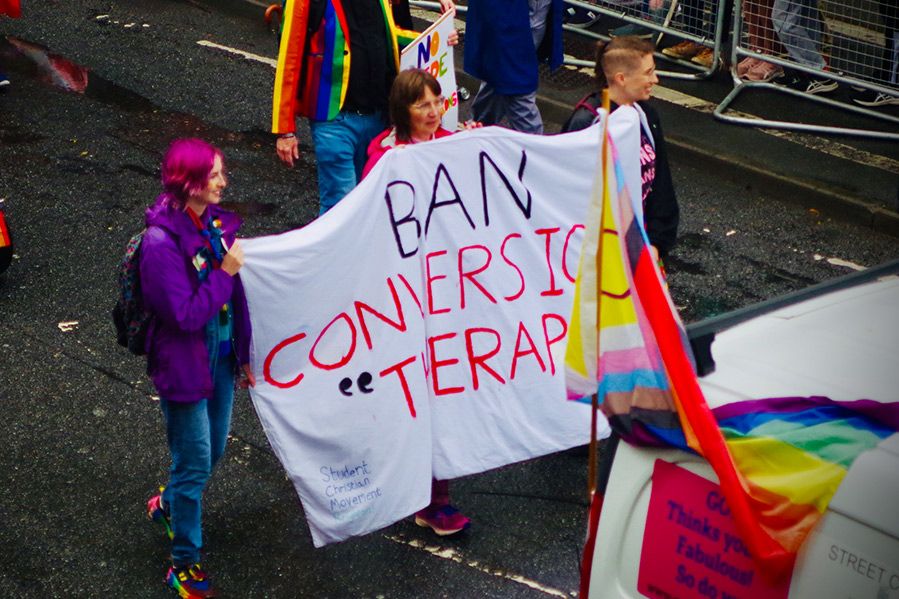
The Supreme Court just sided with a Christian therapist in Colorado who says her First Amendment rights were violated by a Colorado law prohibiting the controversial practice of conversion therapy for LGBTQ+ youth.
The Court’s 8-1 decision in Kaley Chiles v. Patty Salazar, executive director of the Colorado Department of Regulatory Agencies, et al., will likely have sweeping implications nationwide; More than 20 states have laws restricting conversion therapy.
Members of the nation’s highest court argued that Christian therapist Kaley Chiles’ speech was being unreasonably restricted by the law, though the lone dissenter – Justice Ketanji Brown Jackson – argued that some First Amendment restrictions aren’t unusual when it comes to medical professionals.
Now, it seems likely that conversion therapy bans across the country will be rendered unconstitutional in the name of religious liberty. Did the Supreme Court get it right?
What is Conversion Therapy?
First, some background. What is this practice and why is it so controversial? Conversion therapy is the practice of attempting to change a person’s sexual orientation or gender identity through talk therapy, typically aiming to make LGBTQ+ individuals heterosexual or cisgender.
These efforts can include counseling, behavioral conditioning, religious interventions, or other psychological methods. Conversion therapy is often rooted in a religious belief that non-heterosexual orientations or gender diversity are abnormal or undesirable, and that sexual orientation can be changed.
Major medical and mental health organizations, including the American Psychological Association, have widely discredited the practice, citing a lack of scientific evidence for its effectiveness and significant evidence that it can cause harm – including anxiety, depression, and trauma. A 2020 report by the UN Independent Expert on sexual orientation and gender identity concluded that “depending on the severity or physical or mental pain and suffering inflicted to the victim, [conversion therapy] may amount to torture.”
Religious therapists have long stated that conversion therapy bans restrict their First Amendment rights, arguing that changing clients’ sexual orientation is the only way they can treat the LGBTQ+ community in a manner in line with their religious beliefs.
The Supreme Court Ruling
On Tuesday, the Supreme Court decisively ruled against a 2019 Colorado law banning therapists from practicing conversion therapy on minors. Kaley Chiles, the evangelical Christian therapist who originally challenged Colorado’s law, argued that it prevented her from treating youth clients who wanted to live a straight, heterosexual life “consistent with their faith.”
“While the First Amendment protects many and varied forms of expression, the spoken word is perhaps the quintessential form of protected speech. And that is exactly the kind of expression in which Ms. Chiles seeks to engage,” wrote Justice Neil Gorsuch in the Court’s majority opinion. “Colorado’s law does not just regulate the content of Ms. Chiles’s speech. It goes a step further, prescribing what views she may and may not express.”
The judgment was not unexpected. In recent years, the Supreme Court has placed a high value on religious liberty and the right to faith expression in public life, siding with a high school football coach who prayed on the 50-yard line during games, ruling that a Christian web designer could legally discriminate against same-sex couples, and even agreeing with religious parents that they should be able to opt their kids out of any school lesson which might mention or acknowledge the existence of LGBTQ+ people.
RELATED: Supreme Court Justice: U.S. Should Return to "Place of Godliness"
What Did the Dissent Say?
Two members of the Court’s liberal wing – Justices Elena Kagan and Sonia Sotomayor – ruled with the majority. Only Justice Ketanji Brown Jackson dissented, arguing that “this decision might make speech-only therapies and other medical treatments involving practitioner speech effectively unregulatable.” She says that in overturning the lower court ruling, the Court unwittingly opened the door to the challenge of longstanding regulations governing medical ethics.
“To put it bluntly,” she wrote, “the Court could be ushering in an era of unprofessional and unsafe medical care administered by effectively unsupervised healthcare providers.”
LGBTQ+ advocates agree, and are condemning the ruling for privileging religious practice over their community’s health and safety.
“This is a dangerous practice that has been condemned by every major medical association in the country,” stated Glad Law Director of Family Policy Polly Crozier. “Today’s decision does not change the science, and it does not change the fact that conversion therapists who harm patients will still face legal consequences.”
What is your reaction?
101 comments
-
 Kirsty Hermiston
What happened to We are all Gods children? Love all?
-
 Leslie A. Hulberg Née Tomasura
How many people have died because of “conversion therapy?” How many kids will end up committing suicide rather than coming out? How many will be confused or leave their spouses later in life rather than live a lie? And how many people will be affected by that person leaving? What about future children? How will they be affected? And the spouse? How will it affect them knowing they will never be able to truly satisfy the needs of their spouse? I believe if you love someone you set them free. You don’t try to change them to suit your identity. Parents just need to love their children regardless of who they are. Don’t try to change nature. It doesn’t work. And apparently your love for them comes with caveats. That’s the saddest part of it all.
-
 Rev. B.D. Rees
I believe in "One God". The Father almighty. I believe in the "Holy Trinity" The Father, Son, and the Holy Spirit. I believe in "God who created ALL THINGS. With that being said:, I believe with my whole being that, "GOD DON'T MAKE MISTAKES".... For those people who believe my being Gay is wrong on some biblical level, I say this to you: "I think that by not listening to the TRUE WORDS OF CHRIST, Not listening to the lessons Christ taught, and NOT heeding the Ten Commandments that GOD gave to us, You and your belief system are more IMMORAL than I could EVER BE!! You are NOT teaching the Love of Christ to your fellow church goers, you are instead teaching HATE, DISCRIMINATION, and BIGOTRY!! So don't give me your Pious attitude about being a Priest or a Minister of God and teach your parishoners the Hate you have been brought up on!! Listen to the gentle words of Christ, and feel the true feeling of the Holy Spirit in the practice of giving and respecting your fellow man whoever they may be.....
-
 Mary E Benoit
Sexuality is broader than he she. I never questioned my sexuality, never explored, happy being heterosexual. Being gay is the same except society has expectations that we all need to overcome. Love is love.
-
 Rev Ned
You can’t “Pray the gay away”. Further evidence that Christofascist Republicans are stupid and/or brainwashed.
-
 Gillian Brown-McCord
It drives me bananas seeing this administration being so oppressive. I realize that there can always be concerns about parents making permanent decisions (like gender affirming care) for their kids, who may well be taking a temporary and fadish lifestyle view, but I prefer to think that a child's parents know them well, and are capable of knowing what is best for them. I really think conversion "therapy" is much more akin to an abuse protocol, not unlike what you see in these teen delinquent boot camp, "scared straight" scenarios, where they bring teenaged children into adult prisons for a day, and allow behaviors to happen in a prison, that wouldnt normally even be allowed between the adult prisoners. When the action is simply a means to an end (traumatizing someone into compliance) its not truly conversion therapy, its more akin, legally, even, to the same exact issues the teenager or adult was facing that got them in trouble to begin with- I would call it compelling a person into a state of complacency, by coercion. Coercion is generally an illegal method of gaining consent. Its not allowed for gaining sexual access to a person, its not annallowable means of gaining a confession, and it sure as God is Good, isnt a means of managing a persons sexuap attraction preferences or gender identity.
Jesus Himself accepted trans folks, in Matthew 19. I will never back down from this. A eunuch is a simple concept- it is all encompassing of any person, born or made, that is incapable of having children. Jesus said some are born that way, some are made that way by other men, and some are made that way by personal choice. Jesus said "all that can accept that, should accept it."
When our Creator is talking about "homosexuals" understand, that word wasnt actually used. These terms were added in, during the MIDCENTURY by the Germans in charge. The Germans were, at that time, very white supremacist, and had JUST been killing anyone that was nnon German, non White, Jewish, and yes, Gay or Trans. Berlin was a bustling progressive home to a very inclusive population, just before the Nazis took over. After the war ended, the Germans who lost, pushed their ideaology into the bible, by changing a few words. Originally, the terms in original scripture that now read "homosexuals" the VERSES of Scripture said God was talking about men who lay with young boys. Pedophiles.
The fact that all this LGBTQ+ hate is continuing to be pushed and perpetuated by what can only be described as the Nazi regime, or perhaps, the NeoNazi regime. Its exactly the same in concept.
We have been in a Great War, between Good and Evil since the 1920s. This IS a long war- and practicing tolerance, patience, kindness, and love, and even more importantly- giving God the Glory, on an ongoing basis, is THE way we, and God, will win this war. Oppression is the Antithesis of God. God never wanted us to oppress each other, at all. Be mindful of your capacity to welcome all with a kindred spirit, and have a "come as you are" mentality, and when we do this, we will be fighting alongside God. His Word and His Messengers are also not our charges. We also have to stand up for the orphans, the unwanted, the sinners in prisons, the the widows, and even for an evangelical approach to the very same Nazis we are trying to conquer. Its how God will win people BACK. Repentance is important. Lets all focus on that. Amen. To God Be The Glory!!!
-
Gillian Brown-McCord
"The fact is,* that..."
Wish I could fix the many typos.
"God and his messengers are not our ONLY charges..."
And other missed words and added characters, obviously, that can misconstrue my post.
AMEN TIMES A MILLION. THANK YOU GOD.
-
-
 CJC
CJC
I think it's pointless but you have to decide where a parent's rights start and stop.
-
 James Riggle-Johnson
Hit them where it hurts—money always speaks. If conversion therapy is going to be allowed, then the people harmed by it should start suing the therapists and organizations responsible for the damage they’ve caused. I do not understand how a medical professional can legally inflict psychological harm on a patient. Every major medical and mental health association has already concluded this practice is harmful—yet that consensus is being set aside by eight justices with no training in the field. If the courts won’t call it harm, juries might.
-
 High Priest Shadowwolf
Look, Let me be crystal clear here, No Therapy, Praying, or any other actions is going to change who a person is and using religion to do so is crazy. That person should be going to therapy to figure out why they feel the way they do. I am a gay man and i have found out that Most ( I wont say all ) that have issues with gay people are not secure in their sexuality. I have set down with a lot of people that were raised in the Christian Faith being taught that they should go out and judge people for what they do or for who they are, now I am a wiccan High Priest and I work with all faiths. I do not care who you pray to because it is our choice how we want to believe. (the Christian Jesus did hang out with the stand up follow the law people he hung out with the crooks and the ones not following the laws of God but yet he didn't judge them. Just as God states do not judge unless he be judged the same). If people ( and this doesn't only affect Christians ) would actually follow what their religion teaches then they wouldn't worry about what others were doing they would be looking at what they are doing and trying to help others as it states in all religions. As Wiccans we believe in An Ye Harm None, Do What Ye Will. No I know people are going to take that as if we can just do what ever we want but no this means do what you want as long as you harm no one and that includes yourself. Sexuality is for no one to decide but that person and if its something that you don't agree with then you as a individual can stay away from it but you have no right to try and dictate how others should live. Now let me be clear I have no problem with any religion, I have a problem with people trying to use religion to push their idea of how people should live. I use to live in Kansas where the Phelps are. They picket even Christian churches and they themselves claim that they are Christian. This for me makes me sad for Christians because that is not what the Christian God teaches. He teaches love, Acceptance, Caring, And treating others as you would want to be treated. Now I will say that no I don't think anyone under the age of 18 should have gender reaffirming surgeries or hormone therapy. But let me be clear on this that is my opinion, and i have a right to that but at the same time it should also be up to the parents to help make that decision for their child. How would you like it if I told you how you could live and how you could dress or what you could eat and do or even with your children. Now i know your going to tell me it isn't the same. But I hate to tell you that it is. When are we all going to start to love each other and and show one another that we care instead of showing hate. Think about it if we all did that then we wouldn't have all the issues that we do in our Country.
-
Gillian Brown-McCord
You are fantastic, and totally SPOT ON, with all of this. AMEN!!
-
-
 Penny Prentice-Best
If we were willing to focus on some core teachings associated with Christianity, and most major religions, love thy neighbor as thyself, and do unto others as you would wish it done to yourself, we might be less quick to judge and condemn, more accepting of our differences. Our humanness tends to lean toward suspicion and rejection of those who do not conform to our particular concept of "normal". Our religions have developed complex ways to judge and "weed out" or "save" those who don't fit. Members of the gay community have been recipients of religious judgment and "corrective efforts" for centuries, but in many tribal cultures the nature of their character and skills were more important than their sexual preferences. By excluding, shunning, judging any group of people as broken, less than, undesirable, because of appearance or ethnicity, or sexual preference, we automatically force them to hide who they are, devalue them, cause emotional pain and inner conflict. Why? Being gay does not make one a criminal or a deviant. Our Creator has not made a "mistake". Our humanness is but one expression of divine creation in this vast universe. Let us work on expressing that humanness with kindness, compassion, courage, and generosity towards one another.
-
Gillian Brown-McCord
This. Kudos to those Ordained to speak the truth, and who are fighting this good fight, with Love and Compassion. You are serving the Lord, mightily. Keep up this work. It is Essential. AMEN AND BLESS YOU.
-
-
 ronald
verbale thropy is used for a lot of ceses of all kinds, what every one is saying is there is no therapy for a gay person, but no one ways you can walk away from treatment if it's not working. praying all you want doesn't erase a sin. and if you see it as a sin and keep doing it then praying is a habit and not a real quest to correct the problem. some answers sound like a political sound bite not a real thought for where it stands with the bible and jesus,
-
 Brian Scott Hoff
So now a parent can decide that their children should be talked into being straight. The kid has no recourse to not go through with this. The "counselor" can say anything they want. And.. our Constitution is OK with that? Disgusting.
-
 William R Clapie
Using the bible to justify anything is wrong. The book is a collection of fables, allegories, horror tales, etc. "The bible" as far as I know has few referents about sexuality, "tho shall not lay with man as with woman", or something similar. Hummm. Choir boys anyone? Passages of a priest calling on God to punish children that called him bald, had the kids murdered did he! Many other examples. Question, if there are now eight billion people in this world, where did they all come from? Eve was made from a part of Adam. Hummmm. Cloning? Then one "hellacious" amount of begats to get where we are today. I will let the cloning question remain open since Eve popped out without all the parts.
-
 Rev. Dr. Robert Allan Roush
Only therapies that have peer-reviewed effectiveness should be used. Therapists should help people explore and find their true selves. Gentle self-exploration and introspection guided by a skilled therapist goes a long way.
Unfortunately, the Colorado law was poorly worded and didn't allow for an exploration that would conclude anything but LGBTQ. This kept many therapists from even taking such clients, leaving many out in the cold.
Balance needs to be achieved. There's a reason why the liberal justices also struck the law down.
-
 Shawn Peter Flanagan
The Hippocratic Oath states i will do no harm, i will put my patients first. So if conversation therapy harms a person, by mental,physical, or emotional harm then they are in violation of that Oath.even as a minister we must have compassion, and understanding as to what is best for the one to whom we are talking to. Dose a child know the difference between heterosexual or bisexuality , answer in No they don't; but a teenager dose so what age are we talking to and what is the mental state of the individual. Before we can discuss the sexual preference we need to understand the individual. To many people try to step in with( helpful) suggestions, i say if you are not a Doctor in that field keep quiet and mind your own business because they went to school for that field but please Doctors remember your Oath, and as you talk to them remember that GOD is standing there as well and he sees you both. Amen.
-
 Christopher Michael Carlson
Seems like things were worded to fit a specific agenda. They didn't argue that "conversion therapy" was beneficial. The arguments made were to argue that delving into Gender Dysphoria topics shouldn't be blocked. Therapy should be all inclusive. If one therapist can essentially introduce the idea that a male could be a "transgender" female then there should be no reason whatsoever that another should be able to dive deeper and maybe find an underlying cause and actual help repair it before making someone another headline and possibly causing them more harm. Chloe Cole went through serious irreversible trauma because she didn't get the actual help she needed and at the age of 15 she had both of her breast's removed and will NEVER be able to breastfeed her children if she is even able to have her own children. Stop playing games this practice is literally ruining people's lives.
-
Gillian Brown-McCord
There is one aspect about Chloe Cole I agree with you abd her on: She was indeed (at minimum) dealing with traits associated with borderline personality disorder. I dont think she ever even got a Psych Eval. That said, I think anyone who is misdiagnosed or even correctly diagnosed, even potentially having this disorder, deserves to get several years of psychiatric care to treat the underlying disorder, before gender affirming care becomes an option. That said, I do approve of all legislation that allows an injured party to file a personal injury claim against doctors who failed to fo their due diligence before performing gender affirming care. But I wont agree that "the practice" of gender affirming care IS what is ruining peoples lives. The practice that is messing people up, is indeed the sin of greed, along with Pride. When these two sins get together, no good can follow. Just something to chew on, there.
-
 Patricia Ann Gross
Gillian,
What you describe here is the SOP for the transitioning process. A minimum of two years of therapy with a qualified clinician who has to sign a "clearance" that the patient/client is ready to start the process. Sometimes, more therapy is warranted. After that, at least two years of hormone therapy before any [reputable] plastic surgeon will perform the top or bottom surgery.
By the way, some women who have family history of breast cancer opt for a total bilateral mastectomy, especially if they carry a certain gene that has been known to be common among women with breast cancer. As for her ability to have children, if they left the "bottom parts" alone, a mastectomy would only affect her ability to breast feed the child. That would only be an issue if they performed a partial or complete hysterectomy and did the reconstruction to complete the sex change.
Bottom line is that there are at least four years from the time a person decides to transition until any surgery, if this person had her breasts removed at 15, she very likely tried to rush the process rather than let it play out. Whether it was the parents, the child, or the therapist, it doesn't matter, the process was not followed.
-
-
-
 Jayne Marie Richards
The only part of conversion therapy allowed is talk therapy. All other conversion techniques are still banned as they should be. Let's be real here, the only people sending their minors to conversion therapy are religious folks who believe it's a sin. Non-relgious therapists do not push judgment on their clients nor is it permitted.
-
 Linda L Noel-Duquesnel
If "God" doesn't make mistakes, then conversion therapy wouldn't be necessary...correct? They can't have it both ways. Make it make sense.
-
 Roger Harold Gray
challenging questions - legal, medical, psychological. from a legal viewpoint, the challenge regards 1st amendment issue. this is not a surgical procedure..."only" talk therapy. from psychological viewpoint, the treatment is nonsense and potentially very destructive. from the medical viewpoint - should the practitioner be required/recommended to provide risk of treatment warnings? eg. Dear parents and patient/client -- this therapy runs the risk of increasing suicidal ideation or behavior. As with any medication or procedure? If the treatment fails, or worse creates damage, might there be grounds for a malpractice suit?
-
 Clara Ries
All medical practices should be in alignment with current standards of care and decisions should be left to the individual (or their parents) and medical professionals, period.
Religious counseling outside of a medical practice should be protected by freedom of speech unless it is harmful to an individual in a direct way, in which case civil or criminal litigation should be available as a remedy. This would include counseling that contradicted statute law, such as we have seen in sex cults, the Peoples Temple, and other groups working under the guise of a church or religion.
However, religious counseling should not ever be considered therapy. It is not.
-
 K. Doc Patterson
God loves all his creations with unconditional love. Religion interpretation has made rules to reject God's children because they are different. It’s says “Love thy neighbor as thy self”. Jesus made life pretty simple his people have changed his word to make them feel comfortable. Sad state of affairs.
-
 John Florea Jr
I suppose ice-pick lobotomies will be ok now as long as you claim a religious belief. This is ridiculous and another reason that religion should be banned across the globe. Evil people will twist religion whatever they want to do, even if it violates others. What about the right to refuse medical treatment? I guess your right to choose goes away if someone else has a religious belief. Almost everyone I have ever met that was forced into conversion therapy has chosen to NEVER speak to their parents again and most no longer trust the medical profession.
-
 Christopher Charles Douglas Paradis
No one is calling for Lobotomies. This is simply people seeking counselling to change their behaviours of their own free will. That should be their right to do so.
The myth that so called conversion therapy involves barbaric means such as lobotomies and electric shocks is living a fictionalized version of the modern mental health industry.
Your example seems to involve children. I would say such counselling should be with people deemed as adults as I do believe that the person seeking help should not forced into something and seek out help willingly.
-
Christopher Michael Carlson
Yes, it wasn't even an issue of converting a gay child to be straight. It had to do with colorado deciding therapists shouldn't be allowed to broach the subject of if someone is transgendered or maybe just a Tomboy with some other issues kind of thing. They're pushing an agenda here and not trying to actually provide all options but the one that suits their current political stances.
-
-
-
Leslie A. Hulberg Née Tomasura
And what happens when someone choses to leave the faith they or their families have chosen? Mental and physical “conversion therapies” could be detrimental to a person and lead down a very dangerous and dark path. If one no longer feels the freedom to choose, what stops the other believers from indoctrination through torture and torment? It is hard enough for someone to know they are LGBTQIA or they no longer believe something they were taught was true or right or normal (including a faith regardless of sexual orientation). What is to stop the fringe faiths to go after anyone leaving their group? When I say fringe I am referring to cult-like behaviors such as the Manson Family or something far worse that young people may have stumbled into. Or perhaps someone like myself who is the child of parents of different religions that their families and not the parents, each decided that I should grow up in their religious belief system and that the other parent’s religious beliefs were bad or wrong. Trust me when I say something as simple as that scenario is hard enough with some “conversion therapy” telling you what you feel is not normal. Who you are is not normal, it’s a mental illness etc. I don’t believe the Supreme Court has really looked at this in an unbiased constitutional manner, but rather from a religious standpoint that they were taught was “normal”. We must return to the secular so our rights and freedoms and privacy can once again prevail for all individuals regardless of gender, faith or orientation. Imagine if you were taken by a rogue band of LGBTQIA people and day in and day out, you were told that straight people were disgusting and they would all be punished and they should all be killed or jailed. Imagine too that if you showed any straight tendencies, you’d be punished and made to suffer until you conformed to the norms of LGBTQIA. Yes, it is a very unlikely situation. But, it is the other side of the same coin.
-
Christopher Michael Carlson
That was not the issue at hand when I read the actual briefs. It was a therapist being shackled from exploring weather or not a patient actually had Gender Dysphoria. The only option according to the law was to say the child or children were not find out if there were actually underlying issues or trauma couple with something like being a tomboy. I've sadly seen to many articles coming from this outlet that are absolutely biased in one direction. I believe in therapy but there are no good outcomes if you're only allowed to discuss the grass being green but not the fact that the rain makes it that way.
-
-
 PKBW
PKBW
Get rid of them
-
 Garrick William Hale
Could you please explain this post of yours? It sounds very loaded, and possibly masked in violent rhetoric.
-
-
Garrick William Hale
As a gay man, I introduced myself into conversion therapy in the past, ONLY, to still be rejected by my family in my 50's now. It does not work. Period. Tried to have myself and my god, change me for 3 years, and what happened you may ask? Nothing. If anything it increased those same sex attraction feelings. That was in the past, now I'm living in accordance with what makes me feel happy. For every time, I hear being gay is a sin, I just wanna throw up. It affects folks like me on a deep level, and as it should. People who say this are simply being willfully ignorant at this point, instead of going back to the original translations, and looking at who the audience of the bible was in Jesus' time, and the authors personal opinions thrown in, as well as thousands of translations.....As a side note, I no longer practice ''brand'' christianity now, but still have the Christ (love) energy wrapped around my heart!
-
 Elizabeth Jane Erbe Wilcox
Love your response 💕
And since “god” is omniscient, s/he already know you are gay and knows that conversion “therapy” won’t work, and you’ll always be gay, so you are exactly as you were created!
-
-
Christopher Charles Douglas Paradis
Conversion Therapy is a term coined by those against the idea of people seeking counselling to transition to heterosexuality. The activists that are opposed to the idea of counselling to change ones desires to another set of desires don't see the irony of the conversion therapy that the trans community utilizes in an attempt to change genders. Usually to the extremes of life changing pharmaceuticals and surgeries.
The way that activists paint the picture of conversion therapy is a person sat down in a chair receiving electric shocks which is not the case at all. Anybody who is seeking counselling to achieve behavioural changes of their own free will should not be restricted to do so. Anybody who is against it should therefore be against the conversion of men and women attempting to become the opposite sex. They are both conversion therapies, having said that, one is more invasive than the other. The counselling is reversible, surgeries & hormones are not so easy to reverse if one changes their mind.
-
Elizabeth Jane Erbe Wilcox
It sounds like you think being transgender is a choice. Interesting. It’s not. An education would greatly help you to understand the science behind being transgender.
When did you decide to have white skin, brown eyes, gray hair, and to be cis gender?
-
Christopher Charles Douglas Paradis
Transgenderism is a choice. You can decide to have the drugs and procedures. No one is forcing them to do that with the exception of activist parents who groom their children with that ideology.
What would a gender confused person do in ancient times when hormone replacements and surgeries did not exist. They would have to love themselves as nature made them. Immutable aspects such as skin color (not sure why you assumed white), eye color (not sure why you chose brown specifically as if was a negative trait), gray hair as things we don't have control over from birth. Arguably hair & eye color in modern times can be controlled with hair color and contacts. Skin color, not so much. We would actually be horrified that someone would want to change their skin color and not love attributes that God gave them.
That wasn't really my point though. My point was that trans procedures are a form of conversion therapy. It is utilizing outside means to make physical changes to convert a person. If a trans person can seek out that type of conversion therapy, why can't someone that has feelings for the same sex seek out assistance to not have those feelings if that is what they want to do (not forced of course). In the same sense that someone thinks they are born in the wrong body, there are those that may deem that they were born with desires they do not wish to have. You can't say one form of conversion therapy is okay but the other is not. That would be hypocritical. You would want to deny people seeking help of their own free will?
-
 Michael Hunt
It may be a choice to go through surgical transition but at what point is someone deciding that they are now transgender? Why would someone choose to be a member of a community that is regularly discriminated against, often with violence?
There have always been people who are transgender, we just now have scientific advancements that they didn't have. History is full of men who presented themselves as women and vice versa.
-
-
-
-
 Randy Michael Mellinger
God created Adam both male and female and put that as the norm, anything outside of those two genders is a perversion to what God put into play. Pagans historically have practiced homosexuality and transgenderism. The Supreme Court ruled in favor of God's plan for mankind.
-
 Brien
Brien
If I don't believe in your psychotic murderous God then what? Will you support burning at the stake? What kind of torture will you support to FORCE your beliefs on me? And just how far are you willing to go? I am fully prepared to defend myself, are you? You see my ignorant friend, this can get real ugly real quick. I am personally sick of others trying to impose their beliefs on everyone. For the record, I don't believe in the Easter bunny either.
-
Elizabeth Jane Erbe Wilcox
I’ve never heard anyone describe Adam as being intersex! That’s an amazing concept that deserves additional research. Thank you for pointing that out.
-
 Rev_Shaun
How do you know - and no bible quotes are allowed here, only peer-reviewed independent references - that a, there is a god and b, that he, she or it 'created' anyone?
-
Rev_Shaun
Which God?
-
-
 Steven Ferrell
It is those pushing that alphabet ideology and sin on children that are doing the most harm.
-
Garrick William Hale
Let me tell you something Steven. When I was a boy in first grade, I knew I was different and gay, even tho I didn't have a word for it. I wanted to receive valentines cards on Valentines Day from the boys, and didn't quite understand why everyone made such a big deal of it. There was no thought of sex cuz I was too young, but man, I sure wish someone would've been there that could've helped me or supported me in knowing I was not a freak, but just a kid trying to find his place in the world. Yep, would've given anything in my heart, to have just had someone who would've listened.
-
Elizabeth Jane Erbe Wilcox
Please tell us exactly what “harm” those of us who recognize that there is an “alphabet spectrum” are causing?
I have seen hundreds or thousands of reports of white, cis males who bring sexual harm (rapes, digital penetrations, oral copulation) upon infants, toddlers, teens, adults. Most also profess to be “christian.” Those are the demons.
-
Christopher Charles Douglas Paradis
In Stevens defence, when I was in elementary LGBTQ was never mentioned nor did it need to be. The focus was on academics and athletics. There was no activism of any kind with the exception to perpetuate the untruth about the rivalry of European settlers and Native Americans. Little kids don't need to know about the different forms of sexuality. To Steven's point, pushing alternative lifestyles are confusing and not conducive to the development of young minds.
You claim you have "seen' hundreds of reports white males doing horrible crimes yet not list examples. You did single out white men, even though those crimes are diverse in who commits them. I get it though, diversity is the ideal we live by until their is scenario where we want it less in the case of pointing out bad behaviour. The "cis" thing is just nonsense. It was coined by Dana Leland Defosse in 1994. It wasn't like it was ratified by the straight community. LGBTQ+ want things categorized so badly that just being a straight "normie" needs a letter designation. Aside from that, I can cite two examples off the top of my head of harms caused by the "alphabet spectrum". The shooter of Charlie Kirk had a lover who identified as trans and the Nashville school shooter among others. This is not to bash that side of the aisle, God knows every group has their potential to commit heinous acts but let's not pretend that one group is holier than the other.
-
-
-
 Alexander Clarke
Prayer does not work. Period. It only makes the one praying feel good.
-
 Kevin Joseph Kervick
Reparative Therapy works for some patients some of the time, and should be available for those that want it. Nobody does Conversion Therapy outside of some fringe cults in god knows where. The problem with the Conversion Therapy laws in many states was that they went so far as to scare therapists from asking good questions in psychotherapy with questioning youth. Many people, especially children, were damaged because they went down a harmful pathway that could have been avoided if therapists simply slowed down and asked good questions.
-
 James Trenton Smith
If you're grown you have free will to mutilate your body if you choose, but this is not the case for children. I think the Supreme Court got this decision about as right as they did the Dred Scott decision and the 3/5ths a man Law. What audacity does it take to call oneself Supreme... well it takes the audacity of a Pharisee...
-
 Michael Benjamin Roberts
There is a very large difference between Religion and a Cult. Christian Nationalism is NOT a religion it is a cult wrapped in an American flag just like Peoples Temple, Heavens Gate, Branch Davidians, Order of the Solar Temple etc.—esssentially a wolf in sheep’s clothing. This was a Supreme Court decision based on Constitutional Free Speech (which has also recently been perverted by our current administration). Bring the case up again citing the historic intentional harm to minors that has been caused by the scourge of Conversion Therapy—that might have a better chance of prevailing in the courts using factual anecdotal evidence by many, many of the victims and mental health professionals.
-
 Jamie Frost
Just remember; if you believe the " gay can be prayed away" then heterosexuality can also be prayed away..
-
James Trenton Smith
They are not equal...
-
Patricia Ann Gross
Just different.
-
-
 Robert Gagnon
Well according to gender and identity theory everyone is born straight, gay, bi or trans and there's nothing that can change that. I guess people that switch up later in life have a built in trigger on a certain date. Just imagine, wealth, happiness, love, political party, every human experience is predetermined before birth and free will along with responsibility for your actions are an illusion. Even this discussion is prewritten. Glad to do my part!
-
Michael Hunt
That's not quite correct. A person is born with sexual attractions that they do not have control over and over time they can change. Studies have found there are many genetic indicators that affect one's sexuality and suggest that sexual attraction is very complex and can change over time as the body changes.
-
Robert Gagnon
Some biology's may influence some people, but nothing forces you to like or prefer anything. The butterfly effect of tens of thousands of impressions made between birth and preference or attraction is completely random. What else explains a very effeminate women that wishes to express themselves as a butch female, or a man? It's as simple as you like what you like. There are different levels of obsession. Why people feel the need to claim they are born that way is making an excuse for their behavior to either themselves or everyone else. How can sexual attraction be more complex than the mind behind it? You're removing the act from the actor.
-
Michael Hunt
I never said that sexual attraction is more complex than the mind. The mind is incredibly complicated which is why sexual attraction is also so complex.
"It's as simple as you like what you like."
I don't know why I like what I like, I just like certain things because that's what by biology is attracted to. I'm not forced to like anything, but, as a heterosexual male, I can't decide that I'm no longer attracted to women and I'm now attracted to men. I could choose to engage in a relationship with a man but, at my core, I wouldn't feel right because I'm actually attracted to women.
This is what I mean when I say that sexual attraction is biological. Yes, it can be impacted by outside impressions but there are plenty of LGBTQ people in deeply conservative families who should have every reason to not be queer and yet the outside influences against being queer did not prevent them from being queer.
-
Patricia Ann Gross
Robert,
Your argument doesn't track. As a "butch female" (who is also straight and cis-gender), I would love to occasionally love to "get glamorous," and have tried it a few times. I've actually been told I look good when I do, and the pictures from the events bear that out, but it wasn't me, and I really didn't feel right. Nothing I have ever tried has made me lose the "butch image," which today is rather dangerous with "bathroom laws" going into effect. I fit, and am more comfortable in that "inbetween" space than as either extreme.
-
-
-
-
-
 Lion on the Beach
LGBTQ+ advocates agree and are condemning the ruling for privileging religious practice over their community’s health and safety.
Praying for these sad individuals is what prayer by concerned individuals is trying to accomplish for the people's health and safety. Sad that they cannot understand that.
-
 Morgan Lewis Williams
I don't agree to waste money on conversion, as it is against nature.
-
 Daniel
Other people's relationships, straight or queer, are their own. And I respect that.
-
 Ari Joseph Bertine
They have opened an interesting can of worms. Where is the line drawn? If I am a therapist who, for example, believes that Christianity is harmful, am I now entitled to attempt to convert my clients to get them to stop being Christian? Am I allowed to tell a client to go ahead and kill himself because he'd be better off in Heaven? What if I belong to a cult that primotes child marriage; am I allowed to counsel children to submit to that and accept adult sexual abuse? If someone's sincerely held religious belief is harmful, what is now to stop them from inflicting it on a hapless client?
-
Christopher Charles Douglas Paradis
Obviously we should never counsel people to harm themselves or others.
This is about personal choice and counselling to change personal behaviours for their personal goals without harm to others. Can't believe that has to be spelled out. First of all, suicide is against the teachings of biblical text as that would disrespect the very life God has given an individual. Sexual abuse is already on the books as a crime, thus any competent counsel should not be suggesting that and if they did, they would be held to account and lose their license and perhaps go to prison.
No competent therapist is going to counsel you to commit harm to others or yourself.
-
-
 Jessica Dawn Treichler
Here is US, we all know the hx of this, goes way beyond talk! Is torture! If someone wants Christian counseling then that is their choice! But it must have consent to speak of no matter what age! And no PHYSICAL camps or “therapies” for it! This is abuse! A therapy condemns that person to core is wrong, when they speak the opposite on the church, love thy neighbor-made is his own image. Seen many where turns into MH issues and violence.
-
Rev. B.D. Rees
Well people, I'm gonna be blunt..... CONVERSION THERAPY MY ***!! You CAN'T pray the Gay away from something God has made! What kind of MORONS think that they can change a person by torture, or brainwashing?, and that's all this really is.... Brainwashing by the different Religious groups who happen to believe that Gay people should NOT exist, and have been taught by the Religious leaders, BIGOTRY and HATE of ANYTHING that is NOT "White Anglo Saxon Evangelical Christian"..... I'm Gay, I have always been what I believe God made me. I don't try to CONVERT Religious zealots to be Gay and by God, I don't want these Barbaric Christians to try to do that to me, or ANY child by disrupting their natural course of development!!
-
 Mark
Mark
Conversation therapy?? You are who you are plain and simple
-
 Mrknowitall
You are who you believe you are, Satan loves to trick people into believing Homosexuality is good and natural the same way he has grown men raping kids.
-
Michael Hunt
Don't blame Satan for the actions of pedophiles. Satan did not make any person (usually white, Christian men) sexually abuse children, they made the choice of their own free will.
-
Rev. B.D. Rees
MrKnowitall.... Just What kind of MORONIC statement is that??? I could say the same thing about "Straight People".... Main stream Religion pounds into their parishoners heads every Sunday that their way of life is good and Natural.... I believe my way of life is what God intended me to be, what you believe is your own affair.... Quit trying to impose your Ancient beliefs on people that really don't care!
-
Gillian Brown-McCord
Rape is a crime- and most definitely ungodly. However, you are confusing some concepts. Fornication IS the crime of rape, and the crime of exploiting people/ charging for/ paying for sex/ rape/ pedophilia. It is NOT "being gay." It's just that in Sodom and Gomorrah, where fornication and oppressive treatment of others was the standard norm, there were some oppressive people there who tried to rape God's Angels. When the bible says stuff about homosexuality, it's talking about rape. Let me further explain this.
The Christian bible explicitly describes sex as being wonderful, with fornication being described as a much more specific type of sexual sin- which is laid out pretty clearly, as being the following: sex that one is paying for or charging for; rape and other non consenting sex acts; pedophilia (at the time of the writings, the church was the legal authority, or had a major hand in legislation, and church clergy would exploit ambitious young men and boys who wanted a higher and more admirable role in this process. Many of our current pedophilia and anti rape laws are built on the literal backs of these children, who were groomed, raped, and sometimes even murdered after being imprisoned by the Church!- The original word that was replaced by the word "homosexual" was a word that meant men who lay with young boys- it would be better translated as "pedophile." But the bible's wording was changed by mid 20th century GERMANS (there's a clue- see also the yellow triangle/ or the star patches on prison scrubs worn by Holocaust victims) who have been propagandizing hate for gays and any other non white minorities, ever since.)
Other examples given by the bible of fornication had nothing to do with childbearing, or caring for someone genuinely- a woman whose husband died, would be allowed and encouraged to marry the husband's brother in law, so he could take care of her and the children, and she could retain her social status, without having to find a new husband who had to pay a dowry (reimbursement for a home worker/ money earner).
People were allowed to have more than one sex partner, even if they were not married, because the sex they were having was simply not done with the intent to fornicate, i.e. to exploit or be exploited as a prostitute or member of a brothel. Female Slave owners, for instance, could marry a slave woman, but at that point, she was no longer to be treated as unequal to his other wife. She was equal to his other wives. The idea of having a large family, was so widely accepted, that "concubines" were often used to maximize the childbearing potential of any one man. A concubine was essentially a surrogate parent, and a member of the family, like a wife, who was also present in parenting the children. The barren or less fertile wives would approve of a concubine, and recommend her to her husband, in fact. Fertility treatments were not very good back then, as you can probably imagine.
Moreover, the other aspects of fornication did include the concept of having an extramarital affair, but in this case, there was no consent by the wife, and the wife wasnt having sex- plus, it was often done as a sexual assault, or for exploitative reasons, and it was generally based on the concept of lust. More often than not, the fornicator is the one who lusted after (wanting to use an exploit) another man's wife, rather than respecting her or loving her as a human.
Fornication is not gay love/ gay monogamous sex, however just like for heterosexuals, gay people can fornicate also. But just being gay doesn't appear to make someone a fornicator (a prostitute) or sinful. Now, that said, God isn't a fan of sex in general. He would rather we only have sex out of an abundance of caution against lusting after and eventually abusing other people. He would MUCH prefer we all just "keep it in our pants" like he does, but he allows us the benefit of sex, to fend off sin, which sounds odd, but it works extremely well for sexually active monogamous married people.
It's a big issue that needs to be clarified in churches throughout the world, so that people can stop hating other people just over who they love, and instead focus on a more caring and uplifting means of supporting one another.
-
Gillian Brown-McCord
Additionally, the concept of consent when paying a prostitute for sexual favors, is a misread and misdirected concept entirely. The fact is, if nobody was willing to pay her to have sex with them, then she likely would not have any desire TO have sex with them. "The world's oldest profession" is simply a collection of misguided people, who are actively being raped for money, and enslaved into a world of sexual favor using the guise of the "sex workers" achieving or earning some kind of monetary gains, from having done so. 90 % of all "prostitutes" are trafficked and they do NOT keep their money. There is also a low incidence of true caring or consent between "independent" prostitutes and the men who pay them for sex. Again, its fornication, based on HOW it exploits a person, and getting access to someones inmost parts, by means of waving compensation in their faces, is NOT the same as obtaining enthusiastic consent. Consent is ENTHUSIASTIC. Without any enthusiasm, there is no chance at proving consent. OK with that said, I am done here. Go in peace, brethren.
-
-
-
 Rev. Miche'al Yosef Dixon
“This is a dangerous practice that has been condemned by every major medical association in the country,” stated Glad Law Director of Family Policy Polly Crozier. “Today’s decision does not change the science, and it does not change the fact that conversion therapists who harm patients will still face legal consequences.” this said it. It was a Scientific medical decision not anything to do with religion one way or the other. It just happens to agree with general Christian views. Obviously many didn't read the article closer it's the court's ruling it's the LGBTQ+ forcing people to convert to them that is ruled "harmful". Thd court is stating leave it in the jurisdiction of the Medical Doctor's with license and certificates. Both alphabet people and Religious people butt out.
-
Patricia Ann Gross
Rev. Miche'al,
You would be hard pressed to find any single member of the LGBTQIA++ community that is forcing anyone to convert to one of them. Do they support people who are, but have been outsted by their families and friends with nowhere else to turn? Of course they do. It's called compassion. Most gay and transgender people I know would NEVER force anyone. But if they need a place to stay or a meal to eat, they will likely provide it. Stories of people who have been through being put out by family or put through this type of therapy have been truly tragic. From all I've heard, the therapy is worse than the rejection. Think of it this way, you have two choices. To be rejected by your family or to be forced to reject the person you believe yourself to be.
-
Mrknowitall
Your delusional, the only thing that's dangerous is anyone who is against this and saving kids from killing themselves..How do you support killing kids ?
-
James Riggle-Johnson
Mrknowitall, you don’t seem to know anything about this subject. So much for “know-it-all.” The only reason LGBTQ kids think about suicide is that their religion condemns them. Conversion therapy amplifies those suicidal tendencies. Telling a child that God despises them is harmful. Disowning a child because they are LGBTQ is harmful.
-
Michael Hunt
Kids who undergo conversion therapy are more likely to commit suicide than those who are allowed to be homosexual.
-
-
-
Robert Gagnon
This both good and bad news. Bad because trying to change someone's sexual preference does not work and only ridicules and dehumanizes the person. Good because reparative therapy was eliminated along with conversion which can help many with incongruence in combating dysphoria. By eliminating reparative, the identity faction and their unproven faith based born that way theory don't seek the cause of individual dysphoric anxiety. Many times it is trauma or another symptom of other mental issues. They think jumping on the trans wagon fixes everything and convince many this is the only alternative. I agree with reparative therapy, but not conversion. They should never have bundled them together like an insurance commercial. But this was intentional by WPATH to leave transition as the only viable medical solution. Read The Trans Manual or Irreversible Damage and learn something about how much damage these gender theorists have caused. Denying people proper care is as bad as prescribing the incorrect solution.
-
Mrknowitall
It absolutely works, the only way to chase out demons is with the name of Jesus Christ
-
James Riggle-Johnson
Statistics disagree with you, Mrknowitall. Science disagrees with you. A book of mysticism, written by men, mistranslated hundreds of years later, is NOT God talking.
-
-
-
Morgan Lewis Williams
Expect more mental health issues.
-
 Daniel Todd Kamm
My profession and practice under my state license explicitly prohibits the practice.
That said, there are people in my profession and under my same state's license who support conversion therapy.
Conversion therapy, in and of itself is a violation of the individual. Short of dubious outcomes reporting, and terrified parents' rights cases I have never seen a solid method these people claim to use to "convert" people to whatever they are converting to: there is no method, no skill set that providers are required to master or certifications that make any sense, including how the treatment is administered , ethics, respect the individual in treatment... client's rights, HIPPA, etc.
The court handed that one over on a technicality because they had a bigger fish to fry this week: birthright citizenship.
But not to worry, my dears... the insurance industry is not about to start paying for "conversion therapy," regardless of whether they approve or disapprove: it has to do with paying for an un-demonstrated treatment to address... anything that will cost them money.
Better to buy a few cough drops.
Peace Out and Hag Pesach Semeach!
-
Mrknowitall
You support killing kids, you should be arrested
-
Michael Hunt
Conversion therapy, the practice of trying to force someone to no longer be homosexual or transgender, has a direct connection to higher rates of suicide amongst those subjected to it. Conversion therapy actually kills kids.
-
-
-
 Robert James Ruhnke
What a sloppy mess this will be. Too many kids are getting kicked out of their homes for being LGBTQ+ let’s just add insult to injury.
-
Patricia Ann Gross
With or without conversion therapy, the child will suffer. Either being kicked out, or suffering the atrocity of trying to convert them. For those I have known who have been through both, being kicked out of their homes was the better option.
-
-
 Colleen McAllister
The world would be better if we all stayed out of others personal lives and bedrooms. Therapy of any kind does not change "sinners". This is an issue between the person and their god. Stay out of it.
-
Patricia Ann Gross
Colleen,
Well said. And for the parents that would subject their children to this type of "therapy," please understand that you are sending them through torture, unless you are convinced they are trying to figure it out. For most kids and especially in heavily religious families, the children won't "come out" until they are certain about how they feel about their sexuality or gender.
-
Mrknowitall
Their is one God and he detests Homosexuality so much, and why is that ? Because it is Demonic
-
James Riggle-Johnson
God did not write that in the bible.
-
Garrick William Hale
@Mrknowit all ) huge distinction ---→ your God, not mine.
-
-
-
-
 Echo
Echo
Best explanation by the United Nations:
"Expert bodies, including the UN Committee Against Torture, confirm these practices meet the threshold of ill-treatment under the European Convention on Human Rights (ECHR)."
No one should be subjected to torture, and removing the ban is a green light to commit atrocities that history has already covered. Sad day of injustice.
-
 Nicholas J Page
If a person is gay doesn't mean you can change the gender no matter what so I haven't heard of this in England.
-
Patricia Ann Gross
Don't confuse "gay" and "changing gender." They are two different topics. Gay is about romantic attraction and gender is about identity as male, female, "none of the above," or "somewhere inbetween." Conversion therapy supposedly addresses both, but as Daniel Todd Kamm has said a few posts back, there are no detailed certifications, requirements, or methods, and therefore nothing to gauge which it addresses.
-
-
 Reverend Paula Copp
Conversion “therapy” is misguided at best, torture when performed by religious organizations. The problem is that being gay isn’t a choice. Conversion “therapy” is only okay if the person in question WANTS to change, and nobody under the age of 18 should be forced to endure such barbaric treatment.
-
 Michael Burton
Paula, I agree, you have said it all whe it comes to religious organizations. The issue for the Supreme Court was a First Amendment question. What the members didn't address, is what is to prevent a practioner from going beyond "speech" in their efforts to "convert". I think Justice Jackson nailed it when she wrote "...“this decision might make speech-only therapies and other medical treatments involving practitioner speech effectively unregulatable.”
-
 Richard William Mc Peake
I think as a gay Christian you should ask: CAN YOU PRAY AWAY THE RAMPANT LUST IN THE GAY COMMUNITY. Learn it is not about your orientation, but about what displeases God. As Christians we must decide individually thru prayer and meditation attempt to know and understand God.
-
Garrick William Hale
Heterosexuals then should ask of themselves the same? Make it make sense...
-
-
-
Christopher Michael Carlson
No one under 18 should be allowed to have irreversible transgender type procedures either but here we are. That is what the actual case was about, not praying the gay away. There are many cases that unequivocally prove harm is being done to children. Look up Chloe Cole from California, they performed a double mastectomy on her at 15 years old! The doctors involved should be banned from practicing medicine!
-

Conversion Therapy is brainwashing by untrained "experts" who fear or resent gays.